Yannik Hilla, Maximilian Stefani, Marco Michael Nitzschner, Wolfgang Mack (2024). Flight Simulation Task Performance Predicts Military Multitasking Better Than Laboratory Measures. In: Human Error, Reliability, Resilience, and Performance. AHFE Open Access, vol. 132, pp. 61–71. https://doi.org/10.54941/ahfe1004881
Proficient multitasking abilities are essential for conducting military operations. Air Force pilots, for instance, must monitor control panels and respond to radio messages while steering an aircraft. Moreover, infantry soldiers need to collaborate in teams in addition to executing orders. Whether both conditions require the same multitasking abilities is unclear. This raises the question, which mechanism accounts for efficient multitasking behavior. One answer may be that individuals possess a general multitasking ability, enabling them to conduct multitasking at more or less the same level of proficiency regardless of task requirements. Likewise, multitasking performance in military operations may be influenced by the proficiency in employing task-specific skills and abilities to handle high workload conditions, suggesting that only individuals with a certain skill set may be suitable for specific military tasks. Determining which account predicts military multitasking best, may significantly improve soldiers’ success rate. To address this, we recruited 25 officer cadets to perform multitasking in three different environments (laboratory, flight simulation, shooting gallery). In the laboratory, individuals needed to solve math problems and memorize radio signals separately and concurrently. In the flight simulation, individuals steered a hair cross (representative for an aircraft) using a joystick. Additionally, they had to respond to control panels and radio signals, and monitor a tank system. In the shooting gallery, the cadets had to solve math problems and memorize radio signals while shooting at ring targets. Laboratory multitasking and military performance were operationalized by means of a modified version of the multitasking throughput measure, allowing to compare performance modulations across different task conditions. We expected that the cadets’ laboratory multitasking assessment predicted their military performance in the shooting gallery best, given that both settings shared similar task requirements. To test this hypothesis, we conducted Bayesian regression analyses. In contrast to our expectation, we found that a compound score of the flight performance measures predicted military performance best. Both measures also correlated with military service duration. This effect implies that military performance may be related to a general multitasking ability. But further research will be required to test if this effect also translates to other military occupational fields.
MULTITASKING AS A PREDICTOR OF MILITARY PERFORMANCE Proficient multitasking abilities are essential for conducting military opera- tions. Air Force pilots, for instance, must monitor control panels and respond to radio messages while steering an aircraft. Moreover, infantry soldiers need to collaborate in teams in addition to executing orders. Whether both condi- tions require the same multitasking abilities is unclear. But determining which multitasking abilities predict military performance best may greatly improve personnel selection procedures (Chérif et al., 2018).
Traditionally, multitasking abilities have been operationalized based on performance differences in at least two tasks in case they had to be executed simultaneously compared to separately. Hereby, humans usually display a performance decrement in multitasking conditions, which appears to be related to task-specific interference between cognitive functions and motor actions (Wickens, 2008). This approach allows straightforward application and is prevalently used under laboratory conditions. However, combining arbitrary tasks is unlikely to simulate naturalistic multitasking conditions. Alternatively, computer-based multitasking scenarios simulating everyday and occupational tasks have been developed to assess multitasking abilities. The SynWin (formerly SYNWORK) (Elsmore, 1994) and Multi-Attribute Task battery (MATB) (Cegarra et al., 2020), for instance, have been preva- lently used for military investigations. The MATB, for instance, comprises four subtasks (system monitoring, tracking, communications, and resource management) to simulate a flight environment. Such multitasking environ- ments represent more naturalistic multitasking settings. But this approach implies that rather a general multitasking ability (relying on cognitive control functions, such as attention and working memory (Redick et al., 2016)) than task-specific skills may account for multitasking proficiency, which might be an oversimplification.
Nevertheless, the idea of such a general multitasking ability as a pre- dictor of military multitasking performance is appealing. It suggests that soldiers with an advanced multitasking ability may successfully conduct any operation irrespective of task-requirements. There is evidence in favor of this account: for instance, the Armed Services Vocational Aptitude Battery scores of Navy Sailors (Hambrick et al., 2011) and improvements in flight performance evaluations of U.S. Air Force flight cadets (Barron and Rose, 2017) could be predicted by their SynWin performance. However, none of these measures reflected actual performance assessments. Thus, concluding that military success relates to a general multitasking ability may be pre- mature. More applied investigations found that rather task-specific abilities relate to military performance: for instance, both law enforcement offi- cers and untrained individuals displayed a better (that is more controlled) shooting performance as a function of response inhibition training than non- task related cognitive training (Biggs, Cain and Mitroff, 2015; Hamilton et al., 2019). These results contradict the idea of a general multitasking ability and point towards task-specific abilities as predictors of military multitasking.
Flight Simulation Task Performance Predicts Military Multitasking 63
CURRENT STUDY This study aimed to determine which approach to operationalizing multi- tasking was more apt for predicting military performance (the general or task-specific multitasking ability approach). Judging from research results outlined above, it seemed more likely that task-specific abilities affect mili- tary performance (Biggs, Cain and Mitroff, 2015; Hamilton et al., 2019). To test this, we recruited 25 officer cadets and assessed their performance in three different multitasking environments (laboratory, flight simulation (MATB), and shooting gallery). We applied similar task combinations in the laboratory and shooting gallery to simulate similar task load conditions. Thus, labo- ratory performance should predict military performance better than MATB measures. This, in turn, was supposed to support the hypothesis according to which task-specific rather than general multitasking abilities predict military performance best.
Sample Characteristics The officer cadets were students enrolled at the University of the Bundeswehr in Munich (Germany). The majority of them were male (nmale = 17), served in the infantry (ninfantry = 16), and at least 20 years old (M = 22.72, SD = 2.20, range [20, 29], MBayes = 22.96, CI [21.69, 24.22], Age ∼exponentially mod- ified Gaussian distribution). They had served for at least one year (M = 3.52, SD = 1.73, range [1.5, 9], MBayes = 1.16, CI [0.96, 1.36], Military Service Duration ∼exponentially modified Gaussian distribution), and displayed average intelligence and working memory processing abilities (see below for further information). All officer cadets provided written informed consent prior to their assessments. Data were processed in accordance with Art. 6 Abs. 1 lit. a EU-DSGVO. The local Ethics Review Board approved the exper- imental design of this study (EK UniBw M 23-49). Participants could acquire student lab tokens as a reward for their participation.
Procedure The officer cadets underwent assessments at two different sites and two dif- ferent days, respectively. Recruiting started in February 2022 and assessments were conducted in April 2022. The first assessment took place in a labora- tory. There, intelligence scores and working memory processing abilities were assessed. For this, the short version of the Hagen Matrices Test (Heydasch, Haubrich and Renner, 2013) and three working memory span tasks of the Wechsler Adult Intelligence Scale (Wechsler, 2012) were used, respectively. Common intelligence is indicated by values between 4 and 6 (Heydasch, Haubrich and Renner, 2013). The cadets displayed an average intelligence score of 4.76 (SD = 0.93, range [3, 6], MBayes = 4.69, CI [4.25, 5.08], Score ∼skewed normal distribution). Common working memory process- ing abilities are reflected by values around 10 (Wechsler, 2012). The cadets showed average values of 9.93 (SD = 1.46, range [8, 13], MBayes = 9.22, CI [8.33, 10.15], Score ∼skewed normal distribution), 9.21 (SD = 2.11, range [6, 12], MBayes = 8.73, CI [7.93, 9.56], Score ∼skewed normal dis- tribution), and 9.68 (SD = 1.68, range [7, 14], MBayes = 9.68, CI [8.66,
10.72], Score ∼Gaussian distribution) for forwardly, backwardly and in some ascending order repeated word spans, respectively.
Subsequently, the cadets performed a math and radio task. At first, each task was performed separately, starting with the math task. Afterward, both tasks had to be performed simultaneously. For the math task, the cadets had to solve math problems, employing arithmetic operations, such as addition, subtraction, multiplication, division, and percentage calculations of numbers with up to three digits, for instance, “69:3” or “80% of 40”. In each assess- ment, 30 different problems had to be solved. Each correct response granted one point. Thus, the cadets could acquire between 0 and 30 points in each assessment. For the radio task, the cadets had to memorize auditory word spans of five elements (call sign, unit identifier, cardinal direction instruction, distance information, and action instruction), for instance, “Fox1, Cater- pillar, South, 400, move away”. In each assessment, ten such spans were presented. However, only five of them were to be memorized. This was indi- cated by the appropriate call sign. The remaining messages were sham signals addressed to another unit or they needed to be aborted. This was indicated by the word “duck” at the end of a message. The cadets could earn one point per correctly reported word in a span. Thus, they could acquire between 0 and 25 points per assessment.
Following this, the participants performed the MATB. For performing the system monitoring task, individuals needed to monitor and respond to four barometers and two squares by pressing F1, F2, F3, F4, F5, or F6 in case an arrow indicator deviated too strongly from zero (barometers) or a square changed color, respectively. For performing the tracking task, individuals had to steer a circle as close to the center of a hair cross as possible using a joy- stick. For performing the communications task, individuals were supposed to adjust a radio frequency in correspondence to a radio message addressed to them. For performing the resource management task, individuals needed to monitor a system comprising six connected tanks and adjust pumps such that the filling volume of the two upper tanks matched optimal filling levels. The performance in the system monitoring and communications tasks were based on the number of misses; the performance in the tracking and resource management tasks on the mean deviation from the respective optimal levels. This completed the first round of assessments.
The second round was conducted in a shooting gallery off-campus. There were max. 15 days between assessment days. In the shooting gallery, the cadets performed a shooting exercise in four different conditions (only shoot- ing, shooting + math, shooting + radio, shooting + math + radio). By combining a shooting exercise with at least one additional task, a multitask- ing environment simulating a military operation was created. The shooting task required the cadets to shoot or to withhold to shoot at ring targets. Whether a target had to be fought was indicated by a light signal. In each assessment condition, 20 out of 30 ring targets had to be fought. The order of to-be-fought ring targets was random. Ring targets were presented every 6 sec. The cadets did not shoot actual ammunition but shot compressed air using modified Heckler & Koch G36 firearms. They could earn up to 10
Flight Simulation Task Performance Predicts Military Multitasking 65
points per target (if they hit the center). The shooting performance was deter- mined based on the average number of points over 20 trials and could range between 0 and 10.
At first, the cadets performed only the shooting task in the shooting gallery. Then, they performed the shooting, math and radio tasks simultaneously. The same math and radio tasks as in the laboratory but different math problems and auditory memory materials were used. Afterward, the shooting exercise was performed in conjunction with the math task. Following this, the shoot- ing and radio tasks were executed, simultaneously. And after this, another multitasking assessment including all three tasks was performed. This latter assessment was conducted to control if cadets would display practice effects.
Statistical Methods The data analysis started with testing if the data fit better to a Gaussian, an exponentially modified Gaussian or a skewed normal distribution. For this, the data were fit to each distribution using maximum likelihood method and the model fit was determined based on the Bayesian information crite- rion value. Then, Bayes factors (BF) were computed to determine to which distribution the data fit best (Wagenmakers, 2007). BF > 1 was consid- ered sufficient. Descriptive statistical measures (mean (M), standard deviation (SD)) were computed as prescribed by the respective best fit distribution. The range comprised the minimum and maximum values.
To estimate expected parameter values, Bayesian posterior distribu- tions were modeled using Markov-Chain-Monte-Carlo algorithms with four chains and at least 5000 iterations. Either Gaussian, exponentially modi- fied Gaussian or skewed normal distributions were used as link functions (depending on the outcome of the preceding analysis). Prior distributions were considered normally distributed. The expected value of each variable (MBayes) and corresponding 95% credibility intervals (CI) were computed based on the respective sample simulations.
To operationalize multitasking performance, either a modified version of the multitasking throughput (MT) (Fox, Houpt and Tsang, 2021) or a compound score was computed. The MT value represents the average over all standardized performance decrements as a function of multitasking: MTij = P cstd,ij/N (with cstd,ij = cij/sd(cj), cij = scoremultitasking,ij − scoresingle task,ij, i = individual, j = task, and N = number of tasks). For instance, the multitasking throughput based on laboratory performance (MTLaboratory) was the average difference between multitasking and mere math and radio performance, divided by the standard deviation of the respec- tive difference values. Note that, for MTShooting Gallery, performance measures of three tasks were used, but single math and radio performance were inferred from the laboratory assessment. More specifically, we used the Bayesian esti- mates of the respective single task performance. Assessments in the shooting gallery were only possible if military personnel were available to provide access to and enable to operate in the facility. Also, assessment time slots were constrained to ca. 1 hour. Thus, it would not have been ecologically reason- able to spent this time on assessing mere math and radio performance again.
To compute MATB compound scores, performance values of each MATB task were z-standardized, averaged, and multiplied with (−1) (to match the values of the MT values). Thus, small values indicate poor and large values good multitasking performance (in both measures).
To determine which predictor(s) explained MTShooting Gallery best, Bayesian regression models were computed with z-standardized predictors (MTLaboratory, MATB compound scores). The model fit was determined as a function of the log-likelihood of a predictor model compared to the log- likelihood of an intercept-only model (with no predictor). The BF value thereof expressed how well the predictor(s) explained MTShooting Gallery. BF > 3 was considered sufficient. Additionally, we also controlled if military ser- vice duration (in years) represented a predictor of MTShooting Gallery. Then, the model fits of all models explaining a sufficient portion of the variance of MTShooting Gallery and models of combinations of the respective predic- tors were compared to determine the best model. For this, α ∼Normal(0, 0.001), σ ∼Normal(1, 0.25), and β ∼Normal(0.30, 0.05) were chosen as priors, and Gaussian distributions as link functions, respectively.
One core assumption of the approach assuming task-specific abilities as main contributing factor for multitasking is that task performance should indeed be worse in multitasking compared to single-task conditions. To con- trol for this, Bayesian hierarchical regression analyses with shooting, math, and radio performance as criterion variables, performance conditions as pre- dictors, and subject as random effect were analyzed. Intercept-only models also included random effects. BF > 3 was considered sufficient to indicate significant performance differences between multi- and single-task condi- tions. For analyses regarding laboratory assessments, µMath ∼Normal(15, 4), σ Math ∼Normal(4, 0.25), and µRadio ∼Normal(12.5, 3), σ Radio ∼Normal(3, 0.25), αRadio ∼Normal(0, 0.25), and SDSubject ∼Normal(0, 0.25) were cho- sen as priors for the intercept-only models, and β ∼Normal(0, 1) for the predictor models, respectively. Gaussian and skewed Normal distributions were used as link functions. To test for performance differences between mul- titasking conditions with three tasks at different measurement time points, µMath ∼Normal(13.20, 2), σ Math ∼Normal(2, 0.5), and µRadio ∼Nor- mal(12.35, 1), σ Radio ∼Normal(1, 0.25), αRadio ∼Normal(0, 0.25), and µShooting ∼Normal(8, 0.5), σ Shooting ∼Normal(0.5, 0.01), αShooting ∼Nor- mal(0, 0.05), and SDSubject ∼Normal(0, 0.25) were chosen as priors for the intercept-only models, and βMeasurement ∼Normal(0, 0.25) for the predic- tor models, respectively. To test for multitasking decrements in the shooting gallery, we used the same priors as described above for the intercept-only models, and βCondition ∼Normal(2.36, 3.07), βCondition ∼Normal(−5.48, 7.18), and βCondition ∼Normal(0, 0.25) for the math, radio, and shooting tasks, respectively. Gaussian and skewed Normal distributions were used as link functions.
The general multitasking ability approach, in contrast, implies that multi- tasking relies on cognitive control functions, such as attention and working memory (Redick et al., 2016). These also correlate with intelligence (Colom et al., 2010). Thus, we controlled if working memory processing abilities and
Flight Simulation Task Performance Predicts Military Multitasking 67
intelligence scores were associated with MATB compound scores. For this, the same procedure as described above but with different variables was used.
All statistical analyses were conducted using R statistical software (R Core Team, 2022). Data, materials, and code supporting the findings of this study will be available in a repository on Open Science Framework (https://osf.io/umrk3/).
RESULTS
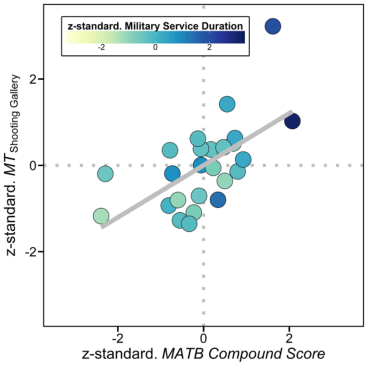
Predictors of Military Multitasking A model including MATB compound scores and military service duration as predictors explained MTShooting Gallery best. It explained MTShooting Gallery approximately two times better than the second-best model with MATB compound scores, MTLaboratory, and military service duration as predictors (BF = 1.69). Moreover, it explained MTShooting Gallery ca. 289 times bet- ter than the intercept-only model (BF = 289.11). Besides, including MATB compound scores to a model already comprising MTLaboratory and military service duration improved the model fit by a factor of approximately five (BF = 4.86). This indicated that MATB compound scores represented the best predictor of MTShooting Gallery. As can be inferred from Figure 1, officer cadets performing well in the MATB appear to have also performed well in the sim- ulated military operation. This correlated with how long they had already served in the military. However, this effect is unlikely related to superior shooting performance as a function of service duration per sé since all cadets reported similar amounts of shooting practice (in hours) prior to assessments. Additional model fit comparisons are summarized in Table 1.
Figure 1: Associations between military multitasking performance (MTShooting Gallery), a compound score of flight simulation performance measures (MATB compound score), and military service duration (in years). Z-standard.: z-standardization was applied. MT: modified multitasking throughput value, whereby small values indi- cate bad and large values good multitasking performance. MATB: Multi-attribute task battery.Table 1. Model fit comparisons of models with different predictors of MT Shooting Gallery. BF values indicate how much more likely the data fit to a model in comparison to the preceding model. The best model comprised MATB compound scores + military service duration.
Table available in the original PDF paper.
Predictor(s) BF Intercept-only - MTLaboratory 4.35 Military Service Duration 4.45 MTLaboratory + Military Service Duration 1.82 MATB compound scores 1.30 MATB compound scores + MTLaboratory 1.83 MATB compound scores + MTLaboratory + Military Service Duration 2.04 MATB compound scores + Military Service Duration 1.68
Performance Decrements in Multitasking Environments (Laboratory and Shooting Gallery) In the laboratory, the officer cadets displayed a decrement in radio perfor- mance in the multitasking condition, M = −5.48, SD = 7.18, range [−20, 8], MBayes = −2.48, CI [−3.94, −1.02], compared to the single-task condi- tion, M = 17.83, SD = 5.53, range [4, 25], MBayes = 16.30, CI [15.02, 17.57], BF =164.23. But an increase in math performance in the multitasking condi- tion, M = 2.36, SD = 3.07, range [−5, 7], MBayes = 0.95, CI [−0.55, 2.47], relative to the single-task condition, M = 13.20, SD = 5.44, range [6, 23], MBayes = 13.92, CI [12.51, 15.32], BF = 1.63.
In the shooting gallery, the officer cadets performed equally well in the math (M = −0.40, SD = 2.93, BF = 0.99), radio (M = 1.44, SD = 2.99, BF = 1.33), and shooting tasks (M = −0.01, SD = 0.76, BF = 1.10) at both assessment time points when all three tasks had to be executed. Thus, practice effects were unlikely, and performance scores of both assessment time points were averaged.
Following this, the participants displayed a weak decrement in math performance in the multitasking condition when all three tasks had to be performed, M = −0.64, SD = 2.05, range [−4, 4], MBayes = −0.21, CI [−2.47, 2.07], relative to the multitasking condition when only two tasks had to be performed, M = 13.52, SD = 6.17, range [5, 25], MBayes = 13.30, CI [11.68, 14.93], BF = 0.28. Moreover, their radio performance dropped in the multitasking condition with three tasks, M = −3.12, SD = 3.43, range [−10, 2], MBayes = −3.14, CI [−4.33, −1.96], relative to the mul- titasking condition with two tasks, M = 9.60, SD = 2.81, range [4, 15], MBayes = 10.00, CI [9.17, 10.86], BF = 15918.35. Note here, that these were performance comparisons between multitasking conditions not considered for MT calculations. MT values were computed based on performance dif- ferences between multitasking and single-task performance. Thus, the results described here serve only to outline all task-specific performance differences. They are not representative of the task differences used for computing MT values.
Flight Simulation Task Performance Predicts Military Multitasking 69
Besides, the cadets’ shooting performance decreased in case they had to perform either the math or radio task, or both tasks in addition to shooting (BF = 4.82). For an overview of all performance decrements, see Table 2.
Table 2. Shooting performance as a function of different workload conditions.
Table available in the original PDF paper.
Condition M SD Range MBayes 95% CI Shooting 8.73 0.63 [6.30, 9.40] 8.60 [8.36, 8.85] Shooting + Math −0.30 0.41 [−1.00, 0.80] −0.17 [−0.40, 0.06] Shooting + Radio −0.31 0.56 [−1.30, 1.00] −0.18 [−0.41, 0.05] Shooting + Math + Radio −0.48 0.56 [−1.45, 0.80] −0.32 [−0.55, −0.09]
Associations Between MATB Performance, Working Memory and Intelligence Furthermore, the officer cadets’ MATB compound scores only correlated weakly with their working memory performance for forwardly, r(23) = 0.19 (BF = 1.35), backwardly, r(23) = 0.14 (BF = 0.92), and in some ascending order repeated spans, r(23) = 0.20 (BF = 1.42). Additionally, there was only an almost moderate correlation with their intelligence scores, r(23) = 0.29 (BF = 2.87).
DISCUSSION
In summary, MATB (flight performance) measures predicted the officer cadets’ multitasking performance in the simulated military operation better than laboratory assessments. This was astonishing, given that the labora- tory approach shared task requirements with the assignment in the shooting gallery while the MATB did not. The only similarity between all three mul- titasking environments was that auditory information had to be memorized. However, while five radio signals had to be reproduced after a short retention time in the laboratory and shooting gallery; in the MATB, radio and fre- quency information assigned to a personal identifier had to be memorized to adjust respective radio frequencies. Thus, both tasks demanded very different responses. This indicates that the cadets’ performance in the shooting gallery might be rather related to a general multitasking ability than task-specific abilities.
Such a general multitasking ability should rely on cognitive control func- tions, including working memory processing abilities (Redick et al., 2016). However, there were only weak correlations between the officer cadets’ work- ing memory span task performance and MATB compound scores. Besides, there was only an almost moderate correlation between their intelligence scores and MATB performance – although cognitive control functions, intel- ligence, and multitasking proficiency should be related (Colom et al., 2010). Excluding the possibility of a general multitasking ability because of this may be premature, given that there are inconsistent findings as to which cognitive functions contribute to multitasking behavior (Himi et al., 2022). Aside from
this, span task performance represents a very crude measure of working mem- ory performance and might not have been sufficiently construct valid. Thus, our results hint towards a general multitasking ability as a determining factor of military multitasking proficiency. But the mechanism thereof is unclear.
On that note, the reliability of the effect should be considered with caution. Firstly, the effect was found foremost in infantry officer cadets. To ensure that the effect also translates to additional service branches, it needs to be demonstrated in other military samples. On top of that, a replication study to confirm the robustness of the effect is desirable, given that the sample size of this study was relatively small, and Bayesian methods may only partially compensate for a lack of statistical sensitivity thereof. Also, the participants displayed a very similar math performance irrespective of whether they con- ducted the task in conjunction with another task or separately. Thus, the assumption of task-specific multitasking decrements was not fulfilled across all tasks. This effect was likely related to strategic decisions made by the cadets (as verbally reported). Thus, it unlikely confounded the results. But there were no empirical data to confirm this.
CONCLUSION
In conclusion, multitasking scenarios like the MATB may be more apt for predicting soldiers’ military multitasking performance than classical labora- tory assessments. The core of this effect may be a general multitasking ability. However, the robustness of this effect and whether it translates to additional military occupational areas must be verified by future research.
ACKNOWLEDGMENT
We would like to thank Benjamin Buschlinger, Max Dill, Christina Saalwirth, and Sophie-Marie Stasch for their support. There is a preprint of this work on PsyArXiv (https://psyarxiv.com/5hqp2/). This work was conducted in the absence of funding. The authors declare no conflict of interest.
REFERENCES
Barron, L. G. and Rose, M. R. (2017) Multitasking as a predictor of pilot performance: Validity beyond serial single-task assessments, Military Psychology, Volume 29, No. 4. Biggs, A. T., Cain, M. S. and Mitroff, S. R. (2015) Cognitive training can reduce
civilian casualties in a simulated shooting environment, Psychological Science, Volume 26, No. 8. Cegarra, J., Valéry, B., Avril, E., Calmettes, C. and Navarro, J. (2020) OpenMATB: A Multi- Attribute Task Battery promoting task customization, software exten- sibility and experiment replicability, Behavior Research Methods, Volume 52, No. 5. Chérif, L., Wood, V., Marois, A., Labonté, K. and Vachon, F. (2018) Multitasking in
the military: Cognitive consequences and potential solutions, Applied Cognitive Psychology, Volume 32, No. 4. Colom, R., Martínez-Molina, A., Shih, P. C. and Santacreu, J. (2010) Intelligence, working memory, and multitasking performance, Intelligence, Volume 38, No. 6.
Flight Simulation Task Performance Predicts Military Multitasking 71
Elsmore, T. F. (1994) SYNWORK1: A PC-based tool for assessment of performance in a simulated work environment, Behavior Research Methods, Instruments, & Computers, Volume 26, No. 4. Fox, E. L., Houpt, J. W. and Tsang, P. S. (2021) Derivation and demonstration of a
new metric for multitasking performance, Human Factors, Volume 63, No. 5. Hambrick, D. Z., Rench, T. A., Poposki, E. M., Darowski, E. S., Roland, D., Bearden, R. M., and Brou, R. (2011) The relationship between the ASVAB and multitasking in Navy sailors: A process-specific approach, Military Psychology, Volume 23, No. 4. Hamilton, J. A., Lambert, G., Suss, J. and Biggs, A. T. (2019) Can cognitive training
improve shoot/don’t-shoot performance? Evidence from live fire exercises, The American Journal of Psychology, Volume 132, No. 2. Heydasch, T., Haubrich, J. and Renner, K. H. (2013) The short version of the Hagen Matrices Test (HMT-S): 6-item induction intelligence test, Methods, Data, Analyses, Volume 7, No. 2. Himi, S. A., Volberg, G., Bühner, M. and Hilbert, S. (2022) Individual differences
in everyday multitasking behavior and its relation to cognition and personality, Psychological Research, Volume 87, No. 3. R Core Team (2022) R: A language and environment for statistical computing.
Vienna: R Foundation for Statistical Computing. Available: https://www. R- project.org/. Redick, T. S., Shipstead, Z., Meier, M. E., Montroy, J. J., Hicks, K. L., Unsworth, N., Hambrick, D. Z., and Engle, R. W. (2016) Cognitive predictors of a com- mon multitasking ability: Contributions from working memory, attention control, and fluid intelligence, Journal of Experimental Psychology: General, Volume 145, No. 11. Wagenmakers, E. J. (2007) A practical solution to the pervasive problems of p values,
Psychonomic Bulletin & Reviev, Volume 14, No. 5. Wechsler, D. (2012) Wechsler Adult Intelligence Scale – Fourth Edition. Pearson. Wickens, C. D. (2008) Multiple resources and mental workload, Human Factors, Volume 50, No. 3.
LISTED IN THE AHFE DIGITAL BOOKSTORE CATALOGUE
Explore the complete digital volume
Human Error, Reliability, Resilience, and Performance
Read this individual research paper free through the original publisher, or explore the full digital proceedings book.
ISBN 978-1-964867-08-3
Explore this ISBN in the AHFE Bookstore ↗Listed in the July 2026 bookstore catalogue; search by ISBN to confirm current availability · Digital book purchase optional