Jin Liang, Cong Peng, Si Li, XIN WANG, ZHEN LIAO, Ye Deng, Yang Yu, Liang Zhang, Xiaofang Sun, Yulin Zhang (2024). The Changing Rule and Intervention Strategy of Long-voyage Crew's Alertness. In: Neuroergonomics and Cognitive Engineering. AHFE Open Access, vol. 126, pp. 253–259. https://doi.org/10.54941/ahfe1004758
In order to reveal the change law of long-voyage crew alertness in the time dimension of voyage, determine the best time for long-voyage crew alertness intervention, and design the intervention strategy to improve long-voyage crew alertness, this study designed and carried out a series of long-voyage simulation experiments based on the needs of long-term voyages. The results of the study found that the rhythm of the simulated crew is disturbed and the best and worst changes are reversed on the prometaphase of the mid-long-term voyage, which may mean rhythm disturbance is one of the reasons for the alertness sharp declining of the crew. The ERPs latency of target locking the alertness test has no significantly different in the before, middle and after stages on mid-short voyage, that is, the time of detecting target is no delay, but the response time increases, indicating that the decrease of alertness of the crew on mid-short voyages may be related to the decrease of response ability. Based on the above results, the intervention timing for alertness was determined, intervention strategies were designed, and the effectiveness of intervention strategies was verified through experiments.
Alertness play a vital role in the safety of maritime navigation. However„ the crew were affected by many adverse factors such as vibration, social isolation, noise, and rotating duty in the course of long voyage (Viitasalo et al., 2008), their physical and mental state would gradually decline, lead the crew’s alert- ness decline (Liang et al., 2020), which seriously threatens the safe navigation of the ship. Studies of other populations have confirmed that the design of tar- geted oriented strategies based on the changing characteristics of long-term crew’s alertness can improve the alertness of crew and reduce the adverse effects of long-term work (Ruscitto and Ogden, 2016).
Revealing the changing rules of crew’s alertness during the long voyage can clarify the timing of crew’s alertness intervention during the long voyage,
which is one of the references for the design of crew’s alertness intervention strategy.
Previous studies have mainly used cognitive behavioral tests such as PVT to measure crew alertness, and judged the rise and fall of crew alertness according to the change of reaction time(Basner and Dinges, 2005; Blatter and Cajochen, 2007; Blatter et al., 2006). Increased response time means decreased alertness of the crew, decreased response time means increased alertness of the crew. The change of reaction time not only reflects the crew’s reaction ability after finding the target, but also reflects the crew’s ability to detect the target. However, according to the PVT reaction time index, it is not possible to distinguish whether the decrease of alertness of long-sailing crew is due to the decrease of target detection ability or the decrease of reaction ability after detecting the target. Revealing the mechanism of crew alertness change can clarify the target of crew alertness intervention in the course of long voyage. So the mechanism of crew alertness change is also one of the main references for the design of long voyage alertness intervention strategy.
At present, it is not clear how the crew’s alertness changes during the long voyage. The study of Liang et al. preliminarily revealed that the alertness of the crew decreased with the sailing time during the long voyage, and prelim- inarily determined the key timing of the short and medium voyage changes. However, the study did not clarify whether the reduced alertness of long- voyage crew was due to a decline in target detection or a decline in the ability to react when a target was detected.
Therefore, it is necessary to carry out research to understand the change rule and mechanism of the alertness of long-voyage crew, so as to provide the references for the design of the alertness maintenance strategy for long- voyage crew. In order to reveal the change rule of long-voyage crew alertness in the time dimension of voyage, determine the best time for long-voyage crew alertness intervention, and design the intervention strategy for long-voyage crew alertness, this study designed and carried out a series of long-voyage simulation experiments based on the needs of the long-term voyages.
Participants 12 male subjects were recruited through the society in the short-medium voy- ages experiment. 8 male subjects were recruited through the society in the long-medium voyages experiment. 12 male subjects were recruited through the society in the intervention strategy verification experiment. The subjects had completed high school or college education, who were physically and mentally healthy. They all have no drug, alcohol, smoking, Internet depen- dence and addiction, no history of inherited diseases, hepatitis b, hepatitis c, AIDS or other infectious diseases, and no history of severe allergies. They had no mental disorders, no psychological diseases, no organic and functional mental and neurological lesions, no sleep disorders or abnormalities in the two and three generations. All participants possessed normal visual acuity (or corrected visual acuity), hearing, smell and language expression ability, without color blindness, color weakness. All subjects passed the interview, systematically physical examination and psychological evaluation.
The Changing Rule and Intervention Strategy of Long-Voyage Crew’s Alertness 255
Procedure We organized three ship simulation long voyage experiments: once mid-short term voyage experiment, once mind-long term voyage experiment and once intervention strategy verification experiment. This research carried out the simulation experiments of short and medium voyage to reveal the rule of littoral alertness of long-sailing crew. The differences between the two exper- iments are the simulation voyage time is different and the participants are different. The experiment subjects were divided into three groups, and the three groups took turns on duty for 24 hours during the min-short simulated voyage. The subjects of the mid-long simulated voyage experiment also car- ried out the same rest system as the mid-short term simulated voyage, but all the subjects were on duty according to the duty mode of one group, and the other two groups were on virtual shift.
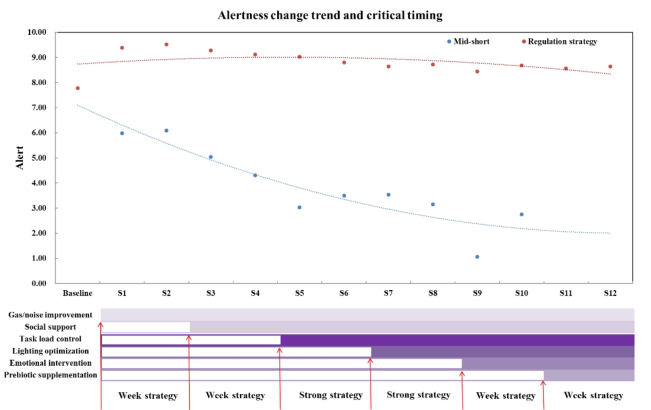
Considering the working ability of the subjects attenuates to different degrees with the sailing time in different periods during the mid-short long voyage simulation experiment, this study designed a hierarchical and phased control strategy scheme based on the previous research results. Specifically, according to the degree of alertness attenuation during the whole voyage, the voyage period is divided into different stages. We collected various regulatory strategies (Ruscitto and Ogden, 2016; Askaripoor et al., 2019; Mahachandra et al., 2015; Brown et al., 2014; Sara et al., 2022; Brown and Whitehurst, 2015) and asked experts to evaluate the regulatory strategies. Five types of regulation strategies were selected according to the results of regulation strength score and implemensibility. The different control strategies are used at different stages according to the strength of the expected effect of the strate- gies. The principle of the intervention strategy is that the strong regulation strategy was used in the stage of significant alertness attenuation, and the weak intervention strategy was used in the stage of relatively small alertness attenuation.
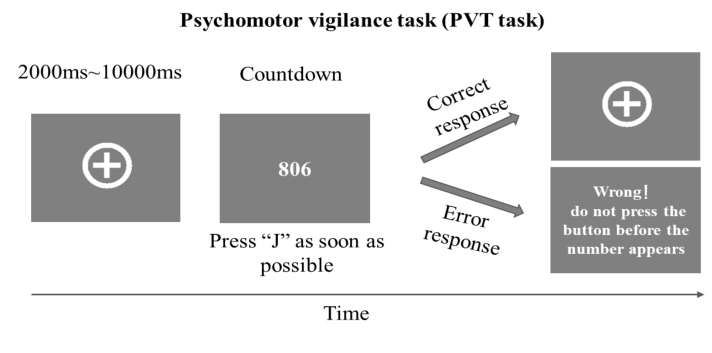
During these experiments, the work tasks and living conditions of the crew were completely simulated a certain ship type. The volunteers were required to fully implement work and life system of the actual seafarer during the simulated long voyage, and carry out the ship simulation task during working time. Before and after their working time, the PVT task was used to evaluate the cognitive alertnes. The study passed an ethical review (Certificate No: 2019013) before the experiment was conducted. The subjects were asked to look at the fixation point in the center of the screen after the start of the psychomotor vigilance task (PVT task), and press the “J” button immediately when they saw a number countdown. The num- ber countdown would continue to increase until the right key was pressed, and the response time of the key was recorded. Participants were asked to respond as soon as possible, but not before the number appears, other- wise an error message would appear. The experimental process is shown in Figure 1.
Figure 1: Psychomotor vigilance task (PVT task).
In order to explore the neural mechanisms underlying changes in alertness, we conducted additional PVT-ERPs experiment during simulated long voy- ages. The ERPs data lock to PVT was collected by NeuroScan32 conducting EEG system. We made some adjustments to the experimental parameters of the PVT task, with a time interval of at least 1 second between the two PVT trials to reduce the overlap of ERPs components. 60 trials were conducted in one PVT task.
RESULT
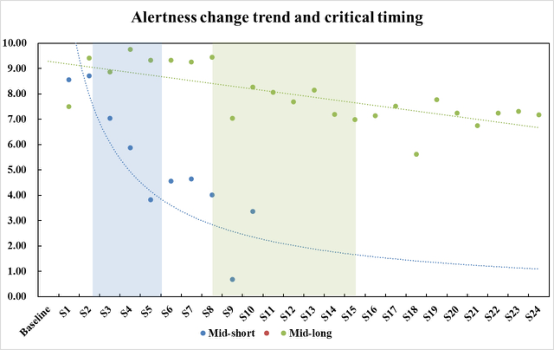
In the mid-short simulation long voyage experiment, the crew’s alertness decreased with the sailing time (the average decreased by 7.36%, the high- est decreased by 27.48%). The timing of dramatic changes in the mind-short simulation long voyage experiment is about one third of the voyage period. The PVT task reaction time was normalized and mapped to 0–10 coordinates in this study, see Figure 2.
Figure 2: Alertness change trend and critical timing.
The Changing Rule and Intervention Strategy of Long-Voyage Crew’s Alertness 257
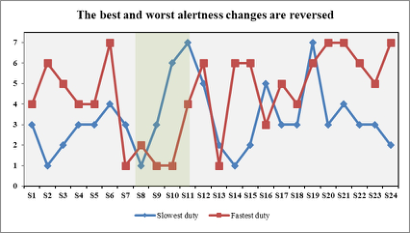
The alertness of the crew from 3:00 to 15:00 is poorer, and the alertness of the crew from 12:00 to 15:00 is the worst. The alertness from 15:00-3:00 is better, among which the alertness is the best between 21:00 and 24:00. Performance on the psychomotor vigilance task (PVT) sensitively reflects a circadian modulation of neurobehavioral functions, as well as the effect of sleep pressure developing with duration of time awake (Graw et al., 2004). On the prometaphase of the mid-long-term voyage, the rhythm of the sim- ulated crew is disturbed and the best and worst changes are reversed on the prometaphase of the mid-long-term voyage, which may mean rhythm disturbance is one of the reasons for the alertness sharp declining of the crew.
Figure 3: The best and worst alertness changes are reversed.
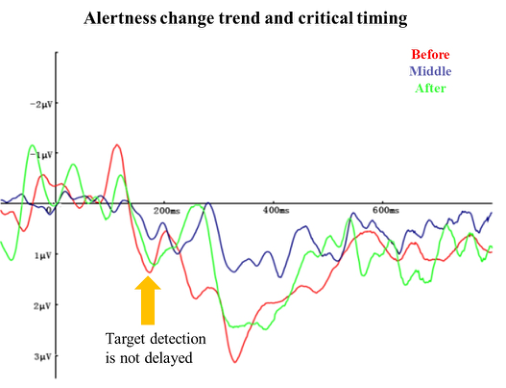
The ERPs latency of target locking had no significantly different in the before, middle and after stages of the mid-long voyage, which mean the time of detect target has no delay. The response time of PVT task in PVT-ERPs experiment increased, which indicates that the decrease of alertness of the crew on short-medium voyages may be related to the decrease of response ability.
Figure 4: Alertness change trend and critical timing.
Using the control strategy in different stages can effectively maintain the working ability of the personnel during the long voyage.
Figure 5: Alertness change trend and critical timing.
CONCLUSION
The results of the study found that the rhythm of the simulated crew is dis- turbed and the best and worst changes are reversed on the prometaphase of the mid-long-term voyage, which means rhythm disturbance may be one of the reasons for the sharp decline of the crew alertness during the long voy- age. The ERPs latency locking to PVT task has no significantly different in the before, middle and after stages during the mid-long term voyage, which indi- cates the time of detecting target has no delay, but the response time increases, indicating that the decrease of alertness of the crew on mid-medium voyages may be related to the decrease of response ability. The intervention timing for alertness was prometaphase of the mid-long-term voyage, the effectiveness of regulatory strategies was verified through experiments, such as training for reaction enhancement.
ACKNOWLEDGMENT
Thanks to Tuoyang Zhou, Yuqian Zhang, Xiaoyi Zhou, Yongjiang Fu, Zhanshuo Zhang, Ning Li, Bei Zhang, Jiangrong Lv and other persons participated in or providing support during the experiments.
REFERENCES
Askaripoor, T., Motamedzade, M., Golmohammadi, R., Farhadian, M., Babamiri, M. & Samavati, M. (2019), “Effects of light intervention on alertness and mental performance during the post-lunch dip: a multi-measure study”, Industrial Health, Vol. 57, No. 4.
The Changing Rule and Intervention Strategy of Long-Voyage Crew’s Alertness 259
Basner, M. & Dinges, D. F. (2005), “Maximizing sensitivity of the psychomotor vigilance test (PVT) to sleep loss.”, Sleep, Vol. 34, No. 5, pp. 581–91. Blatter, K. & Cajochen, C. (2007), “Circadian rhythms in cognitive performance:
Methodological constraints, protocols, theoretical underpinnings”, Physiology & Behavior, Vol. 90, No. 2–3, pp. 196–208. Blatter, K., Graw, P., Münch, M., Knoblauch, V., Wirz-Justice, A. & Cajochen, C.
(2006), “Gender and age differences in psychomotor vigilance performance under differential sleep pressure conditions”, Behavioural Brain Research, Vol. 168, No. 2, pp. 312–317. Brown, L. J., Schoutens, T., Whitehurst, G., Booker, T., Davis, T., Losinski, S. & Diehl, R. (2014), The Effect of Blue Light on Pilot and Flight Attendant Behavioral Alertness, SSRN Transportation. Brown, L. & Whitehurst, G. (2015), “The Effects of Bright Light Intervention on
Flight Crew Behavioral Alertness and Cognitive Fatigue”. Graw, P., Kr Uchi, K., Knoblauch, V., Wirz-Justice, A. & Cajochen, C. (2004), “Circadian and wake-dependent modulation of fastest and slowest reaction times during the psychomotor vigilance task”, Physiology & Behavior, Vol. 80, No. 5, pp. 695–701. Liang, J., Wang, X., Zhang, L., Deng, Y., Zhou, Y., Zhang, Y., Yu, Y., Liao, Z., Tian,
Z., Zhang, Z. & Fu, Y. (2020), “The Effect of a Long Simulated Voyage on Sailors’ Alertness”, Springer International Publishing, Cham, pp. 454–462. Mahachandra, M., Yassierli & Garnaby, E. D. (2015), “The Effectiveness of Invehicle Peppermint Fragrance to Maintain Car Driver’s Alertness”, Procedia Manufacturing, Vol. 4471–477. Ruscitto, C. & Ogden, J. (2016), “The impact of an implementation intention to
improve meal times and reduce jet lag in long-haul cabin crew”, Psychology & Health, 1. Sara, B., Elizabeth, H., Alexandra, E., Ashley, P., Madeline, T., Michelle, S., Ian, R.
& Gena, G. (2022), “0015 Effectiveness-Implementation Study of Two Novel Lighting Interventions for Shiftworkers on a Submarine Watchfloor”, SLEEP, No. Supplement_1, pp. Supplement_1. Viitasalo, K., Kuosma, E., Laitinen, J. & Härmä, M. (2008), “Effects of shift rotation and the flexibility of a shift system on daytime alertness and cardiovascular risk factors.”, Scandinavian Journal of Work Environment & Health, Vol. 34, No. 3, pp. 198–205.
LISTED IN THE AHFE DIGITAL BOOKSTORE CATALOGUE
Explore the complete digital volume
Neuroergonomics and Cognitive Engineering
Read this individual research paper free through the original publisher, or explore the full digital proceedings book.
ISBN 978-1-964867-02-1
Explore this ISBN in the AHFE Bookstore ↗Listed in the July 2026 bookstore catalogue; search by ISBN to confirm current availability · Digital book purchase optional