Anna Schultz, Lucas Paletta, Amadeus Linzer, Judith Goldgruber, Ursula Berger, Wolfgang Kratky, Silvia Russegger, Sandra Draxler, Thomas Orgel, Amir Dini, Michael Schneeberger, Martin Pszeida, Wolfgang Weiss, Thomas Pfitzer, Marisa Koini, Sandra Schuessler, Julia Zuschnegg (2024). SmartAktiv: A tablet- and virtual reality-based training for individuals with cognitive decline. In: Cognitive Computing and Internet of Things. AHFE Open Access, vol. 124, pp. 75–84. https://doi.org/10.54941/ahfe1004705
Against the background of population ageing and the increasing global prevalence of chronic diseases, such as dementia (Nichols et al., 2022), and the associated increase in healthcare services, the development of new technologies to counteract an impending care gap is of great importance. Virtual Reality (VR) has been identified as a new technology in addressing the needs of older people (Abdi et al., 2020) and shown to improve quality of life (QoL; Afifi et al., 2022) and performance of activities of daily living (ADL; Ge et al., 2018). To the authors’ knowledge there is no combination of immersive VR and tablet training that (1) has been developed with and for people with cognitive decline, and (2) targets intelligent multimodal activation and ADL training within meaningful/leisure activities. The aims of the SmartAktiv project concern the development of a tablet- and VR-based training environment and its impact on QoL and ADL performance as well as the correlation of digital biomarkers for dementia and different screening tools and questionnaires. Methods: In a first phase, data from previous VR-studies were examined and discussed in an expert workshop (n = 6) and a focus group (n = 7 people with cognitive decline) to develop the VR scenarios. The tablet-training is based on an earlier study, its content was adapted to the VR scenarios within an expert workshop (n = 10). In a second phase, a usability study with n = max. 9 participants with cognitive decline and n = max. 3 health professionals will be conducted to adjust the tablet-VR-system. In the third and final phase, the system will be tested in a one-month pilot study (n = max. 30) including participants with subjective cognitive decline, mild cognitive impairment, and mild dementia. Collected data will comprise quantitative and qualitative data from questionnaires/scales, sensor data from the VR-glasses, tablet-PC, biosensors and interviews to assess QoL, usability, cognition, ADL-performance, and experience. First Results: Four scenarios (beach, winter, hiking, and urban experience) were selected for further development. The focus group provided valuable insights into the preferred means of transport and the planned activities (e.g., gathering mushrooms in a forest, eating ice cream in a beach bar) within each VR scenario. The planned training (tablet and VR-scenarios) will cover the entire journey, from planning (e.g., packing a suitcase) to embarking on the chosen trip (e.g., boarding the right means of transport), and will integrate interactive cognitive (I)ADL tasks, such as managing finances and medication. Results of the usability and pilot study will be presented at the conference. Conclusion: SmartAktiv aims to develop an innovative learning environment which enables multimodal activation through playful interactive cognitive training. Additionally, SmartAktiv strives to advance the use of biomarkers in the early diagnosis of cognitive impairments.
Projections show that as the population ages and grows, dementia rates will increase worldwide (Nichols et al., 2022), with dementia cases pre- dicted to triple to 131 million by 2050 (Prince et al., 2016). Dementia is a
neurogenerative disorder that is characterized by memory impairment and cognitive decline. As a result, people living with dementia experience an increase in care dependency as the disease progresses, which affects their functional status (Alzheimer’s Association, 2023; Schüssler et al., 2016), i.e., one’s ability to execute activities of daily life (ADL; Lawton & Brody, 1969). While in the earlier stages of dementia difficulties arise in performing instru- mental activities of daily living (IADL), such as managing finances or using the telephone, as the disease progresses, difficulties arise in performing basic ADL, such as dressing (Giebel et al., 2015). In light of these concerning pro- jections and the impact dementia has on individuals and societies, there is a growing need to develop interventions for both the prevention and treatment of dementia.
CONTEXT AND RELATED WORK Cognitive decline is prevalent among older adults, with dementia represent- ing the most severe form and also the main cause of disability currently affecting about 50 million individuals across the globe (World Health Organi- zation, 2019). Studies have shown that subjective cognitive decline (SCD) and mild cognitive impairment (MCI) increases the risk for developing dementia (Mitchell et al., 2014). While individuals with SCD only perceive a subjective cognitive change (Röhr et al., 2020), those with MCI already exhibit an objec- tive mild cognitive impairment (Petersen, 2016). Before the onset of dementia, individuals may experience difficulties in IADLs. In the review of Jekel et al. (2015), the authors examined 37 studies, 35 of which reported IADL deficits in patients with MCI (Petersen, 2004). Financial capacity emerged as the most commonly affected IADL in MCI patients (Jekel et al., 2015). MCI patients advance to dementia more quickly than non-MCI patients (Petersen, 2004), but cognitive deterioration in MCI patients can be slowed down (Jean et al., 2010; Ngandu et al., 2015). Consequently, early detection and monitoring of functional status in MCI as well as in dementia is of particular importance (Livingston et al., 2017), as are timely interventions (Alzheimer’s Associa- tion, 2019). Therefore, the development of tools to identify populations at high risk of developing dementia, such as MCI, is of great importance.
Non-pharmacological interventions, such as multicomponent interven- tions, have shown promise in improving cognitive function. For example, (Ngandu et al., 2015) found that a non-pharmacological multicomponent intervention significantly improved neuropsychological test scores, executive functioning and processing speed in MCI patients. Similarly, technology- based interventions, including computers and virtual reality (VR), have also been used for cognitive and physical exercises. Such training programs have shown promising results in improving quality of life (QoL) and different domains of cognition (Hagovská et al., 2017; Man et al., 2012; Zuschnegg et al., 2023) among individuals with MCI. For instance, Chen et al. (2020) reported that a tablet-based training program targeting cognitive abili- ties improved IADL scores compared to a control group among non-MCI patients. On the other hand, VR interventions, such as those developed by Shin et al. (2023), have shown potential in improving ADL-training through
SmartAktiv: A Tablet- and Virtual Reality-Based Training 77
simulated scenarios like 1) cooking food, 2) dressing, 3) ordering food, 4) grocery shopping, and 5) cleaning.
Although both tablet- and VR-based interventions have been used in (I)ADL training, previous interventions failed to achieve convincing effects. Furthermore, to the authors’ knowledge, there is currently no combina- tion of tablet and immersive VR training that (1) has been developed with and for people with cognitive decline, and (2) targets intelligent multimodal activation and (I)ADL training within meaningful/leisure activities.
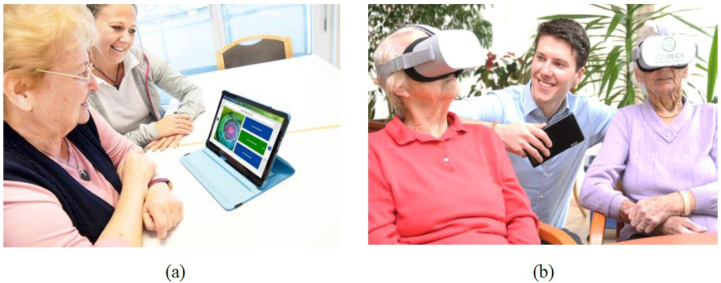
The aim of the SmartAktiv project is to design a tablet- and VR-based training for individuals with cognitive decline (Figure 1) and to examine the effects this training exerts on older adults’ quality of life and on the perfor- mance of selected (I)ADLs (e.g., finances, medication). In addition to that, the SmartAktiv project concerns the correlation of digital biomarkers for dementia and different screening tools and questionnaires. Exploratory stud- ies with eye movement measurements in VR were quite promising. Paletta et al. (2021) extracted eye movement features, such as blink rate, while par- ticipants observed a three-minute video. Through eye movement analysis they could reliably distinguish between people with early Alzheimer’s disease and healthy controls.
Figure 1: (a) Application of the tablet-based multimodal activation app of Joanneum Research in the nursing home (credit: Joanneum Research / M. Schwarzl). (b) Applica- tion of VR-based user journey (credit: VitaBlick GmbH).
TABLET- AND VR-BASED TRAINING Tablet Training System
The tablet-training that will be used in SmartAktiv was developed as part of earlier projects (AktivDaheim: EK: 1505/2016, AMIGO: EK:30-401ex17/18, and multimodal: EK:31-556 ex18/19) offering a choice of 44 topics with 16 available exercise types (e.g., quizzes, puzzles, gap texts, mathematics). The “multimodAAL app” (Mapp) has already proven to be very suitable for cognitive activation among older people: In a 6-month RCT study, train- ing with the Mapp resulted in a preservation of cognitive status compared to the control group (Berger et al., 2022) and AI-based digital biomarkers
were identified for the screening of cognitive deficits (Pszeida et al., 2023). The following exercise types were selected for the training: quiz, outsider, mathematics, puzzle, gap text, and step sequence.
VR Training System Pico 4 Enterprise devices will be used for the application of VR. The stan- dalone devices include an eye-tracking and a hand-tracking function via four integrated RGB cameras that allow users to see their own hands in the VR application and perform certain simple tasks (e.g., by clicking on certain objects, i.e., a chestnut). The VR headset has a resolution of 4320×2160 pix- els and a refresh rate of 90 Hz. It weighs 586 grams, distributed evenly across the front and back of the VR headset in a senior-friendly manner, ensuring a stable weight distribution and comfortable wearing experience.
Eye Tracking A five-point calibration method will be used, where the user concentrates sequentially on five relevant points, displayed like target symbols (Paletta et al., 2021). In the VR-training environment we then obtain data about the intersection of the eye gaze vector with the VR objects and with panoramic images or videos in 2D space. Image coordinates are calculated relative to the orientation of the eye orientation axis, which serve as the basic unit of measurement for quantifying attention.
For a general characterization of gaze behavior, the following features will be measured, (i) Concentration in the sense of deliberate focusing of attention on a specific activity (Paletta, Brijacak, et al., 2019), (ii) cognitive load on the basis of correlating characteristics from eye-tracking data (Paletta et al., 2015) as well as in the specific context of multitasking load (Paletta et al., 2020), as it is specifically used in specific serious games (Paletta, Grabher, et al., 2019), and finally (iii) indicators for the measurement of inhibition in a VR-based version of the anti-saccade test (Paletta, Pszeida, et al., 2019) and for stress in the form of the Task Switching Rate (Paletta, Brijacak, et al., 2019).
Bio-Signal Data Bio-signal data such as heart rate and heart rate variability are recorded using a smartwatch (Garmin vivosmart 5) to measure the participant’s mental state (i.e., cognitive-emotional stress) during training (Schneeberger et al., 2022). These data would be valuable for analyzing the relation between stress and cognitive performance during the intervention.
METHODS
Study Design and Recruitment of Participants In a first phase, data from previous VR-studies (e.g., Haeussl et al., 2021) were examined and discussed in an expert workshop (n = 6), a focus group (n = 7 people with cognitive decline), and an interview (n = 1 person with cognitive decline). Participants were recruited by the Geriatric Health Care
SmartAktiv: A Tablet- and Virtual Reality-Based Training 79
Centers Graz, Albert Schweizer Institute for Geriatrics and Gerontology. The focus group and interview were held at a nursing home in Graz, Austria.
In a second phase, a usability study with n = 9 participants with cogni- tive decline and n = 3 health professionals will be conducted to adjust the tablet-VR-system. In the third and final phase, the tablet-VR-system will be tested in a one-month pilot study (n = 30) including participants with sub- jective cognitive decline, mild cognitive impairment, and moderate cognitive impairment based on the MoCA classification (Fisher & Thomson, 2014; Nasreddine, n.d.). Participants will be asked to complete each scenario (com- bination of tablet- and VR-based training) at least once. Each session will last for approximately 46 minutes and include tablet and VR-based training as well as pre- and post-training measures, such as the Simulator Sickness Ques- tionnaire (Kennedy et al., 1993). Collected data will comprise quantitative data from questionnaires/scales, sensor data from the VR-glasses and biosen- sors, and qualitative data from interviews assessing, for instance, usability and experience.
Data Analysis Qualitative content analysis (Schreier, 2012) was performed on the tran- scribed audio-recorded focus group and interview of phase 1. Based on the interview guide, we developed a concept-driven coding frame with main and subcategories. This coding frame was then supplemented with data-driven subcategories based on the audio transcripts. As a last step, main and sub- categories were summarized, interpreted and discussed with the research team. MAXQDA (Version 2018) was used for qualitative data analysis. The same procedure will be adopted in the second and third phase of the study. Quantitative analysis (i.e., pearson/ spearman correlation coefficients) will be conducted using SPSS.
RESULTS
Sample Characteristics (Phase 1) The average age of participants was 77.39 (SD = 6.38) and 71.43 % were female. The majority (57.14 %) reported a high level of education (A-levels or a university degree), 28.57 % reported a medium and 14.29 % a low level of education. A total of three people received care allowance.
Focus Group and Interview (Phase 1) The expert workshop collectively agreed upon four scenarios (see Figure 1) for further development. The tablet- and VR-based training should envelop an entire journey, i.e., starting with planning the trip, buying tickets, travel- ing to the respective destination, activities on site, and ending with the return journey. A total of three scenarios (beach, winter, city; Figure 2) were then dis- cussed within a focus group. The hike-scenario was subject of an additional interview. The focus group, respectively the interview, provided insights into the design of the avatar, the means of transport, and planned activities on- site. Although the environment tended to be seen as more relevant than the
avatar, participants expressed some criticism. The presented avatar in the VR was generally perceived as too artificial and not perceived as one’s own body. The texture and stiffness of the hand were particularly noticeable. As regards the means of transport, participants prioritized the train, bus and car, over plane, due to ecological concerns. Scenario unspecific activities were food shopping or visiting a restaurant. Scenario specific activities encompassed going for a walk on the beach (beach), skiing (winter), visiting a museum or concert (city) and collecting forest objects such as mushrooms (hike).
Figure 2: Contents of the VR scenarios.
CONCLUSION
In this paper, we have introduced the SmartAktiv project and reported pre- liminary findings of the first project phase, i.e., the design of the training program. SmartAktiv sets out to combine tablet- and VR-based exercises that target multimodal activation and (I)ADL training (e.g., finances) within meaningful/leisure activities designed with and for older adults with cog- nitive decline. We will evaluate the proposed intervention in a final pilot study with regards to older adults’ quality of life and the performance of selected (I)ADLs (e.g., finances, medication) as well as the training program’s usability. Within the SmartAktiv project and through eye-tracking analysis, we want to advance research on digital biomarkers. In this context, we will
SmartAktiv: A Tablet- and Virtual Reality-Based Training 81
correlate digital biomarkers for dementia with scores from various screening tools and questionnaires.
In terms of content, the combined tablet and VR training will envelop an entire journey, from planning the trip to the departure. The expert workshop selected four scenarios which were then discussed within a focus group and an interview. Qualitative data provided insights into the avatar design, the means of transport and activities to be performed within the VR.
ACKNOWLEDGMENT
We wish to thank all the participants who took part in the study.
CONFLICT OF INTEREST No potential conflict of interest was reported by the authors.
FUNDING SOURCES This research was supported by the Austrian Research Promotion Agency (FFG) and the Austrian Federal Ministry for Climate Action, Environment, Energy, Mobility, Innovation and Technology (BMK) by project SmartAktiv (grant number FO999904045).
REFERENCES
Alzheimer’s Association. (2019). 2019 Alzheimer’s disease facts and figures. Alzheimer’s & Dementia, 15(3), 321–387. https://doi.org/10.1016/j.jalz.2019.01. 010 Alzheimer’s Association. (2023). 2023 Alzheimer’s disease facts and figures. Alzheimer’s & Dementia, 19(4), 1598–1695. https://doi.org/10.1002/alz.13016 Berger, M., Schüssler, S., Zuschnegg, J., Russegger, S., Paletta, L., Fellner, M., Strobl, B., Ploder, K., Hofmarcher-Holzhacker, M., Stögerer-Oberschmid, E. M., Guttmann-Lattmanig, A., & Koini, M. (2022). Preliminary results of computer- based multimodal training in Alzheimer’s disease over six months – the multi- modAAL study. Alzheimer’s & Dementia, 18(S7), e068759. https://doi.org/10. 1002/alz.068759 Fisher, M., & Thomson, S. (2014). Dementia and Driving Safety: A Clinical Guide-
line. (Version 3). Driving with Dementia Working Group. https://www.healthnavi gator.org.nz/media/1008/dementia-and-driving-clinical-guideline.pdf Giebel, C. M., Sutcliffe, C., & Challis, D. (2015). Activities of daily living and quality of life across different stages of dementia: A UK study. Aging & Mental Health, 19(1), 63–71. https://doi.org/10.1080/13607863.2014.915920 Haeussl, A., Schuessler, S., Paletta, L., Fuerli, H., Koch, B., Binder, T., Schneeberger,
M., Andreu, J.-P., Reidl, S., Beranek, S., Hartmann, R., & Sighart, M. (2021). Requirements Analysis on Emotional Preferences for Leisure Activities in Virtual Reality for Female Nursing Home Residents – A Mixed Method Approach. In H. Ayaz, U. Asgher, & L. Paletta (Eds.), Advances in Neuroergonomics and Cognitive Engineering (Vol. 259, pp. 453–460). Springer International Publishing. https://do i.org/10.1007/978-3-030-80285-1_52
Hagovská, M., Dzvoník, O., & Olekszyová, Z. (2017). Comparison of Two Cognitive Training Programs With Effects on Functional Activities and Quality of Life. Research in Gerontological Nursing, 10(4), 172–180. https://doi.org/10.3928/ 19404921-20170524-01 Jean, L., Bergeron, M.-È., Thivierge, S., & Simard, M. (2010). Cognitive Intervention
Programs for Individuals With Mild Cognitive Impairment: Systematic Review of the Literature. The American Journal of Geriatric Psychiatry, 18(4), 281–296. https://doi.org/10.1097/JGP.0b013e3181c37ce9 Jekel, K., Damian, M., Wattmo, C., Hausner, L., Bullock, R., Connelly, P. J., Dubois, B., Eriksdotter, M., Ewers, M., Graessel, E., Kramberger, M. G., Law, E., Mecocci, P., Molinuevo, J. L., Nygård, L., Olde-Rikkert, M. G., Orgogozo, J.-M., Pasquier, F., Peres, K., … Frölich, L. (2015). Mild cognitive impairment and deficits in instrumental activities of daily living: A systematic review. Alzheimer’s Research & Therapy, 7(1), 17. https://doi.org/10.1186/s13195-015-0099-0 Kennedy, R. S., Lane, N. E., Berbaum, K. S., & Lilienthal, M. G. (1993). Simu-
lator Sickness Questionnaire: An Enhanced Method for Quantifying Simulator Sickness. The International Journal of Aviation Psychology, 3(3), 203–220. https: //doi.org/10.1207/s15327108ijap0303_3 Lawton, M. P., & Brody, E. M. (1969). Assessment of Older People: Self-Maintaining and Instrumental Activities of Daily Living. The Gerontologist, 9(3 Part 1), 179–186. https://doi.org/10.1093/geront/9.3_Part_1.179 Livingston, G., Sommerlad, A., Orgeta, V., Costafreda, S. G., Huntley, J., Ames, D.,
Ballard, C., Banerjee, S., Burns, A., Cohen-Mansfield, J., Cooper, C., Fox, N., Gitlin, L. N., Howard, R., Kales, H. C., Larson, E. B., Ritchie, K., Rockwood, K., Sampson, E. L., … Mukadam, N. (2017). Dementia prevention, intervention, and care. The Lancet, 390(10113), 2673–2734. https://doi.org/10.1016/S0140- 6736(17)31363-6 Man, D. W. K., Chung, J. C. C., & Lee, G. Y. Y. (2012). Evaluation of a virtual reality-based memory training programme for Hong Kong Chinese older adults with questionable dementia: A pilot study. International Journal of Geriatric Psychiatry, 27(5), 513–520. https://doi.org/10.1002/gps.2746 Mitchell, A. J., Beaumont, H., Ferguson, D., Yadegarfar, M., & Stubbs, B. (2014).
Risk of dementia and mild cognitive impairment in older people with subjec- tive memory complaints: Meta-analysis. Acta Psychiatrica Scandinavica, 130(6), 439–451. https://doi.org/10.1111/acps.12336 Nasreddine, Z. S. (n.d.). MoCA cognitive assessments FAQ. MoCA cognitive assessment. Retrieved February 20, 2024, from https://mocacognition.com/faq/ Ngandu, T., Lehtisalo, J., Solomon, A., Levälahti, E., Ahtiluoto, S., Antikainen,
R., Bäckman, L., Hänninen, T., Jula, A., Laatikainen, T., Lindström, J., Man- gialasche, F., Paajanen, T., Pajala, S., Peltonen, M., Rauramaa, R., Stigsdotter- Neely, A., Strandberg, T., Tuomilehto, J., … Kivipelto, M. (2015). A 2 year multidomain intervention of diet, exercise, cognitive training, and vascular risk monitoring versus control to prevent cognitive decline in at-risk elderly people (FINGER): A randomised controlled trial. The Lancet, 385(9984), 2255–2263. https://doi.org/10.1016/S0140-6736(15)60461-5 Nichols, E., Steinmetz, J. D., Vollset, S. E., Fukutaki, K., Chalek, J., Abd-Allah, F., Abdoli, A., Abualhasan, A., Abu-Gharbieh, E., Akram, T. T., Al Hamad, H., Alahdab, F., Alanezi, F. M., Alipour, V., Almustanyir, S., Amu, H., Ansari, I., Arabloo, J., Ashraf, T., … Vos, T. (2022). Estimation of the global preva- lence of dementia in 2019 and forecasted prevalence in 2050: An analysis for the Global Burden of Disease Study 2019. The Lancet Public Health, 7(2), e105–e125. https://doi.org/10.1016/S2468-2667(21)00249-8
SmartAktiv: A Tablet- and Virtual Reality-Based Training 83
Paletta, L., Brijacak, I., Reiterer, B., Pszeida, M., Ganster, H., Fuhrmann, F., Weiss, W., Ladstatter, S., Dini, A., Murg, S., & Mayer, H. (2019). Gaze-based Human Factors Measurements for the Evaluation of Intuitive Human-Robot Collabo- ration in Real-time. 2019 24th IEEE International Conference on Emerging Technologies and Factory Automation (ETFA), 1528–1531. https://doi.org/10. 1109/ETFA.2019.8869270 Paletta, L., Grabher, A., Dini, A., Mayr, M., Taberhofer, A., Pokvic, E., Gunzer, W.,
& Pilz, R. (2019). Immersive imagination in urban oases of mindfulness: The VR- SenseCity toolbox for sensible, emotional and measurable experiences in future smart cities. Proceedings of the 24th International Conference on Urban Planning and Regional Development in the Information Society Geomultimedia, 391–400. Paletta, L., Pittino, N. M., Schwarz, M., Wagner, V., & Kallus, K. W. (2015). Human Factors Analysis Using Wearable Sensors in the Context of Cognitive and Emo- tional Arousal. Procedia Manufacturing, 3, 3782–3787. https://doi.org/10.1016/ j.promfg.2015.07.880 Paletta, L., Pszeida, M., Nauschnegg, B., Haspl, T., & Marton, R. (2020). Stress
Measurement in Multi-tasking Decision Processes Using Executive Functions Analysis. In H. Ayaz (Ed.), Advances in Neuroergonomics and Cognitive Engi- neering (Vol. 953, pp. 344–356). Springer International Publishing. https://doi.or g/10.1007/978-3-030-20473-0_33 Paletta, L., Pszeida, M., & Panagl, M. (2019). Towards Playful Monitoring of Executive Functions: Deficits in Inhibition Control as Indicator for Cognitive Impairment in First Stages of Alzheimer. In N. J. Lightner (Ed.), Advances in Human Factors and Ergonomics in Healthcare and Medical Devices (Vol. 779, pp. 109–118). Springer International Publishing. https://doi.org/10.1007/978-3- 319-94373-2_12 Paletta, L., Pszeida, M., Schüssler, S., Andreu, J.-P., Dini, A., Zweytik, E., Steiner,
J., Grabher, A., & Lodron, J. (2021). Virtual Reality-Based Sensory Triggers and Gaze-Based Estimation for Mental Health Care. In H. Ayaz, U. Asgher, & L. Paletta (Eds.), Advances in Neuroergonomics and Cognitive Engineering (Vol. 259, pp. 461–468). Springer International Publishing. https://doi.org/10. 1007/978-3-030-80285-1_53 Petersen, R. C. (2004). Mild cognitive impairment as a diagnostic entity. Journal of Internal Medicine, 256(3), 183–194. https://doi.org/10.1111/j.1365-2796.2004. 01388.x Petersen, R. C. (2016). Mild Cognitive Impairment: CONTINUUM: Lifelong Learn-
ing in Neurology, 22(2, Dementia), 404–418. https://doi.org/10.1212/CON. 0000000000000313 Prince, M., Comas-Herrera, A., Knapp, M., Guerchet, M., & Karagiannidou, M.
(2016). World Alzheimer Report 2016: Improving healthcare for people living with dementia coverage, quality and costs now and in the future. Alzheimer’s Disease International. Pszeida, M., Paletta, L., Russegger, S., Orgel, T., Draxler, S., Koini, M., Berger, M., Fellner, M., Spat, S., Schuessler, S., Zuschnegg, J., Strobl, B., Ploder, K., & M Hofmarcher Holzhacker, M. (2023). Mild Dementia Decision Support from AI-based Digital Biomarkers using Mobile Playful Exercises with High Adher- ence. 14th International Conference on Applied Human Factors and Ergonomics (AHFE 2023). https://doi.org/10.54941/ahfe1003970
Röhr, S., Pabst, A., Riedel-Heller, S. G., Jessen, F., Turana, Y., Handajani, Y. S., Brayne, C., Matthews, F. E., Stephan, B. C. M., Lipton, R. B., Katz, M. J., Wang, C., Guerchet, M., Preux, P.-M., Mbelesso, P., Ritchie, K., Ancelin, M.-L., Carrière, I., Guaita, A., … for Cohort Studies of Memory in an International Consor- tium (COSMIC). (2020). Estimating prevalence of subjective cognitive decline in and across international cohort studies of aging: A COSMIC study. Alzheimer’s Research & Therapy, 12(1), 167. https://doi.org/10.1186/s13195-020-00734-y Schneeberger, M., Paletta, L., Wolfgang Kallus, K., Reim, L., Schönauer, C., Peer, A.,
Feischl, R., Aumayr, G., Pszeida, M., Dini, A., Ladstätter, S., Weber, A., Almer, A., & Wallner, D. (2022). First Responder Situation Reporting in Virtual Reality Training with Evaluation of Cognitive-emotional Stress using Psychophysiolog- ical Measures. 13th International Conference on Applied Human Factors and Ergonomics (AHFE 2022), 43, 73–82. https://doi.org/10.54941/ahfe1001841 Schreier, M. (2012). Qualitative content analysis in practice. Sage Publications Ltd. Schüssler, S., Dassen, T., & Lohrmann, C. (2016). Care dependency and nursing care problems in nursing home residents with and without dementia: A cross- sectional study. Aging Clinical and Experimental Research, 28(5), 973–982. https: //doi.org/10.1007/s40520-014-0298-8 World Health Organization. (2019). Risk reduction of cognitive decline and demen-
tia: WHO guidelines. World Health Organization. https://iris.who.int/handle/ 10665/312180 Zuschnegg, J., Schoberer, D., Häussl, A., Herzog, S. A., Russegger, S., Ploder, K., Fellner, M., Hofmarcher-Holzhacker, M. M., Roller-Wirnsberger, R., Paletta, L., Koini, M., & Schüssler, S. (2023). Effectiveness of computer-based interventions for community-dwelling people with cognitive decline: A systematic review with meta-analyses. BMC Geriatrics, 23(1), 229. https://doi.org/10.1186/s12877-023- 03941-y
LISTED IN THE AHFE DIGITAL BOOKSTORE CATALOGUE
Explore the complete digital volume
Cognitive Computing and Internet of Things
Read this individual research paper free through the original publisher, or explore the full digital proceedings book.
ISBN 978-1-964867-00-7
Explore this ISBN in the AHFE Bookstore ↗Listed in the July 2026 bookstore catalogue; search by ISBN to confirm current availability · Digital book purchase optional