Shengdi Xiao, Jingjing Li, Dmitrijs Dmitrenko (2024). Sit back, relax, and sniff some lavender!: Investigating the Impact of Scent on Passengers in Air Taxis. In: Affective and Pleasurable Design. AHFE Open Access, vol. 123, pp. 150–160. https://doi.org/10.54941/ahfe1004686
Air taxi services (ATS) have emerged as a potential solution to tackle congestion and pollution issues associated with traditional taxis. However, the perception of passengers on innovative experiences remains under-studied. Extensive literature has established that scents possess a strong influence on human emotions and can contribute to relaxation. To bridge this research gap, we adopted the Wizard-of-Oz Study method, widely employed in human factors research, to investigate (1) the scent preferences of individuals regarding ATS and (2) the influence of scents on passengers in air taxis. We show that there was a statistically significant difference between male and female responses to lavender(p<0.001*) and peppermint(p=0.001*) flavours in liking. However, males and females responded statistically significantly differently in terms of relaxation only to peppermint scent(p=0.042*), and not to lavender(p=0.063). Our findings have the possibility to provide a guide to the development of experience design on the ATS.
Air taxis, a relatively new and innovative mode of transportation, have emerged as a promising solution for alleviating traffic congestion and reduc- ing pollution emissions in urban areas. For instance, New York, Houston, Los Angeles, and Orlando in the United States decided to build infras- tructure for air taxi services (Jr, 2021) (Pfeifer& Georgiadis, 2021). These advanced vehicles offer the potential to transform human transportation across cities, improving convenience and efficiency for passengers. However, despite the growing interest in air taxi services, research on user preferences and experiences in this context remains limited. Addressing this knowl- edge gap is crucial for advancing the development and adoption of air taxi technologies.
One of the primary concerns expressed by potential users of air taxis relates to safety during the journey (Straubinger et al., 2020) (Al Haddad et al., 2020). Such concerns can negatively impact passengers’ emotions and overall experience, potentially hindering the widespread accep- tance of air taxis as a viable transportation alternative. Therefore, exploring
strategies for enhancing passengers’ relaxation and well-being during air taxi rides is essential, thereby increasing public trust in this emerging technology.
The sense of smell has a unique connection to human emotions, with scents possessing the ability to influence mood and promote relaxation (Amores & Maes, 2017) (Milotic, 2003). Previous research has investigated the effects of scent on passengers and drivers in various transportation set- tings, revealing the potential of olfactory stimuli to improve user experiences (Dmitrenko et al., 2020) (Spence, 2021) (Silva et al., 2021). In response to these findings, car manufacturers such as Mercedes-Benz, BMW, and Bent- ley have begun integrating olfactory interfaces into their high-end vehicles to enhance the well-being of drivers and passengers (Dmitrenko et al., 2017). However, research on the effect of scent on passengers in air taxi services is scarce. Specifically, investigations into the selection of appropriate scents, the elicitation of target emotions, and the overall impact of olfactory stimuli on passengers remain limited.
The Wizard of Oz Study method has been widely used in human factors research, particularly in the context of self-driving cars, to explore people’s preferences and conduct prototype tests in real traffic conditions (Wang et al., 2017). By utilizing this method to investigate the role of scents in air taxi services, we aim to contribute to the understanding of how olfactory stimuli can enhance passenger experiences and promote the adoption of this novel transportation mode.
To begin addressing this research gap, we pose two primary research ques- tions: 1) What scent preferences do people have for air taxi services? and 2) How can scents potentially influence passengers in air taxis? Then we adopt The Wizard of Oz Study method, drawing on literature research, pro- totyping, an experimental environment created with Unity, user evaluation by 10 participants, and data analysis. Specifically, we focus on the effects of two scents—lavender and peppermint—on passengers’ emotions in air taxi services. Both scents (lavender and peppermint) were selected based on their documented associations with relaxation and invigoration, respectively (Raudenbush, 2009) (Howard, 2008).
The rest of this paper is organized as follows: Section 2 presents a review of the relevant literature on the current development of Air Taxi Ser- vice (ATS), the Impact of Scents on Passengers in Transportation Contexts, and The Wizard of Oz method in Vehicle Study. Section 3 describes our research methodology, including prototype design and experimental environ- ment. Section 4 presents the results of user experience evaluation. Section 5 discusses the implications of our findings and the potential limitations of our study. Finally, Section 6 concludes the paper, and highlights the main contributions of our research and directions for future research.
RELATED WORK
The Current Development of Air Taxi Service (ATS) Concept vehicles for air taxi operations, also known as urban air mobility or on-demand mobility applications, are enabled by vertical take-off and landing (VTOL) capability. They use low disk-loading rotors to minimize
power and energy requirements. Air taxis and road vehicles differ signif- icantly in operational environment and mobility. Air taxis, operating in airspace with VTOL capabilities, offer vertical mobility, while road vehicles rely on terrestrial infrastructure for horizontal mobility. In addition, short- range requirements of the urban air taxi operation permit consideration of non-traditional propulsion concepts (Howard, 2008). Besides, the urban air taxi service (ATS) has the basic characteristics of regular taxis. According to the research from Rajendran and Srinivas, ATS has the following fea- tures: On-Demand Availability, Real-time Vehicle Routing, Single/Multiple Segments Per Trip, Low Vehicle Capacity, Long or very long Trip Distance, High Ride Fare, High Vehicle Travel Speed, Low Trip Duration Uncertainty and Both shared and non-shared Ridesharing (Rajendran, 2020).
Various countries and companies are also responding positively to ATS. Dubai was the first country to test a drone taxi service in 2017, a drone designed by the German company Volocopter (Wakefield, 2017). Dubai has indicated that it hopes the service will become a viable transport system for the city. The company has also stated that it will have the taxi up and run- ning within five years. In addition, the German company Volocopter has announced that it has partnered with Japan Airlines to launch air taxis within the next three years commercially. Air taxis will allow the Japanese to shorten their commute and effectively ease the road congestion rate by skipping city traffic and flying them to their destinations by ATS. Therefore, my research is of great significance for the development of society, the country, and the environment.
The Impact of Scents on Passengers in Transportation Contexts Scent plays an important role in the human sensory experience. Although at this stage scent has not been used in vehicles as much as in the built environ- ment, a large number of researchers have begun to explore the use of scent in vehicular interactions. Spence outlined four key functional roles for scent in passenger transport environments. These include the masking of malodours, the introduction of a brand’s signature scent, short-term olfactory marketing interventions and the use of the functionality of scent to enhance the travel experience (Spence, 2021).
In the application of scent in the market. Dunkin’ Donuts in South Korea has installed scent dispensers on public buses. When the Dunkin’ Donuts buzz is played on the bus radio, the scent dispenser releases the coffee smell for passengers to inhale. As a result, sales in shops near bus stops increased by 29% (Poon, 2017). Furthermore, Quercia et al. created the Smellmap Amsterdam to visualise scents (Quercia, 2015). It is a map of the city in the form of scents, emphasising human interaction with sensory data.
Dmitrenko et al. indicated that peppermint could help calm drivers and shift their mood towards positive values (Dmitrenko et al., 2020) and another study demonstrated increased alertness and concentration in drivers (Dmitrenko et al., 2017). Besides, Raudenbush et al. found that peppermint reduced frustration and helped participants to focus on driving tasks. Nev- ertheless, peppermint was also associated with faster reaction times than cinnamon (Raudenbush et al., 2009).
Sit Back, Relax, and Sniff Some Lavender! 153
Baron and Kalsher (Quercia et al., 2015) demonstrated that the scent of lemon can increase driver alertness and mood. And Martin and Cooper showed that it had a positive effect on people’s braking performance in a sim- ulated driving task (Fu et al., 2019). Clearly, the scent has a significant impact on the users’ experience. Thereby, we would like to explore the appropriate scent-user interaction to address the user’s needs.
The Wizard of Oz Method in Vehicle Study The Wizard of Oz method encompasses a range of techniques in which some or all of the interactivity, often controlled by computer technology, is simulated or ‘wizardized.’ This approach has become dominant in human- computer interaction (HCI) research and has been widely adopted as the user base diversifies and the technology being investigated evolves (Weiss et al., 2009). The method is also popular in the vehicle human factors research community, as it enables the simulation of prototype autonomous vehicles in real traffic conditions.
Habibovic et al. examined the components and their linkages in vehicle testing using the Wizard of Oz method, applying the three main test quality criteria: objectivity, reliability, and validity to the method (Habibovic et al., 2016). Okur collected a multi-modal in-vehicle dataset between passengers and AMIEs through a realistic scavenger hunt activity using ‘Wizard-of-Oz’ with multiple rounds of conversation (Okur et al., 2019). Meurer conducted a ‘Wizard-of-Oz’ study with an electric vehicle, concealing the driver in front of the passenger to simulate a robot taxi (Meurer et al., 2020). Numerous studies have demonstrated the effectiveness of the ‘Wizard-of-Oz’ approach in exploring vehicle human factors.
METHODOLOGY
To address our research question, we adopted the A Wizard of Oz method, which emphasizes the importance of understanding users’ needs, preferences, and expectations to inform the development of effective solutions. We con- ducted a step-by-step process, including literature research, prototype design, an experimental environment created with Unity, user tests, and qualitative and quantitative data analysis.
Storyboard As shown in Table 1 below, we have designed a storyboard that describes the storyline that the participant needs to do.
Table 1. A description of the scene that the participant needs to complete.
Table available in the original PDF paper.
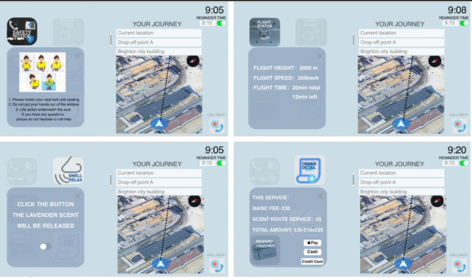
Number Description of the Tasks 1 Get the safety information through the in-car UI 2 Check the flight status through the in-car UI 3 Relax the mind and body by releasing scent on the in-car UI 4 Check the order details through the in-car UI
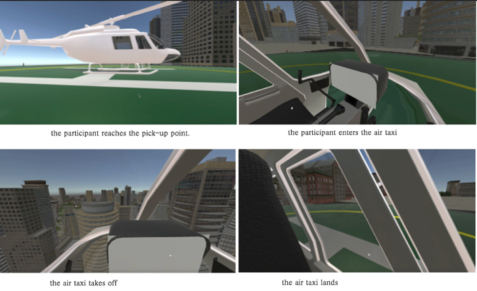
Prototype Design This section presents the user test prototypes, including the prototyping of the In-car UIs and a 3d virtual scenario of an air taxi flight. The prototype for In-car UIs was created using Adobe XD. The 3D virtual scene of the air taxi flight was created using Unity. As shown in Figure 1 below, the prototype shown below is an In-car UI for passengers. As shown in Figure 2 below, the prototype shown below is an air taxi simulation for participants.
Figure 1: The in-car UI prototype for taking an air taxi.Figure 2: The simulated prototype for taking the air taxi.
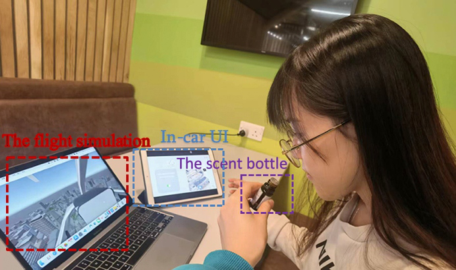
User Test This section describes the experiments used for the user test. The method of the experiment was used for the impact of the different scents on the user in the simulated air taxi. And the simulated test environment is shown in Figure 3.
Ten participants were recruited by email to conduct the user tests. Firstly, the participants were asked to read the briefing sheet. Then they were required to complete the scenes mentioned in Table 1. When experiencing Scene 3, we manually provided participants with the odour of their choice.
Sit Back, Relax, and Sniff Some Lavender! 155
After the participants completed their scenes, they were given time to oper- ate the interface on their own. Finally, the participants filled out the 7-Point Likert Scale to evaluate their response to the scent.
The whole procedure of this study has been approved by the ethics commit- tee. The ethical review application (application number ER/SX50/1), which was approved as a high-risk study, included the following documents: recruit- ment wording, briefing sheet, information on the specifics of each essential oil, consent form for project participants, participant information sheet, gen- eral risk assessment, questionnaire and interview questions, debrief sheet, the certificate of approval and the response from CREC members.
Figure 3: The experimental setup of each prototype and scent in the user test. (The flight simulation was presented on a laptop and the in-car user interface was presented using a tablet. The bottle was used to provide participants with the corresponding scent while they experienced the two functions of safety notice and smell relax.)
RESULT AND ANALYSIS In this section, we analyzed the data from the user evaluation using a quan- titative analysis method. The data is analyzed in two groups: the relaxation and preference of the participants for the two scents, and the reactions of the different genders to the two scents.
Quantitatively analyzed 10 participants for the ratings of liking and relaxation. We conducted separate Independent Samples T-test of partici- pants’ responses to lavender and peppermint scents on liking and relaxation, and the results are shown in Table 2.
As shown in Table 2, participants’ responses to lavender and peppermint scents were not statistically significantly different in liking (P = 0.480) and relaxation (P = 0.389). The scents of lavender (M = 5.60, SD = 1.505) were all liked slightly more than the scent of peppermint (M = 5.10, SD = 1.595). And the scent of peppermint (M = 4.8, SD = 1.619) was slightly more relaxed than the scent of lavender (M = 4.10, SD = 1.912).
Quantitative analysis of peppermint and lavender scents by gender. We conducted Independent Samples T-tests on participants’ responses to lavender and peppermint scents on liking and relaxation for different genders, and the results are shown in Table 3.
Table 2. The result of mean scores and standard deviation about liking rating.
Table available in the original PDF paper.
Emotion Scent N M SD T P Liking Lavender 10 5.60 1.505 0.721 0.480 Peppermint 10 5.10 1.595 Relaxation Lavender 10 4.10 1.912 0.883 0.389 Peppermint 10 4.80 1.619
As shown in Table 3, there was a statistically significant difference between male and female responses to lavender (p<0.001*) and peppermint (p = 0.001*) flavours in liking. However, males and females responded sta- tistically significantly differently in terms of relaxation only to peppermint scent (p = 0.042*), and not to lavender (p = 0.063).
Additionally, females like lavender (M = 7.00, SD = 0.00) and peppermint (M = 6.40, SD = 0.447) much more than males prefer lavender(M = 4.20, SD = 0.447) and peppermint (M = 3.80, SD = 1.095). For relaxation, females also feel relaxed about lavender (M = 5.20, SD = 1.304) and peppermint (M = 5.80, SD = 0.837) much more than males prefer lavender (M = 3.00, SD = 1.871) and peppermint (M = 3.80, SD = 1.643).
Table 3. The result of the independent samples t-test about lavender and relaxation.
Table available in the original PDF paper.
Emotion Scent Gender N M SD T P Liking Lavender Female 5 7.00 0.00 14.000 <0.001* Male 5 4.20 0.447 Peppermint Female 5 6.40 0.548 4.747 0.001* Male 5 3.80 1.095 Relaxation Lavender Female 5 5.20 1.304 2.157 0.063 Male 5 3.00 1.871 Peppermint Female 5 5.80 0.837 2.425 0.042* Male 5 3.80 1.643
DISCUSSION
In this study, we have investigated the effects of scent on passengers in air taxis using a simulation experiment based on the Wizard of Oz study method. Our findings reveal that there is no statistically significant difference in peo- ple’s preference for lavender and peppermint scents. However, there was a significant difference in liking between the genders for lavender and pep- permint scents. For relaxation, there was a statistically significant difference between the genders only for peppermint scent and not for lavender. More- over, females were much more likely than males to prefer the lavender and peppermint scents.
This section discusses the benefits of peppermint and lavender scents for passengers in the environment of air taxi travel, and the differences between the two scents by gender, based on the results.
Sit Back, Relax, and Sniff Some Lavender! 157
The Benefits of Peppermint and Lavender Scents for Passengers As shown in Table 3, the results of our study show that passengers do prefer lavender and peppermint scents when simulating air taxi travel. Although participants’ points on relaxation are not high, the results show that they also meagrely help passengers to relax while simulating air taxi travel. However, there was little difference between the preference for peppermint and lavender scents and the level of relaxation.
This observation aligns with previous research suggesting that these scents have calming effects on individuals, which can lead to the overall enhanced well-being of people in the driving environment (Dmitrenko et al., 2020). Additionally, through feedback from our air taxi simulations, some testers who were addicted to smoking said that the menthol-flavoured cigarettes made them feel awake and relaxed. Therefore, the lavender and peppermint scent potentially delivered during the flight not only made them feel relaxed but also cleared the minds of some passengers. As Dmitrenko et al. have demonstrated: the peppermint scent is very effective in conveying alerting and urgent messages (Dmitrenko et al., 2017). When flying at high altitudes, keeping passengers awake while accessing important information, such as safety instructions, is important to them. So, we suggest that both scents could be combined with safety notices to achieve a clearer mind and relaxation when passengers are given safety information.
It is worth noting that while our study focused on lavender and pep- permint scents, other scents might also have similar effects on passengers’ emotions. Future research should investigate a broader range of scents to determine which are most effective in promoting relaxation and overall passenger satisfaction in air taxi services.
The Relationship Between Gender and Scents Another key finding of our study is the significant difference in the level of relaxation between genders when exposed to lavender and peppermint scents by the T-test. And females responded far more strongly to the scent-liking level than males in an air taxi environment, whether it was a peppermint scent or a lavender scent. As Sorokowski et al. found, Females usually have better olfactory abilities than males (Sorokowski et al., 2019).
This observation suggests that the design and implementation of air taxi services should take into account the potential gender differences in prefer- ences and reactions to scents. The integration of adjustable scent diffusion systems in air taxis could be a viable solution to accommodate the varying preferences of passengers. Adjustable scent diffusion systems would allow passengers to customize the type and intensity of scents during their rides, thereby creating a personalized experience that caters to their preferences. Such a system can also help passengers avoid the potential negative effects that certain scents can have on certain passengers, such as motion sickness reactions or headaches (Schartmüller & Riener, 2020).
Our study has provided valuable insights into the effects of scent on passen- gers in air taxi services and the significant difference in the level of relaxation between genders when exposed to lavender and peppermint scents. These findings can be used to inform the design and implementation of air taxi
services, ultimately promoting the acceptance and advancement of this new technology. However, given the limitations of our study and the potential for further exploration, future research must continue to investigate the impact of scents on passengers in air taxi services, as well as consider a broader range of factors that may influence the passenger experience.
Limitation Despite the significant findings obtained from our study, there are some limi- tations that should be acknowledged. First, the sample size for our study was relatively small, with only 10 participants. A larger sample size might have provided more reliable and generalizable results. Future research should aim to include a more diverse and larger sample of participants to better under- stand the effects of scent on passengers in air taxi services. Second, Scent delivery issues: We have used manual methods to deliver scents. We have oil bottles, which are the oil bottles I’ve used in our research, but like an automated sent delivery system. Thirdly, the fidelity of the prototypes is still relatively low. For example, although I have a flight simulation in Unity, it is quite artificial. Hence the fidelity still needs to be improved. Lastly, we focused on only two scents in our investigation, which may not capture the full range of preferences and effects of various scents on passengers. Future research should build upon our findings by exploring different scent types and concentrations, as well as investigating their impact on passengers in real air taxi services.
CONCLUSION
This study reveals significant insights into the user experience for air taxi services. Our research underscores the importance of considering individ- ual scent preferences and gender differences in service design. Lavender and peppermint scents were found to enhance passenger relaxation, with gender differences noted in their impact, providing valuable insights for tailoring air taxi environments to meet diverse passenger needs.
This research contributes to the growing body of knowledge on user experience in autonomous transportation systems, particularly air taxis. By delving into factors such as scent preferences and gender, we have identi- fied key areas that can be leveraged to improve user experience, thereby promoting the adoption of this innovative mode of transport.
We hope that our findings will guide future research in this field and inform the development of air taxi services. However, we recognize that further stud- ies are needed to validate and extend our results, particularly with larger and more diverse populations. By continuing to explore passenger preferences and experiences, we can better design air taxis that meet the needs of all users.
ACKNOWLEDGMENT
The authors would like to acknowledge.
Sit Back, Relax, and Sniff Some Lavender! 159
REFERENCES
Al Haddad, C., Chaniotakis, E. et al. (2020, February). Factors affecting the adoption and use of urban air mobility. Transportation Research Part A: Policy and Practice. 132, 696–712. https://doi.org/10.1016/j.tra.2019.12.020 Amores, J., & Maes, P. (2017, May). Essence: Olfactory interfaces for unconscious
influence of mood and cognitive performance. In Proceedings of the 2017 CHI conference on human factors in computing systems (pp. 28–34). https://doi.org/ 10.1145/3025453.3026004 Dmitrenko, D., Maggioni, E., Vi, C. T., & Obrist, M. (2017, September). What did I sniff? Mapping scents onto driving-related messages. In Proceedings of the 9th International Conference on Automotive User Interfaces and Interactive Vehicular Applications (pp. 154–163). Dmitrenko, D., Maggioni, E., Brianza, G., Holthausen, B. E., Walker, B. N., &
Obrist, M. (2020, April). Caroma therapy: Pleasant scents promote safer driv- ing, better mood, and improved well-being in angry drivers. In Proceedings of the 2020 chi conference on human factors in computing systems (pp. 1–13). Fu, M., Rothfeld, R., & Antoniou, C. (2019). Exploring Preferences for Transportation Modes in an Urban Air Mobility Environment: Munich Case Study. Transportation Research Record, 2673(10), 427–442. https://doi.org/10.1177/ 0361198119843858 Habibovic, A., Andersson, J., Nilsson, M., Lundgren, V. M., & Nilsson, J.
(2016, June). Evaluating interactions with non-existing automated vehicles: Three Wizard of Oz approaches. In 2016 IEEE intelligent vehicles symposium (IV) (pp. 32–37). IEEE. Howard, S., & Hughes, B. M. (2008). Expectancies, not aroma, explain impact of lavender aromatherapy on psychophysiological indices of relaxation in young healthy women. British Journal of Health Psychology, 13(4), 603–617. Jr, B. (2021, October 18). You may be able to book a flying taxi within three years.
BBC. https://www.bbc.co.uk/news/business-58895259 Meurer, J., Pakusch, C., Stevens, G., Randall, D., & Wulf, V. (2020, July). A wizard of oz study on passengers’ experiences of a robo-taxi service in real-life set- tings. In Proceedings of the 2020 ACM Designing Interactive Systems Conference (pp. 1365–1377). Milotic, D. (2003). The impact of fragrance on consumer choice. Journal of
Consumer Behaviour, 3(2), 179–191. https://doi.org/10.1002/cb.131 Okur, E., Kumar, S. H., Sahay, S., Arslan Esme, A., & Nachman, L. (2019, April).
Natural language interactions in autonomous vehicles: Intent detection and slot filling from passenger utterances. In International Conference on Computational Linguistics and Intelligent Text Processing (pp. 334–350). Cham: Springer Nature Switzerland. Pfeifer, S. and Georgiadis, P. (2021, August 24). Investors pledge a record $4.3bn for air taxi start-ups: Funding for next-generation air mobility soars 83% over five years but market exuberance may be waning. Financial Times. https://www.ft.c om/content/ec8bab06-9118-4453-b60e-defd32b230a7 Poon, L. (2017, March 08). To Entice Riders, Singapore Buses get a ‘Signature Scent’:
Will More People Ride Public Transit if it Smells Nice? Bloomberg City Lab. Bloomberg. https://www.bloomberg.com/news/articles/2017-03-08/singapore-bu ses-now-have-a-special-%20smell-to-entice-riders Quercia, D., Schifanella, R., Aiello, L. M., & McLean, K. (2015). Smelly maps: The digital life of urban smellscapes. In Proceedings of the International AAAI Conference on Web and Social Media (Vol. 9, No. 1, pp. 327–336).
Rajendran, S., Srinivas, S. (2020, November). Air taxi service for urban mobility: A critical review of recent developments, future challenges, and opportunities, Trans- portation Research Part E: Logistics and Transportation Review, 143, 102090. https://doi.org/10.1016/j.tre.2020.102090 Raudenbush, B., Grayhem, R., Sears, T., & Wilson, I. (2009). Effects of pepper-
mint and cinnamon odor administration on simulated driving alertness, mood and workload. North American Journal of Psychology, 11(2), 245–245. Schartmüller, C., & Riener, A. (2020, September). Sick of scents: Investigating non-invasive olfactory motion sickness mitigation in automated driving. In 12th International conference on automotive user interfaces and interactive vehicular applications (pp. 30–39). Sorokowski, P., Karwowski, M., Misiak, M., Marczak, M. K., Dziekan, M., Hummel, T., & Sorokowska, A. (2019). Sex differences in human olfaction: a meta-analysis. Frontiers in psychology, 10, 242. Spence C. (2021). Scent in Motion: On the Multiple Uses of Ambient Scent in the
Context of Passenger Transport. Frontiers in psychology, 12, 702517. https://doi. org/10.3389/fpsyg.2021.702517 Straubinger, A., Rothfeld, R., Shamiyeh, M., Büchter, K. D., Kaiser, J., & Plötner, K. O. (2020). An overview of current research and developments in urban air mobility–Setting the scene for UAM introduction. Journal of Air Transport Management, 87, 101852. Wakefield, J. (2017, September 26). Dubai tests drone taxi service. BBC. https://ww
w.bbc.co.uk/news/technology-41399406 Wang, P., Sibi, S., Mok, B., & Ju, W. (2017, March). Marionette: Enabling on-road wizard-of-oz autonomous driving studies. In Proceedings of the 2017 ACM/IEEE international conference on human-robot interaction (pp. 234–243). Weiss, A., Bernhaupt, R., Schwaiger, D., Altmaninger, M., Buchner, R., & Tscheligi,
M. (2009, December). User experience evaluation with a wizard of oz approach: Technical and methodological considerations. In 2009 9th IEEE-RAS Interna- tional Conference on Humanoid Robots (pp. 303–308). IEEE.
LISTED IN THE AHFE DIGITAL BOOKSTORE CATALOGUE
Explore the complete digital volume
Affective and Pleasurable Design
Read this individual research paper free through the original publisher, or explore the full digital proceedings book.
ISBN 978-1-958651-99-5
Explore this ISBN in the AHFE Bookstore ↗Listed in the July 2026 bookstore catalogue; search by ISBN to confirm current availability · Digital book purchase optional