Abeer Alnafjan (2024). Math Game for Elementary School Children Using Leap Motion Controller. In: Intelligent Human Systems Integration (IHSI 2024): Integrating People and Intelligent Systems. AHFE Open Access, vol. 119. https://doi.org/10.54941/ahfe1004605
Education holds significant importance in society as it provides individuals with essential knowledge, skills, and critical thinking abilities. However, traditional educational approaches may not always engage children effectively. To address this, innovative methods are needed to make education more interesting and captivating for children. By incorporating interactive elements such as educational games, multimedia resources, and creative teaching techniques, we can create a learning environment that fosters curiosity, exploration, and active participation. This approach enhances learning outcomes and fosters a lifelong passion for learning in children. In recent years, the advancement of technology has transformed the educational landscape, offering a wide array of resources to enhance learning experiences. Educational games have emerged as a promising tool, particularly in fostering children's interest and engagement in various subject areas. There has been a significant increase in the number of studies, projects, and research efforts dedicated to designing guidelines and frameworks for integrating technology and educational games in the field of education. This increased focus demonstrates the acknowledgment of the significant potential of educational games as effective tools for improving learning outcomes. To ensure the effectiveness of these games, researchers and developers have identified essential features that contribute to their educational value. These features include the ability to stimulate critical thinking, minimize the reliance on textual content, provide user-friendly interfaces, and promote interactivity. By incorporating these elements into game design, educators can create engaging learning experiences that foster deeper understanding and knowledge acquisition among learners. The focus on these crucial features demonstrates the commitment to designing educational games that effectively support learning goals and engage students in meaningful ways. Our project’s primary aim is to design and develop an educational game employing hand movements using the Leap Motion Controller (LMC) as an interactive input device. The game aims to enhance children's understanding of arithmetic operations, specifically addition and subtraction, in an enjoyable and captivating manner. The use of LMC enables the recognition of children's gestures representing numbers, thereby providing an interactive learning experience. The objectives of the project include acquiring relevant background knowledge, establishing functional requirements and computational constraints, designing and developing a math game incorporating elements such as 3D animations and pictures, and validating the game's effectiveness in achieving its intended benefits for both children and their teachers.The paper is organized into five sections. Section 1 introduces the problem and outlines the aim and objectives of the project. Section 2 reviews related works in the field. Section 3 presents the system design. Section 4 describes the challenges anticipated during and after implementation. Finally, Section 5 concludes with a summary of our findings, future work, and design considerations.
Education is important in society as it provides individuals with essential knowledge, skills, and critical thinking abilities. However, traditional educa- tional approaches may only sometimes engage children effectively. Innovative methods are required to make education more interesting and engaging for children. We can create an engaging learning environment by incorpo- rating interactive elements like educational games, multimedia resources, and creative teaching techniques that encourage curiosity, exploration, and active participation. This approach enhances learning outcomes and fosters a lifelong passion for learning in children (Zeng et al., 2020).
In recent years, the advancement of technology has transformed the edu- cational landscape, offering a wide array of resources to enhance learning experiences. Educational games have emerged as a promising tool, particu- larly in fostering children’s interest and engagement in various subject areas. There has been a significant increase in the number of studies, projects, and research efforts dedicated to designing guidelines and frameworks for inte- grating technology and educational games in the field of education. This increased focus demonstrates the acknowledgment of the significant poten- tial of educational games as practical tools for improving learning outcomes (Vanbecelaere et al., 2021).
To ensure the effectiveness of these games, researchers and developers have identified essential features that contribute to their educational value. These features include stimulating critical thinking, minimizing reliance on textual content, providing user-friendly interfaces, and promoting interactiv- ity. By incorporating these elements into game design, educators can create engaging learning experiences that foster more profound understanding and knowledge acquisition among learners. The focus on these crucial features demonstrates the commitment to designing educational games that effectively support learning goals and engage students in meaningful ways (Zeng et al., 2020). Our project aims to design and develop an educational game employing hand movements using the Leap Motion Controller (LMC) as an interac- tive input device. The game aims to enhance children’s understanding of arithmetic operations, specifically addition and subtraction, in an enjoy- able and captivating manner. Using LMC enables the recognition of the children’s gestures representing numbers, thereby providing an interactive learning experience. The project’s objectives include acquiring relevant back- ground knowledge, establishing functional requirements and computational constraints, designing and developing a math game incorporating elements such as 3D animations and pictures, and validating the game’s effectiveness in achieving its intended benefits for children and their teachers.
The paper is divided into five sections. Section 1 provides background information on mathematics and online and mobile learning. Section 2 reviews relevant works in the field. Section 3 presents the system description. Section 4 discusses the findings. Finally, Section 5 concludes with a summary of the findings, future work, and design considerations.
BACKGROUND
Mathematics Mathematics is a crucial subject in education, encompassing arithmetic and practical problem-solving. It has scientific applications and fosters skills like accuracy, time management, and effective management practices. How- ever, children often face challenges in understanding mathematical symbols and performing arithmetic operations, hindering their learning progress. Teachers also encounter difficulties teaching mathematics, including nav- igating students’ varying mental abilities and ensuring effective commu- nication. Distance learning exacerbates these challenges by limiting phys- ical interaction and making it harder to assess students’ understanding (Fuson et al., 2015).
Online and Mobile Learning Online and mobile learning has become prevalent among children due to the accessibility and popularity of mobile devices and technologies. Children between the ages of 3 and 9 increasingly utilize these devices for educa- tional purposes, with the aid of games, videos, and applications covering
Math Game for Elementary School Children Using Leap Motion Controller 853
various subjects. While parental supervision is often necessary, online learn- ing offers flexibility and the ability to access educational resources anytime and anywhere. This has been particularly evident during times of crises and pandemics, where the reliance on mobile devices for studying, learning, and recreational activities has increased (Zeng et al., 2020).
RELATED WORK
In the following, we explore previous research on games that facilitate learning through play, discussing their goals and outcomes.
A study in (Giannakos et al., 2012) aimed to assess the design and edu- cational effectiveness of a storytelling mathematics video game developed using Scratch. The objective was to improve students’ mathematical skills and numerical competence. The game was evaluated with a small group of twelve students, and the results revealed that the story-based math video game successfully captured students’ interest and positively impacted their performance in an assessment test. Notably, the improvement was more sig- nificant among students who had previously struggled in mathematics. These findings suggest that video games can potentially engage and benefit students with difficulty focusing on their studies.
A study in (Ibarra et al., 2019) aimed to develop and evaluate iFrac- tions, a free game-based learning tool designed to teach fractions to children between the ages of 6 and 10. The tool was developed using HTML5, JavaScript, Mysql, and the phaser.io framework, and it was aligned with the six facets framework for serious games. The first assessment involved 29 prospective math teachers from the University of São Paulo who completed activities using the tool. The study found that 76% of teachers completed three activities without issues, while 24% completed only one or two activi- ties. Following this, the tool was improved and tested with 78 children from schools in Peru and Brazil. The majority of the children engaged with dif- ferent activities in iFractions, such as the quadrilateral blocks game (75%), the circle representation on the Cartesian Plane (19%), and the equivalence between two fractions (6%).
A study in (Akman & Çakır, 2023) examined the impact of the educational virtual reality game “Ke¸sfet-Kurtul” on fourth-grade students’ academic achievement in fractions and their engagement in mathematics. The results showed that the game increased academic achievement and maintained stu- dent engagement in mathematics. The experimental method was as effective as the school method regarding academic achievement and engagement. In terms of social engagement, the VR game outperformed the school method. However, there were no significant differences in affective and cognitive engagement.
A study in (Bang et al., 2023) investigated the effectiveness of My Math Academy, a personalized math learning program with adaptive assessments, on kindergarten and first-grade students’ learning outcomes and engagement. The results showed that students using My Math Academy made significant learning gains in math compared to those who did not use the program. The program was well-received by teachers, who found it helpful and valuable
854 Al-Nafjan
for enhancing student engagement, motivation, and confidence in math. The findings suggest that My Math Academy can improve early math skills and maintain student interest.
SYSTEM DESCRIPTION Research has shown that children with better finger sense, meaning their ability to mentally represent individual fingers, tend to perform better on symbolic math assessments. Our math game is designed to leverage the benefits of finger counting and finger sense in early math learning. By incor- porating enjoyable counting, addition, and subtraction activities using finger gestures, we aim to extend children’s understanding of mathematical concepts while simultaneously enhancing their finger sense and overall math abilities (Fischer et al., 2020).
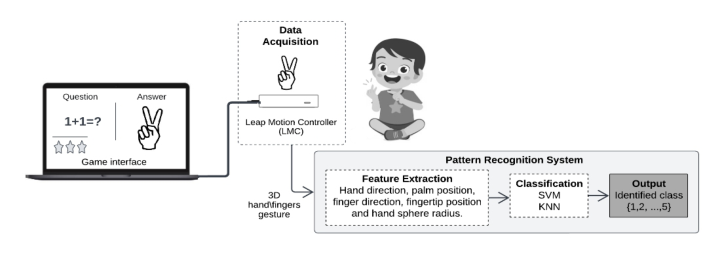
Our game system consists of two stages: detection and translation. We employed LMC to capture the 3D hand and finger gestures in the detec- tion step. Subsequently, the translation stage converts the captured hand and finger gestures into the corresponding numerical representation, which is then displayed on the screen as the game output. Figure 1 illustrates the game/system framework.
The game interface presents the question to the user. The LMC is utilized to detect finger movements. These detected movements are subsequently trans- lated into numerical representations, and the system verifies the accuracy of the answer. Depending on the correctness of the answer, the game provides visual feedback through movements and interactive sounds.
Figure 1: Math game/system framework.
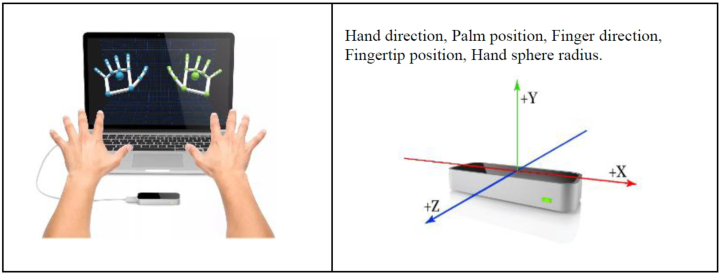
Hardware and Dataset Leap Motion Controller: LMC is a compact device that tracks hand and finger movements in 3D space. It offers precise gesture recognition and enables natural interaction with digital content. The LMC finds applica- tions in gaming, virtual reality, design, and more. High-resolution tracking and low latency connect physical gestures and virtual responses seamlessly.
Math Game for Elementary School Children Using Leap Motion Controller 855
While it has some limitations, the LMC’s potential for immersive experi- ences and intuitive controls makes it a promising technology for the future of human-computer interaction.
Dataset: this system employs a flat-file database to store data pertaining to numbers 1 to 5, which are represented using finger symbols with a single hand. The database file includes entries for the five numbers, ranging from 1 to 5, and consists of the associated hand gesture features. The data collection process involved three subjects repeating each number 10 times, leading to 150 samples being stored in the file. The extracted features include hand direction, palm position, finger direction, fingertip position, and hand sphere radius data. Notably, all the features are represented as vectors, denoting their values in the x, y, and z coordinates, as shown in Figure 2.
Figure 2: Leap motion controller (LMC).
Prototype The game’s development involved utilizing the Python programming lan- guage for tasks such as feature selection, classification, and integration with the graphical user interface (GUI).
The system employs two machine learning classifiers, namely support vec- tor machine (SVM) and k-nearest neighbors (KNN), utilizing the Scikit-learn library. The reasoning for using two classifiers is to compare and analyze their respective results. Both classifiers are supervised learners that begin by obtaining data from a CSV file. The data is then divided into training and testing sets. Notably, the classifier allocates 80% of the data for training and 20% for testing. Consequently, when a child moves their hand, the system records the movement and extracts the relevant features. Subsequently, the recognition classifiers (SVM/KNN) generate the corresponding numerical representation. The system then transmits the result to the graphical user interface (GUI) for presentation. Additionally, the system awards a point in the form of a star for each correct answer and provides auditory feedback as reinforcement.
The system features a user-friendly interface that prompts users to replicate the input gesture. The average response time of the system is approximately
856 Al-Nafjan
20 milliseconds. However, for the sake of simplicity, the initial implementa- tion focuses on utilizing a single hand to represent numbers ranging from 1 to 5. Additionally, the game includes equations involving addition and subtraction operations limited to these numbers.
DISCUSSION
The deployment and testing phases of the math game utilizing the LMC have demonstrated that the system aligns well with user and system requirements. Using hand-counting techniques, the system allows children to record their responses to math questions, specifically addition and subtraction. Instead of relying on verbal or written responses, the system captures and interprets the hand gestures made by the children to represent their answers. This approach aims to engage children in an interactive and tactile learning experience while reinforcing their understanding of mathematical concepts.
Regarding the classification algorithm used in this study, we evaluated the accuracy of both the SVM and KNN algorithms to assess their effectiveness in recognizing and interpreting the recorded hand gestures. Our findings indi- cated that the SVM algorithm achieved a higher accuracy rate of 94%, while the KNN algorithm achieved an accuracy rate of 90%. The results demon- strate that the SVM algorithm was successful in accurately distinguishing between different hand gestures and assigning the appropriate numerical rep- resentations with a high level of accuracy. This indicates its effectiveness in accurately classifying the hand gestures used in the math game system. On the other hand, the KNN algorithm also performed well, achieving a respectable accuracy rate of 90%. Despite its slightly lower accuracy compared to SVM, it still demonstrated the ability to classify hand gestures effectively.
However, the system does have certain limitations primarily related to the performance of the LMC. These limitations include a restricted range of motion and a lag between movements. One issue is the inability to detect both hands. To improve accuracy, some studies have explored using both LMC and Kinect. Additionally, in other research, a proposal was made to use two LMCs to address the limited tracking range and increase the number of features.
CONCLUSION
Learning through play is integral to active learning strategies to enhance educational quality and deliver high-quality educational services. Using play- based learning strategies proves to be an effective educational approach that facilitates the attainment of curriculum-related goals and fosters the development of communication and interaction skills among learners.
In this study, our objective was to design and develop an interactive educa- tional mathematical game specifically tailored for elementary school children. The game focused on enhancing skills in adding and subtracting 5-digit num- bers and utilized LMC along with game interface and finger representation for mental arithmetic.
Math Game for Elementary School Children Using Leap Motion Controller 857
By integrating learning and enjoyment within an educational framework, these games enable students to derive meaning from their learning experi- ences. Such games represent organized educational activities that rely on learners’ movement and effectiveness. Moreover, they enhance students’ motivation to learn through interactive engagement, facilitating the achieve- ment of specific educational objectives and expanding their knowledge horizons.
REFERENCES
Akman, E., & Çakır, R. (2023). The effect of educational virtual reality game on primary school students’ achievement and engagement in mathematics. Interactive Learning Environments, 31(3), 1467–1484. https://doi.org/10.1080/10494820. 2020.1841800 Bang, H. J., Li, L., & Flynn, K. (2023). Efficacy of an Adaptive Game-Based Math
Learning App to Support Personalized Learning and Improve Early Elementary School Students’ Learning. Early Childhood Education Journal, 51(4), 717–732. https://doi.org/10.1007/s10643-022-01332-3 Fischer, U., Suggate, S. P., & Stoeger, H. (2020). The Implicit Contribution of Fine Motor Skills to Mathematical Insight in Early Childhood. Frontiers in Psychology, 11. https://doi.org/10.3389/fpsyg.2020.01143 Fuson, K. C., Clements, D. H., & Sarama, J. (2015). Making early math education
work for all children. Phi Delta Kappan, 97(3), 63–68. https://doi.org/10.1177/ 0031721715614831 Giannakos, M., Chorianopoulos, K., & Jaccheri, L. (2012). Math Is Not Only for Science Geeks: Design and Assessment of a Storytelling Serious Video Game. 2012 IEEE 12th International Conference on Advanced Learning Technologies, 418–419. https://doi.org/10.1109/ICALT.2012.16 J. Ibarra, M., Jimenez, W., Soto, C., Chavez, E., Chiclla, E., Silva, A., & Brandao, L.
de O. (2019). Game Based Learning for Math Learning: Ifractions Case Study. 2019 International Conference on Virtual Reality and Visualization (ICVRV), 208–211. https://doi.org/10.1109/ICVRV47840.2019.00050 Vanbecelaere, S., Cornillie, F., Sasanguie, D., Reynvoet, B., & Depaepe, F. (2021).
The effectiveness of an adaptive digital educational game for the training of early numerical abilities in terms of cognitive, noncognitive and efficiency outcomes. British Journal of Educational Technology, 52(1), 112–124. https://doi.org/10. 1111/bjet.12957 Zeng, J., Parks, S., & Shang, J. (2020). To learn scientifically, effectively, and enjoyably: A review of educational games. Human Behavior and Emerging Technologies, 2(2), 186–195. https://doi.org/10.1002/hbe2.188
LISTED IN THE AHFE DIGITAL BOOKSTORE CATALOGUE
Explore the complete digital volume
Intelligent Human Systems Integration (IHSI 2024): Integrating People and Intelligent Systems
Read this individual research paper free through the original publisher, or explore the full digital proceedings book.
ISBN 978-1-958651-95-7
Explore this ISBN in the AHFE Bookstore ↗Listed in the July 2026 bookstore catalogue; search by ISBN to confirm current availability · Digital book purchase optional