Bernhard Rueger (2024). User-centred planning for rail vehicles to increase efficiency. In: Intelligent Human Systems Integration (IHSI 2024): Integrating People and Intelligent Systems. AHFE Open Access, vol. 119, pp. 59–69. https://doi.org/10.54941/ahfe1004603
In order to increase efficiency in terms of revenue on the railways, the path often taken is to maximise the number of seats. This is expected to "sell" as many seats as possible and thus increase profits. However, 20 years of research prove that seat-maximising wagons are actually inefficient. The reason is that the needs of passengers and, above all, human behaviour in vehicles when getting on and off, moving around, finding a seat, stowing luggage and staying in the train cabin are not sufficiently taken into account. Today's design approaches from the industry assume that passengers behave in all phases of the rail journey as expected by the industry or the operators. In reality, however, passengers always behave in such a way that they find the most comfortable way for themselves. In practice, neglecting passenger requirements leads to high inefficiencies, as passengers do not behave as expected by the design approaches. For example, in long-distance trains, little consideration is given to the diverse requirements around luggage storage. As a result, luggage is often placed in the aisles, on or in front of seats or, in extreme cases, even in the middle of the boarding area. The consequences are, on the one hand, a decrease in actual seat occupancy and thus a reduction in capacity and a significant increase in dwell time. The consequence is high inefficiency, as longer dwell times mean delays and operational restrictions as well as a significantly higher energy demand due to the higher speeds required. Well-designed vehicles, which focus on people from the outset, not only increase customer satisfaction through better quality, but also significantly improve efficiency through increased punctuality and up to 30% lower energy consumption. In 20 years of research at the Vienna University of Technology, over 400.000 passengers in Europe in over 100 different types of vehicles have been observed and precisely recorded with regard to their behaviour when choosing seats and storing luggage. Likewise, more than 20.000 passengers were closely observed during passenger changeover with the help of video analyses. From this very extensive data set, a calculation algorithm was developed and also processed into a proprietary software, with the help of which rail vehicles can be optimised based on the actual behaviour of passengers and their requirements and thus be designed significantly more efficiently.
When planning any system that is to be used by people, the behaviour of the users and their needs and requirements must be known as precisely as possible. Otherwise, the systems will not meet the users’ requirements and will therefore be underutilised or inefficient.
In order to increase the efficiency of the railway, it is always of great importance to understand the railway in its complexity as an holistic sys- tem. Optimisation attempts in sub-areas may often reduce the efficiency of other areas.
Passenger vehicles are one area of the railway that offers a high potential of optimisation, also for the overall railway system. When planning efficient vehicles, it is important to know exactly the possible behaviour of passen- gers and their needs. In practice, unfortunately, this is often not taken into account and only supposed economic advantages are prioritised. It is assumed that passengers will behave in the way that the vehicle manufacturers or the operators expect. In reality, however, the opposite is the case. Passengers try to prioritise their own comfort throughout the entire journey, from boarding the train to finding and choosing a seat, storing their luggage and getting off, even if this results in disadvantages for other passengers or the train operator.
However, this “non-compliant” behaviour means that, for example, the passenger flow is significantly retarded and therefore the dwell time of the train is increased. Likewise, some of the luggage is not stored as intended,
but blocks seats and aisle. This reduces the actual availability of seats, pas- senger comfort and passenger satisfaction. All of this leads to a significant inefficiency; for example, the longer dwell time in stations requires a higher travelling speed in order to keep to the timetable and therefore sometimes significantly higher energy consumption.
In order to identify and understand the problems and challenges for oper- ators and to create clear measures for improvements, a series of projects was launched at the TU-Wien (Vienna University of Technology) in 2001, which continues to this day in the form of many individual projects and con- tinuously collects and processes behavioural data. The aim was and still is to define measures that significantly increase the efficiency of the vehicles and thus simultaneously generate great benefits for operators and also for passengers, e.g. by increasing comfort.
METHOD
Since 2001, the behaviour of over 400,000 passengers in over 100 different vehicle types in Central Europe has been analysed in detail and supple- mented by surveys of 60,000 passengers. From these and other methods, it has been possible to derive a calculation model with which vehicle layouts can be assessed and thus optimised with regard to the criteria of passenger changeover time, luggage accommodation and seat usability. The methods used are described below.
Passenger Observations In order to generate an objective data set, it is essential to analyse the behaviour of passengers in such a way that they do not realise that their behaviour is being recorded. To this end, “snapshots” were taken in the vehi- cles. Surveyors walked through the train and recorded on a floor plan of the carriage exactly where which people were sitting, what they were doing and what luggage was stored where in each section. Apparent characteristics such as the estimated age and gender of the people and their choice of seat (or standing room) and the activities they were carrying out were recorded. Fur- thermore, it was recorded exactly what type of luggage (trolley, travel bag, rucksack - in each case according to the size categories small, medium and large) was deposited where and in what form. All these investigations were carried out in over 100 different layouts of rail vehicles in order to determine the influence of the vehicle design on the behaviour of passengers.
A precise statistical analysis of the data thus provided the knowledge of which areas of a layout are more and less popular depending on the equip- ment, design or location in the carriage. The information also reveals which equipment elements are used in which form. In addition, there are precise findings as to which items of luggage are placed where.
Surveys The observations were supplemented by a survey of around 60,000 passen- gers. The aim of the surveys was to gain the following insights into the
User-Centred Planning for Rail Vehicles to Increase Efficiency 61
behaviour and needs of passengers, depending on age, gender, purpose of travel, group size and other personal characteristics:
Type, estimated size and weight and number of items of luggage
Luggage storage location & reason for the choice of accommodation
Difficulties when boarding and travelling with luggage and accommoda- tion
Specific requirements for the accommodation
Seating requirements The data was used to create an exact calculation model for the volume of luggage and the type of luggage storage depending on the individual char- acteristics of the travellers. In combination with the observation data, it is possible to predict very precisely where which items of luggage are stored in a defined vehicle layout, how many items of luggage are not properly deposited and, conversely, how many are a nuisance (e.g. at the seat, in the aisle, in the boarding area, etc.).
Baggage Data Collection In addition, several thousand items of luggage were recorded in detail. The exact dimensions in centimetres, the exact weight in kilograms and the type of luggage were recorded. It was also recorded whether and how many wheels the luggage had and whether it was soft or hard cover. Parallel to the luggage survey, passengers were asked about their luggage and their subjec- tive perception of the size and weight of their luggage was recorded. This data could therefore be correlated very well with the survey data.
Video Analyses of the Passenger Changeover To determine the exact passenger changeover time, over 20,000 passengers were filmed by video camera while boarding or alighting using permits. Analysing these videos enables statements to be made to the nearest tenth of a second about how long it takes a person to board or alight depending on their age, gender, any limitations, the luggage they are carrying and the vehicle design. The exact width of the vehicle doors, the number of steps from the platform, the size of the boarding area and the design of the interior were determined.
In addition to the exact representation of the time required for boarding, the data also allows to interpret the influence of the interior design on the passenger backlog and the increased time required to be recalculated.
Passenger Changeover Tests In order to determine the exact behaviour of individual people in vehicles during passenger changeover, various passenger changeover scenarios were simulated over five days in around 20 different vehicle layouts with over 100 persons. In each scenario, luggage had to be taken into the vehicle and stowed away and/or special seats, including reserved seats, had to be found. Six cam- eras were positioned in each of the sections to record the exact movement sequences under the different personal and vehicle-related conditions. Finally,
62 Rüger
this data was also compared with the video recordings at the boarding doors of normal passenger trains in order to determine whether the “re-enactment” of the respective situations resulted in a change in behaviour compared to real operation and whether the data could therefore be falsified. This comparison and targeted observations by the organisers on the train led to the realisation that the reenacted scenarios could hardly be distinguished from real scenarios in terms of the time required.
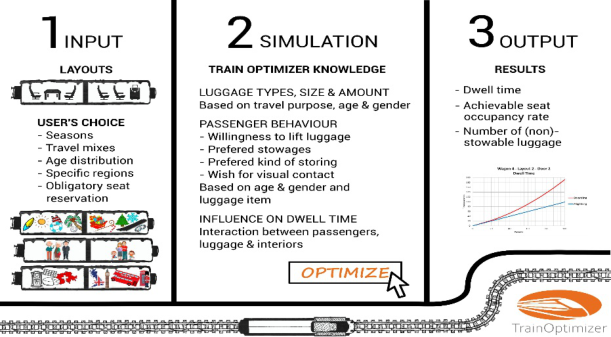
Creation of the Calculation Model The evaluation of the extensive data led to a calculation model that can be used to optimise the expected passenger changeover time, luggage storage and seat usability for new vehicle layouts. The passenger changeover time largely follows a quadratic parabola when boarding and a linear one when alighting. The gradient of the curves is influenced by the various parameters of the car- riage at the boarding area and in the interior (number of steps, door width, aisle width, layout of the seats and luggage racks, size of the luggage racks and much more) as well as by the personal characteristics of the travellers and the luggage they are carrying. Based on the calculation model, a soft- ware called TrainOptimizer® was developed, with the help of which layouts can be created very easily without CAD knowledge and evaluated in terms of passenger changeover time, luggage storage and seat usability. TrainOptimiz- er® was also honoured with the “Red Cabin Awards for Rail Interiors”in the “Technological Innovation Of The Year” category. In Figure 1 schematically visualises the three steps of the software (input of layouts, know-how of the software and visualisation of the results).
Figure 1: Steps in the TrainOptimiser® software (netwiss).
PASSENGER BEHAVIOUR There are two situations during a train journey in which the interaction of passengers with the existing vehicle layout has a significant impact on the quality of service. These are boarding and alighting and luggage storage during the journey. Both influences are directly related to each other.
User-Centred Planning for Rail Vehicles to Increase Efficiency 63
Luggage Storage Luggage storage is significantly influenced by two factors. On the one hand, there must be sufficient capacity to accommodate the luggage, and on the other hand, passenger needs must be extensively taken into account with regard to luggage storage, which, if ignored, will lead to negative behaviour from an operational point of view.
Passenger needs are simple and understandable, but can become complex challenges when designing vehicles. The two main needs are:
Passengers do not want to lift larger items of luggage
Passengers want visual contact with their luggage
Lifting and Shifting the Luggage & Visual Contact The primary distinction to be made is which luggage is to be lifted. Smaller and lighter items of luggage are more likely to be lifted than larger and heavier items. The willingness to lift luggage can be divided into three “comfort lev- els”. The “Comfort” level takes into account those travellers who are willing to lift their luggage. The “Standard” level recognises those travellers who are reluctant to lift their luggage, but do so when circumstances require it, and the “Limit” level takes into account the pieces of luggage actually lifted in fully occupied carriages. This limit value can only be determined using the “obser- vation” method described above, as travellers provide different information during interviews depending on the situation than they do in reality.
In addition to the basic readiness to lift baggage, a distinction must be made between the height to which baggage is lifted. In this respect, a distinction is made between two heights, one to a height of around one metre, which is used for luggage racks, and one to the height of an overhead rack.
As the required lifting not only determines the stowability of luggage in stowage compartments and is therefore a key factor in operational quality, but also has a significant influence on passenger comfort and therefore pas- senger satisfaction, efforts should be made to always use the “Comfort” level wherever possible. This level should be used in particular in carriage classes with a higher comfort level, such as first or higher classes. In second class, the “Standard” level may also be used where appropriate. The “Limit” level reflects the limit that can just be reached. In practice, more items of baggage than defined in this level are not lifted.
Furthermore, the willingness to shift luggage must also be taken into account. This refers to whether travellers are prepared to tilt or turn luggage. This is particularly important for all storage spaces into which luggage has to be “threaded”, such as under seats or between seat backrests in the case of narrow seat spacing. As a general rule, travellers do not want to shift their luggage for stowage and do not do so in practice. It must therefore be possible to stow items of luggage in the same way as they are transported by the trav- ellers. Trolleys on two or four wheels that are transported upright must be stowed in an upright position. Travel bags should be stored in a horizontal position if possible, ideally at a height of approx. one metre, which corre- sponds to the middle compartment of luggage racks. Smaller or medium-sized
64 Rüger
trolleys, which are easier to lift, are often stored horizontally in luggage racks, by travellers, for example.
For around 90% of passengers, it is important for reasons of subjective safety to have their luggage in their field of vision while travelling. Approx- imately 75% of travellers are also explicitly prepared to place their luggage in a disruptive manner (e.g. on or in front of seats or in the aisle) in order to establish visual contact.
Storage Space Dimensioning In addition to the principles mentioned above, it is also essential to create sufficient luggage storage capacity. To this end, it is important to have pre- cise knowledge of the average volume of luggage in the intended area of use of the vehicles. Furthermore, luggage must always be considered in three dimensions. In practice, the volume of luggage is often assumed, but this corresponds to a one-dimensional view. Here, any cross-sectional areas, e.g. between the seat backrests, are often used and multiplied by the available depth, e.g. from the aisle to the window. All the volumes obtained in this way are added up to a total volume for luggage storage in the vehicle, which gives the illusion of large luggage storage capacities. In practice, many of these cross-sectional areas cannot be utilised at all!
Effects of Inadequately Dimensioned Luggage Racks Disregarding the above-mentioned requirements for luggage storage means that travellers either cannot store their luggage at all because there is not enough storage space in practice, or they do not make sufficient use of the shelves available because they conflict with the basic requirements of visual contact or avoidance of lifting. This leads, for example, to over- head shelves remaining partially unused and luggage still not being stowed properly.
In both cases, items of luggage that cannot be stowed are placed near the passengers on or in front of seats or in the aisle area. Unstowable luggage leads to seats being blocked and passengers having to stand when the train is full. On average, two to three pieces of luggage that are not properly stowed result in the effective loss of a seat.
Passenger Changeover Passenger changeover is a highly complex process and an interplay between passenger characteristics and the overall vehicle layout. Passenger-specific influencing factors include age and gender, any physical limitations and the luggage carried, which in turn depends on the chosen purpose of the journey.
The vehicle layout results in three main areas with different influences. These are the boarding door, the boarding area, which can also serve as a catchment area, especially in local transport, and the entire interior, which essentially corresponds to the seating area. The door width, the gap between the platform and the vehicle and the number of steps have a significant influ- ence on the boarding time. The design of the boarding area determines how
User-Centred Planning for Rail Vehicles to Increase Efficiency 65
well the passengers can continue into the seating area and how many pas- sengers can remain in it in the event of a backlog so that the train can still depart.
There are several influencing factors in the interior. The stowability of luggage has a significant influence. As described above, items of luggage that cannot be stowed away are sometimes left in the aisle area, where they block the flow of passengers. The simplicity of luggage storage has a further influ- ence. Ideally, if travellers can put their luggage down “in passing”and then go straight to the nearest seat, the passenger flow is faster than if travellers have to shift their luggage several times to store it. Passenger flow slows down considerably, especially if luggage has to be lifted in order to stow it in the overhead storage compartment or if the distance between two seat backrests is too short and the luggage can only be stowed by tilting it, if at all.
In addition, the aisle width and any alternative spaces have an influence on passenger flow. Avoidance spaces are essential for the oncoming traffic that arises when there is a high volume of passengers, the aisle width is important for ease of movement with luggage, also when people are busy depositing luggage and others may be able to pass.
PLANNING PRINCIPLES IN VEHICLES Luggage Racks
The luggage racks must comply with the above-mentioned principles of visual contact and the avoidance of lifting operations, especially of large items of luggage up to the height of the overhead rack. For reasons of efficiency, the actual willingness of different passengers to lift luggage may be taken into account when dimensioning luggage racks. Smaller and medium-sized items of luggage, which also tend to be lighter, are placed in the overhead com- partment to a greater extent voluntarily by travellers, while larger items of luggage only make up a small proportion of around 20%. This means that overhead racks may very well be used as a basis for the calculation, but only to the extent that corresponds to the passengers’ willingness to use them and by no means per se for all items of luggage.
It is also important to ensure that luggage racks are well distributed in the seating area. Good distribution leads to appropriate use, as most trav- ellers have visual contact with the luggage. At the same time, the distribution also means that luggage can be stowed more easily by passengers, allowing passengers to change seats more quickly.
In addition to the arrangement of the luggage racks, it is essential to know exactly how much and what type of luggage is expected. The type of luggage or the corresponding mix determines the required dimensions of the luggage racks. If the dimensions of the racks are too narrow by a few centimetres, it is often the case that certain items of luggage cannot be stored at all or only in such a way that an unusable free space remains, making the racks inefficient. At the same time, care must be taken to ensure that all available items of luggage can be accommodated in terms of quantity, especially for all those areas of use and travel purpose mixes where full utilisation of the vehicle is
66 Rüger
expected and desired. Under no circumstances should only the total volume of the luggage and the luggage racks be determined and then compared!
Overall Vehicle Concept The entire vehicle concept has a significant influence on the passenger changeover time. This starts with the vehicle bodies. In addition to the advantage of up to 50% less tare weight per seat and the resulting major energy-saving effect, shorter and therefore wider car bodies have the advan- tage of enabling wider aisles. Aisles with a width of over 60cm allow up to 25% shorter passenger changeover times than those with a width of 50cm. Another key factor is the arrangement of the doors. The classic arrange- ment at the two ends of the carriage means that on average 50% of passengers per carriage board through one door and then have to pass through the same interior. Since the boarding time in the respective carriage interiors essentially follows a quadratic parabola as the number of boarding passengers increases, a higher number of passengers passing through a cross-section leads to a dis- proportionate increase in the passenger changeover time. If, on the other hand, the doors are arranged in such a way that the passenger flow can be divided when entering the boarding area, the passenger changeover time can be significantly reduced. On the one hand, the number of people entering the respective interior space through a cross-section is halved with a good design, which leads to a noticeable reduction in boarding time with a power function. On the other hand, the division of passengers also reduces backlog effects from one of the two areas.
If the seating area follows immediately after a small entrance area, then backlog effects from the interior are very quickly shifted to the entrance. If the route to the seating area is longer, for example due to toilets or other installations, the effects of backlog from the seating area are reduced.
In the seating area, as described above, attention must be paid to a good layout and the correct and sufficient planning of the luggage racks. In addi- tion, well-distributed alternative spaces should be created. This can be done by ensuring that tables in vis-á-vis seating groups do not extend all the way to the aisle, but are approx. 10 to 15cm shorter. Luggage racks should also be moved slightly away from the aisle, which also creates good sidestep spaces.
EXAMPLE LAYOUT COMPARISON Three layouts are compared with each other in order to illustrate the effects that the correct consideration of luggage racks and the arrangement of the doors have on the achievable seat occupancy rate and the passenger changeover time.
They are classic passenger coaches, in layout V1 with 94 seats and, apart from a small rack, mainly overhead luggage racks. In layout V2, only 86 seats are available, but there are much better options for luggage storage to meet travellers’ requirements (see Figure 2 and Figure 3). In layout V3, the doors are arranged in the quarter points, which results in a division of the passenger flow after boarding, which significantly speeds up the passenger changeover
User-Centred Planning for Rail Vehicles to Increase Efficiency 67
time. In all cases, the luggage racks have three compartments, measured from below with a height of 85 - 40 - 40 cm, above which is the overhead shelf.
Figure 2: Example layout V1 (source netwiss - layout creation in TrainOptimizer®).
Figure available in the original PDF paper.
Figure 3: Example layout V2 (source netwiss - layout creation in TrainOptimizer®).
Figure available in the original PDF paper.
Figure 4: Example layout V5 (source netwiss - layout creation in TrainOptimizer®).
Figure available in the original PDF paper.
Subsequently, a fictitious travel purpose mix (peak travel day) is specified. It is assumed that 50% of holiday travellers use the train.
Only checked baggage in air travel is considered as baggage. Baggage that may be taken on board an aircraft cabin is regarded as hand baggage and is subsequently not assessed, as it is assumed that it can be accommodated in any case or at least does not have any serious negative impact.
The Standard level (see above) is used as the comfort level for lifting readiness.
Luggage Storage and Seat Occupancy Rate
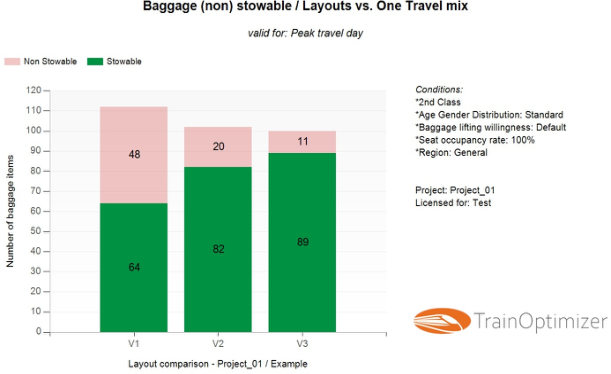
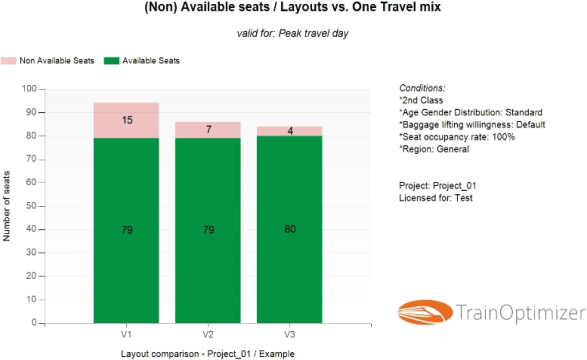
Figure 5 shows that 48 items of baggage cannot be stowed in layout V1, 20 in layout V2 and only 11 in layout V3. In addition to severe comfort restrictions and general problems caused by luggage that cannot be stowed away properly, such as security problems or delays, the luggage that cannot be stowed away means that only 79 of the 94 seats can be used in layout V1. In layout V2, only 86 seats are still available, of which 79 seats are de facto usable, and in layout V3, as many as 80 of the 84 available seats are available (see Figure 6).
This analysis clearly shows that maximising the number of seats does not bring any added value, as more than 80 seats can never be used anyway. A reduction in the number of seats therefore not only leads to a noticeable increase in comfort for travellers, but also to a higher proportion of available seats.
68 Rüger
Figure 5: (Non-)stowable luggage items in layout comparison (source netwiss - evaluation with TrainOptimizer®).Figure 6: (Un)available seats in layout comparison (source netwiss - evaluation with TrainOptimizer®).
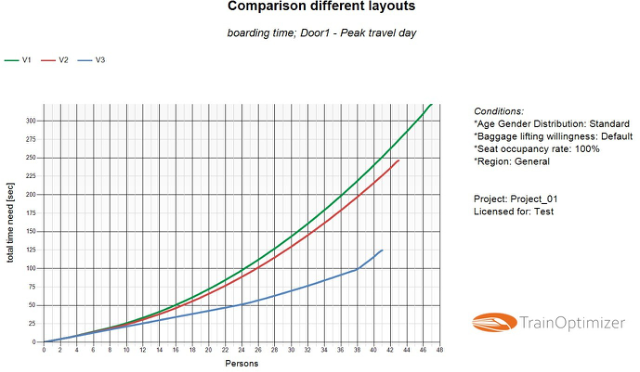
Passenger Changeover Time In Figure 7 it can be seen that the time required for boarding increases over linearly as the number of boarding passengers increases. Furthermore, it can be seen that the time required for layout V2 increases less with improved luggage storage (higher capacity, better distribution in the vehicle) and better alternative options. For example, 40 boarding passengers require an average of approx. 215 seconds with layout V2, whereas the time required for 40 passengers with layout V1 is already just under 10% longer at an average of approx. 240 seconds. A particularly large difference can be seen in layout V3. Here, 40 people only need approx. 110 seconds to board, which is less than half the time required for the other variants!
User-Centred Planning for Rail Vehicles to Increase Efficiency 69
Figure 7: Time required for boarding passengers when comparing layouts (source netwiss - evaluation with TrainOptimizer®).
CONCLUSION
The vehicle layout and the associated interior design have an influence on the quality of operation in many ways. The correct and sufficient dimensioning of luggage racks has a significant influence. Trays that do not meet the basic needs of travellers, such as the desired visual contact with the luggage or the avoidance of lifting and manipulation processes for larger items of luggage, result in many items of luggage being placed in a disruptive manner. This leads to a reduction in seat utilisation and significantly longer dwell time. With appropriate planning, a lower number of seats means that more seats are available overall, even in absolute terms, and that dwell time can be reduced.
The differences shown in this article for the three variants simulated with TrainOptimizer® illustrate that with approx. 12% fewer seats, the propor- tion of usable seats remains at least the same or is even higher than with the 94-seat maximised variant. At the same time, the passenger changeover time is approx. 20% shorter with a 60% passenger changeover and even 50% shorter with the version with the doors at the quarter points! In order to gain these insights, it was very important to analyse the actual passenger behaviour on the trains in the best possible way, as a calculation and simulation model is only ever as good as the data behind it!
FH-St. Pölten (2017). Frederich Fritz, The future of the railway, ZEV (Glasers Analen) 110, May 1986, pp. 124–134. Plank Viktor, Dimensioning of luggage racks in passenger trains, diploma thesis TU
Vienna, 2008. Simulation with TrainOptimizer® simulation software www. TrainOptimizer.com.
LISTED IN THE AHFE DIGITAL BOOKSTORE CATALOGUE
Explore the complete digital volume
Intelligent Human Systems Integration (IHSI 2024): Integrating People and Intelligent Systems
Read this individual research paper free through the original publisher, or explore the full digital proceedings book.
ISBN 978-1-958651-95-7
Explore this ISBN in the AHFE Bookstore ↗Listed in the July 2026 bookstore catalogue; search by ISBN to confirm current availability · Digital book purchase optional