Yu Xiao, Yong Wang, Zhiguo Fang (2024). The Application of AR VR, and MR Technologies in the Museum Field: A Bibiometric Analysis from 2014 to 2023. In: Intelligent Human Systems Integration (IHSI 2024): Integrating People and Intelligent Systems. AHFE Open Access, vol. 119, pp. 636–655. https://doi.org/10.54941/ahfe1004529
Museums have always played an indispensable role as a key place for cultural inheritance and educational dissemination. However, with the rapid development of science and technology, Augmented Reality (AR), Virtual Reality (VR) and Mixed Reality (MR) technologies have gradually changed the traditional way of museum display and interaction, bringing brand new opportunities and challenges to the museum field. In this paper, we take the relevant literature collected by Web of Science as the data source, and comprehensively use VOSviewer and CiteSpace in the method of scientific bibliometrics to draw scientific knowledge map from the distribution of literature in terms of the year of output, countries, research institutions, authors, references and keywords, etc., and carry out the visual analysis in order to sort out the research lineage and systematically know The global characteristics and theoretical basis of the research on the application of Ar, Vr, and Mr technologies in the field of museums in the international scope, and explore the new trend of future development according to the current research hotspots. The results show that the overall number of literature within the search scope is on the rise, with Italy, China and the United States in the leading position of research, and the research hotspots are mainly focused on the research of virtual reality cultural heritage, the research of museum education, the research of museum user experience, the research of museum digitization, and so on. Together, the references cited constitute the main knowledge base of Ar, Vr, and Mr technologies in the museum field and link most of the studies together. User research, information and communication technologies, authenticity, and consumer behavior emerge as emerging trends for future development. Poor collaboration between research organizations and authors, as well as the lack of highly productive authors are the main limitations of the research at this stage. The study shows that Ar, Vr, and Mr are the technologies that are widely used in the museum field today and the research interest is increasing day by day globally. This paper provides useful insights for practitioners, researchers, and policy makers in the museum community to support the digital transformation of museums.The use of scientific bibliometric methods is a valuable tool to comprehensively analyze and understand the current status and global characteristics of research in this field.
The Application of AR, VR, and MR Technologies in the Museum Field 637
artistic heritage, but are also key places for knowledge transfer, educational inspiration and audience interaction (Chen Gang, 2013). However, with the rapid development of science and technology, the traditional way of display- ing museums is undergoing significant changes. In this change, Augmented Reality (AR), Virtual Reality (VR) and Mixed Reality (MR) technologies are coming to the forefront, bringing unprecedented opportunities and challenges to the museum field.AR, VR and MR technologies have not only achieved great success in the field of entertainment, but have also gradually penetrated into the fields of culture and education (Chang et al., 2014), offering brand new possibilities for museum display, interaction and education, providing brand new possibilities for museum display, interaction and education. These technologies are capable of combining the real world with digital informa- tion to create rich immersive experiences that enable visitors to gain a deeper understanding of cultural heritage, historical events, and natural wonders (Terra, 2004).
Research on Ar, Vr, and Mr technologies in museums (hereinafter referred to as AR/VR/MR in Museums) has grown rapidly in the last decade and has produced a large body of literature. However, there is a lack of systematic literature review to sort out the current research status, theoretical founda- tion and future research direction. At the same time, the amount of research literature in this field is huge, and the knowledge structure is diversified and complex, so it is difficult to objectively analyze the research hotspots and development dynamics of this field by only relying on the analysis method of reviewing and summarizing the traditional literature at a stage, and it is even more difficult to accurately grasp how AR, VR, and MR technologies affect the museum field in a specific way. In order to more comprehensively explore the research status, research hotspots and development trends of AR/VR/MR in Museums, Web of Science (WOS) database is used as the data source in the study, and the existing literature is visualized with the help of scientific bibliometrics to present the knowledge structure, so as to provide reference and an overall overview for scholars’ research in this field.
RESEARCH DESIGN Data Sources
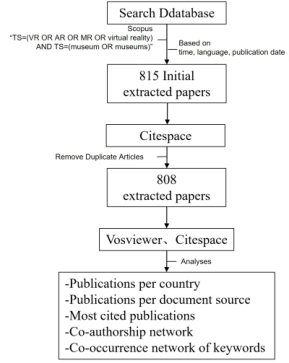
High-quality scientific literature is more representative of the discipline because it is subject to rigorous peer review and publication scrutiny (Chal- craft, 2004). In this study, we selected the WoS Core Collection, a world- renowned citation indexing database widely used in scientific research and evaluation for its groundbreaking content, high quality data, and long his- tory, as the database to obtain the initial data. SCI Expanded, SSCI, A&HCI, CPCI-S, ESCI, CCR-EXPANDED, IC were selected as the search sources in the WoS Core Collection. The search period was set from 2014 to 2023, the language was limited to English, and the sources were not streamlined to avoid the loss of interdisciplinary documents. In order to obtain the maxi- mum number of relevant documents and improve the accuracy of the search, we mainly restricted the search to “subject” and set the search formula as
“TS=(VR OR AR OR MR OR virtual reality) AND TS=(museum OR muse- ums)”. By further reading the titles and abstracts of the documents, manually eliminating irrelevant documents, and importing the screened documents into CiteSpace software for de-weighting, we finally obtained 808 valid docu- ments, which were exported to TXT plain text files for further quantitative analysis.
Research Methodology In order to comprehensively explore the research landscape of AR/VR/MR in Museums, this paper is based on the bibliometric and scientific mapping methodology, and integrates the visualization software CiteSpace (V5.8.R3) and VOSviewer (V1.6.16), to visualize scientific knowledge from the per- spectives of the volume of publications, high-frequency authors, publishing institutions, research hotspots, research frontiers, research trends, and so on. The research of scientific knowledge is visualized from the perspective of publication volume, high-frequency authors, research hotspots, research frontiers, research trends and so on, and the research status and develop- ment trend of this field in the past ten years are summarized. Both software are citation metrics analysis visualization tools running on JAVA program, which can effectively establish the mapping relationship between the knowl- edge units of literature, and clearly show the macrostructure of knowledge through visual information.VOSviewer was developed by Van Eck and Walt- man (2010)from the Center for Science and Technology Research, Leiden University, the Netherlands, in 2009, which has a powerful user graphical interface and mapping visualization features that are suitable for large-scale data to locate the focus and hotspots of a research topic.CiteSpace, developed by Dr. Chaomei Chen (2014)of Drexel University in the United States in con- junction with Dalian University of Technology, visualizes the development trend as well as the evolution of a discipline or research topic in a specific period of time, and has been widely used in bibliometric analysis in recent years. The specific research process is shown according to Figure 1.
Figure 1: Research framework.
The Application of AR, VR, and MR Technologies in the Museum Field 639
RESEARCH OVERVIEW AND HOT SPOTS ANALYSIS Analysis of Research Literature
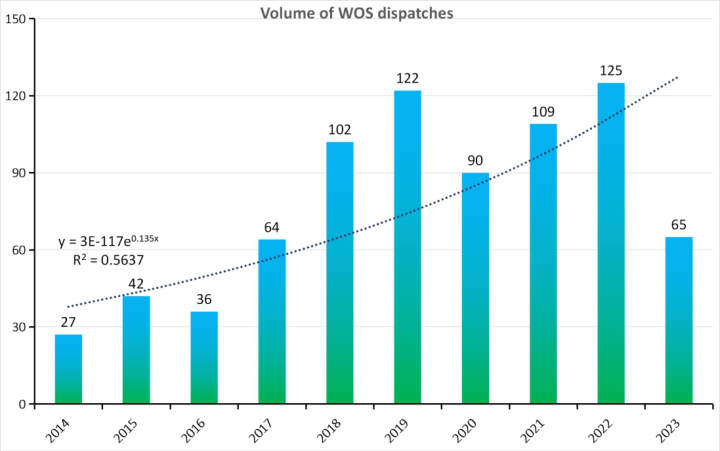
The changing law of statistical academic literature output over time devel- opment is an important method to measure the development trend of the research topic, which can effectively assess the research dynamics of the dis- cipline (Li, 2019). According to the time of publication of sample literature on the amount of articles issued by the statistical organization, drawing the quantitative trend of the literature, as shown in Figure 2. From Figure 2 the curve of the volume of publications and the trend line can be seen in 2014- 2023 the overall upward trend of the literature output of the academic com- munity, the academic research has not yet reached the peak, and is currently in the period of development. 2014–2017 is the beginning stage of the research, and the volume of publications is relatively small. From 2017 onwards, the growth rate of the number of publications is obvious, and the growth rate of literature output is faster. Although it fell back in 2020, the number of publications remained stable at about 90-130, and it is expected to continue to rise. It can be seen that the current research on AR/VR/MR in Museums is not mature, and the relevant research needs to be carried out in further depth.
Figure 2: Annual output distribution of research literature on AR/VR/MR in museums.
Analysis of Research Institutions
Table 1 shows the countries with the highest average number of publica- tions and contributions over the last 10 years. Most of the articles related to AR/VR/MR in Museums were written by Italian authors (161 publications), followed by China (120 publications) and the United States ranked third (75 publications). At the same time we calculated the citation average (TC/TP)
to understand the research contribution of each country, TC/TP also reflects to some extent the quality of the publication and the degree of recognition of the publication by other experts. Table 1 now shows that the UK had only 73 articles on this field, but harvested 1342 citations, TC/TP: 18.34. Korea published 36 articles and received 412 citations, TC/TP: 11.44. Italy pub- lished 161 articles and harvested 1764 citations, TC/TP: 10.69.When looking at the TC/TP scores, the UK is the highest scoring country on the list with 18.34, which is higher than the country with the highest number of cita- tions. The impressive quantitative and qualitative performance of Western countries demonstrates the innovation of their research theories.
Table 1. Most influential countries.
Table available in the original PDF paper.
According to TP According to TC Name TP TC TC/TP Name TP TC TC/TP
Italy 161 1764 10.96 Italy 161 1764 10.96 China 120 405 3.38 UK 73 1342 18.34 USA 75 486 6.48 Greece 46 557 12.1 UK 73 1342 18.34 USA 75 486 6.48 Greece 46 557 12.1 South Korea 36 412 11.44 Note: TP = Total Publications; TC = Total Citations. TC/TP = Total Citations/Total Publications.
Analysis of Research Institutions A total of 981 institutions worldwide have conducted research related to AR/VR/MR in Museums within the scope of the search is shown in Fig. 3. The size of the nodes of the institutions in Fig. 3 indicates the output of the articles, and the connecting lines between institutions represent the strength of cooperation. The closer the cooperation is the wider the connecting line between institutions. From the distribution of the strength of cooperation relationship (the number of cooperation) within each sub-network, the inter- national cooperation of AR/VR/MR in Museums research is not close. It shows a strong geographical characteristic and is mainly based on the coop- eration between institutions in their own countries and regions. Institutional cooperation is in a state of “regional concentration and overall dispersion”. Two large subgroups of high-impact institutions are formed by the “Polytech- nic University of Valencia” and the “University of Salento”. Table 2 shows the top five institutions in terms of literature production from 2014 to 2023: Marche Polytechnic University (14 publications), Politecnico di Milano (12 publications), Polytechnic University of Valencia (10 publications), College of New Rochelle (10 publications), University of Salento (10 publications), University of Salento (10 publications), and University of Salento (10 pub- lications). New Rochelle (10 publications), University of Nottingham (10 publications). These five institutions are the main contributors to AR/VR/MR in Museums research worldwide. In terms of the distribution of disciplines among research institutions in the academic world, the dominant institutions in engineering and computer-related disciplines are the main researchers in this field.
The Application of AR, VR, and MR Technologies in the Museum Field 641
Marche Polytechnic University Italy 14 366 26.14 Politecnico di Milano Italy 12 96 8 Polytechnic University of Valencia Spain 10 76 7.6 College of New Rochelle USA 10 68 6.8 University Of Nottingham UK 10 55 5.5 According to TC
Name Country TP TC TC/TP Coventry University UK 3 393 131 Anchester Metropolitan University UK 7 371 53 Marche Polytechnic University Italy 14 366 26.14 Curtin University Australia 4 329 82.25 Aristotle University of Thessaloniki Greece 4 298 74.5
Note: TP = Total Publications; TC = Total Citations. TC/TP = Total Citations/Total Publications.
Analysis of Research Authors Authors are the smallest unit of literature output and direct contributors to the field of AR/VR/MR in Museums. By studying the authors’ co-citations, it is possible to identify the more active scholars in this field worldwide. After disambiguation of authors and statistical analysis, the study has a total of 2569 authors. However, not many authors were found to be highly produc- tive through the statistics. Table 3 lists the most influential authors who have published in this field from 2014 to 2023. First of all, there are the TOP 5 authors in terms of number of publications: Partarakis (8 publications), Pietroni (7 publications), Emmanouil (7 publications), De Paolis (7 publi- cations), Yoo, Kyungjin (7 publications). These authors can be considered as the most active authors in this research area. Top 5 authors in terms of citations: Dieck (total citations: 358), Bekele (total citations: 329), Pierdicca (total citations: 319), Fontoni (total citations: 316), Timothy (total citations: 308). These authors can be considered as the most contributing authors in the field of study.
Analysis of Research Journals Identifying the sources of highly cited journals is very important as it will also help future researchers to target these journals for publications. Table 4 lists the top 10 journals in terms of journal publications and citations for the years 2014-2023. And their respective 5-year IF (Impact Factor) is listed.
Table 3. Most influential authors.
Table available in the original PDF paper.
According to TP Name Organization TP TC TC/TP
8 51 6.38
Nikolaos Partarakis Foundation for Research and Technology Hellas
7 4 0.57
Eva Pietroni Dickinson State University 7 60 8.57 Zidianakis, Emmanouil FORTH-ICS 7 51 7.29 Lucio Tommaso T De Paolis University of Salento 7 33 4.71 Yoo, Kyungjin University of Maryland College Park According to TC
Name Organization TP TC TC/TP
5 358 71.6
Dieck, M. Claudia Tom Manchester Metropolitan University
6 319 53.17
Bekele, Mafkereseb Kassahun University of South Australia 4 329 82.25 Roberto Pierdicca Marche Polytechnic University
3 308 102.67
Emanuele Frontoni University of Macerata 5 316 63.2 Timothy Jung Manchester Metropolitan University Note: TP = Total Publications; TC = Total Citations. TC/TP = Total Citations/Total Publications.
Table 4. Most influential journal.
Table available in the original PDF paper.
Name Publisher name If TP TC TC/TP
2.88 18 444 24.67
journal of cultural heritage ELSEVIER FRANCE 2.23 11 678 61.64 acm journal on computing and cultural heritage
applied sciences-basel MDPI 0.57 22 160 7.27 computers in human behavior ELSEVIER 2.78 4 108 27 information & management ELSEVIER 2.4 2 96 48 virtual archaeology review UNIV POLITECNICA VALENCIA sustainability MDPI 0.68 11 91 8.27 current issues in tourism ROUTLEDGE JOURNALS 1.72 2 68 34
Note: TP = Total Publications; TC = Total Citations. TC/TP = Total Citations/Total Publications.
These 10 journals account for 58.8% of the citations in all publications in the field of AR/VR/MR in Museums. They also account for 20% of the total number of articles published. The top 5 cited journals are: journal of cultural heritage (11 publications), acm journal on computing and cultural heritage (18 publications) and computers & education (3 publications), international
The Application of AR, VR, and MR Technologies in the Museum Field 643
journal of human-computer studies (3 publications), applied sciences-basel (22 publications).
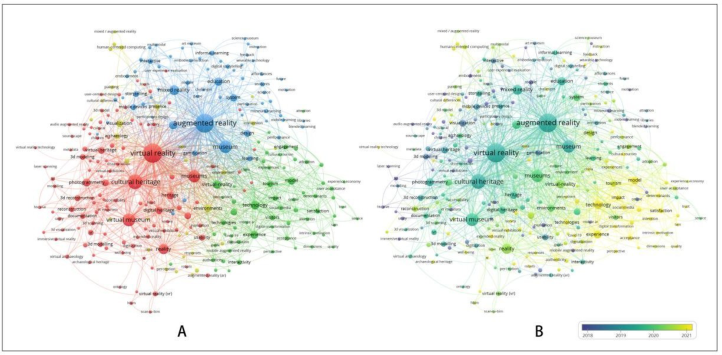
Analysis of Research Hot Spots and Frontier Trends The keywords of the literature are highly refined by the authors of their research. The high-frequency co-occurring keywords reflect the research hotspots of AR/VR/MR in Museums research for a long time (Li&Chen,2018). The 808 documents within the search scope contain a total of 2526 keywords. After running Vosviewer and setting the keyword co-occurrence frequency to 3, 94 keywords were filtered and merged with synonyms to form keyword co-occurrence clusters, see Fig. 4A. Among them, the keyword co-occurrence mapping has 278 nodes, 3057 connecting lines, and 4 main clusters were formed in total. From the analysis results, the hot research topics of AR/VR/MR in Museums can be divided into four major categories, which are #1 (red) Virtual Reality Cultural Heritage Research,#2 (blue) Museum Education Research, #3 (green) Museum User Experience Research, and #4 (yellow) Museum Digital Research.
Cluster #1 - Virtual Reality Cultural Heritage Research. This cluster con- sists of 33 keywords, mainly containing virtual reality, cultural heritage, virtual museum, Reality, Photogrammetry, Heritage, digital heritage Environ- ments, Visualizatio, 3d modeling and other keywords. Virtual reality cultural heritage refers to the use of virtual reality technology to convert, reproduce, and restore all movable and immovable properties of cultural heritage into shareable and reproducible digital forms. It can be interpreted in a new per- spective, preserved in a new way, and utilized in a new way (Wang 2009; Li et al., 2006). Virtual reality technology can reconstruct multi-dimensional cultural space, providing the possibility of immersion in the digital world. It is becoming an important tool for cultural heritage research, preservation and dissemination. The application of virtual reality technology in the field of cultural heritage protection is mainly divided into 2 directions: cultural relics protection and auxiliary cultural relics exhibition (Li et al., 2020). In terms of cultural relics protection, a great deal of work is currently focused on how to quickly and accurately establish 3D models of cultural relics. Virtual reality technology can repeatedly model artifacts and sites to select the most suitable restoration solutions. This process does not cause damage to the arti- facts and greatly reduces the cost of restoration, which is crucial for cultural relics restoration. In assisting the exhibition of cultural relics, virtual real- ity technology relies on the characteristics of immersion and multi-sensory, users realize the off-site immersive tour of ancient buildings and cultural relics. This technology can help tourists to understand the details of cultural relics, capture the curiosity of visitors, increase the interest of the tour and expand the dissemination of knowledge. Carrozzino (2011) to the Italian Tuscany traditional bronze casting process as the object of the process of cast- ing method, through the virtual reality technology to establish the user can participate in the immersive interactive platform. Users can follow the birth process and creation steps of the bronze artwork, and understand the histor- ical background through the interactive content such as graphic introduction
and movie in the virtual environment. Virtual reality technology makes this ancient and endangered folk skills can be reproduced.
Cluster #2 - Museum Education Research. This cluster consists of 66 key- words and mainly contains keywords such as augmented reality, Museum, mixed reality, Education, Art, System, Design, Interactive, informal learn- ing, storytelling, mobile application and other keywords. Museum education usually refers to informal learning that takes place in museums (but also in various public institutions such as science and technology museums, art gal- leries, zoos and botanical gardens) (Adams, 2007). With the development of emerging information technologies and new educational ideas, AR, VR, and MR technologies have begun to be widely used in educational learning sce- narios in museums. This kind of interaction means based on the real world, augmented by virtual data, gives educators a new way to express to the learn- ing object, but also with the closest to the natural way of communication for the learners to build a space for independent exploration. This is very inspir- ing for teaching abstract content. Both in line with Piaget’s (1965) “move the laboratory to the classroom” concept and practice, but also in line with the constructivist learning theory of “learning is a real situation of experience” point of view (Jonassent, 1994). At present, the application of AR, VR and MR technologies in museum education is mainly reflected in the construction of the learning environment, the construction of learning resources, and the interaction between people and exhibits (Zhang, 2017). According to the dif- ferent roles played, it is mainly divided into exhibition type and guided tour type. The former is a fixed-point exhibition, where learners can experience the application in a fixed place. The use of these and other technologies helps to present some of the physical objects that cannot be easily or realistically displayed, enriching the content and form of teaching (Hu, 2023). The latter adopts mobile devices, giving different feedback in different exhibition loca- tions, including introduction, knowledge links, models, games, etc. (Yuan & Zhou, 2021). The latter adopts mobile devices, giving different feedback in different exhibition. AR, VR, MR technology helps integrate different forms of resources, it is because of these characteristics, making it in the field of education has great potential for development and application space.
Cluster #3 - Museum User Experience Research. This cluster consists of 59 keywords, mainly containing the keywords of technology, Experience, Model, digital museum, Usability, Tourism, Visitors, Impact, Satisfaction, and engagement. The concept of User Experience (UE or UX for short) was first proposed by Donald Norman, an American cognitive psychologist and computer engineer. It refers to the subjective feelings and the satisfaction of needs that the user generates when using a product, and is a collec- tion of all subjective feelings associated with the interaction (Jesse, 2008). Through the continuous innovation of technology application, digital muse- ums provide users with cultural services in a richer and more diverse way. Users can interact with the exhibits in close proximity during the tour to obtain a smoother and deeper visit experience, thus deepening the sense of immersion and immersion (Mohd Noor Shah & Ghazali, 2018). During the digital museum experience, the user’s interaction with the museum is mul- tidimensional, immediate, and uncertain. In order to enable users to have a
The Application of AR, VR, and MR Technologies in the Museum Field 645
consistently good experience in each dimension, the user experience process needs to be systematically analyzed. Currently, user experience can be cate- gorized according to the process as (1) pre-use user needs, including users’ information content needs, information service needs, and information sys- tem needs (Cao et al., 2013). More typically, Dr. Kano of Japan classified user needs into basic needs, expectation needs, and excitement needs, and summa- rized the Kano model (Kano, 2018). (2) User behavior during use, including user willingness to use, user adoption behavior, user continuous use behav- ior and user transfer behavior. For example, scholars such as Tu Xia (2016), Wu Yan et al (2014), and He Wei et al (2015) construct user usage willing- ness models based on the TRA model, TAM model, UTAUT model, and the information system success model (D&M), respectively, to study the relevant factors affecting the user’s willingness to use and the degree of relevance. (3) The evaluation of user experience after use is mainly categorized into qualitative, quantitative and comprehensive evaluation methods.Hassenzahl (2001) also categorized user experience into three types of indicators, namely, enjoyment, entertainment and aesthetics, based on Attrack Diff scale, and measured user experience directly through questionnaire method.
Cluster #4 - Museum Digital Research. This cluster consists of 33 key- words, mainly containing the keywords museums, navigation, Digitalization, immersion, Innovation, Accessibility, visualization, human-centered comput- ing, digital technology, human computer interaction, presence and other keywords. Digital museum refers to the use of network technology, informa- tion technology, multimedia technology to realize the functions of cultural relics such as custody, research, display, education, etc., and it is a data sys- tem that displays the products of literature and culture in various forms such as image, text, film, voice, etc. (Ahmed et al., 2020). This digital transforma- tion can take many forms. For example, visitors are able to use smartphones or tablets on websites to enhance the museum experience, digitize collections and display them online, and field trips employ devices for interaction. There is a wide variety of digital technologies, which are mainly categorized into the following according to the usage scenarios:(1) Online museum technologies mainly include 360 view tour, Google Map Street tour, etc. 360-degree tour creates an image of the exhibition with a sense of realism for the user. For this experience, the images must be of very high quality to ensure that the photos match accurately when stitched together. This technology provides an eas- ier, adjustable museum experience for online visitors. Google provides more detail to online visitors to the museum by adding annotations to the works in Street View. When one visits a Google Street View museum, one will see information about the paintings on the wall and zoom in on any selected work with the browser option (Bedard et al., 2006). (2) Offline museum technologies mainly include) Virtual Reality (VR), Augmented Reality (AR), Hologram, etc.VR is a combination of video and panoramic tours that cre- ates a virtual reality experience in museums, where the technology creates a simulated environment for the user to be shown in a high-quality 3D format similar to that of video game museum materials. Instead of viewing with a traditional screen, the user is immersed in enjoying the interaction with the
3D world (Lepouras et al., 2004). Compared to VR technology, AR tech- nology allows museum guiding systems to create richer interactions. Because AR technology can superimpose virtual information on the real world, it can enhance real-world objects and environments (Walczak et al., 2004). Holo- grams are used to describe a photographic technique that stores scattered light produced by an object and then presents it in three dimensions. This gives a richer and more tangible experience, which museums and exhibitions are now increasingly using to revive realistic scenes from the past (Jung et al., 2004). In order to further study the cutting-edge themes and development trends of AR/VR/MR in Museums, the average appearance time of keywords was statistically analyzed separately and superimposed on the original cluster diagram, see Figure 4B.From the research hotspots summarized in the four clusters in Figure 4B, it can be found that Cluster #3 - Museum User expe- rience has the closest overall time to the present for the keyword, and is a cutting-edge theme in current AR/VR/MR in Museums research. Secondly, Cluster #4 - Museum Digitization is also a research direction that current AR/VR/MR in Museums research focuses on. Cluster #1 - Virtual Reality Cultural Heritage as a whole has an average emergence time prior to 2018 and is a hotspot for early research in the discipline. The main keywords in the entire clustering network with an average occurrence time later than after 2021 are visualization, virtual heritage, Usability, mobile devices, 3d modeling, Gamification, Interactive, 3d printing, Navigation, mobile, etc.
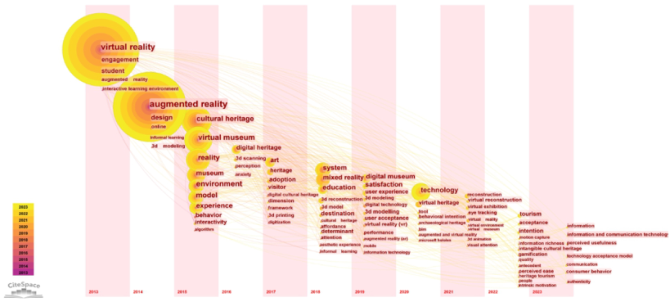
In order to further determine the evolution and overall development trend of AR/VR/MR in Museums research hotspots, the average appearance time of keywords was statistically analyzed to obtain Fig. 5 (Keywords Timezone) and Fig. 6 (Keywords Burst Term), respectively.The Keywords Time Zone intuitively reflects the frequency magnitude of keywords within the retrieval range and the time of their first appearance. It is often used by scholars to
The Application of AR, VR, and MR Technologies in the Museum Field 647
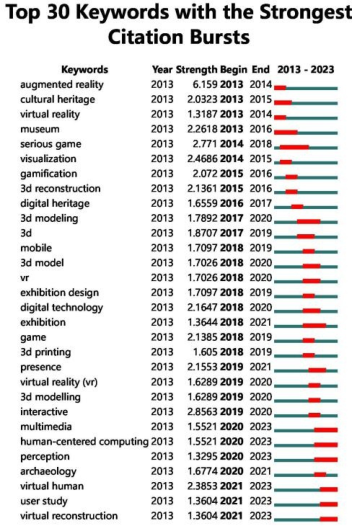
determine the pre-trend of the research topic. Keywords Burst Term lists the top 30 keywords in terms of emergence intensity in different periods, where the darker parts characterize the emergence intensity of keywords in the literature as well as the relatively prominent years. Keyword emergence repre- sents the degree of attention to the research topic in different periods, which can also reflect the changing trend of research and past research hotspots (Workman, 2013). Keywords Timezone and Keywords Burst Term are both indicators of keyword analysis combined with the time dimension. Combin- ing these two indicators to analyze can obtain more reliable research results (Kleinberg, 2003).
From Figure 5, it can be seen that the early keywords of AR/VR/MR in Museums research mainly focus on digital cultural heritage research, such as augmented reality, cultural heritage, virtual reality, digital heritage, and so on. Subsequently, the research began to shift to digital technology research, such as online, 3D modeling, 3D scanning, 3D printig, etc. The subsequent research focused more on the digital cultural heritage. Subsequent research focuses more on education and learning scenarios, with keywords such as satisfaction, user experience, acceptance, intention, interactive, etc. appear- ing after 2019. It can be seen that the research focus is gradually shifting to the human experience of use, as well as more diversified research meth- ods to continuously improve immersion and engagement. Consistent with the results in Figure 5, the chronological ordering of the top 30 keywords in Figure 6 shows that the keywords have transitioned from cultural heritage and digital heritage to 3D modeling and finally to human-centered comput- ing, virtual human, user study, which still show the same pattern of human experience. study, still showing the trend from cultural heritage research to user experience research. Combining Time Zone, Burst and Keyword Co- occurrence Clustering Maps, AR/VR/MR in Museums research will focus on user research, information and communication technology, authenticity, and consumer behavior in the future.
Figure 5: Keywords timezone of AR/VR/MR in museums.Figure 6: Keywords burst term.
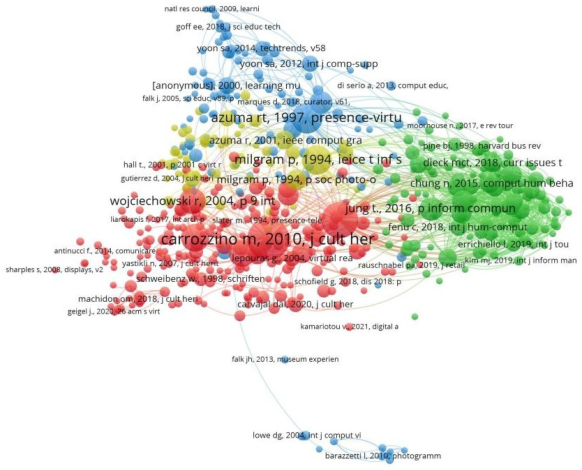
ANALYSIS OF THE THEORETICAL BASIS OF THE STUDY References form a co-citation relationship due to being cited in pairs in the citing literature, and the higher the co-citation intensity of two documents, the greater the correlation between them (Theodoraki et al., 2022). The co- citation frequency of a reference, on the other hand, indicates its influence and importance in the field of study (Chen et al., 2010). This metric can be used to understand which literature in a research field has received extensive attention and citations, and which studies have had a significant impact on the development of the field (Liu & Duffy, 2023). To further understand the knowledge structure and research base of the field of AR/VR/MR in Muse- ums, a reference co-citation analysis was conducted. According to statistics, a total of 20794 valid references originating from 2569 scholars were cited in 2416 documents within the search. Based on VOSviewer, we extracted the references with a citation frequency of not less than 4 in 2014-2023, and generated a reference co-citation clustering network consisting of 538 refer- ences and 26734 co-citation relations as shown in Figure 7. Consistent with the results of the keyword co-occurrence clustering, the reference co-citation clustering continued to form four clusters of #1 virtual reality cultural her- itage research, #2 museum education research, #3 museum user experience research, and #4 museum digitization research. The classical literature with the top 3 citations in each cluster is shown in Table 5.The literature contained in these four clusters constitutes the most important knowledge base in the field of AR/VR/MR in Museums, stringing together research from different disciplines.
The Application of AR, VR, and MR Technologies in the Museum Field 649
In Cluster #1 (Virtual Reality Cultural Heritage Studies), Carrozzino’s (2011) et al. article “Beyond virtual museums: experiencing immersive vir- tual reality in real museums’ article received the most attention. The article totaled 78 citations in our co-citation network. The study proposes a cate- gorization of VR installations specifically geared towards cultural heritage based on the level of immersion and interaction provided by the virtual real- ity system. On the interaction axis, systems were categorized into three main categories: ‘non-interactive’, ‘interaction using the medium’, and ‘interaction using nature’. On the experience axis, systems were categorized according to the degree of immersiveness. Systems were ranked in decreasing order of immersion from non-immersive systems (i.e., tabletop systems) to more immersive systems. This work advises on the cost, usability, and quality of the sensory experience of cultural heritage display installations and enables curators to provide more precise programs for different users through cat- egorization. The second most cited article is Bruno’s (2010) “From 3D reconstruction to virtual reality: A complete methodology for digital archaeo- logical exhibition” in the Journal of Cultural Heritage. The study overcomes the complexity of selecting, coordinating and managing the design of VR applications in traditional cultural heritage. A complete methodology for creating a virtual cultural heritage exhibition system is presented. The sys- tem is based on realistic, high-quality 3D models of archaeological finds (reconstructed using 3D scanners and high-definition cameras) and a low- cost multimedia stereoscopic system called MNEME. The system is easy to transport and allows users to interact with the richness of the archaeological finds in a free and easy way. Also of interest is the 2004 paper Building Virtual and Augmented Reality Museum Exhibitions by Wojciechowski et al. This research constructed a 3D modeling system-ARCO-that allows museums to
build and manage artifacts based on virtual reality and augmented real- ity exhibits, providing museums with a new way to explore their cultural heritage collections.
Table 5. All the clusters are cited in the top 3 classical literatures.
Table available in the original PDF paper.
Literature name Affiliated clusters
Publication time
Total linkage
Total citations #1 2010 654 78
Beyond virtual museums: Experiencing immersive virtual reality in real museums
#1 2010 289 37
From 3D reconstruction to virtual reality: A complete methodology for digital archaeological exhibition
#1 2004 272 36
Building Virtual and Augmented Reality Museum Exhibitions
#2 2016 549 31
Effects of Virtual Reality and Augmented Reality on Visitor Experiences in Museum
#2 2018 498 27
When art meets tech: The role of augmented reality in enhancing museum experiences and purchase intentions
#2 2015 441 23
Tourists’ intention to visit destination: Role of augmented reality applications for heritage site
#3 2014 347 28
Development and behavioral pattern analysis of a mobile guide system with augmented reality for painting appreciation instruction in an art museum
#3 2008 163 20
Bridging the Gap between the Digital and the Physical: Design and Evaluation of a Mobile Augmented Reality Guide for the Museum Visit
#3 2012 257 17
Using augmented reality and knowledge-building scaffolds to improve learning in a science museum
#4 1994 448 45
A taxonomy of mixed reality visual displays
#4 1994 340 25
Augmented reality: A class of displays on the reality-virtuality continuum An Augmented Reality Museum Guide #4 2008 207 17
In Cluster #2 (Research on User Experience in Museums), the article “Effects of Virtual Reality and Augmented Reality on Visitor Experiences in Museums” by South Korean professor Timothy Jung et al. (2018) has the highest citation frequency (497), located at the center of the co-citation network.Timothy Jung et al. investigated the effects of social presence on vis- itor experiences in virtual reality environments using social presence theory and experience economy theory. A strong predictive effect of social presence in virtual reality environments on the experience economy was proposed. The results of this study provide theoretical and managerial insights into the adoption of VR and AR technologies in museums. Also cited with high fre- quency in this cluster is When art meets tech: The role of augmented reality in enhancing museum experiences and purchase intentions by Prof. Zeya He et al. (2016). Based on Attentional Control Theory and Mental Imagery The- ory, the article suggests that the more vivid the design elements of AR displays
The Application of AR, VR, and MR Technologies in the Museum Field 651
in a museum visit environment, the higher the user experience and willingness to pay.The remaining highly cited literature is Namho Chung et al.’s (2015) article in Computers in Human Behavior, which uses a questionnaire and structural equation modeling to argue that users’ personal factors (TR), stim- ulus factors (visual appeal), and contextual factors (convenience conditions) have significant influence, improving the role of AR on user experience.
In Cluster #3 (Museum Education Research), the article “Development and behavioral pattern analysis of a mobile guide system with augmented reality for painting appreciation instruction in an art museum I” article is the most influential and is at the center of the co-citation network. The article designed a mobile guide system combining art appreciation instruc- tion with AR and explored the learning performance of three groups of tour participants. The results argued for the positive contribution of AR to museum education, showing that AR guidance can effectively improve visi- tors’ learning efficiency in museums, facilitate the visiting process experience, and extend the duration of visitors’ concentration (Chang et al., 2014). The second is the article published in Proceedings of the 3rd international confer- ence on Digital Interactive Media in Entertainment and ArtsSeptember 2008 by Damala et al. The article designed a fully functional AR mobile multime- dia guide for the Musée des Beaux-Arts in Rennes, France. Through practical use and quantitative analysis, it was found that even in a complex environ- ment such as a museum, an AR-assisted interface can successfully and quickly shift the attention of visitors from the physical space to the digital space. The article establishes that attention is also one of the factors that ar influences museum education. This was followed by SA Yoon et al.’s 2008 article in the International Journal of Computer-Supported Collaborative Learning. Using an experimental design, the study compared four conditions for learning in a science museum, namely the use of augmented reality technology and a knowledge-building scaffold known to be successful in the formal classroom. The results showed that students benefited more in terms of knowledge when using both technologies and could improve their ability to theorize from the museum experience. The results of this study open the door to further adapting augmented reality technology and knowledge building scaffolds to informal learning environments.
Cluster #4 (Museum Digitization Research) has the highest number of cita- tions for the article “A taxonomy of mixed reality visual displays” published by Milgram et al. in 1994. The article defines the term “mixed reality” (MR) and creates a three-dimensional taxonomy that includes the following dimen- sions: breadth of world knowledge (how much do we know about the world we are displaying?), reproduction realism (how realistically can we display it?) and breadth of existential metaphor (how much of an illusion does the observer have in that world?). This taxonomy clarifies terminological issues by placing apparently unrelated developments carried out by VR develop- ers, computer scientists, and (tele) robotics engineers, among others, within a single framework. This methodology allows for the comparison of fundamen- tal similarities and differences between various research endeavors. Milgram et al., also discussed and introduced the concept of the “virtual reality con- tinuum” in their paper of the same year. The concept can be understood as
having the real and virtual environments as the two ends of a continuum, with the center of the continuum being called “mixed reality,” where augmented reality is near the real environment and virtual reality is near the virtual envi- ronment. This concept has been widely used in research and development for building virtual and augmented realities. The 2008 article by Miyashita et al. demonstrated an AR system with powerful features in a museum envi- ronment. A study of museum users demonstrated that the use of full 6DOF augmented reality as an aid to art appreciation is now possible without the limitations of markers or other environmental instruments. In addition, the article demonstrates the use of augmented reality for museum route guidance, proving the feasibility of ar technology in museums.
CONCLUSION
Applied research in AR/VR/MR in Museums is generally on the rise in terms of time-series paper output, but the growth is slow. There are not many highly productive countries/regions, institutions and scholars in the devel- opment process of 2014-2023, and the research collaborations are mostly intra-institutional collaborations with a fragmented distribution. The key- word clustering study reveals that the application of virtual reality technology in museums is very comprehensive and diversified, which can be mainly divided into four main categories, #1 virtual reality cultural heritage, #2 museum education, #3 user experience, and #4 museum digitization. These clusters together constitute the research hot areas and themes of virtual reality technology application in the museum field, both including the development of innovation and practical application at the technical level, as well as the scene expansion and interactive experience at the use level. From the time- keyword clustering and Burst Term, it is concluded that the future research hotspots of AR/VR/MR in Museums are mainly user research, ICT, authen- ticity, and consumer behavior. It also pays more attention to the concept of “user-centered” and emphasizes the human experience. Analyzing the total citation network of references, it can be found that the theoretical founda- tion of AR/VR/MR in Museums research is relatively mature. In the long process of development, a large amount of literature knowledge from inter- disciplinary fields has been drawn upon, and a number of classic literatures have been produced. The research covers multiple levels, from technology development to user experience evaluation. These findings can help relevant scholars to grasp the research structure and latest trends of ar, vr, mr tech- nologies in the museum field, and provide a solid foundation for the further development of the field.
REFERENCES
Adams, J. D.. (2007). The historical context of science and education at the american museum of natural history. Cultural Studies of Science Education, 2(2), 393–440. Ahmed, Z. A., Qaed, F., & Almurbati, N. (2020, November). Enhancing museums’
sustainability through digitalization. In 2020 Second International Sustainabil- ity and Resilience Conference: Technology and Innovation in Building Designs (51154) (pp. 1–4). IEEE.
The Application of AR, VR, and MR Technologies in the Museum Field 653
Bedard, C., Dubois, J., Lehtinen, S., & Loveland, B. (2006). Museum virtual tour design guide. USA: Worcester Polytechnic Institute. D. Lumb, “Google’s virtual museum tours tell you more about the art,” engadget, 2017. Bitkina, O. V., Kim, H. K., & Park, J. (2020). Usability and user experience of med-
ical devices: An overview of the current state, analysis methodologies, and future challenges. International Journal of industrial ergonomics, 76, 102932. Bruno, F., Bruno, S., De Sensi, G., Luchi, M. L., Mancuso, S., & Muzzupappa, M.
(2010). From 3D reconstruction to virtual reality: A complete methodology for digital archaeological exhibition. Journal of Cultural Heritage, 11(1), 42–49. Cao, Shujin, Chen, Yijin, & Yang, Tao. (2013). An empirical study of library user satisfaction based on user needs. Chinese Journal of Librarianship (5), 16. Carrozzino, M., & Bergamasco, M. (2010). Beyond virtual museums: Experienc-
ing immersive virtual reality in real museums. Journal of cultural heritage, 11(4), 452–458. Carrozzino, M., Scucces, A., Leonardi, R., Evangelista, C., & Bergamasco, M..
(2011). Chalcraft, A.. (2004). Encyclopedia of library and information science (2nd edition).
Reference Reviews, 18(7), 8–9. Chang, K. E., Chang, C. T., Hou, H. T., Sung, Y. T., Chao, H. L., & Lee, C. M.
(2014). Development and behavioral pattern analysis of a mobile guide system with augmented reality for painting appreciation instruction in an art museum. Computers & education, 71, 185–197. Chen, C. (2006). CiteSpace II: Detecting and visualizing emerging trends and transient patterns in scientific literature. Journal of the American Society for information Science and Technology, 57(3), 359–377. Chen, C. (2014). The citespace manual. College of Computing and Informatics, 1(1),
1–84. Chen, C., Ibekwe-SanJuan, F., & Hou, J. (2010). The structure and dynamics of cocitation clusters: A multipleperspective cocitation analysis. Journal of the American Society for Information Science and Technology, 61(7), 1386–1409. Chen, G.. (2013). Intelligent Museum--New Trend of Digital Museum Development.
Chinese Museum (04), 2–9. Chung, N., Han, H., & Joun, Y. (2015). Tourists’ intention to visit a destination: The role of augmented reality (AR) application for a heritage site. Computers in Human Behavior, 50, 588–599. Chung, N., Lee, H., Kim, J. Y., & Koo, C. (2018). The role of augmented reality
for experience-influenced environments: The case of cultural heritage tourism in Korea. Journal of Travel Research, 57(5), 627–643. Damala, A., Cubaud, P., Bationo, A., Houlier, P., & Marchal, I. (2008, September).
Bridging the gap between the digital and the physical: design and evaluation of a mobile augmented reality guide for the museum visit. In Proceedings of the 3rd international conference on Digital Interactive Media in Entertainment and Arts (pp. 120–127). Hassenzahl, & Marc. (2001). The effect of perceived hedonic quality on product appealingness. International Journal of Human Computer Interaction, 13(4), 481–499. He, W., & Li, H.. (2015). An empirical study on mobile library users’ willingness to
use. Library and Intelligence Work (7), 9. He, Z., Wu, L., & Li, X. R. (2018). When art meets tech: The role of augmented reality in enhancing museum experiences and purchase intentions. Tourism Man- agement, 68, 127–139.
Hu, Yina. (2023). Research on immersive experience design of museum guided tour based on panoramic perspective--Taking Suzhou Museum as an example. Art & Design: Theory Edition (2), 4. JESSE JAMES GARRETT. (2008). Elements of user experience: the user-centered
Web: English. Mechanical Industry Press. Jonassen, D. H. (1994). Thinking technology: Toward a constructivist design model.
Educational technology, 34(4), 34–37. Jung, T., Chung, N., & Leue, M. C. (2015). The determinants of recommendations to use augmented reality technologies: The case of a Korean theme park. Tourism management, 49, 75–86. Jung, T., tom Dieck, M. C., Lee, H., & Chung, N. (2016). Effects of virtual
reality and augmented reality on visitor experiences in museum. In Information and Communication Technologies in Tourism 2016: Proceedings of the Interna- tional Conference in Bilbao, Spain, February 2-5, 2016 (pp. 621–635). Springer International Publishing. Kano, N. (2018). The Kano Model. by Konstantin Kumynsky. Kleinberg, J. (2003). Bursty and hierarchical structure in streams. Data mining and knowledge discovery, 7(4), 373–397. Lepouras, G., Katifori, A., Vassilakis, C., & Charitos, D. (2004). Real exhibitions in
a virtual museum. Virtual Reality, 7, 120–128. Li Xujian, Li Hao, and Xiong Jubeng. (2020). Application of virtual reality technology in cultural heritage field. Science and Technology Herald, 38(22), 9. Li, D., Zhu, Y., Du, Z., & Hong, T.. (2006). Virtual tang-style timber-frame building
complex. DBLP. Li, J., Liu, J. H., Wang, J. F., & Feng, C. K... (2019). Research on fsj-based academic map for fire safety. Fire Science and Technology, 38(12), 6. Li, Xingyuan, & Chen, Yehua. (2018). Analysis of citespace-based application of
entropy in domestic social science research. Science and Technology Management Research, 38(13), 8. Milgram, P., & Kishino, F. (1994). A taxonomy of mixed reality visual displays.
IEICE TRANSACTIONS on Information and Systems, 77(12), 1321–1329. Miyashita, T., Meier, P., Tachikawa, T., Orlic, S., Eble, T., Scholz, V.,... & Lieberknecht, S. (2008, September). An augmented reality museum guide. In 2008 7th IEEE/ACM International Symposium on Mixed and Augmented Reality (pp. 103–106). IEEE. Mohd Noor Shah, N. F., & Ghazali, M. (2018). A systematic review on digital
technology for enhancing user experience in museums. In User Science and Engi- neering: 5th International Conference, i-USEr 2018, Puchong, Malaysia, August 28–30, 2018, Proceedings 5 (pp. 35–46). Springer Singapore. Piaget, J. (1965). The stages of the intellectual development of the child. Educational psychology in context: Readings for future teachers, 63(4), 98–106. Theodoraki, C., Dana, L.-P., & Caputo, A. (2022). Building sustainable entrepreneurial ecosystems: A holistic approach. Journal of Business Research, 140, 346–360. Tu, X. (2016). An empirical study on factors influencing users’ willingness to use
WeChat public platform in university libraries. Journal of Information Resources Management, 6(1), 9. Van Eck, N., & Waltman, L. (2010). Software survey: VOSviewer, a computer program for bibliometric mapping. scientometrics, 84(2), 523–538. Virtually preserving the intangible heritage of artistic handicraft. Elsevier Masson (1). Walczak, K., Cellary, W., & White, M. (2006). Virtual museum exbibitions.
Computer, 39(3), 93–95.
The Application of AR, VR, and MR Technologies in the Museum Field 655
Wang, Y. H. (2009). Digitization of national cultural heritage. People’s Publishing House. Wojciechowski, R., Walczak, K., White, M., & Cellary, W. (2004, April). Building
virtual and augmented reality museum exhibitions. In Proceedings of the ninth international conference on 3D Web technology (pp. 135–144). Workman, R. (2013). What is a Hologram?. live science. Wu, Yan, Zhannan, & Luo, Yi. (2014). A study on the construction of a model of willingness to use open course resources in colleges and universities from the perspective of user acceptance. Research in Librarianship (18), 8. Yoon, S. A., Elinich, K., Wang, J., Steinmeier, C., & Tucker, S. (2012). Using aug-
mented reality and knowledge-building scaffolds to improve learning in a science museum. International Journal of Computer-Supported Collaborative Learning, 7, 519–541. Yuan, Z. & Zhou, Jingjing. (2021). A Review of Research on Interactive Guided Tours in Museums. Journal of Literature and Museums (04), 54–62. Zhang, Mei-xia. (2017). Venue Construction and Venue Learning with New Media
Technology Support--Taking the Museum of Modern Education Technology as an Example. China Electrochemical Education (02), 20–24.
LISTED IN THE AHFE DIGITAL BOOKSTORE CATALOGUE
Explore the complete digital volume
Intelligent Human Systems Integration (IHSI 2024): Integrating People and Intelligent Systems
Read this individual research paper free through the original publisher, or explore the full digital proceedings book.
ISBN 978-1-958651-95-7
Explore this ISBN in the AHFE Bookstore ↗Listed in the July 2026 bookstore catalogue; search by ISBN to confirm current availability · Digital book purchase optional