Frank Flemisch, Nicolas Daniel Herzberger, Marcel Usai, Joscha Wasser (2024). Beyond Levels of Automation: Human System Modes, Levels, Functions and Patterns for an Intelligent Human Systems Integration of Humans and Co-Systems. In: Intelligent Human Systems Integration (IHSI 2024): Integrating People and Intelligent Systems. AHFE Open Access, vol. 119, pp. 514–523. https://doi.org/10.54941/ahfe1004516
Technological developments like automation, autonomous functions or generative artificial intelligence might contribute solving global challenges like global warming, energy shortage or demographic change, but only if this technology is intelligently integrated with humans, organizations, and the environment, in short: Only with a truly intelligent Human Systems Integration (HSI). Examples for this integration challenge can be found in aviation with increasingly automated aircraft or uncrewed aircraft systems (UAS), on the road with partially and highly automated vehicles, in industry 4.0 with partially autonomous factories, or in defence systems with highly automated or “autonomous” weapon systems.Key concepts that help to structure the complexity of such sociotechnical systems are operation modes e.g., with the example of mode confusion in aviation (e.g., Abbott et al., 1996), levels of automation (LOA, starting with Sheridan et al., 1978, landmark publication by Parasuraman et al., 2000 and SAE, 2021), layers of assistance and automation (e.g., Pacaux-Lemoine & Flemisch, 2019 and Flemisch et al., 2019), and Human Systems Patterns (e.g., Alexander et al., 1977 and Baltzer, 2021).Especially in the discussion about vehicle automation, the perception in the community might be that everything is solved with LOA (e.g., as the SAE, 2021 based on bast, Gasser et al., 2012). On the other hand, with more variation in automation, it becomes increasingly clear that the concept of LOA is very valuable from an engineering perspective, but not sufficiently clear for users without being complemented with other concepts. For human factors and human systems integration (HSI) in aviation, automotive & transportation automation as well as in Industry 4.0, we successfully used LOA together with modes, layers and especially patterns, and matched them with the classical human factors constructs of performance, workload, situation awareness and usability.A key concept for a sufficient understanding of LOA, modes, layers and patterns are models, especially mental models as a representation of the real human-machine system within the cognition of the human or machine actors in the different layers of a system. More precisely, it is crucial to maintain the consistency between levels, layers, modes and patterns, i.e., sufficient consistency of the mental models and, based on this, sufficient situational awareness of all relevant stakeholders. Subsequently, the consistency between capability, authority, control and finally responsibility is important (e.g., Flemisch et al., 2012 and F. Flemisch et al., 2023).
A SHORT OVERVIEW OF THE CONCEPTS IN THEIR RELATION IN THE METASYSTEM Levels of Automation
The levels of automation (LOA) basically describe the distribution of work- share between a human and a machine entity and are related, but are not the same, to the extent to which a technical subsystem can operate with- out human intervention. These levels are typically classified on a scale, often referred to as the levels of automation or autonomy levels, which were for cars defined by the German federal highway research institute (bast, Gasser et al., 2012) and later adapted by the Society of Automotive Engineers (SAE International, SAE, 2021) in the context of automated vehicles. However, the concept of automation levels can be applied to various fields, including manufacturing, aerospace, and robotics.
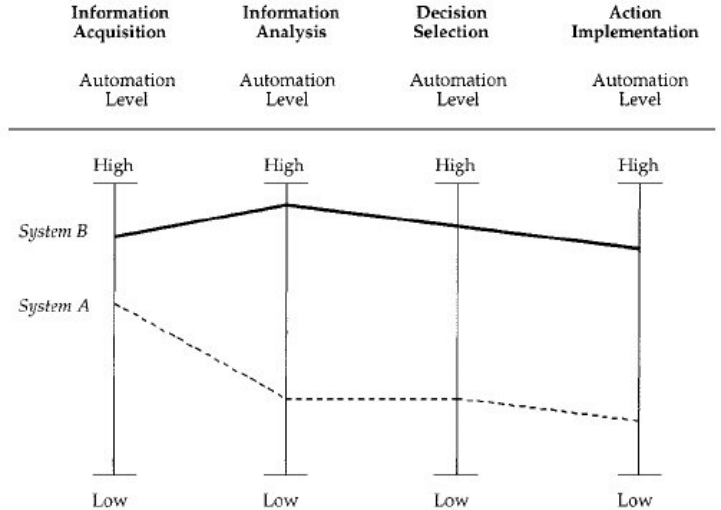
Figure 1: Levels of automation for independent functions (Parasuraman et al., 2000).
Parasuraman et al. (2000) described the levels of automation as a dis- tribution of control on the functions, or states of information processing, and proposed a process on how to come to a good design of the levels (see Fig. 1). According to Parasuraman, automation levels can be classified based on the allocation of tasks and responsibilities between humans and machines. Flemisch et al. (2003ff) added the concept of shared control, where the responsibility for performing tasks is distributed between a human operator and the automated system. In this shared control paradigm, the automation levels are not rigid boundaries but rather fluid interfaces that define the extent to which humans and machines collaborate in completing tasks (see Fig. 2).
Figure 2: Scale of assistance and automation (Flemisch et al., 2003 and Flemisch et al., 2017, a forerunner of Gasser et al., 2012 and SAE, 2021).
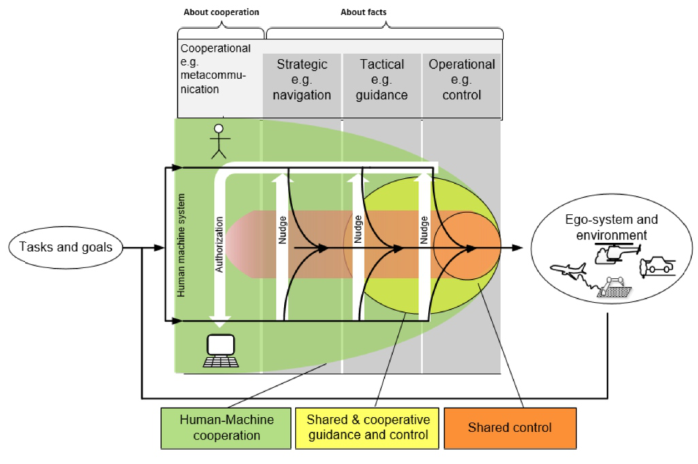
Layers of Automation and AI Faced with the increasing proliferation of automation on different layers in traffic systems, Pacaux-Lemoine and Flemisch (2019), accompanied by Flemisch et al. (2016), introduced the concept of Layers of Automation. The basic idea is that automation cannot only be differentiated regarding the func- tions or stages of information processing, but also by the layer of the system in which the automation works. Based on earlier work by Donges (2012), they structure the vehicle guidance and control task in complex traffic systems into layers of navigation, guidance and control. Later on, Flemisch et al. (2016) generalized this idea to form layers of cooperation on a tactical, operational and strategical layer, accompanied by a cooperational (meta-)layer which addresses the special need to maintain a cooperation between the human and the co-system (initially described by, e.g., Hoc & Lemoine, 1998).
Figure 3: Generic model for layers of assistance and automation (Flemisch et al. 2019).
In the context of the cooperation between the human and the co-system, the distinction between the degrees of human involvement becomes particu- larly relevant. Here, the concepts of “in the loop,” “on the loop,” and “out
Beyond Levels of Automation 517
of the loop” describe the varying degrees of human involvement and control in cooperative systems.
In the Loop: When humans are in the loop, they are actively engaged and directly controlling the system. They make real-time decisions, monitor the system’s performance, and intervene when necessary. This level of involve- ment is common in manual or semi-automated interactions where human judgment and expertise are essential.
On the Loop: Being on the loop refers to a supervisory role where humans oversee automated systems from a higher level. They set goals, define param- eters, and establish guidelines for the automated processes. While humans are not directly controlling every action, they retain the authority to mod- ify the system’s objectives and intervene if the system deviates from the desired course. This level of involvement is typical in systems with partial automation, where humans provide guidance and oversight.
Out of the Loop: In an out of the loop scenario, humans are largely removed from the direct operational control of the system. The automa- tion operates independently without requiring human intervention in routine tasks. Humans can still be involved in exceptional situations or when the co- system encounters problems beyond its capabilities. This level of automation is common in fully autonomous or highly automated systems.
The distinction between these layers of involvement is crucial in designing automated systems, as it determines the balance between human decision- making and machine automation or artificial intelligence (AI). Striking the right balance ensures optimal system performance, safety, and efficiency, taking advantage of both human expertise and machine capabilities while minimizing the risk of errors.
MODES AND TRANSITIONS OF OPERATION WITH AUTOMATION AND AI With the advent of levels and layers of automation, now expanded to all co-systems including AI, the concept of modes was pushed a bit into the back- ground. Nevertheless, mode confusion as described for aviation by (Billings, 1997) now also appeared for car and truck automation (e.g., Eom & Lee, 2022). Modes are usually defined as states in which a system is in, however, engi- neers often call modes a state of the technical subsystem, Human Factors and Human Systems Integration specialists often talk about the human-machine system.
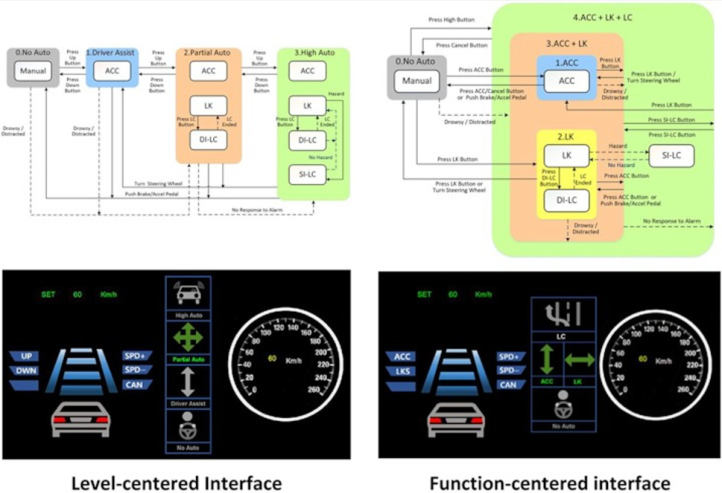
What is the difference between mode and level or layer? Modes can be based on levels and or layers, but can also be based on other structural ele- ments, e.g., functions. Figure 4 shows modes bases on layers, and modes based on functions.
Modes can also contain additional information and annotations. An exam- ple for this is the Minimum Risk Maneuver (MRM) / Minimum Risk State in vehicle automation, which is still on a highly automated level, and when addressing the tactical and operational layer is quite specific for emergency issues in order to prevent the worst, until a driver can recover again.
Figure 4: Levels versus function centred interface (Eom & Lee, 2022).
Whenever we are talking about modes, which are essentially states of the system, we also have to talk about transitions. Transitions refer to the pro- cesses or periods of change from one mode to another. In various contexts, transitions can involve shifts in personal life, societal changes, or alter- ations in systems and technologies, signifying a movement from one phase to another. For the use of cooperative systems, it is critical that users understand these transitions and, above all, the respective modes.
Therefore, when designing, engineering and implementing the modes, it must be taken into account that users often have a far lower level of techni- cal understanding and can only understand or differentiate between a limited number of modes (mode awareness) and that too many modes can lead to lack of understanding or even dangerous confusion (mode confusion), as described by Schieben et al., (2008) and Schieben et al., (2010), as well as Othersen et al., (2017), Flemisch et al., (2017) Lassmann et al., (2020), and Tinga et al., (2022).
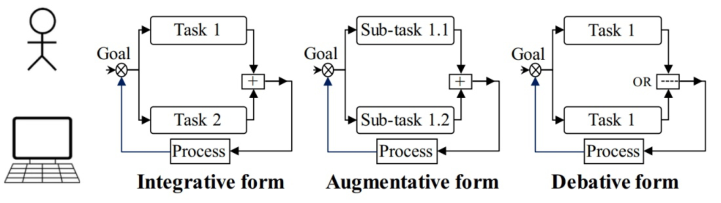
HUMAN SYSTEM PATTERNS: MORE SPECIFIC FORMS TO DESCIBE INTERACTION IN MODES, ON LEVELS AND LAYERS Patterns can be understood as proven solution strategies for recurring prob- lems. A pattern describes a problem or a system (Alexander et al., 1977) and associated tension poles (Flemisch & Onken 2022) that occur repeat- edly in our environment and then describe the core of the solution to these problems in such a way that they can be reused again and again (Alexander et al., 1977). Figure 5 depicts a fundamental human-machine design pattern by (Pacaux-Lemoine & Flemisch, 2019), using the example of cooperation:
Beyond Levels of Automation 519
The integrative form is used when human and machine have complementary competences and can share the task, the augmentative form when have they have similar competences to perform a task and can split it into sub-tasks and the debative form is used when they have similar competences and can debate the best possible solution.
Figure 5: Fundamental human-machine design pattern (Pacaux-Lemoine & Flemisch, 2019), adapted from (Schmidt 1991). The upper task is assigned to the human operator and the lower task to an AI-co-system (based on Pacaux-Lemoine & Flemisch, 2019, adapted from Schmidt et al., 1991).
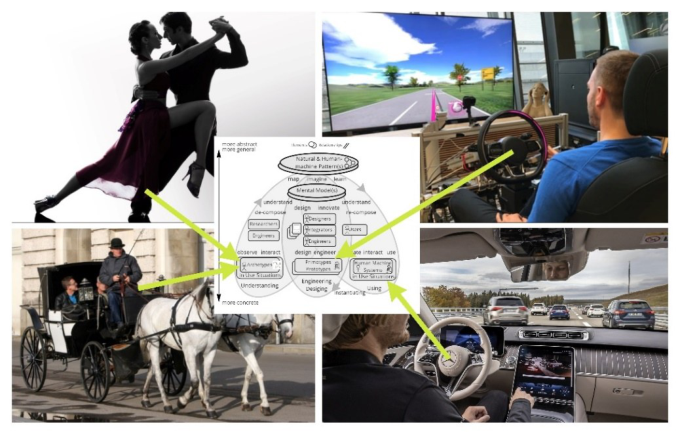
Patterns can originate from different, e.g., naturalistic inspirations: Figure 6 depicts how examples from human-human interaction (dancing) or human-animal interaction (rider/horse) have been applied to human-vehicle interaction. Perhaps the best-known example is the H(orse) mode, which transferred the interaction between rider and horse (tight reign, loose reign, secured reign) to automated driving functions and the first automation modes (Flemisch et al., 2003).
Figure 6: Design pattern of human-human and human-animal interaction applied to human-vehicle interaction (Flemisch et al., 2022).
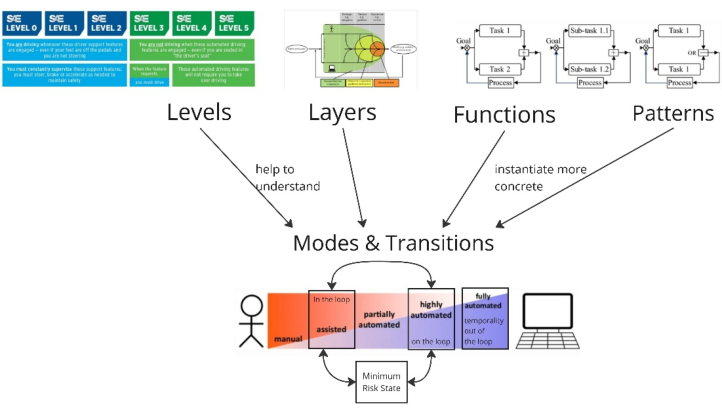
RELATIONSHIPS BEWEEN LEVELS, LAYERS, FUNCTIONS, MODES AND PATTERNS Levels of Automation (LOA) describe a basic distribution between humans and a machine, based on the technical capabilities of a co-system, and can help to understand the modes and transitions of a socio-technical system. With increasing LOA, a system is able to transition into higher automated operation modes. As depicted exemplary in Figure 7, with increasing SAE LOA, a human-machine system might provide more automation modes and therefore more transitions between these modes. This makes LOA especially useful for the engineering part of automated systems, whereas system modes and transitions are what users experience in a system. It is increasingly impor- tant to design sociotechnical systems in a way that the modes and transitions can be handled by the users. There is no automatism that means that all levels of automation which are technically possible are also implemented as modes and transitions, because this might overload the users.
Figure 7: Interplay of levels, layers, functions and patterns towards modes and transitions. (Based on Flemisch et al., 2003 and 2017, SAE 2019, Usai et al., 2021, Pacaux-Lemoine & Flemisch 2019 and Flemisch et al., 2022.)
Layers and functions help to structure socio-technical systems and their modes and transitions. Human Systems patterns in particular support the instantiation of automation modes or transitions. More specific, automation functions form the abilities of the automation side of a human-machine sys- tem. Levels of automation depend on sets of functions to be available to enable certain automation modes.
Patterns, especially interaction patterns, are a tool to design and describe interaction and cooperation of specific automation modes and transitions between them. The pattern behind e.g., a mode transition describes the inter- action between human and machine with the modes, and throughout the transition phase.
Beyond Levels of Automation 521
OUTLOOK: LEVELS, LAYERS, MODES AND PATTERNS FROM AUTOMATION TO AI IN A HOLISTIC VIEW Levels, layers and functions are useful constructs to structure our auto- mated and AI-supported sociotechnical systems. These constructs help to define interaction and cooperation patterns, which can then be instantiated with modes and transitions. These modes and transitions can then be imple- mented by designers and engineers, and if successful, then easily understood and used by the users and other stakeholders. Mental models of design- ers, engineers, users and other stakeholders are at the very center of this complex game. Future research should especially investigate how these men- tal models can be built up, developed and maintained in resonance with a quite dynamic development towards partially and highly automated and AI-supported world.
ACKNOWLEDGMENT
This project was funded within the Priority Program 1835 Cooperative Interacting Automobiles (CoInCar) of the German Science Foundation DFG.
REFERENCES
Abbott, K., Slotte, S. M., Stimson, D. K. & U. S. (1996) The interfaces between flightcrews and modern flight deck systems. United States. Department of Trans- portation. Federal Aviation Administration; United States. National Aeronautics and Space Administration. Alexander, C., Ishikawa, S. & Silverstein, M. (1977) A pattern language: Towns,
buildings, construction. Oxford Univ. Press: New York, NY. Baltzer, M. C. A. (2021) Interaktionsmuster der kooperativen Bewegungsführung von Fahrzeugen: Lehr- und Forschungsgebiet Systemergonomie / Lehrstuhl und Insti- tut für Arbeitswissenschaft. Dissertation, Aachen, Shaker Verlag; Dissertation, RWTH Aachen University, 2020. Available from: https://doi.org/40345. Billings, C. E. (1997) Aviation Automation: The Search for a Human-Centered
Approach. 0805821279. Available from: https://trid.trb.org/view/572335. Donges, E. (2012) Fahrerverhaltensmodelle. In: Winner, H. (Ed.) Handbuch Fahrerassistenzsysteme. Vieweg+Teubner Verlag: Wiesbaden, pp. 15–23. Eom, H. & Lee, S. H. (2022) Mode confusion of human–machine interfaces for
automated vehicles. Journal of Computational Design and Engineering, 9(5), 1995–2009. Available from: https://doi.org/10.1093/jcde/qwac088. Flemisch, F., Baltzer, M., Abbink, D., Siebert, L. C., van Diggelen, J., Herzberger, N. D., Draper, M., Boardman, M., Pacaux-Lemoine, M., & Wasser, J. (2023). Towards a Dynamic Balance between Humans and AI-based Systems. In: Multi- disciplinary Reserach Handbook on Meaningful Human Control over Artificial Intelligence Systems. Edward Elgar Publishing (in press). Flemisch, F. O., & Onken, R. (2002). Open a window to the cognitive work pro-
cess! pointillist analysis of Man–Machine interaction. Cognition, Technology & Work, 4, 160–170. Flemisch, F., Abbink, D., Itoh, M., Pacaux-Lemoine, M.-P. & Weßel, G. (2016) Shared control is the sharp end of cooperation: Towards a common frame- work of joint action, shared control and human machine cooperation. IFAC- PapersOnLine, 49(19), 72–77. Available from: https://doi.org/10.1016/j.ifacol .2016.10.464.
Flemisch, F., Abbink, D. A., Itoh, M., Pacaux-Lemoine, M.-P. & Weßel, G. (2019) Joining the blunt and the pointy end of the spear: towards a common framework of joint action, human–machine cooperation, cooperative guidance and control, shared, traded and supervisory control. Cognition, Technology & Work, 21(4), 555–568. Available from: https://doi.org/10.1007/s10111-019-00576-1. Flemisch, F., Adams, C. A., Conway, S. R., Goodrich, K. H., Palmer, M. T. & Schutte,
P. C. (2003) The H-Metaphor as a guideline for vehicle automation and interac- tion. L-18448. Available from: https://ntrs.nasa.gov/citations/20040031835. Flemisch, F., Altendorf, E., Canpolat, Y., Weßel, G., Baltzer, M. C. A. & López Hernández, D. et al. (2017) Uncanny and Unsafe Valley of Assistance and Automation: First Sketch and Application to Vehicle Automation. In: Advances in Ergonomic Design of Systems, Products and Processes. Springer, Berlin, Heidelberg, pp. 319–334. Flemisch, F., Heesen, M., Hesse, T., Kelsch, J., Schieben, A. & Beller, J. (2012)
Towards a dynamic balance between humans and automation: authority, ability, responsibility and control in shared and cooperative control situations. Cogni- tion, Technology & Work, 14(1), 3–18. Available from: https://doi.org/10.1007/ s10111-011-0191-6. Flemisch, F., Usai, M., Herzberger, N. D., Baltzer, M. C. A., Hernandez, D. L.
& Pacaux-Lemoine, M.-P. (2022) Human-Machine Patterns for System Design, Cooperation and Interaction in Socio-Cyber-Physical Systems: Introduction and General overview. In: 2022 IEEE International Conference on Systems, Man, and Cybernetics (SMC), 2022 IEEE International Conference on Systems, Man, and Cybernetics (SMC), Prague, Czech Republic. IEEE, pp. 1278–1283. Gasser, T. M., Arzt, C., AYoubi, M., Bartels, A., Buerkle, L. & Eier, J. et al. (2012) Rechtsfolgen zunehmender Fahrzeugautomatisierung. Wirtschaftsverlag NW. Hoc, J.-M. & Lemoine, M.-P. (1998) Cognitive Evaluation of Human-Human and
Human-Machine Cooperation Modes in Air Traffic Control. The International Journal of Aviation Psychology, 8(1), 1–32. Available from: https://doi.org/10. 1207/s15327108ijap0801_1. Lassmann, P., Othersen, I., Fischer, M. S., Reichelt, F., Jenke, M. & Tüzün, G.-J. et al.
(2020) Driver’s experience and mode awareness in between and during transitions of different levels of car automation. In: Proceedings of the Human Factors and Ergonomics Society Europe. Othersen, I., Petermann-Stock, I., Schoemig, N. & Fuest, T. (2017) Methoden und Wechselwirkung Kognitive Übernahmefähigkeit nach einer pilotierten Fahrt. ATZelektronik, 12(S1), 26–31. Available from: https://doi.org/10.1007/s35658- 017-0068-4. Pacaux-Lemoine, M.-P. & Flemisch, F. (2019) Layers of shared and cooperative con-
trol, assistance, and automation. Cognition, Technology & Work, 21(4), 579–591. Available from: https://doi.org/10.1007/s10111-018-0537-4. Parasuraman, R., Sheridan, T. B. & Wickens, C. D. (2000) A model for types and levels of human interaction with automation. IEEE Transactions on Sys- tems, Man, and Cybernetics. Part A, Systems and Humans : a Publication of the IEEE Systems, Man, and Cybernetics Society, 30(3), 286–297. Available from: https://doi.org/10.1109/3468.844354. SAE (2021) SAE International Standard J3016: Taxonomy and Definitions for Terms
related to Driving Automation Systems for On-Road Motor Vehicles. Schieben, A., Damböck, D., Kelsch, J., Rausch, H. & Flemisch, F. (2008) Haptisches feedback im spektrum von fahrerassistenz und automation. In: Heißing, B. & Deklerk, K. (Eds.) 3. Tagung Aktive Sicherheit durch Fahrerassistenz.
Beyond Levels of Automation 523
Schieben, A., Temme, G., Köster, F. & Flemisch, F. (2010) Intermediate results of the Human Factors work in the EU-Project HAVEit: Interaction design and simula- tor testing of the Joint System for highly automated vehicles. In:, HFES Europe Conference, 13.-15. Oktober 2010, Berlin. Schmidt, K., Rasmussen, J., Brehmer, B. & Leplat, J. (1991) Cooperative work: A
conceptual framework. In: Distributed decision making: Cognitive models for cooperative work, pp. 75–110. Sheridan, T. B., Verplank, W. L. & Brooks, T. L. (1978) Human/computer control of undersea teleoperators. NASA. Ames Res. Center The 14th Ann. Conf. on Manual Control. Available from: https://ntrs.nasa.gov/citations/19790007441. Tinga, A. M., Cleij, D., Jansen, R. J., van der Kint, S. & van Nes, N. (2022) Human
machine interface design for continuous support of mode awareness during auto- mated driving: An online simulation. Transportation Research Part F: Traffic Psychology and Behaviour, 87, 102–119. Available from: https://doi.org/10.1016/ j.trf.2022.03.020.
LISTED IN THE AHFE DIGITAL BOOKSTORE CATALOGUE
Explore the complete digital volume
Intelligent Human Systems Integration (IHSI 2024): Integrating People and Intelligent Systems
Read this individual research paper free through the original publisher, or explore the full digital proceedings book.
ISBN 978-1-958651-95-7
Explore this ISBN in the AHFE Bookstore ↗Listed in the July 2026 bookstore catalogue; search by ISBN to confirm current availability · Digital book purchase optional