Sandra Mateus, Daniel Ramírez, Jorge Giraldo, Claudia Ramos (2024). Development of a Video Game for Cognitive Stimulation in Early-Stage Alzheimer's Disease. In: Intelligent Human Systems Integration (IHSI 2024): Integrating People and Intelligent Systems. AHFE Open Access, vol. 119, pp. 372–381. https://doi.org/10.54941/ahfe1004501
In this research, a videogame was developed using Unity and WebGL as a cognitive stimulation strategy for patients with early-stage Alzheimer's disease. The process of construction of the videogame, began with the definition of cognitive needs and patient characteristics, obtained through literature review and interviews with experts. The interviews were focused on the following skills: the memory, the attention, the executive function, and the problem solving. These skills can be positively impacted with videogames and are detailed according to their degree of impairment in Alzheimer's disease.Next, the story and conceptual methodology of the videogame were identified with a literature review: achieving a certain degree of personalization according to the patient's context, inclusion of rhythmic music that accompanies the player's experience, and adaptation of different difficulty levels based on each patient. The videogame is conceptually categorized as a Serious Game and was created with a Game Design Document (GDD) specifying the dynamics and mechanisms of the game. Following, the video game was development using Unity and WebGL framework.The video game starts with the player entering the mini world, placing the user in the scenario of the initial route, which aims to perform a basic diagnosis of the player's weakest skills. After, the central cycle begins, which involves exploring the world in search of mini games that can be either completed or failed. Completing all the mini games in the scenario is unlocked.Based on the psychiatrist's indications with respect to the validation of previous tools, the recommendation to carry out individualized sessions for each patient together with their caregiver was accepted, since carrying out a joint session with all the patients could make it difficult. Each session with the patient and their caregiver lasted one hour, in which they interacted with the platform and the videogame while they were recorded by voice and video, applying the Thinking Aloud methodology.Finally, the patients expressed ease of use the videogame, even for those who had never used a computer, in addition to considering it entertaining, an element that the caregivers confirmed when they perceived interest in the patients at the time of the test, a factor that contributes to adherence to treatment.
Alzheimer’s Disease is considered the most common Major Neurocognitive Disorder today and is related to serious memory problems (Patterson, 2018). However, many diagnosed people with this disease also have neuropsychiatric symptoms in some point of their lives (Lyketsos et al., 2011); For instance, it is presumed that 90% of affected individuals with Alzheimer’s dementia have this symptomatology (Volicer, 2018). Also, one or more psychological or behavioral symptoms affect nearly people with dementia in the course of their illness (Kales et al., 2015).
Development of a Video Game for Cognitive Stimulation 373
To optimize the effectiveness of pharmacological measures in the treatment of neuropsychiatric symptoms, while are reducing the risk of adverse events, several multimodal approaches have been designed, that mean to combine pharmacological treatment with cognitive, behavioral, psychoeducational, occupational and family interventions. The results of these combinations have led to the conclusion that the most useful approaches to maintain and maximize functioning in Alzheimer’s disease, to reducing the caregiver’s bur- den and improving quality of life, are those that mix individualized and interdisciplinary (García-Casal et al., 2017).
On the other hand, although multimodal interventions benefit both patients with this disease and their caregivers, attending programs in per- son is complicated for them, because some people live in rural areas, and it is difficult for them to travel. Therefore, it is necessary to have multimodal interventions that use telehealth technologies (Curioso and Galan-Rodas, 2020). One of the strategies recently included as fundamental part of several technology-mediated therapies, is based on the use of video games (Mocanu et al., 2016). The approach to this type of strategies should include the personalization of the interactive elements according to the patient’s needs (Astell et al., 2014). This is why not any commercial game can be useful in the cognitive stimulation of patients with Alzheimer’s disease (Chang et al., 2013). Among the non-pharmacological measures for the treatment of Alzheimer’s, it has been demonstrated that video games can have useful effects in delay- ing the degenerative effects of diseases such as Alzheimer’s (Herranz-Gómez, 2020). These non-pharmacological treatments also have a positive impact in the accessibility and economic burden during Alzheimer’s treatment in patients and caregivers (Romero Vanegas, 2022). Additionally, key aspects regarding the use of IT based solutions in people with dementia include to involve the patient in pleasurable activities that represent cognitive stimu- lation (Meiland et al., 2017). It is validated that the use of video games in a clinical setting produces positive effects on the cognitive area of patients, obtaining health benefits in different clinical contexts (Moscardi, 2020).
Another component that can contribute to the effectiveness of a multi- modal intervention is cognitive rehabilitation, which is traditionally carried out with paper tasks and in recent decades, has been migrating to digital tools, such as computerized rehabilitation programs, virtual reality and video games. These treatment strategies have been validated to be equally or more effective than traditional tools (Kueider et al., 2012).
The Unity graphics engine has proven to be efficient for the development of 2D and 3D video games, in entertainment, academic and scientific context, such as neural training (Paszkiel et al., 2021). Also, it has been shown that the use of WebGL in HTML5-based web environments can provide similar and even superior results with respect to alternative technologies in reproduction of interactive multimedia content, such as mobile applications or desktop applications (Min et al., 2018).
For this reason, this research proposes the development of a video game using Unity as a graphics engine and the WebGL specification, for subsequent integration in a web environment developed with the Flask framework and
the jQuery library. It is intended to achieve cognitive stimulation in patients with early Alzheimer’s disease.
CHARACTERIZATION OF THE COGNITIVE NEEDS OF PATIENTS WITH EARLY-STAGE ALZHEIMER’S DISEASE AND DETERMINATION OF THE FOUNDATIONS OF THE VIDEO GAME Based on the identified needs from professionals in healthcare, psychology, neuropsychiatric and nursing, there was a requirement for an ICT (Infor- mation and Communication Technologies) based tool to impact cognitive stimulation in patients.
Identification of Cognitive Skills to Impact and Impact Patients Based on the literature review, the following four specific cognitive skills have been identified that can be positively impacted with video games: memory, attention, executive function, and problem-solving ability. These skills are detailed below, according to their degree of impairment in Alzheimer’s dis- ease (Oliveira et al., 2021). To the qualitative characterization of patients who may benefit from cognitive stimulation through the video game, it was identified through literature review and information collected in co-creation workshops that this kind of intervention is only useful for patients in early stages of Alzheimer’s disease, with the aim of delaying the cognitive decline, considering that in a moderate and severe state of the disease, improve- ment is not possible. Based on the presented conclusions, the selection and inclusion criteria outlined in this research are reviewed and adopted, which involve the following patient characteristics: over 18 years old, Major Neu- rocognitive Disorder (MND) diagnosis due to mild Alzheimer’s disease, on Clinical Dementia Rating (CDR) with levels 0.5 and 1, ability to read and write, accompaniment of a caregiver and access to a computer with internet connection.
Narrative and Conceptual Definition of the Video Game For the definition of the narrative and conceptual methodology of the video game, several key aspects were identified from the literature review: achiev- ing a certain degree of personalization according to the patient’s context, inclusion of rhythmic music that accompanies the player’s experience, and adaptation of different difficulty levels based on each patient’s cognitive abil- ities. Additionally, Serious Games are found to consider important factors that entertainment-focused video games lack. Therefore, the video game is conceptually categorized as a Serious Game.
Furthermore, Yepes (2022) proposes a series of specific characteristics that could be included in the development of video games, with a proper focus on the cognitive needs of patients with Alzheimer’s disease. The conceptual and narrative characteristics presented in Table 1 are defined as part of the methodology for the development of the video game.
Development of a Video Game for Cognitive Stimulation 375
Table 1. Conceptual and narrative characteristics of the video game.
Activities for stimulation of different cognitive skills.
Attention
Limited number of lives at the beginning of the game.
Executive Function
Customization of the experience according to the patient’s context and ability.
Various questions and educational activities to generate different stimuli.
Setting in a 3D fictional world that is simple to avoid confusing the patient.
Different ways adapted to the patient’s ability.
Problem-Solving
Simplicity in both gameplay and learning.
Exploration of a world with an avatar representing the patient.
Feedback for the patient and the caregiver.
Bonuses for overcoming activities.
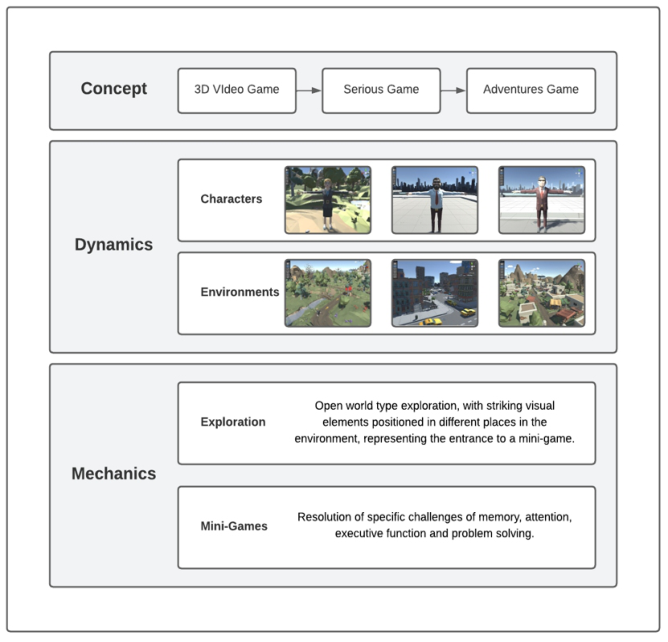
DESIGN OF THE PLANNING AND PRODUCTION MODEL OF THE VIDEO GAME THROUGH THE GAME DESIGN DOCUMENT (GDD) According to the definitions and conclusions from the previous chapter, the initial planning concepts that are part of the initial information in the Game Design Document (GDD) are established. Figure 1 presents an overview of the content developed in the GDD through the so-called One-Page GDD. This scheme provides a brief presentation of the GDD content, summarizing the concept, dynamics, and mechanics.
Additionally, 12 mini-games were defined, according to each one of the cognitive abilities to be impacted and adopting the recommendations con- cluded from the literature review and issued by experts in the area. These minigames were divided into 5 game routes: a first diagnostic route and four specific routes for each one of the cognitive abilities.
IMPLEMENTATION OF THE VIDEO GAME USING THE UNITY GAME ENGINE AND WEBGL According to the resources characterized from literature review and the development of the steps, the project was development in Unity as a 3D project, using version 2021.3.23f1, which is the latest available version with Long Term Support (LTS) and includes the necessary updates and imple- mentations to web platform development support, incorporating the WebGL specification as the rendering standard for browsers.
To graphical resources of the development, representative objects of a real environment are sought, based on a Low poly approach, to ensure per- formance on devices with limited graphical resources. Low poly is defined as a characteristic of 3D models, consisting of constructing objects using
geometric elements with few vertices (Lightbox, 2020). To this end, the “POLYGON - Sampler Pack” package from Synty Studios is incorporated into the project resources, which contains multiple low poly resources used in the construction of the environments.
Figure 1: One-page GDD (overview).
Graphic Scenarios Once the packages and libraries are imported, the construction and design of the base graphical environment begins, using the 3D models included in the POLYGON package and making use of customized textures according to the graphic needs of the scenes, generating two general scenarios.
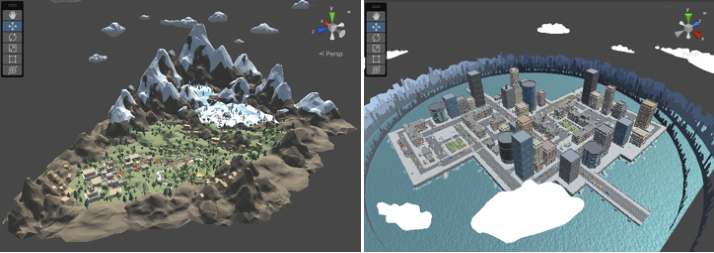
Two complete and robust scenarios are constructed in terms of size and number of objects, separated into two different scenes within the project. These scenarios serve as a foundation for the other dependent scenes related to each specific interaction in the video game. The first general scenario recre- ates a mountain setting with sections of a village, a camp, a field, and snowy areas. The second general scenario recreates a city setting, including many objects and sections such as parks, streets, and buildings that will be use- ful for setting up challenges. Figure 2 presents the two constructed general scenarios.
Development of a Video Game for Cognitive Stimulation 377
Figure 2: General graphic scenarios (mountain and city).
Development of Interactions and Mechanics Counting on the built graphical environment, we proceed to the implementa- tion of the interactions and mechanics defined at a general level for the video game and at a specific level for each one of the mini-games, through the cod- ing of scripts in C#, as the standard language in Unity that includes all the necessary libraries for the management of scenes, objects, components and properties.
The general mechanics refer to the interaction features that are part of the entire video game in its different scenarios and do not vary between them. Also, for each pre-defined mini-game, specific scripts are required to ensure its proper functioning and define all the mechanics and interac- tions between the player and the game (scenes, objects, components, and properties). For each of the 12 mini-games that are part of the video game, the necessary scripts are coded to control the mechanics and the required interfaces. Figure 3 presents two runtime scenes of one of the implemented mini-games. The first scene showcases direct interaction with the mini-game within the 3D environment, while the second scene presents a 2D menu at the end of the challenge.
Figure 3: Mini-game scenes.
Finally, to measure the results of the patients’ interaction with the video game, a score is calculated for each challenge based on the time required and the number of attempts needed to complete the challenge. The selection of
routes is done through the scenes created for each level of each challenge and using user information obtained through interaction with the backend. By crossing this information, checkpoints are generated that call the challenges defined for the specific route and at the determined difficulty level for the user.
The strategy defined in the conceptualization and characterization of the serious game requires a reward system for overcoming the mini-games through a variable that represents a quantity of coins possessed by the user. To make the use of coins more dynamic, a personal space called “My Gar- den” is created, where the player uses the coins earned to place decorative objects.
VALIDATION OF THE VIDEO GAME IMPLEMENTATION WITH PATIENTS TO VERIFY THE OBTAINED RESULTS Four patients diagnosed with Major Neurocognitive Disorder due to Alzheimer’s disease and their respective caregivers were selected. The par- ticipating patients in the study are in the age range of 50 to 80 years old and have low or no affinity for computer use. The participating caregivers are in the age range of 40 to 70 years old and have low to moderate affinity for computer use.
Based on the previous experience of the members of the master project regarding the validation of previous tools, the recommendation to conduct individualized sessions for each patient and their caregiver was followed. This decision was made to ensure that conducting a joint session with all patients would not hinder the execution of the test and the collection of necessary data. Each session with the patient and their caregiver lasted for one hour. During this time, they interacted with the video game while being recorded through voice and video. The Thinking Aloud methodology was applied, where participants verbalized their thoughts and reactions during the inter- actions. The sessions with each patient and their caregivers were divided into three stages: caregiver’s interaction with the web platform, patient’s interaction with the video game and survey about the interaction experience.
Upon consolidating the responses from the participating patients and care- givers, along with the extraction of information stored by the video game during the tests and the review of recorded sessions, positive results were obtained regarding the interaction of the target users with the development. The patients uniformly expressed that they found the video game easy to use, even for those who had never used a computer before. They also consid- ered it entertaining, which was confirmed by the caregivers who observed the patients’ interest during the test. This factor contributes to treatment adherence.
The gradual adaptation of patients to the controls and mechanics of the video game as they progressed through the challenges, as well as the generated times and attempts used to overcome the mini-games reflected in the scores, demonstrate positive cognitive stimulation. It starts with the attention given when taking control of the video game and extends to the cognitive skills stimulated through its use. From the solution developed in this work, it is
Development of a Video Game for Cognitive Stimulation 379
possible to measure the evolution related to the scores obtained for each cog- nitive ability during the different interactions a patient has with the video game over time. This measurement serves as a reference for the evolution of the skills involved in the video game.
CONCLUSION
Video games are an Information and Communication Technology tool that proves to be useful as therapy environments in areas such as rehabilitation and cognitive stimulation, allowing for positive effects on cognitive disor- ders in patients with early-stage Alzheimer’s disease. The solution developed in this research consists of a 3D video game as a playful and therapeutic environment focused on cognitive stimulation for patients with Alzheimer’s disease.
Through a literature review prior to development and the analysis of infor- mation derived from co-creation workshops conducted within the framework of the master project with patients and caregivers, four basic cognitive skills were identified as susceptible to stimulation through therapy environments such as video games, with the aim of reducing the progression of the disease: memory, attention, executive function, and problem-solving. The developed video game offers specific challenges focused on stimulating these cognitive skills. The previous research allowed for the identification of the specific char- acterization of patients and at which stage of the disease they are most likely to reduce the progression of cognitive symptoms.
The use of the Unity graphics engine, along with the WebGL specification, enabled the creation of a final prototype of the video game that requires minimal hardware specifications to be run on web browsers of computers or mobile devices. This factor directly impacts the loading and accessibility of the treatment for patients and caregivers, addressing a problem identified in previous research.
ACKNOWLEDGMENT
Thanks to the participants and their caregivers of master project “Develop- ment of a multimodal intervention with an emphasis on anosognosia for the treatment of Alzheimer’s Disease through Information and Communication Technologies, ICT”, financed by the Ministry of Science, Technology and Innovation of Colombia.
REFERENCES
Astell, A., Alm, N., Dye, R., Gowans, G., Vaughan, P., & Ellis, M. (2014). Digital Video Games for Older Adults with Cognitive Impairment. Computers Helping People with Special Needs. Paris, France: ICCHP 2014. https://doi.org/10.1007/ 978-3-319-08596-8_42 Chang, K., An, N., Qi, J., Li, R., Levkoff, S., Chen, H., & Li, P. (2013). Food
stamps: A reminiscence therapy tablet game for Chinese seniors. IEEE/ICME International Conference on Complex Medical Engineering, CME, (pp. 556–561). Beijing, China. https://doi.org/10.1109/ICCME.2013.6548312
Curioso, W. H., & Galan-Rodas, E. (2020). El rol de la telesalud en la lucha contra el COVID-19 y la evolución del marco normativo peruano. Acta Médica Peruana, 37(3), 366–375. https://doi.org/10.35663/amp.2020.373.1004 García-Casal, J., Goñi Imízcoz, M., Perea Bartolomé, M., García Moja, C., Calvo
Simal, S., & Cardelle García, F. (2017). Rehabilitación del reconocimiento de emo- ciones combinada con estimulación cognitiva para personas con enfermedad de Alzheimer. Eficacia sobre aspectos cognitivos y funcionales. Revista de neurología, 65(3), 97–104. Herranz-Gómez, A. (2020). El uso de los videojuegos en la prevención del deterioro cognitivo en personas mayores. NeuroRehabNews, Octubre. https://doi.org/10.37382/nrn. Octubre.2020.552 Kales, H., Gitlin, L., & Lyketsos, C. (2015). Assessment and management of behavioral and psychological symptoms of dementia. BMJ, 350. https://doi.org/10. 1136/bmj.h369 Kueider, A., Parisi, J., Gross, A., & Rebok, G. (2012). Computerized cognitive train-
ing with older adults: a systematic review. PloS One, 7(7). https://doi.org/10.1371/ journal.pone.0040588 Lightbox Academy. (2020). Lightbox Academy. Retrieved 1 de Abril de 2023, from Lightbox Academy Blog: https://lboxacademy.es/blog/modelado-low-poly-que-es/ Lyketsos, C. G., Carillo, M. C., Ryan, J. M., Khachaturian, A. S., Trzepacz, P., Amat-
niek, J.,... Miller, D. S. (2011). Neuropsychiatric symptoms in Alzheimer’s disease. Alzheimer’s & Dementia, 7(5), 532–539. https://doi.org/10.1016/j.jalz.2011.05. 2410 Meiland, F., A., I., Mountain, G., Robinson, L., van der Roest, H., García- Casal, J. A.,... Tsolaki, M. (2017). Technologies to Support Community-Dwelling Persons With Dementia: A Position Paper on Issues Regarding Development, Usability, Effectiveness and Cost-Effectiveness, Deployment, and Ethics. JMIR rehabilitation and assistive technologies, 4(1). https://doi.org/10.2196/rehab.6376 Min, Q., Wang, Z., & Liu, N. (2018). An Evaluation of HTML5 and WebGL for
Medical Imaging Applications. Journal of Healthcare Engineering, 2018. https: //doi.org/10.1155/2018/1592821 Mocanu, I., Marian, C., Rusu, L., & Arba, R. (2016). A Kinect based adaptive exergame. 2016 IEEE International Conference on Intelligent Computer Com- munication and Processing (ICCP), (pp.117–124). Cluj-Napoca, Romania. https: //doi.org/10.1109/ICCP.2016.7737132 Moscardi, R. (2020). Los efectos positivos de jugar videojuegos y su aplicación en
entornos no lúdicos. Cuadernos del Centro de Estudios en Diseño y Comuni- cación. https://doi.org/10.18682/cdc.vi110.4066 Oliveira, J., Gamito, P., Souto, T., Conde, R., Ferreira, M., Corotnean, T.,... Neto, T. (2021). Virtual Reality-Based Cognitive Stimulation on People with Mild to Moderate Dementia due to Alzheimer’s Disease: A Pilot Randomized Controlled Trial. International journal of environmental research and public health, 18(10), 5290. https://doi.org/10.3390/ijerph18105290 Paszkiel, S., Rojek, R., Lei, N., & Castro, M. A. (2021). A Pilot Study of Game Design
in the Unity Environment as an Example of the Use of Neurogaming on the Basis of Brain–Computer Interface Technology to Improve Concentration. NeuroSci, 2(2), 109–119. https://doi.org/10.3390/neurosci2020007 Patterson, C. (2018). The state of the art of dementia research: New frontiers.
London: Alzheimer’s Disease International (ADI).
Development of a Video Game for Cognitive Stimulation 381
Romero Vanegas, S. (2022). Exploración de necesidades multidimensionales en la demencia: un abordaje desde el reconocimiento hacia la justicia social en Colombia. Universidad Nacional de Colombia. Volicer, L. (2018). Behavioral Problems and Dementia. Clinics in geriatric medicine,
34(4), 637–651. https://doi.org/10.1016/j.cger.2018.06.009 Yepes Quintero, A. (2022). Tipo de juegos o actividades para ayudar a los pacientes con Alzheimer.
LISTED IN THE AHFE DIGITAL BOOKSTORE CATALOGUE
Explore the complete digital volume
Intelligent Human Systems Integration (IHSI 2024): Integrating People and Intelligent Systems
Read this individual research paper free through the original publisher, or explore the full digital proceedings book.
ISBN 978-1-958651-95-7
Explore this ISBN in the AHFE Bookstore ↗Listed in the July 2026 bookstore catalogue; search by ISBN to confirm current availability · Digital book purchase optional