Eunji Lee (2023). Transforming the homecare offering scene: How the technology plays a role. In: Emerging Technologies in Healthcare and Medicine. AHFE Open Access, vol. 116, pp. 46–54. https://doi.org/10.54941/ahfe1004356
Digital health receives more and more attention as a solution to reduce the burden of healthcare cost in today's aging society. However, compared to other types of services, digital health service projects seem to have higher rates of stopping at pilot stages and do not get integrated into the actual medical practices. Adopting digital health solutions in today's healthcare settings often requires changes of work processes that can have a significant impact on the work practices of the healthcare professionals. Thus, there is a need for understanding both the current practice and the new proposed practice in service level with a more analytical and systematic approach. We conducted a multiple case study of homecare practices. Shadowing, contextual interviews, customer journey mapping, and semi-structured in-depth interviews were conducted in homecare settings in Norway and Sweden. Document analysis allowed us to add an additional case (a remote patient monitoring at home) to our study. The results of our study show that several key components of homecare services (service worker, secondary service worker, service interaction type, and sub-service provision context) were dissimilar among different homecare settings without or with a digital health solution. Our study might be useful to gain a deeper insight of homecare services and to understand the key components and the changing actors’ roles to consider when adopting digital solutions to the homecare services.
The number of elderly people is increasing globally, and this growth is only expected to accelerate in the coming decades (World Health Organisation, 2023). In Norway, the proportion of elderly people (67 years and older) went up from 8 percent in 1950 to 15 percent in 2020 and is projected to increase to 19 percent and 24 percent in 2030 and 2050, respectively (Statistics Nor- way, 2020). In Sweden, the proportion of elderly people (65 years and older) went up from 11.8 percent in 1960 to 20.4 percent in 2022 (Statistics Swe- den, 2023). Increasing aging population is positively associated with growing healthcare cost. Both Norway (4th) and Sweden (7th) were listed in the top 10 countries with the highest healthcare cost in 2022 (World Population Review, 2023). Digital health is defined as “the proper use of technology for improving the health and wellbeing of people at individual and population levels, as well as
Transforming the Homecare Offering Scene: How the Technology Plays a Role 47
enhancing the care of patients through intelligent processing of clinical and genetic data” (Fatehi et al., 2020). In terms of cost and health outcomes, dig- ital health interventions have shown growing positive evidence (Jiang et al., 2019; Bhardwaj et al., 2021; Gentili et al., 2022). However, digital health projects seem to have much higher rates of stopping at pilot stages and do not get integrated into the actual medical practices (Dendere et al., 2021). 75% of implemented eHealth are out to be considered to be operating failures (Berg, 1999; Granja et al., 2018). The causes can vary. For example, the failures can be caused by the com- plexity in digital health services involving many stakeholders with highly specific knowledge, different organisations, and dissimilar information sys- tems (Box et al., 2010; Abouzahra, 2011), which are challenging when designing the services.
Changing of a work process is required when adopting a digital health solution and the healthcare professionals’ work practice can have impact from the change. If the changes are not properly implemented, it can put the patients at risk in the worst case. Therefore, understanding both the cur- rent work practice and the new proposed work practice in service level in a more analytical way can be helpful for adoption or integration of a digital health solution.
The growing population of the elderly necessitates a greater need for home healthcare services (Genet et al., 2012). Delivering home healthcare service is undoubtedly a complex activity. It entails the involvement of various groups of people (e.g., patients, family of patients, healthcare professionals, etc.); home healthcare staff is required to communicate with all these actors that are often located in different geographical locations in order to complete various tasks (e.g., preparing meal, giving medication, etc.) in the different homes of patients. Several studies have been carried out to understand the work of homecare staff (Hägglund et al., 2008; Clark and McGee-Lennon, 2011; Jackson et al., 2015); these studies were based on either scenarios (and not in actual contexts) or a quantitative approach (measuring task completion times).
Identifying the key components of the current homecare service and the prospect homecare service adopting a digital health solution might be help- ful for the understanding of both the current work practice and the new proposed work practice of the homecare service with a more systematic approach. Our research question is “What are the key components of homecare services?”
RESEARCH APPROACH In order to answer the research question, we conducted a multiple case study in different homecare settings in Norway and Sweden. A multiple case study enables us to decipher insights from several cases, thereby supporting the understanding of similarities and differences within and between these cases, which leads to better theorising (Baxter and Jack, 2008).
The study was conducted using service design methods: 1) shadowing; 2) contextual interview; and 3) customer journey mapping (CJM). Shadowing
48 Lee
enables researchers to immerse themselves in the participants’ lives in order to observe their experiences and understand real-time interactions in an intimate way, so that the researchers can detect actual moments of problems whilst gaining a truly holistic view of how the services are operating (Stickdorn and Schneider, 2010, p. 156). Contextual interviews can be conducted with cus- tomers, service workers, or other stakeholders within the context where the service process of interest occurs (e.g., a researcher visits a service worker’s office and conducts the interview with him/her while he/she is working) in order to allow the researcher to better understand the social and physical environmental surroundings of the service (Stickdorn and Schneider, 2010, p. 162–163). CJM denotes a visual representation of the customer’s over- all experience that is constructed with the identified touchpoints, facilitating comparison of several services by identifying problem areas (Stickdorn and Schneider, 2010, p. 158–159). A touchpoint refers to a point of interaction between two actors that occurs in a service process.
In addition to the three aforementioned service design methods, semi- structured in-depth interviews and documents analysis were carried out. A semi-structured interview allows the researcher to dig into the interviewee’s comments and gain additional insights and understanding (Lazar et al., 2010, p. 189). Document analysis is a systematic research method for evaluating or reviewing documents to obtain empirical data in a low-cost way (Bowen, 2009). The collected data from the shadowing and contextual interviews (the field notes and interview transcripts) was first analysed using thematic cod- ing (Madden, 2010, p. 143). This became basis for constructing journeys (work processes) of the homecare staff. Additional questions were asked to the participants in a semi-structured in-depth interview. All contributed to learn the actual homecare practices. Two homecare settings were identified. In order to complement our study, an additional setting (a remote patient home monitoring with an artificial intelligence (AI) (Rghioui et al., 2020)) meeting four criteria: 1) a peer-reviewed journal article, 2) a proposed setting, 3) a setting that applies AI, and 4) a radically different setting comparing to the two identified ones, was chosen from document analysis. These three settings were then analysed using the nine key components of services in healthcare (Lee, 2017): service objective, service customer, secondary service customer, service worker, secondary service worker, service setting, service process, service interaction type, and sub-service provision context.
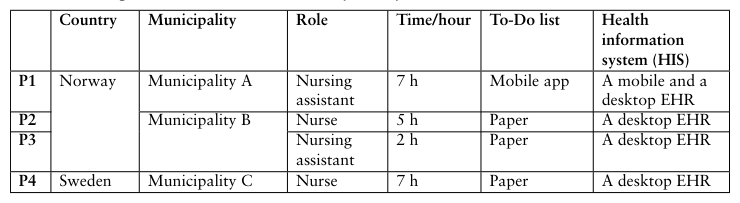
Table 1 illustrates the background information of the participants. We sent a recruiting email with an informed consent form to the homecare service units, explaining the objectives of the study and seeking participation. On the shadowing day, each participant first received the printed informed consent form and returned the form to the researcher after they had signed it. Our study involved several homecare settings both with and without an integrated digital solution in the work practice. The study was conducted in 2016 and involved three participants from two municipalities in Norway, in addition one participant from a municipality in Sweden. Due to the limited time one participant (P2) had, we involved one more participant (P3) from the same municipality (Municipality B).
Transforming the Homecare Offering Scene: How the Technology Plays a Role 49
P1 was a female certified nursing assistant with 28 years of experience in homecare. P2 was a female nurse with three years of experience in home- care. P3 was a female certified nursing assistant with five years of experience in homecare work. P4 was a female nurse, who had worked as a nurse for 27 years. The duration of the shadowing of P1 and P4 was about seven hours each, starting at 7:45 am (P1) and at 3:30 pm (P4). The duration of the shadowing of P2 was about five hours, starting at 8 am. After the shadowing of P2, the shadowing of P3 began around 1 pm and the duration was about two hours.
In homecare settings, information is transmitted and exchanged via dif- ferent types of registration forms (e.g., a paper form or an electronic form). Thus, identifying the different types of ‘To-Do list’ and ‘health information system(s)’ used while the participants were working was important. Three participants (P2, P3, and P4) used a desktop electronic health record system (EHR). One participant (P1) working with a smartphone telecare application used two health information systems (a mobile EHR and a desktop EHR) that communicated with each other.
Table 1. Background information of the participants.
RESULTS
The collected data showed that homecare staff often visit chronic patients. The most common disease the patients had was diabetes. Thus, we decided to focus on the case of caring patients with diabetes. We categorised the caring into three settings: homecare setting 1, 2, and 3. Homecare setting 1 refers the conventional homecare setting where the homecare staff carries their To-Do list in a paper form when they visit patients’ homes. They then often take note on the paper during the visits and register what they have written in a desktop EHR in their office either between visits or after all visits. Homecare setting 2 indicates a homecare setting where the homecare staff carries a mobile phone or tablet PC that has a mobile EHR installed. The homecare staff can find and read their To-Do list in an electronic form in the mobile EHR when they visit patients’ homes. They then register each patient’s condition right away in the mobile EHR during the visit. Homecare setting 3 indicates a remote patient home monitoring setting, a surveillance of diabetics with an AI. In this setting, there is no homecare staff who visits the patient, but a sensor inserted under the skin of the patient measures the patient’s blood glucose levels. The sensor sends the patient’s health data to a mobile app which sends the data to a health information system (HIS).
50 Lee
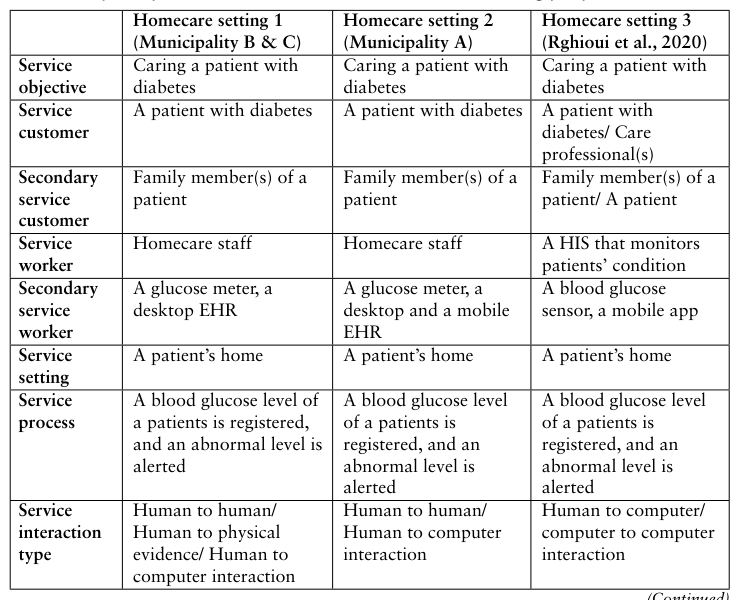
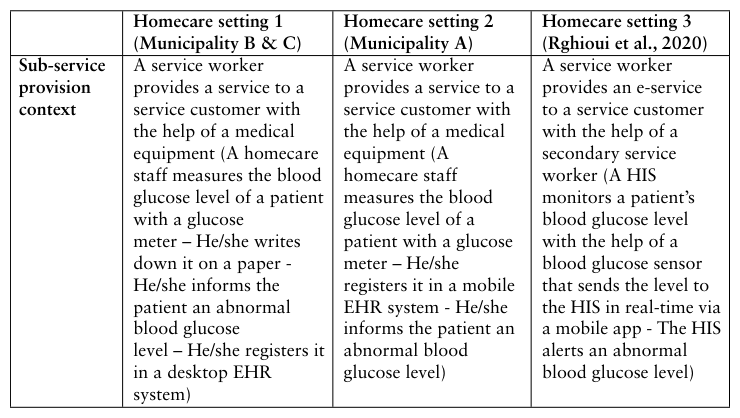
Table 2 shows the idented key components. Service objective, service set- ting, and service process are the same in the three settings. Service customer and secondary service customer can be different in remote monitoring, as the HIS alerts a care professional first before a patient is notified. In homecare setting 1 and 2, a patient with diabetes become service customer and family members of the patient become secondary service customer. A HIS moni- toring patients’ condition is a service worker in remote monitoring, while a homecare staff is a service worker for homecare setting 1 and 2. Remote monitoring has a blood glucose sensor and a mobile app as secondary ser- vice workers, whereas homecare setting 1 has a glucose meter and a desktop EHR, and homecare setting 2 has a glucose meter, a desktop EHR, and a mobile EHR. While remote monitoring has human to computer or computer to computer interaction, homecare setting 1 and 2 have human to human or human to computer interaction as service interaction type. Homecare set- ting 1 also has human to physical evidence (a paper form) interaction. A service worker (a HIS) provides an e-service to a service customer with the help of the secondary service workers in remote monitoring, while a service worker (a homecare staff) provides a service to a service customer (a patient) with the help of a medical equipment (a glucose meter) in homecare setting 1 and 2.
Table 2. Key components of homecare services in case of caring people with diabetes.
(Continued)
Transforming the Homecare Offering Scene: How the Technology Plays a Role 51
Table 2. Continued.
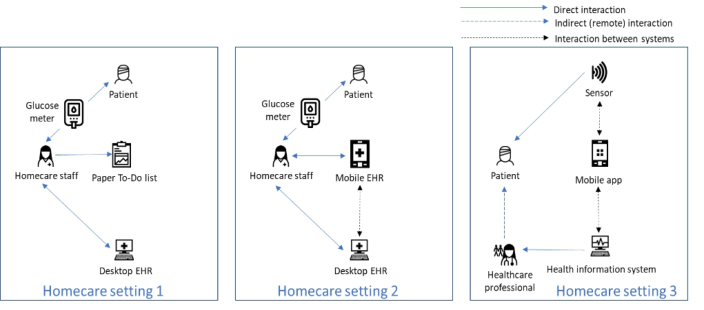
Figure 1 shows interactions among the actors in the three settings. In home- care setting1, the homecare staff interacts with the patient, a glucose meter, a paper form, and a desktop EHR. When a mobile EHR is integrated, the homecare staff does not need to interact with a paper form anymore. Instead, the mobile EHR communicates with the homecare staff and a desktop EHR (homecare setting 2). In case of remote monitoring (homecare setting 3), the homecare staff is not in the scene anymore, but then a sensor keeps inter- acting with the patient and a mobile app. The mobile app interacts with a health information system. A healthcare professional interacts with the health information system and the patient.
Figure 1: Interactions among the actors in the homecare setting 1, 2, and 3.
When there is no digital health solution in the homecare offering scene, a paper plays a vital role not only as a mean to show a To-Do list but also as a mean to write down important information on and to refer for registering the information in a desktop EHR. When a mobile EHR appears in the scene, it takes over the paper’s roles and enables to register the information in the EHR
52 Lee
in real-time through it. This reduces administration time of the homecare staff although the staff might still need to use a desktop EHR from time to time (e.g., when they report deviations in municipality A). A sensor technology completely changes the homecare offering scene by transferring the patient’s health data in real-time via a mobile app to a HIS which monitors the data. As a result, there is no need for a visit by a homecare staff to measure the patient’s blood glucose level which means the role of the homecare staff is completely disappeared in the scene. The sensor allows a healthcare professional (e.g., a general practitioner) to be connected to the homecare offering scene remotely by sending the patient’s real-time health data via a mobile app to a HIS. The HIS alerts the healthcare professional when abnormal health data is observed so that he/she can notify this to the patient.
DISCUSSION AND CONCLUSION Digitalisation is happening everywhere in our society, and it changes the way how we work and the way how we offer services. Healthcare service is not an exception, however the changes often come slower than other types of services (Reddy and Sharma, 2016). It is not only because of the crucial- ity that healthcare service deals with people’s lives but also because of the complexity healthcare service possesses. A change in a service offering scene requires changes of work practices of all the actors who are involved in the service provision and consumption. The consequence of not properly digital- ising a healthcare service can jeopardises the whole healthcare information system and furthermore can threaten patients’ lives. Granja et al., (2018) also found from their systematic literature review that “workflow was the most relevant factor to the outcome of eHealth interventions across all entities.” Thus, understanding the current work practices and the expected work prac- tices in service level with an analytical and systematic approach is especially important for digital health projects.
We observed that the people, systems and even the physical evidence’ roles are changing in a healthcare offering scene as the consequence of adopting a digital health solution. Identifying the key components of the current and prospect service and understanding the possible changes of these roles in the healthcare offering scene might be helpful to pinpoint important things to take into account when digitalising the healthcare service. Considering the identified key components and the expected changes might be useful for designing or reforming the healthcare service including the workflow in a more appropriate way. This might contribute to reducing the failure rates of digital health projects eventually.
The results of our study also show that how an AI can transform healthcare offering scenes and what role it can play in the scenes. This is an important issue in today’s society. Examining a remote monitoring setting with an AI that has a function of automatic providing insulin via an invasive pump based on the patient’s blood glucose level might be interesting to study.
Self-efficacy is a key factor in chronic disease management (Chan, 2021) and important in person-centred care. Examining a setting of patient self- monitoring would also be exciting to see. In this case, the sensor might
Transforming the Homecare Offering Scene: How the Technology Plays a Role 53
empower patients to be more actively involved in their own care by alerting the patients abnormal blood glucose levels directly.
Our further research can also be identifying the key components of home- care services in the case of caring patients with other chronic conditions or patients with multiple chronic conditions. The other chronic conditions can be for instance, COPD or heart disease.
In this paper we do not discuss social, cultural, religious, and ethical issues that can be raised in relation to inserting a sensor under the patient’s skin. The selection of homecare setting 3 was made purely based on the aforementioned four criteria. Examining a setting of remote monitoring of the blood glucose levels using a non-invasive sensor would also be interesting to compare the results.
ACKNOWLEDGMENT
The study presented here was financed by the VISUAL project (project num- ber 219606) funded by the Research Council of Norway. We take this opportunity to thank all the participants who provided data for our study.
REFERENCES
Abouzahra, M. (2011) “Causes of failure in Healthcare IT projects”, proceeding of the Third International Conference on Advanced Management Science, Singapore, IACSIT Press, pp. 46–50. Baxter, P., Jack, S. (2008). Qualitative case study methodology: Study design and
implementation for novice researchers. The Qualitative Report Volume 13, No. 4 pp. 544–559. Berg, M. (1999). Patient care information systems and health care work: a sociotechnical approach. International Journal of Medical Informatics Volume 55, pp. 87–101. https://doi.org/10.1016/S1386-5056(99)00011-8 Bhardwaj, V., Spaulding, E. M., Marvel, F. A., LaFave, S., Yu, J., Mota, D., Lorigiano,
T.-J., Huynh, P. P., Shan, R., Yesantharao, P. S., Lee, M. A., Yang, W. E., Demo, R., Ding, J., Wang, J., Xun, H., Shah, L., Weng, D., Wongvibulsin, S., Carter, J., Sheidy, J., McLin, R., Flowers, J., Majmudar, M., Elgin, E., Vilar- ino, V., Lumelsky, D., Leung, C., Allen, J. K., Martin, S. S., Padula, W. V. (2021). Cost-effectiveness of a Digital Health Intervention for Acute Myocar- dial Infarction Recovery. Medical Care Volume 59, No. 11, pp. 1023–1030. https://doi.org/10.1097/MLR.0000000000001636 Bowen, G. A. (2009). Document analysis as a qualitative research method. Qualitative Research Journal Volume 9, No. 2, pp. 27–40. https://doi.org/10.3316/QR J0902027 Box, T. L., McDonell, M., Helfrich, C. D., Jesse, R. L., Fihn, S. D., Rumsfeld,
J. S. (2010). Strategies from a Nationwide Health Information Technology Imple- mentation: The Va Cart Story. Journal of General Internal Medicine Volume 25, pp. 72–76. https://doi.org/10.1007/s11606-009-1130-6 Chan, S. W.-C. (2021). Chronic Disease Management, Self-Efficacy and Quality of Life. The Journal of Nursing Research Volume 29, No. 1, e129. https://doi.org/ 10.1097/JNR.0000000000000422 Clark, J., McGee-Lennon, M. (2011). A stakeholder-centred exploration of the cur-
rent barriers to the uptake of home care technology in the UK. Journal of Assistive Technologies Volume 5, No. 1, pp. 12–25. https://doi.org/10.5042/jat.2011.0097
54 Lee
Dendere, R., Janda, M., Sullivan, C., Dendere, R., Janda, M., Sullivan, C. (2021).
Are we doing it right? We need to evaluate the current approaches for implemen- tation of digital health systems. Austrailian Health Review. Volume 45, No. 6, pp. 778–781. https://doi.org/10.1071/AH20289 Fatehi, F., Samadbeik, M., Kazemi, A. (2020). “What is Digital Health? Review of Definitions”, in: Integrated Citizen Centered Digital Health and Social Care. IOS Press, pp. 67–71. https://doi.org/10.3233/SHTI200696 Genet, N., Boerma, W., Kroneman, M., Hutchinson, A., Saltman, R. B. (2012).
Home care across Europe: current structure and future challenges. World Health Organization. Regional Office for Europe. Gentili, A., Failla, G., Melnyk, A., Puleo, V., Tanna, G. L. D., Ricciardi, W., Cascini, F.
(2022). The cost-effectiveness of digital health interventions: A systematic review of the literature. Frontiers in Public Health Volume 10. https://doi.org/10.3389/fp ubh.2022.787135 Granja, C., Janssen, W., Johansen, M. A. (2018). Factors Determining the Success and Failure of eHealth Interventions: Systematic Review of the Literature. Journal of Medical Internet Research Volume 20, No. 5, p. e10235. https://doi.org/10.2196/ 10235 Hägglund, M., Scandurra, I., Koch, S. (2008). Scenarios to capture work processes in
shared homecare-from analysis to application. International Journal of Medical Informatics Volume 79, No. 6, pp. 126–134. https://doi.org/10.1016/j.ijmedinf .2008.07.007 Jackson, C., Leadbetter, T., Martin, A., Wright, T., Manley, K. (2015). Making the complexity of community nursing visible: the Cassandra project. British Journal of Community Nursing Volume 20, No. 3, pp. 126–133. https://doi.org/10.12968/ bjcn.2015.20.3.126 Jiang, X., Ming, W.-K., You, J. H. (2019). The Cost-Effectiveness of Digital Health
Interventions on the Management of Cardiovascular Diseases: Systematic Review. Journal of Medical Internet Research Volume 21, No. 6, e13166. https://doi.org/ 10.2196/13166 Lazar, J., Feng, J. H., Hochheiser, H. (2010). Research methods in human-computer interaction. Wiley. Lee, E. (2017). “Identifying Key Components of Services in Healthcare in the Con-
text of out-Patient in Norway”. Proceedings of Healthinf 2017, Porto, Portugal, pp. 354–361. Madden, R. (2010). Being ethnographic: A guide to the theory and practice of ethnography. Sage Publications. Reddy, P., Sharma, B. (2016). Digitalisation: the future of health care. Journal of
Business Management Volume 11. Rghioui, A., Lloret, J., Harane, M., Oumnad, A. (2020). A Smart Glucose Monitoring System for Diabetic Patient. Electronics Volume 9, No. 4, pp. 678. https: //doi.org/10.3390/electronics9040678 Statistics Norway (2020). Dette er Norge 2020. Statistics Norway, Oslo, Norway. Statistics Sweden (2023). Summary of Population Statistics 1960–2022. Statistics
Sweden, Stockholm, Sweden. Stickdorn, M., Schneider, J. (2010). This is service design thinking. Wiley. United Nations (July 31, 2023). Ageing. United Nations Website: https://www.un.o rg/en/global-issues/ageing. World Population Review (July 31, 2023). Health Care Costs by Country 2023.
World Population Review Website: https://worldpopulationreview.com/country- rankings/health-care-costs-by-country.
LISTED IN THE AHFE DIGITAL BOOKSTORE CATALOGUE
Explore the complete digital volume
Emerging Technologies in Healthcare and Medicine
Read this individual research paper free through the original publisher, or explore the full digital proceedings book.
ISBN 978-1-958651-92-6
Explore this ISBN in the AHFE Bookstore ↗Listed in the July 2026 bookstore catalogue; search by ISBN to confirm current availability · Digital book purchase optional