Zhāng Píng, Hanyu Wang, Haokun Tian, Ruzhong Li (2023). Construction of Key Index System of Product Usability Design Based on User Operation Behavior -- An Example of the Intelligent Ultra-cryogenic Refrigerator. In: Usability and User Experience. AHFE Open Access, vol. 110, pp. 443–453. https://doi.org/10.54941/ahfe1003219
Publisher statistics will load when you open Metrics.
AHFE OPEN ACCESS OPEN ACCESS CONFERENCE PROCEEDINGS PAPER
Construction of Key Index System of Product Usability Design Based on User Operation Behavior -- An Example of the Intelligent Ultra-cryogenic Refrigerator
There is a contradiction between the increasing complexity of product functions and the ease of operation. This resulted in the ubiquitous usability problem of products. In view of the mismatch between product usage and user behavior logic, this study systematically analyzes the usage of product from the perspective of user behavior logic, and explores the usability requirements of intelligent ultra-low temperature refrigerators. This paper combines the theory of usability engineering to correlate usability requirements with product design elements. Correlation co-efficient and, weight are calculated by gray correlation analysis and the order relation analysis, and the key indicators of usability design of product are extracted, which provides key indicators, which provides key indicators for product optimization design, quantifies user demand, improves product usability, realize the interaction, mixing and symbiosis mode between human and intelligent machine. In the process of research, providing the intelligent ultra-low temperature refrigerator as an example. As a biological sample or special work piece manager, intelligent ultra-low temperature refrigerator is of great significance for speeding up medical research and promoting industrial development. This study constructs the key index system of product usability design. And by the user knowledge and design knowledge effectively matching to improve product availability, enriched the theoretical system of human-computer interaction design and usability, and provided decision basis for iterative innovation product design, reasonable allocation of resources.
The intemperance and imbalance of design and consumption have brought series of negative effects to human society. The commercialized design that caters to people’s material desire not only meets the diversified needs of users, but also intensifies the contradiction between the complexity of product functions and the ease of operation. This results in the ubiquitous usabi- lity problems of products, so user-centred design is needed to fully consider human-machine coupling. It is one of the core issues that needs to be conside- red in the process of product development and design to improve the usability of products by effectively matching user knowledge with design knowledge.
Under the tide of experience economy, domestic and foreign scholars’ research on product usability gradually increases, mainly focusing on usa- bility design and evaluation methods. Zhou, RG proposed a general usability evaluation method aiming at the fuzziness and uncertainty of users in pro- duct design attribute judgment, by combining the analytic hierarchy process (AHP) with fuzzy evaluation method (Ronggang Zhou & Alan H. S. Chan 2016). Su Jianning’s team firstly took automobile keys as an example to study product modelling design characteristics and attributes. Then they constru- cted an evaluation index model from the aspects of perceived usability and performance usability. Finally, they proposed a product modelling design usa- bility evaluation method based on naive Bayes method (Su Jianning et al. 2016). Li Yongfeng subdivided product usability into appearance, perception, and performance, and applied AHP method to construct product usability evaluation system (Li Yongfeng & Zhu Liping 2012). Liu Long solved the problem that existing methods only evaluate the overall usability of produ- cts. He proposed a quantitative usability assessment method based on failure mode and effect analysis (FMEA), and calculated the usability level of pro- ducts through the analysis and evaluation of product task set (Liu Long & Liu Huchen 2010). Zeng Dong obtained the usability related knowledge through the extraction of design knowledge and user knowledge, and analy- sed the usability problem of product hardware interface (Zeng Dong & Chen Yaming 2008). It could be seen that existing literature largely relied on the judgment of product design attributes, and the evaluation model was mainly constructed based on the mutual affinity of the indicators, so these methods rarely consider the internal uncertainty and fuzziness in the process of jud- gment. This study constructs the key index system of product availability design through demand visualization, by combination of grey association analysis method and sequence relations, goals like quantitative analysis of the demand from the vertical dimension layer and design elements, impro- vement of the evaluation system, effectively transformation of user intention into design schemes can be achieve. Also, it can help enterprises to effecti- vely optimize resource allocation, reduce production costs, improve product market competitiveness and increase user satisfaction.
BEHAVIORAL LOGIC’S NORMAL FORM OF INTELLIGENT ULTRA-CRYOGENIC REFRIGERATOR Human-computer interaction visualization includes data visualization and requirement visualization. Designers choose appropriate information repre- sentation form based on user needs, so that users could receive information and give orders naturally and smoothly, that is, demand visualization (Zhang Lin & Zhao Jing 2015). The requirements of users can be obtained by analy- zing their operation behavioral logic. Both physical logic and behavioral logic belong to decision logic in product design process(Xin Xiangyang 2015). “Physical logic” emphasizes the rational disposition of the attributes of the object itself, while “behavioral logic” pays more attention to the design of user behavior by following human behavior, purpose, and habit to plan the
Construction of Key Index System of Product Usability Design 445
behavior process, construct the common position between human and mach- ine, and create the interaction-mixing-symbiosis mode between human and intelligent machine (Alan Cooper et al. 2012).
Based on the hierarchical progressive behavioral logic model of behavi- oral cognition, interaction and experience, the usage mode of intelligent ultra-cryogenic refrigerator was systematically analyzed (see Figure 1). The mapping relationship between behavioral semantics conveyed by design ele- ments such as product shapes, structures, and functions were clarified, while the behavioral path was rationally planned to realize the natural interaction between human and computer.
Figure 1: The logical model of behavior.
Figure available in the original PDF paper.
Behavioral cognition is the information processing of product usage from the perceptual point of view, which provides decision-making basis for human-computer interaction. According to the use process of intelligent ultra-cryogenic refrigerator, the behavioral cognitive semantics are obtained and described dynamically (see Figure 2). In order to provide users with real- time and effective behavior order, action, state, and feedback instructions, the intelligent ultra-cryogenic refrigerator should be decomposed into simple and direct symbolic elements, projecting its shape, material, time, space, and other multi-dimensional semantic information.
Figure 2: The usage behavioral logic of intelligent ultra-cryogenic refrigerator.
Behavior interaction is to represent and extract behavior phenomena in the process of product operation, as well as deconstruct behavior actions and sequences according to space and time dimensions. Based on the contri- bution degree as a specific measurement criterion, the primary and secondary subordinate relationships of behavior are distinguished, and the direct action based on the core function of “cryogenic storage sample”product is extracted to represent the sequence of behavior: open door →search (sample storage location) →storage →closure (see Figure 3). The key to the successful intera- ction between users and machines is how to find the sample storage location quickly and accurately, avoid the biochemical reaction of samples caused
by frequent door opening and temperature rising, which could help to pro- vide a long-term stable storage environment, and enhance the availability of products.
Figure 3: The usage behavior path of users.
Figure available in the original PDF paper.
Behavioral experience is a comprehensive emotional experience formed by integrating cognition and operation. Intelligent ultra-cryogenic refrigerators are different from ordinary household refrigerators. Because of the special function of ultra-low temperature storage samples, users have higher requi- rements for their usability and pay more attention to safety, comfort, and reliability of product usage.
Usability requirements of intelligent ultra-cryogenic refrigerator include appearance availability, operational availability, and perceived availability. Appearance usability means that products interact with users through visual means such as shape or color, and the usability they present. Reasonable layout of design language can effectively convey behavioral semantic infor- mation for users. Operational usability refers to the feelings brought by the efficiency, performance, and feedback of the product in the specific use process, which would follow the users’ behavior path and optimize the con- figuration of functional elements to help users completing tasks quickly and efficiently. Perceived usability refers to the integration of visual, auditory, tactile, etc. multi-sensory interaction, the subjective impression and real fee- ling of usability that users may perceive during the task execution stage, which would lead to a comfortable and pleasant interactive experience.
RELEVANCE ANALYSIS OF AVAILABILITY REQUIREMENTS AND DESIGN ELEMENTS Availability Requirements of Intelligent Ultra-Cryogenic Refrigerator
Usability is a quality indicator to measure interactive systems or industrial products (NIELEN J.k. 2004). Originally derive from ergonomics, it focuses on the reliability and maintainability of industrial products. In recent years it has gradually extended to the field of interactive system design. According to the ISO 924–11 standard, usability is the degree to which a product could be effectively, efficiently, and satisfactorily achieved by a particular user in a par- ticular context. The usability attributes of industrial products and computer interaction interfaces are different due to their own characteristics.
The intelligent ultra-cryogenic refrigerator had the dual characteristics of industrial product and computer display interface. As an effective manager of biological sample or special work piece, it is mainly used in medical treatment and scientific research. The users are highly dependent on the reliability of the product and strictly control the temperature accurately and stably to avoid
Construction of Key Index System of Product Usability Design 447
the influence of temperature fluctuations on sample quality. The display con- trol system is not as complex as the computer interaction interface and has low demand for learnability and memorability.
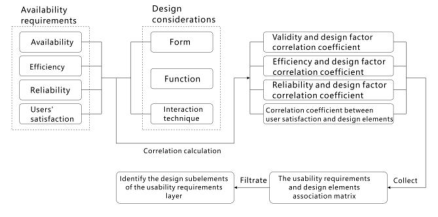
Based on the comprehensive availability requirements and the functional characteristics of the product, the availability requirements of the intelligent ultra-cryogenic refrigerator are finally determined as effectiveness, efficiency, user subjective satisfaction and reliability.
Computation of Weight of Availability Requirements Comprehensive analysis was used to determine availability requirements indi- cators: firstly effectiveness (UR1), efficiency (UR2), reliable (UR3) and user satisfaction (UR4) were labelled, then five usability experts and three rival firms were invited to score the indicators from 9 (very important) to 1 (very unimportant) respectively, after that the original data was collected, and finally the grey correlation analysis was applied to the demand weight calculation. The specific calculation steps were as follows:
k
Initial value: the reference number of the dependent variable was listed as the benchmark vector sequence, denoted as xo k
. The reference number of the independent variable was listed as a sub-sequence, denoted as xi
, and the original data was dimensionless.
k k
−minxi
Equations and mathematical formulas are available in the original paper PDF.
k
′
xi
(1) k k
maxxi
−minxi k i represents the serial number of scoring expert, and xi
refers to the set of scoring experts for each usability requirement.
Equalization: the absolute value of the difference between each sub- sequence and the benchmark vector sequence at each point was calculated, and then the maximum and minimum difference sequences were obtained.
k
k
k
△i
−xi
k
△i
represents the absolute value of the difference between the subsequ- ence and the benchmark vector sequence.
Calculation of the correlation coefficient: the data of absolute value points were obtained, and the correlation coefficient of each absolute value point was calculated according to formula (3).
k
Equations and mathematical formulas are available in the original paper PDF.
= m + εM △i k γ0i represents the relative difference between the subfactor and the parent factor at the point k, and the resolution coefficient ε is usually 0.5.
Calculation of correlation degree: the average value algorithm was used to calculate the correlation degree γ0i, and formula (4) is used to achieve the correlation coefficient of each requirement.
Competition demand correlation coefficient: after the availability demand correlation coefficient was calculated, the importance of competitive demand was also calculated by the same calculation method. The results could be seen from Table 1.
Table 1. Demands correlation.
Table available in the original PDF paper.
Demand UR1 UR2 UR3 UR4 User demand correlation ei 0.513 0.667 0.539 0.572 Competitive demand correlation degree wi 0.644 0.587 0.556 0.587
From the calculation results, it can be seen that the user demand ei and competitive factors wi.
pi = ei × wi, i = 1, 2, . . . , m (5) According to formula (5), the importance pi of availability requirement was UR1 (0.331), UR2 (0.392), UR3 (0.299) and UR4 (0.336). The order from high to low was:
UR2 (efficiency) >UR4 (user satisfaction) >UR1 (validity) >UR3 (reliability) Design Elements of Intelligent Ultra-Cryogenic Refrigerator
Unlike traditional products, intelligent interactive products have three ele- ments: form, function, and interaction. The optimal configuration of form and function elements are determined by user’s interactive experience. Form elements include colour, material, etc. of traditional products; functional ele- ments gradually extend from physical attributes of traditional products to user-centred emotional attributes; interactive elements as unique elements of interactive products, which include the design of software and hardw- are between human-computer interactions, are important factors affecting user satisfaction. The interaction among the three is manifested as follows: (1) form elements provide users with behavioural semantic information, which is a function in itself; (2) form follows behaviour, and behavioural interaction realizes product functions; (3) functional configuration influences interaction mode and form characteristics.
Functional Elements Product functional elements include basic functions and interactive functions. Whether functional elements are properly allocated directly affects product availability. The basic function of intelligent ultra-cryogenic refrigerator is to keep the samples in ultra-low temperature environment by cooling, and the interactive function includes intelligent interaction, temperature control, selection and so on. Refrigeration is a necessary condition for the normal operation of the machine, which is not included in the research of product availability. Interactive functional elements can be divided into intelligent gui- dance, temperature display, selection of freezing storage boxes, high and low
Construction of Key Index System of Product Usability Design 449
temperature alarm, and other functions according to user needs, as shown in Table 2.
Table 2. Usability functional elements of intelligent ultra-cryogenic refrigerator.
Table available in the original PDF paper.
Functional Temperature
Selection Function
Elements Control
Alarm Function Intelligent Interaction
1 Temperature
Intelligent
Optional network
regulation
High and low temperature alarm
guidance
2 Temperature
Statistical data Selection of frozen
record
High and low voltage alarm
storage shelves 3 Temperature
Alarm for heat
Search function Selection of frozen
display
storage box
dissipation difference of condenser
4 Alarm of ambient
Selection of liquid nitrogen standby
temperature exceeding standard
system 5 Power off alarm
Form Elements Form elements (as shown in Table 3) provide users with effective behavi- oral semantic information. Reasonable arrangement of form elements can optimize interaction performance.
Table 3. Usability form factor of intelligent ultra-cryogenic refrigerator.
Interactive Technology Elements Interactive technology elements are mainly divided into electrical control technology and display control technology, as shown in Table 4. Tempera- ture control technology is the safety guarantee of sample cryogenic storage, which can effectively enhance the reliability of the product; defrosting control technology directly affects the clarity of the interface of sample drawer, avoids the interface condensation frost caused by temperature fluctuation, and redu- ces the user’s operating performance; sensing technology is equivalent to the
product’s sensory system, which is an important medium for good communi- cation between human and machine. Interface interaction technology directly affects users’ emotional experience and subjective satisfaction.
Table 4. Usability interactive technical elements of intelligent ultra-cryogenic refrigerator.
Table available in the original PDF paper.
Technical Elements Electrical control technology Display Control Technology 1 temperature control Sensing Technology 2 Defrosting control Interface Interaction Technology
Relevance Solution of Availability Requirements and Design Elements Combining the usability design elements, three experts in the field of usabi- lity research were invited to grade the degree of influence to product design elements on demand from 9 (the degree of influence is very obvious) to 1 (the degree of influence is not obvious), and the original data were collected. The grey relational analysis method was used to match product design elements with usability requirements, and then the design elements under the mapping of usability requirements were obtained, as shown in Table 5.
THE KEY INDICATOR SYSTEM OF INTELLIGENT ULTRA-CRYOGENIC REFRIGERATOR DESIGN The key indicators are designed to provide decision-making basis for product design process and optimize the allocation of quality factors driven by user needs, so as to improve the availability of products.
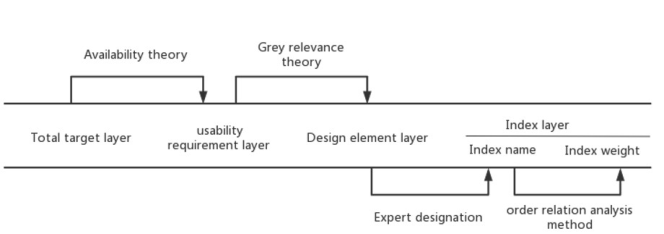
The key indicator system includes the general target layer, usability requi- rement layer, design elements layer and index layer, as shown in Figure 4. The relationship among the total target layer, usability requirement layer and design elements layer is a gradual hierarchical relationship, and the specific interpretation function of design elements layer is undertaken by the index layer. In order to construct the key index system for the availability of intelli- gent ultra-cryogenic refrigerator, the order relation analysis method should be applied to calculate the weight of each index and determine its priority order. From the usability requirement weight calculation, we can see that UR2 > UR 4 > UR 1 > UR3. Efficiency (UR2) is the most important and priority user requirement in the usability design of intelligent ultra-cryogenic refrigerator. Therefore, the index under efficiency (UR2) will be taken as an example to prioritize in the following section, as shown in Table 6.
Ten industry experts were invited to rank the indicators of each design ele- ment in the mapping of usability demand layer, and the order relation analysis method was applied to calculate the index weight. Take the calculation process of expert 1 as an example.
Known importance sorting E1 > E5 > E3 > E2 > E6 > E4, and translated into E1’ > E2’ > E3’ > E4’ > E5’ > E6’, namely the weight WE1 = WE1′,
Construction of Key Index System of Product Usability Design 451
Table 5. The relationship between usability requirements and design elements.
Table available in the original PDF paper.
Number Effectiveness (UR1)
efficiency (UR2) reliability (UR3) User Satisfaction (UR4)
Intelligent guidance
Temperature display Appearance
1 Overall dimensions
function Internal spatial
shape 2 Structural distribution
Segmentation
Appearance Internal space size High and low temperature alarm color
Temperature record Local proportion 3 Operating interface button size High and low voltage surface texture
4 Operating interface button
Size and distribution of alarm shape freezing shelf Sample box information Alarm for heat dissipation difference of
Display interface font
5 Button distribution of
interface
condenser
operating interface
6 Display interface
Display interface size layout Alarm of ambient temperature exceeding
Display interface color standard
7 Temperature
regulation
Power off alarm Display interface style
function
8 Statistical data
function
Selection of liquid nitrogen standby system 9 Search function Temperature control Interface interaction technology 10 Selection of frozen
technology
storage box and function of frozen storage box shelf
Figure 4: Product usability design key indicator system framework.
Table 6. The key indicator system of intelligent ultra-cryogenic refrigerator design.
Table available in the original PDF paper.
Indicator name Number
Overall target layer
Availability requirements
Design element layer layer
Intelligent
Whether the intelligent
E1
guidance
guidance function is function appropriate
Efficiency (UR2)
Internal space
Whether the internal
E2
division
space division is appropriate E3
The key indicator system of intelligent ultra- cryogenic refrigerator design
Internal dimension
Whether the internal space size is appropriate E4 Size and distribution Whether the size and distribution of freezers
of freezers
are reasonable E5 Whether the interface
Sample box information
information of the sample box is clear
interface Display interface layout
E6 is easy to understand
Display interface layout
According to formula (1) and (2), we can get: WE1=0.18, WE2=0.13, WE3=0.13, WE4=0.13, WE5=0.22, WE6=0.22. Calculate the average value to determine the weight of efficiency:
It could be seen from the index weight calculation that the intelligent gui- dance function could significantly improve the use efficiency of the product. Therefore, it could be seen that the intelligent guidance function was the key index of the usability design of the intelligent ultra-cryogenic refrigerator, which conforms to the logic of user operation behaviour, helped users qui- ckly and accurately located the sample storage location, efficiently completed interactive tasks, and optimized interactive performance.
CONCLUSION
With the rapid development of modern medical industry and industria- lization, intelligent ultra-cryogenic refrigerator, as the key equipment for cryogenic storage of biological samples or special workpieces, has been widely used. It is of great significance to speed up the level of medical rese- arch and promote industrial development. With the massive implantation of information technology and chips, the performance and operation of pro- ducts are becoming more and more complicated, which does not match the user’s cognitive and behavioural logic, and greatly decreases the availability of products. Therefore, in order to meet the needs of industrial develo- pment, it is particularly important to evaluate its usability and optimize its
Construction of Key Index System of Product Usability Design 453
product performance. This paper firstly systematically analysed the usabi- lity behavioural logic of intelligent ultra-cryogenic refrigerator, and deeply analysed its usability requirements. Then, by combining with usability rela- ted indicators, the usability requirements were matched with product design elements, after that grey correlation and sequence analysis method were com- bined to calculated the weight. The extraction of ultra-cryogenic refrigerator usability design key indicator-intelligent guidance would help users quickly and accurately find the location of the samples to store and complete tasks efficiently, ensure the stability of the samples, conform to the user’s beh- aviour logic, effectively improve the usability of products, and create the interaction-mixing-symbiosis mode between human and intelligent machines.
ACKNOWLEDGMENT
This paper supported by the 2020 Humanities and Social Science Rese- arch Foundation of Ministry of Education of China, Title: Research on the Design Strategy of Elderly Products Based on Sensory Compensation (20YJA760101). In addition, P. Zhang thanks to our dear friend Xiaomin Ding, always remember the contribution of her.
REFERENCES
Alan Cooper, Robert Reimann & David Cronin. (2012) About face 3 The Essence of Interaction Design. Liu Songtao (Trans.). Beijing: Publishing House of Electronics Industry. Li Yongfeng & Zhu Liping (2012). Product usability evaluation method based
on Fuzzy Analytic Hierarchy Process. Journal of Mechanical Engineering (14), 183–191. Liu Long & Liu Huchen. (2010). Product Usability evaluation method using FMEA.
Industrial Engineering Journal (03), 47–50. NIELEN J.k. (2004). Usability Engineering. Liu Zhengjie (Trans.). Beijing: China Machine Press, 2004: 16–24. Ronggang Zhou & Alan H. S. Chan. (2016). Using a fuzzy comprehensive evalua-
tion method to determine product usability: A proposed theoretical framework. Work (1). doi:10.3233/WOR-162474. Su Jianning, Liu Tingting & Wang Peng. (2016). Research on Usability Evaluation of Product Form Design Based on Naïve Bayes Method. Journal of Machine Design (02), 105–108. doi: 10.13841/j.cnki.jxsj.2016.02.021. Xin Xiangyang. (2015). Interaction Design: From physical logic to behavioral logic.
Art& Design (01), 58–62. doi: 10.16272/j.cnki.cn11-1392/j.2015.01.012. Zeng Dong & Chen Yaming. (2008). Evaluation System of Product Appearance Design Based on Usability. Packaging Engineering (01), 137–139+164. Zhang Lin & Zhao Jing. (2015). Visualization of User Requirements in Product
Design. Journal of Machine Design (7), 126–128. The doi: 10.13841/j.carol. carroll. nki. JXSJ. 2015.07.028.
LISTED IN THE AHFE DIGITAL BOOKSTORE CATALOGUE
Explore the complete digital volume
Usability and User Experience
Read this individual research paper free through the original publisher, or explore the full digital proceedings book.
ISBN 978-1-958651-86-5
Explore this ISBN in the AHFE Bookstore ↗Listed in the July 2026 bookstore catalogue; search by ISBN to confirm current availability · Digital book purchase optional