Oluwaseun Laseinde, Clinton Aigbavboa (2023). Exploring the Effectiveness of Collaborating Planning, Forecasting, and Replenishment (CPFR) in Enhancing Supply Chain Performance in Dropshipping. In: Production Management and Process Control. AHFE Open Access, vol. 104, pp. 146–154. https://doi.org/10.54941/ahfe1003955
Business operations have shifted from inter-organization to cross-enterprise due to supply chain management improvements and information technology advancements. New business models have emerged in response to the explosive growth of online retail, including the drop-shipping concept. Dropshipping is a relatively new type of order fulfillment in which the retailer does not store inventory. The merchant displays goods online and sends customer data to the producer, who ships straight to the customer. This method is frequently utilized as a supply chain solution to meet online demand. However, this model faces several challenges, such as uncertainty of demand, lack of control over inventory, and the need for efficient collaboration with suppliers. This paper explores the effectiveness of Collaborative Planning, Forecasting, and Replenishment (CPFR) in enhancing supply chain performance in dropshipping. Relevant literature on CPFR and drop shipping were explored and the findings indicate that CPFR is an effective strategy for improving supply chain performance in dropshipping. By enhancing collaboration and communication between suppliers and sellers, CPFR helps to mitigate the challenges faced by the dropshipping model.
E-commerce has offered various benefits to retailers in recent years. Many creative industry strategies, such as drop-shipping, have been introduced onto the Internet to improve traditional business processes. The drop-shipping concept emerges due to the advent of eCommerce (Zhang 2017). Drop- shipping is a new sourcing process that the retailer does not need to stockpile. The retailer shows products online and sends customer information to a sup- plier or manufacturer, who delivers the goods to the customer. Drop-shipping
Exploring the Effectiveness of Collaborating Planning, Forecasting 147
is a supply alternative frequently employed to meet online demand (Chiang and Feng 2017). One of the most notable differences between drop-shipping and other supply chain models discussed previously in literature is that wholesalers rather than retailers manage inventory control in dropshipping. (Netessine and Rudi 2004).
Dropshipping differs from conventional supply chain management, in which the wholesaler manages the inventory for the merchants (Katircioglu et al. 2014). One of the most notable distinctions between drop- shipping and traditional retailing is that drop-shipping relies entirely on the movement of products and information throughout the supply chain. In contrast, in conventional retailing, an actual store is required where a customer would select things and pay concurrently with the product’s receipt (Musa et al. 2016). However, this model faces several challenges, such as uncertainty of demand, lack of control over inventory, and the need for efficient collaboration with suppliers.
Collaborative Planning, Forecasting, and Replenishment (CPFR) is a sup- ply chain management practice that aims to improve communication and coordination between supply chain partners. It involves joint planning, fore- casting, and replenishment of inventory to ensure that the right products are available at the right time and in quantity. CPFR has been widely imple- mented in various industries and has significantly improved supply chain relationships and overall business performance.
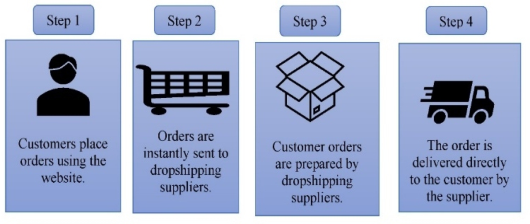
Dropshipping Supply Chain Dropshipping is an act whereby goods are provided directly from the manu- facturer to customers (Li, Zheng, and Liu 2020). Drop-shipping is an economical method for order fulfillment, meaning that the retailer forwards orders from consumers to manufacturers who are in charge of processing the orders and delivering the production products directly to the consumers (Lei and Xue 2021). There are various advantages to this unique model. One of the most significant advantages of dropshipping is the possibility of starting an internet business without investing much money in inventory. Traditio- nally, retailers have had to invest significant capital to purchase inventory. The dropshipping approach eliminates the substantial initial inventory cost requirement because no order is needed until the customer has finalized and paid for the transaction.
Dropshipping offers reduced operational expenses because product pro- curement and warehouse administration are not required. A dropshipping enterprise can function from any location with an internet connection if sel- lers and consumers can communicate easily. Because the offered item is not pre-ordered, shops can offer various products to potential buyers if the pro- vider has the item in stock. It’s easy to grow a drop-ship business because the distributor or supplier does most additional tasks instead of the retailer. The supplier is accountable for collecting, packaging, and transporting the merchandise to the client. The retailer is relieved of the pressure of order pla- cement and having things go wrong, which wastes money and effort (Hayes and Youderian 2013).
148 Laseinde and Aigbavboa
Figure 1: Author developed dropshipping model.
This technique has a significant disadvantage because it does not have all the product information (Cheong, Goh, and Song, 2015).
Due to the manufacturer’s lack of specific product descriptions, it is impos- sible to answer end-user inquiries concerning the product. This inadequate information may affect search engine optimization (Threlfal 2020). The effe- ctiveness of timeless communication within the supply chain management from the wholesaler and retailer to the consumer is critical to dropship- ping (Musa et al. 2016). Businesses across a wide range of industries are looking into ways to increase the effectiveness of their supply networks. These strategies successfully connect supply and demand, reducing inven- tory and stockouts. Supply chain members are eager to share information to estimate client demand better and manage business operations collabo- ratively (Min and Yu, 2008). The demand forecasting process has become more complicated as the lifespan of goods has been reduced, and demand for bespoke products has skyrocketed. According to Tyan and Wee (2003), sup- ply chain members need to be able to exchange information with each other. This procedure is made feasible through collaborative activities, assisting manufacturing and inventory control (Marquès et al. 2012).
Supply Chain Performance Supply chain performance (SCP) refers to the actions taken to expand the supply chain and meet customers’ needs. The SCP process commences with raw materials, advances through parts or components, assembly, and finished products, and ultimately culminates in the delivery of the final product to the customer. According to Banomyong and Supatn (2011), Supply Chain Perfor- mance can be defined as the efficiency of integrating and synchronizing the performance of supply chain participants, taking into account various perfor- mance metrics that are linked to those participants. Anand and Grover (2015) stated that Supply Chain Performance is a comprehensive methodology for assessing the efficiency and effectiveness of a company’s supply chain mana- gement. SCP is an operational measure that can enhance the performance of individual supply chain channels and the overall supply chain, depending on their level of engagement in the supply chain link (Gagalyuk, Hanf, and Hingley 2013).
Exploring the Effectiveness of Collaborating Planning, Forecasting 149
Collaborative Initiatives The industrial landscape has evolved dramatically during the last ten years. Instead of buying essential products given by manufacturers, the production sector has evolved into one defined by customization and a lack of confide- nce in the market’s demand and forecasts. As a result, it has become critical to approach supply chain collaboration strategically. It facilitates the esta- blishment of new income possibilities, efficiencies, and customer retention (Marquès et al. 2012).
Efforts to improve supply chain efficiency began in the 1980s and have since been widely applied. The administration of such programs mana- ges supply, manufacturing, and distribution by linking supply and demand (Vigtil and Dreyer 2008); as a result, waste is minimized, customer expecta- tions are met or exceeded, and service is improved (Gao et al. 2018). The purpose of collaborative supply chain operations is to acquire real-time infor- mation and build a transparent, observable trend that stimulates the whole supply chain (Dreyer et al. 2014). The concept of automatic replenishment Collaborative Planning, Forecasting, and Replenishment (CPFR) centers on the automated processes of operational activities that enhance product flow in the supply chain through accessible data flows (Dreyer et al. 2014). Orga- nizations that embrace such an Information and communication technology approach might profit from lower sales volumes, greater flexibility, and faster response time (Vigtil and Dreyer 2008).
Collaborative Planning, Forecasting, and Replenishment (CPFR) Collaborative Planning, Forecasting, and Replenishment (CPFR) were defi- ned by the Voluntary Interindustry Commerce Standards (VICS) as “a colle- ction of novel business strategies that harness the Internet and EDI to cut inventories and expenses while increasing customer experience significan- tly” (Chen, Yang, and Li 2007). The Voluntary Inter-industry Commerce Standard (VICS) Association created the CPFR committee in 1993 to regu- late the sector’s collaborative processes (Min and Yu 2008). The concepts of Efficient Consumer Response (ECR), including Vendor, Managed Inven- tory (VMI), Jointly Managed Inventory (JMI), Continuous Replenishment (CR), and Product Management, are the foundation upon which the CPFR system is constructed (Chungsuk Ryu 2014). While CPFR originated from conventional collaboration tools like EDI, VMI, and ECR, it varies in that it benefits all supply chain partners engaged by leveraging broader intera- ctive and communication systems throughout the supply chain instead of depending on restricted transaction-level automated processes (Min and Yu 2004). CPFR emphasized integrating the planning process, forecasting, and replenishment by enhancing information sharing (Chen, Yang, and Li 2007). CPFR emphasizes creating synergy across a large variety inside the sup- ply chain network, such as demand forecasting, production and purchasing management, and inventory replacement. The Dynamic Information Sharing Committee, which VICS sponsors, has more than 50 retail and manufa- cturing companies involved in creating CPFR (Chungsuk Ryu 2014). CPFR offers distinct characteristics that assist both consumers and suppliers. CPFR
150 Laseinde and Aigbavboa
achieves enhanced order fulfillment rates and improved cash flow, boosts inventory turnover, and minimizes stockout rates. Other advantages include accurate production planning, stronger business partnerships among mem- bers of the supply chain, fast turnaround times, reduced labor costs, and faster response to customer requirements. CPFR is implemented in several industries (Sherman, 1998; Min and Yu, 2004; Barratt and Oliveira, 2001).
CFFR Implementation Success In 1995, Wal-Mart and its supplier, Warner-Lambert, launched CPFR, which boosted average in-stock rates from 87 to 98 percent, reduced cycle dura- tions from 21 to 11 days, and massively increased sales by $8.5 million (Min and Yu 2008). To reduce stockouts, remove operational volatility, reduce overhead, increase prediction performance, and improve customer happiness, Coca-Cola FEMSA (KOF) chose to implement a supply chain management system. By deploying J.D. Edwards’ advanced Planning Solu- tion, KOF increased demand-planning accuracy to 93 percent and reduced stockouts to less than 1%. The system’s installation increased overall efficie- ncy and, most importantly, improved customer service (Attaran and Attaran, 2007). Herlitz AG, a German office supplies producer, shared information with its merchant, Metro, using CPFR, which resulted in a 15% reduction in inventory, a 50% reduction in stockouts, and a 3% gain in annual sales for the manufacturer (Min and Yu 2008).
Following the implementation of CPFR, Johnson & Johnson’s in-stock rate increased from 91.5 percent to 93.8 percent; Retailers Sears and Michelin reported in 2001 that Sears stores had more in stock, and Sears distribu- tion centers-to-stores increased by 10.7%, while the overall inventory level of Sears and Michelin had decreased by 25% (Steermann 2003). Sagar (2004) reviewed Whirlpool Corporation’s implementation of CPFR and found that it significantly reduces inventory (Hill, Zhang, and Miller 2018). General Electric (GE) worked with its retailers to respond efficiently to consumer demand rather than inventories. Focusing on a build-to-order system, Gene- ral Electric eliminated the costs of keeping inventory and putting together entire truckload transactions. Hence, GE’s sales and distribution expenses were lowered by 12 percent. In addition, retailers reported fewer out-of-stock incidents and enhanced their profit margins on GE merchandise (Niemann, Kotzé, and Jacobs 2018). Mark Barratt & Oliveira (2001) also claimed that CPFR might significantly reduce inventory levels.
In a study case, Esper and Williams (2003) discovered that CPFR could improve collaborative transportation management (CTM) outcomes and revenue (Angulo, Nachtmann, and Waller 2004). As Smaros (2003) pointed out, CPFR made it possible to find out about problems in the supply chain process early because it sent out alerts when things didn’t work out how they were supposed to. By exchanging advanced sales data, the apparel industry increased its forecasting accuracy from 45% to 92%, as seen in the case of Levi Strauss and Company (Småros et al., 2003; Aviv, 2001). Heineken USA began using CPFR in 1996 to reduce cycle time, and it now offers collabo- rative planning and replenishment software to its 100 best partners (Danese 2007).
Exploring the Effectiveness of Collaborating Planning, Forecasting 151
Improvements in demand management and replenishment management assist in ensuring that the appropriate goods are supplied to the appropri- ate clients at suitable timeframes. Supply chain responsiveness will result in a higher inventory level being effectively distributed and managed in the sup- ply chain (Seifert, 2003). CPFR deployment success for other companies is mentioned in (Seifert 2003).
CPFR Products and Opportunities Collaborative technology solutions have seen a significant increase in popu- larity lately. There are no exceptions when it comes to collaborative supply chain solutions. Collaboration solutions will be in demand as e-commerce advances. Leading online platforms now bring together key market players to collaborate on material supply and distribution. Supply chain collaboration advantages are becoming more widespread, leading to deeper one-on-one collaboration between stakeholders. Business to Business exchanges such as “Worldwide Retail Net,” “Transora, and NetXchange” also use CPFR. “Worldwide Retail Exchange” and “GlobalNetXchange” have agreed to embrace CPFR, which is expected to lead to a significant shift in how the world operates together in the following decades. They seek to expand participation in CPFR by creating a shared platform for all participants. It is anticipated that these e-marketplaces will significantly increase con- sumer response and revenues while simultaneously reducing operating and information-sharing costs. CPFR’s advantages will continue to be recogni- zed by more enterprises as e-marketplaces are endorsed and widely known (Attaran and Attaran 2007).
CONCLUSION
With the growth of e-commerce, many e-tailers are selling things online and providing value-added services to consumers via e-commerce platforms. Drop-shipping has become more widely known as an order fulfillment stra- tegy for e-commerce websites, resulting in a growing number of online stores; however, there is increasing pressure on dropshipping merchants to fulfill orders, necessitating the collaboration of dropshipping suppliers. SCM’s collaboration initiatives are a new phenomenon and have received more attention. CPFR has been embraced by many organizations worldw- ide in recent years. Many supply chains are already adopting CPFR as a new concept. In light of its tempting promises and implementation, the advantages and disadvantages of CPFR have been explored. The benefit of using CPFR for retailers is that it reduces out-of-stock situations and improves average inventory percentages. Retail management’s main propensity is to optimize the effectiveness of scarce resources to improve competitiveness throughout the supply chain.
CPFR is a valuable tool to connect various business processes through collaboration. Mutual understanding, on the other hand, is critical to succes- sful integration. Aside from exchanging information, efficient supply chain collaboration necessitates the transfer of ideas, technology, liability, and revenue. Relevant stakeholders must also consider their collaborators’ skills
152 Laseinde and Aigbavboa
Table 1. Collaborative products for the supply chain. Source (Attaran and Attaran 2007).
Table available in the original PDF paper.
Enterprise Features Voyager solutions/Logility (www.logility.com) Trading partners, including suppliers, manufacturers, and retailers, can engage with one another, integrate their processes, and connect their e-fulfillment operations with the help of this program. It enhances the capabilities of ERP and CRM systems in planning, forecasting, simulation, and order fulfillment. CPFR solution Manugistics (www.manugislics)
This business-to-business e-Commerce solution allows business partners’ networks to create, update, and analyze collaborative business strategies. Other features include demand forecasting, material design and request management, and collaborative production planning. Advance planning solutions Oracle J.D Edwards (www.ora cle.com)
This collaborative solution allows stakeholders in the supply chain lo communicate real-time supply and demand information. Agile software/Agile Anywhere (www.agile.com)
This software offers an internet-based, safe and flexible infrastructure, making it suitable for supply chain communication among businesses of various capacities. Retek Syncra Exchange (www.syncra.com, www.retek.com)
This program was designed following the specifications of the CPFR using a highly scalable “numerous” data model and collaborative design. These features enable a large number of interactions between buyers and sellers. Due to the product’s full compatibility with the industry’s most popular CPFR solution, it is simple to link trade exchanges with the expanding community of CPFR networks that significant producers and retailers host. CLO Express/CLO Express Co. (www.cloexpress.com)
This free website provides busy logistics professionals with access to compames involved with logistical solutions, information, journals, analytical tools, and academic and professional opportunities. Logistics experts can personalize their landing page with a single click. My SAP™/SAP (www.SAP.com)
By providing support for essential e-business operations, this application allows an organization to carry out supply chain design and logistics implementation beyond other enterprises. The solution includes (CPFR), (VMI), and transportation planning collaboration. JDA Software Collaborative Supply Chain Solutions (www.jda.com/default.asp)
This program allows distributors, merchants, and producers to collaborate on the same project. Retailers and wholesalers can use this software to effectively manage inventory decisions, reduce safety stock, and reduce the possibility of missed sales opportunities.
and technological expertise when deciding on the best partnership solution. A company’s CPFR can make a huge difference in how its supply chain works by planning for demand, scheduling production and operations, and develo- ping innovative products. To keep up, the CPFR will pressure the company to develop new and better-working methods by fostering a strong, mutual connection with customers.
In the context of drop shipping, CPFR can be an effective strategy for mitigating the challenges faced by this business model. By improving
Exploring the Effectiveness of Collaborating Planning, Forecasting 153
collaboration and communication between the seller and the supplier, CPFR can help to ensure that inventory levels are adequate to meet customer demand. This can help to reduce stockouts and improve customer satisfa- ction. Additionally, CPFR can help to reduce inventory costs by ensuring that inventory levels are optimized. In conclusion, CPFR is an effective strategy for enhancing supply chain performance in dropshipping. By improving collabo- ration and communication between sellers and suppliers, CPFR can help to mitigate the challenges faced by the dropshipping model, such as uncertainty of demand and lack of control over inventory.
REFERENCES
Anand, Neeraj, and Neha Grover. 2015. “Measuring Retail Supply Chain Performance: Theoretical Model Using Key Performance Indicators (KPIs).” Benchmarking 22(1): 135–66. Angulo, Andres, Heather Nachtmann, and Matthew A. Waller. 2004. “Supply Chain
Information Sharing in a Vendor Managed Inventory Partnership.” Journal of Business Logistics 25(1): 101–20. Attaran, Mohsen, and Sharmin Attaran. 2007. “Collaborative Supply Chain Management: The Most Promising Practice for Building Efficient and Sustainable Supply Chains.” Business Process Management Journal 13(3): 390–404. Aviv, Yossi. 2001. “The Effect of Collaborative Forecasting on Supply Chain
Performance.” Management Science 47(10): 1326–43. Banomyong, Ruth, and Nucharee Supatn. 2011. “Developing a Supply Chain Performance Tool for SMEs in Thailand.” Supply Chain Management 16(1): 20–31. Barratt, M, and a Oliveira. 2001. “Supply Chain Collaboration: Exploring the Early
Initiatives - Part One.” Supply Chain Practice 3(October): 34–47. https://www.in gentaconnect.com/content/cranfield/scp/2001/00000003/00000004/art00003 Barratt, Mark, and Alexander Oliveira. 2001. “Exploring the Experiences of Collaborative Planning Initiatives.” International Journal of Physical Distribution and Logistics Management 31(4): 266–89. Chen, Mu Chen, Taho Yang, and Hsin Chia Li. 2007. “Evaluating the Supply
Chain Performance of IT-Based Inter-Enterprise Collaboration.” Information and Management 44(6): 524–34. Cheong, Taesu, Mark Goh, and Sang Hwa Song. 2015. “Effect of Inventory Information Discrepancy in a Drop-Shipping Supply Chain.” Decision Sciences 46(1): 193–213. Chiang, W. K., and Y. Feng. 2017. “Retailer or E-Tailer? Strategic Pricing
and Economic-Lot-Size Decisions in a Competitive Supply Chain with Drop- Shipping.” Journal of the Operational Research Society 61(11): 1645–53. Chungsuk Ryu. 2014. “Review of Collaborative Planning, Forecasting, and Replenishment as a Supply Chain Collaboration Program.” Journal of Distribution Science 12(3): 85–98. Danese, Pamela. 2007. “Designing CPFR Collaborations: Insights from Seven Case
Studies.” International Journal of Operations and Production Management 27(2): 181–204. Dreyer, Heidi, Ola Strandhagen, Maria Kollberg, and Anita Romsdal. 2014. “An Operations Model for Automated Replenishment in the Pharmacy Industry.” (July 2014).
154 Laseinde and Aigbavboa
Gagalyuk, T., J. H. Hanf, and M. Hingley. 2013. “Firm and Whole Chain Success: Network Management in the Ukrainian Food Industry.” Journal on Chain and Network Science 13(1): 47–70. Gao, Yanni et al. 2018. “Supply Chain Coordination: A Review.” Journal of
Advanced Management Science 6(4): 213–17. Hayes, M, and A Youderian. 2013. The Ultimate Guide to Dropshipping. Hill, Craig A., G. Peter Zhang, and Keith E. Miller. 2018. “Collaborative Planning, Forecasting, and Replenishment & Firm Performance: An Empirical Evalua- tion.” International Journal of Production Economics 196(April 2017): 12–23. https://doi.org/10.1016/j.ijpe.2017.11.012 Katircioglu, Kaan et al. 2014. “Supply Chain Scenario Modeler: A Holistic Executive
Decision Support Solution.” Interfaces 44(1): 85–104. Marquès, G., J. Lamothe, C. Thierry, and D. Gourc. 2012. “A Supply Chain Performance Analysis of a Pull Inspired Supply Strategy Faced to Demand Uncertainties.” Journal of Intelligent Manufacturing 23(1): 91–108. Min, Hokey, and Wen Bin Yu. 2008. “Collaborative Planning, Forecasting and
Replenishment: Demand Planning in Supply Chain Management.” International Journal of Information Technology and Management 7(1): 4–20. Min, Hokey, and Wenbin Yu. 2004. “Association for Information Systems AIS Electronic Library ( AISeL) Collaborative Planning, Forecasting and Replenish- ment : Demand Planning in Suppply Chain Management Collaborative Planning, Forecasting and Replenishment : Demand Planning in Supply Ch.” Musa, Haslinda Binti et al. 2016. “Drop-Shipping Supply Chain: The Characteristics
of SMES towards Adopting It.” Social Sciences (Pakistan) 11(11): 2856–63. Netessine, Serguei, and Nils Rudi. 2004. “Supply Chain Structures on the Internet and the Role of Marketing-Operations Interaction.” Interna- tional Series in Operations Research and Management Science: 607–607. http://qbox.wharton.upenn.edu/documents/opim/research/Chapter19.pdf Niemann, W., T. Kotzé, and D. Jacobs. 2018. “Collaborative Planning, Forecasting, and Replenishment Implementation: A Case Study of a Major Grocery Retailer in South Africa.” South African Journal of Industrial Engineering 29(4): 1–16. Seifert, Dirk. 2003. Collaborative Planning/Forecasting, and Replenishment: How
to Create a Supply Chain Advantage. Sherman, Richard J. 1998. “Collaborative Planning, Forecasting & Replenishment (CPFR): Realizing the Promise of Efficient Consumer Response through Collaborative Technology.” Journal of Marketing Theory and Practice 6(4): 6–9. Småros, Johanna, Juha Matti Lehtonen, Patrik Appelqvist, and Jan Holmström.
2003. “The Impact of Increasing Demand Visibility on Production and Inventory Control Efficiency.” International Journal of Physical Distribution and Logistics Management 33(4): 336–54. Steermann, Hank. 2003. “A Practical Look at CPFR: The Sears Michelin Experience.” SUPPLY CHAIN MANAGEMENT REVIEW, v. 7, No. 4: 46–53. https://trid.trb.org/view/606662 Threlfal, Daniel. 2020. Dropshiping 101. Tyan, Jonah, and Hui Ming Wee. 2003. “Vendor Managed Inventory: A Survey of
the Taiwanese Grocery Industry.” Journal of Purchasing and Supply Management 9(1): 11–18. Vigtil, Astrid, and Heidi C. Dreyer. 2008. “Critical Aspects of Information and Communication Technology in Vendor Managed Inventory.” IFIP International Federation for Information Processing 257: 443–51. Zhang, Lu. 2017. “Research on the Improvement of Supply Chain Management
Under Drop-Shipping Model.” 107(Icedem): 251–55.
LISTED IN THE AHFE DIGITAL BOOKSTORE CATALOGUE
Explore the complete digital volume
Production Management and Process Control
Read this individual research paper free through the original publisher, or explore the full digital proceedings book.
ISBN 978-1-958651-80-3
Explore this ISBN in the AHFE Bookstore ↗Listed in the July 2026 bookstore catalogue; search by ISBN to confirm current availability · Digital book purchase optional