John M Ikome (2023). A Dynamic Approach to Minimise Bottlenecks and Improve manufacturing competitiveness in a case study manufacturing Industry. In: Production Management and Process Control. AHFE Open Access, vol. 104, pp. 127–136. https://doi.org/10.54941/ahfe1003060
Vaal University of Technology (VUT), Industrial Engineering and Operation, Management and Mechanical Engineering (IEOMME) Vanderbijlpark Main, Campus-South Africa ↗
Manufacturing organisations are key to the well-being of the society and the combination of competitiveness forces including modern technology adaptation is of great importance in order to obtain the goal of competitive improvement, particularly in a conflicted supply chain system during the production process, a number of manufacturing constraints were identified using the theory of constraint, namely, machine breakdown,employees absenteeism and power failure
Manufacturing organization plays a vital role to the society. According to a research work done by Barners and Kplinsky (2018), they talked about Ford and General Motors being the first to establish an assembling auto- motive plant in South Africa between the year (1924 to 1926), and further stated according to (Juliuse, 1986; Brooks, 1997), the major reason for this industries to enter South Africa was due to an anticipation of tariff protection.
Some basic components including batteries, tires and glass were sourced locally in the early 1930 but in general, these local components did not change much over the next decade and remained low. Although they were over 94 automotive part manufacturing industries that came into light in early 1958, less than 20% was value-added in the automobile manufacture and this picture did not change for over two decades (Julius, 1986), the reason being a huge number of the locally manufactured components were destines for after-market.
According to Naude 2015, et al. 2016, it is only 35 per cent of the local content of vehicles that is produced in South Africa, promoting a situation for automotive assembling plants to import a huge number of parts as local suppliers are lacking the market (Ambe, 2013; Pitot, 2017).
The automotive supply chain (SC) constitute many parties that are inte- grated to get a final product to a customer, this analysis, clearly shows that
this industry is very competitive globally and requires a world-class mana- gement strategy of philosophies such as speed response or just in time (JIT), continuous improvement (CI) and total quality management (TQM) (Naude, 2015). Despite all these strategies put in place and practice, the South African (SA) automotive industry faces realities and a lot of challenges of the right components or product being delivered at the right time and place, causing a bottleneck of work in progress (WIP) and customer’s delivery delays.
According to Barnes 2019, South Africa (SA) automotive industry com- pares favourably with other countries with similar industry in developing countries with regards to availability of raw materials, Flexibility in produ- ction, the support of government and infrastructure. However, despite these positive aspects, the South African (SA) automotive industry’s competitive- ness is under severe pressure (Barners, 2019), as it faces challenges such as bottleneck, poor infrastructures, technology and high labour costs.
This is further justified by a research work done by Badenhorst-Weiss et al., (2016); Moodley, Morris and Barnes (2014), where they narrated about the South African (ACMs), having to compete against cheap imported parts, including counterfeit parts in some cases.
In addition, the total number of vehicles produced in Africa in the year 2018 was 586 396 and out of that South Africa automotive manufacturing industry produced 539 424 vehicles which areare equated to 92% of total vehicles produced in Africa for that year (OICA 2018). When one looks at the figures, it might be convincing but in reality, in the international market, this is relatively small as it represents less than 1% of the international mar- ket share. Please see Table 1 for a total number of 84 141 209 new vehicles produced in 2018 and a 5.3% growth rate. According to the statistic from OICA (2018), from the year 2013 to 2018, the South African automotive shares increased steadily from 0.61% to 0.67% but unfortunately declined rapidly with 0.07% in 2018.
The global automotive industry is directed by a global trend of deve- lopment and satisfying the customers need or capacity demand, however since the introduction of globalisation, the automotive is experiencing huge challenges that are induced by mergers and acquisition, overcapacity, glo- bal manufacturing, strategies, outsourcing and insourcing, environmental requirement, innovation and technology.
Table 1. The global context performance of South Africa automotive industry: OICA (2018).
A Dynamic Approach to Minimise Bottleneck and Improve Manufacturing 129
As a result, all of these constraints have a major impact on emerging nati- ons like South Africa (AIEC, 2018). As a result of the aforementioned, the survival and growth of the South African (SA) automotive industry, parti- cularly (ACMs) global competitiveness is vital for the growth of the nation and as an objective, it is imperative to identify the bottleneck and possible solutions to the competitiveness of the South African automotive industry.
METHODOLOGY
In order to understand the bottleneck within the South African automotive industry, limiting iT competitiveness, a dynamic approach was used, whe- reby a well structure questionnaire was developed and administered in a selected case study automotive industry in South Africa for data collection. The questionnaire aimed was to identify factors that influence the global competitiveness of the South African automotive component industry, as such, all items related to the research objective are presented and followed by a summary of the findings. Sturgeon, et al., (2019), outlines that the important mechanism underlying globalisation is the transfer of advanced manufacturing capabilities to developing economies, at levels of productivity, cost competitiveness and quality is very important.
RESULTS
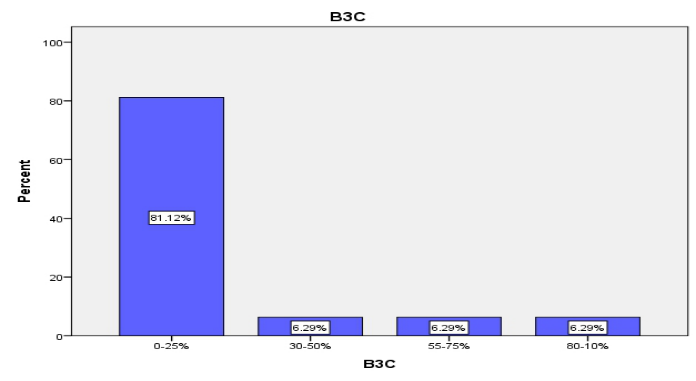
This section presents the results of the descriptive statistics in terms of the mean values and standard deviation for the implications and barriers preven- ting the SA automotive industry from being a globally competitive variable. Table 2 and Figures 1 to 5 show the overall mean values and distributions for the implications and barriers variable.
Based on the means values in Table 2, the respondents stated that even though they believe that lower labour productivity and higher cost of capital are the main factors that affect the automotive component industry’s compe- titiveness in manufacturing, they do not get their components to get or source raw materials within their local province. Therefore, these mean values indi- cate that, on average, the influence of the implications and barriers preventing the SA automotive industry from being globally competitive on the compe- titiveness improvement in the South Africa automotive industry was rated as being around average (2.10 out of 4) by the respondents, and this means that from a descriptive perspective, the respondents perceive that the impli- cations and barriers that are preventing the SA automotive industry from being globally competitive influences the strategies and policies that can be recommended to ensure the sustainability of the SA automotive industry.
To Identify Factors That Influence the Global Competitiveness of South Africa’s Automotive Component Industry Kaplinsky and Morris (2000) noted that the process of production and the tangible activities of transforming goods have become contracted in develo- ping countries, while the implications of industrial activities are becoming
130 Ikome
Table 2. Mean values for implications and barriers.
Table available in the original PDF paper.
Questionnaire items N Minimum Maximum Mean Std. Deviation
143 1 3 1.37 .738
Development Support Of OEM Suppliers
143 1 4 2.66 .864
Cluster Development Programs
143 1 5 1.59 .944
Immediate Vicinity 143 1 4 1.66 .978 Within The Local Province 143 1 4 1.32 .698 Locally 143 1 4 1.38 .862 Globally 143 1 4 1.70 1.075 Profitability 143 1 5 1.54 .984 Research and Development Spend
143 1 5 1.81 1.113
Skills 143 1 5 1.99 1.374 Incentives To The Government
Lower Labour Productivity And Higher Cost Of Capital
143 1 4 3.20 .988
Lower Operating Efficiency And Greater Transactional Cost
143 1 4 3.34 .759
Poor Infrastructure 143 1 4 3.64 .549 Labour Productivity Costs 143 1 4 3.58 .621 Automotive component industry
143 1 4 3.64 .576
Decline In Local Content 143 1 4 3.34 .950 Competition In The National Markets Component Industry 143 1 4 3.46 .602 AVERAGE 4 2.10
globally isolated therefore ethereal functions like research and design and financial services have become contracted in developed countries.
Barnes & Morris (2018) states that for the BRIC countries to develop their global competitiveness in the automotive industry, the approach is to
A Dynamic Approach to Minimise Bottleneck and Improve Manufacturing 131
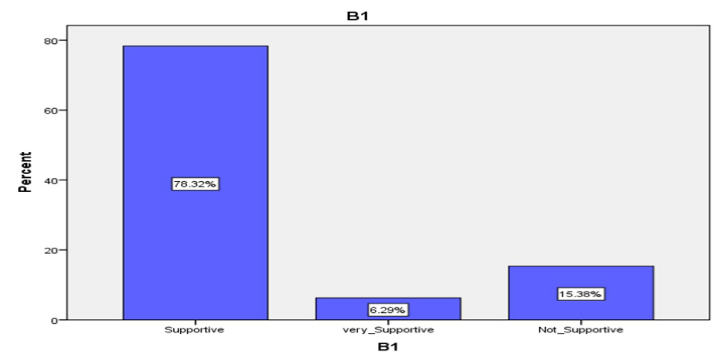
ensure that technical compliance with global OEMs standards is achieved. Damoense and Alan (2014) emphasised that the South African automo- tive component industry sees its integration into the global value chain as direct exposure to global competition. Therefore substantial performance upgrades in the South African automotive industry is due to competitive forces, which limits the opportunities for increases in value addition and out- put. Figure 1 reflects that overall 78.3% of the responses indicated that the supplier development support received from OEMs are supportive.
Additionally, the results show that 6.2% of responses rates supplier deve- lopment programs as very supportive. While 15.3% respondents indicated that it not supportive at all. Overall, these results only reveal that most respondents reported the support received from OEMs as being supportive.
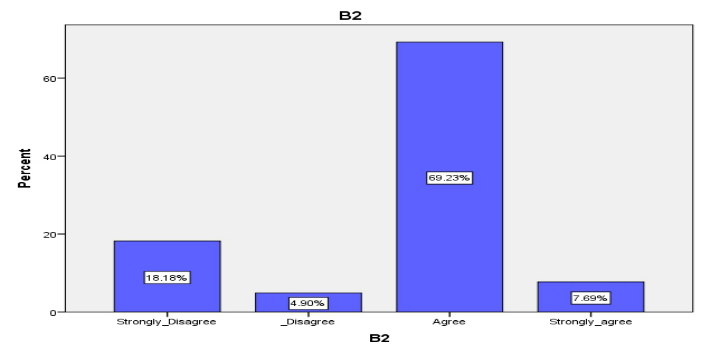
According to Figure 2, overall of 69.2% of the respondents agreed and 7.6% strongly agreed that cluster development programs in the auto com- ponent industry have supported component manufacturers to improve their competitiveness.
The results further outlined that 18.1% of the respondents strongly disa- greed and 4.9% disagreed that cluster development programs in the auto component industry have supported component manufacturers to improve their competitiveness. These findings agree with the research by BCG (2010:20) who reported that BRIC countries like India distinguish themse- lves from their competitors by adapting the cluster approach, where skills and technical expertise is maintained within the industry cluster which cre- ates a competitive advantage for the cluster operating environment. OEMs in India have used this competitive advantage for local sourcing as well as sourcing components for international use. Cluster development programs have positively impacted on improving supplier competitiveness globally.
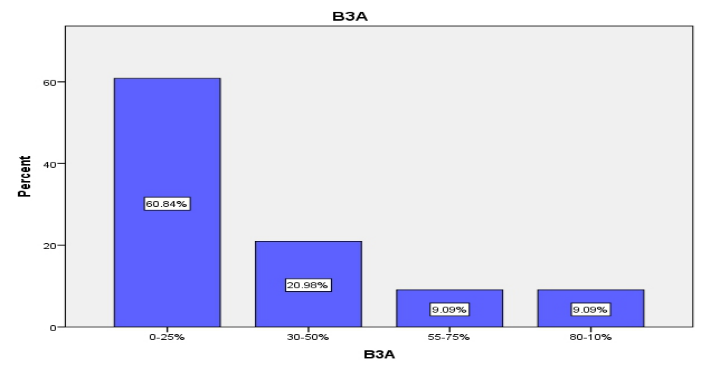
Figure 3 indicates that 60.8% of the respondents indicated that 0-25% of their inputs are sourced within a 100 km radius of their location, while 20.9% of respondents indicated that 30-50% of their inputs are sourced within
Figure 1: Supplier development support received from OEMs.
132 Ikome
Figure 2: Cluster development programs improve manufacturers’ competitiveness.Figure 3: The percentage of raw materials sourced within the surrounding area (in a radius of 100 km).
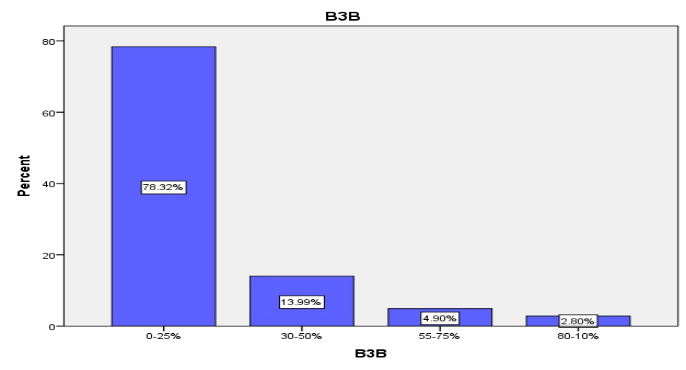
100 km radius of their location, 9.0% respondents indicated that 55-75% of their inputs are sourced within 100 km radius of their location and 9.0% respondents indicated that 80-100% of their inputs are sourced within 100 km radius of their location. The findings further indicate that 78.3% of the respondents indicated that 0-25% of their inputs are sourced within the local province, while 13.9% of respondents indicated that 30-50% of their inputs are sourced within their local province, 4.9% of respondents indicated that 55-75% of their inputs are sourced within the local province and 2.8% of respondents indicated that 80-100% of their inputs are sourced within the local province. Figure 5 outlines that 6.2% of the respondents indicated that 80-100% of their inputs are sourced locally; similarly, 6.2% of respondents indicated that 55-75%
A Dynamic Approach to Minimise Bottleneck and Improve Manufacturing 133
Figure 4: Materials are sourced within the local province.Figure 5: The percentage of raw materials sourced locally.
of their inputs are sourced within the country; in the same way, 6.2% of respondents indicated that 30-50% of their inputs are sourced nationally and 81.1% of respondents indicated that only 0-25% of their inputs are sourced nationally.
The Business Environment of South Africa After the reintroduction to the alglobal market, South Africa has attracted enormous FDI but faces extreme competition that limits its advancement from international industries whose main focal point is increasingly adva- ncing to emerging nations. Other emerging nations’ automotive groups including those of Thailand and Mexico enjoy the advantage of very les- ser prices and greater proximity to main export markets. However, to stay
134 Ikome
within the competitive framework, South Africa (SA) has to address its com- petitive flaws as well as assess its environment. The number of external environmental factors that might influence the automotive industry are as presented.
Political: South Africa is ruled as a legitimate parliamentary and democra- tic country, managed by President Cyril Ramaposal who is also president of the governing party ANC. According to Diewald et al., (2014), South Africa is stabilised in terms of its political situation as a nation and falls under one of six sub-Saharan African nations to under no circumstances have encountered a rebellion or related attempt (coup d’état).
Economic: South Africa has a blended market economy, alongside a resource-rich, middle-income growing market. Trades and industry are undertaken exclusively under the framework of a free enterprise economy. There was robust development from 2004 to 2007, but later the GDP drop- ped nearly 2% in 2009 but regained stability in 2010 – 2011 (Central Intellect Agency, n.d.). The unemployment rate in 2012 was 24.9%, which is a rise from 2011’s 23.9% (Statistics South Africa, 2018).
Social: As a nation, SA has a lot of resources but lack a proper workforce and skills in place. In an attempt to rectify this shortage, the government tried to derive strategies in other to accelerate the skilled labour, but notwithstan- ding all the efforts put in place, 29.7% was recorded in 2012 for unskilled labour (Saunders, et al. 2013). According to a report from Habte, Nardos (2017). This shows that South Africa (SA), has a total number of 27 docto- rates per million or 1 273 doctoral graduates for the entire population size, comparing this, it is a very low retrospective contrast to different nations and one of the significant difficulties for the nation and business. Without any doubt, it clearly shows that South Africa as a nation has a weakness in attracting global talent.
Technological: There is a limited electricity supply capacity and power dis- ruption from ESKOM resulting in several blackouts of electricity usage. SA is constrained as a result of fragile technological infrastructures that continue to be a barrier to the countries’ advancement in this modern world. Further- more, the Department of Trades and Industry (2017) stated that the increased manufacturing cost from electricity and steel price rise might have additio- nally hampered the development pace recorded in current years including the competitiveness of the sectors. According to Kgobe, Chidi and Bwagwan, (2014) research work, shows clearly that South Africa has a weakness related to the transformation of research into commercially viable out-puts (product and services). In 2011, the state was approved merely 123 patents, which is far lower than the number approved to emerging countries or growing economies such as Brazil, Russia, and India.
Environmental: The findings, as well as recommendations related to South African environments, are of less concern to the nation as it is proven gene- rally that the environmental factors are perceived to be less significant issues to address as they pose no danger to the society (Anderson, et al., 2013).
Legal – According to South Africa.info, (2013), the Roman-Dutch regula- tion and English law are the origins of South African law. Agreements relating to commercial transactions are applicable in a global standard and also in
A Dynamic Approach to Minimise Bottleneck and Improve Manufacturing 135
line with international conventions and norms. In addition, the terms of the courts apply equally to everyone regardless of nationality. An independed court ensures respect for commercial rights the sanctity of contracts being protected under the common law (South Africa.info, n.d 2013).
CONCLUSION
The result shows that the South African automotive industry can be global competitive if there are major restrictions on importation and cheap counter- feit automotive components that are a constrain to local manufactures.
REFERENCES
Ambe, I. M. (2013). Key Indicators for Optimising Supply Chain Performance: The Case Of Light Vehicle Manufacturers In South Africa. Journal of Applied Business Research (JABR), 30(1), 277–290. https://doi.org/10.19030/jabr.v30i1.8301 Anderson, B. A., Romani, J. H., Wentzel, M. & Phillips, H. E. (2013) Recycling
behavior among urban South African households: the role of race, history and social status. (Paper presented at the HSRC Seminar Series, 17 August). http://hd l.handle.net/20.500.11910/3967 Automotive Industry Export Council (AIEC). (2018) Automotive Export Manual 2018-South Africa. Pretoria: AIEC. 316 automotive industry. Insitute of Southeast Asia Studies: Singapore. Badenhorst-Weiss, J. & Tolmay, A. (2016). Relationship Value, Trust and Supplier
Retention In South African Automotive Supply Chains. Journal of Applied Busi- ness Research (JABR), 32(5), 1329–1340. https://doi.org/10.19030/jabr.v32i5. 9762 Barnes, J. (2019). on the brink? Skills demand and supply issues in the South African automotive components industry. The Need for Policy Alignment, HSRC Press, pp. 24–44. Barnes, J. & Kaplinsky, R. (2018) Globalisation and the death of the local firm?
The automobile components sector in South Africa. Regional studies, 34(9), pp. 797–812. Barnes, J. & Morris, M. (2018) Staying Alive in the Global Automotive industry: What can developing Economies Learn from South Africa about linking into Global Automotive Value Chains? European Journal of Development Research, 20(1): 31–55. Brooks-Gunn, Jeanne, & Greg J. Duncan. “The effects of poverty on children.” The
future of children (1997): 55–71. Damoense, M. Y. & Alan, S. (2014) An analysis of the impact of the first phase of South Africa’s Motor Industry Development Programme (MIDP), 1995–2000. Development Southern Africa 21(2) June: 264. Damoense, M. Y. & Alan, S. (2014) An analysis of the impact of the first phase
of South Africa’s Motor Industry Development Programme (MIDP), 1995–2010. Development Southern Africa 21(2) June: 264. Department of Trade and Industry (DTI). (2017b) Industrial Policy Action Plan (IPAP), The International Trade Administration of South Africa, Pretoria. Julius. “Anger and anxiety in borderline hypertension.” Psychosomatic Medi-
cine (1986).
136 Ikome
Kaplinsky, R & Morris, M. (2000) A handbook for value chain research. Durban: Industrial Restructuring Project, School of Development Studies, University of Natal. Kgobe, P., Chidi, M., & Bwagwan, N. Research Organisations Skills Plan 2013/14
Update. Centre for Education Policy Development (CEPD). South Africa: Edu- cation, Training and Development Practices Sector Education and Training Authority (ETDP SETA) (2014). Moodley Barnes, J. & Morris, M. (2018) Staying Alive in the Global Automotive industry: What can developing Economies Learn from South Africa about lin- king into Global Automotive Value Chains? European Journal of Development Research, 20(1): 31–55. Naude, Micheline & Badenhorst-Weiss, Johanna. (2016). Supply chain management
problems at South African automotive component manufacturers. 15. Organisation Internationale des Constructuers d’Automobiles (OICA), 2008, viewed 01 January 2018, from www.oica.net. Pitot, R. 2017. NAACAM and the automotive component industry. South African
Automotive Year Book. Definitive reference, statistics & data on the South African motor industry. Section 2: component manufacturing. 10th edition. Durban. Saunders, M., Lewis, P., & Thornhill, A. (2013) Research Methods for Business Students. 8th ed. Harlow: Pearson Education Ltd. Nardos (2017). SouthAfrica.info, (2013) SA Automotive Week. Focus on partnerships, 22 July.
[Online] Available at: www.saaw.co.za/News/09-07-22/focus_on_partnerships.as px. Accessed: 19 January 2020. Statistics South Africa, (2018). Quarterly Labour Force Survey, Quarter 4, 2017.
Statistical release P0211. Pretoria: Statistics South Africa. Sturgeon, T. J., Memedovic, O., Biesebroeck, J. V. & Gereffi, G.: Globalisation of the automotive industry: main features and trends. Int. J. Technol. Learn. Innov. Dev 2(1/2), 7–24 (2019).
LISTED IN THE AHFE DIGITAL BOOKSTORE CATALOGUE
Explore the complete digital volume
Production Management and Process Control
Read this individual research paper free through the original publisher, or explore the full digital proceedings book.
ISBN 978-1-958651-80-3
Explore this ISBN in the AHFE Bookstore ↗Listed in the July 2026 bookstore catalogue; search by ISBN to confirm current availability · Digital book purchase optional