Harsh Chauhan, Henrijs Kalkis (2023). Knowledge management capabilities in the intra-organizational environment. In: Human Factors, Business Management and Society. AHFE Open Access, vol. 97, pp. 220–229. https://doi.org/10.54941/ahfe1003898
To thrive and survive in current economic environment organizations realize the importance of developing knowledge management capabilities. The emphasis is on creating in-house knowledge and its distribution to various departments and functionalities. To attain the self-sufficiency of becoming knowledge based organizations venture in creating internal knowledge capabilities, strategic external acquisitions, integration of knowledge acquired in organizational structure, formal and informal dissemination and retention practices. The dependency of the roles and responsibilities given on business administrators for enacting the process of managing knowledge determines the outcome of developing knowledge management capabilities. The literature review examines issues related with knowledge management capabilities from the perspective of intra-organizational environment. The research identifies the factors influencing knowledge management from creation till retention within organization. The research theoretically examines systematic evaluation of comprehensive literatures. Various scientific theories has been assessed and taken into consideration for developing the construct of paper. It includes the selection of empirical studies from recognized databases and journals. The papers collected have been reviewed methodologically. The concepts of literature review is based on the analysis of scientific discussions and contribution from renowned authors. The Integration of knowledge management capabilities in intra-organizational environment is bonded with the application of knowledge cycle.
Knowledge management capabilities in dynamic intra-organizational envi- ronment have been perceived differently. Many organizations consider it as a pertinent strategic business management process for delivering best possi- ble services to satisfy market needs. For some it’s a long term human capital investments for achieving sustainability. Managing knowledge cycle in intra- organizational context has created competitive prospects. To consolidate their presence in market place business management reconcile knowledge assets as an intangible human resource which has the potential to deve- lop competitive advantage. The process of converting individual knowledge
Knowledge Management Capabilities in the Intra-Organizational Environment 221
into organizational knowledge many organizations launch extensive know- ledge management efforts (Gold et al. 2001). Workers perceive knowledge development as an added advantage for professional career development whereas organizational perspective sees it as a business development capa- bility. The success and failure of knowledge management within intra- organizational setup is heavily relying on the identification and assessment of preconditions broadly known as ‘capabilities’ and ‘resources’ (Inkpen and Dinur, 1998; Law et al. 1998).
In intra-organizational environment business administration set objecti- ves of constant knowledge development, integration, dissemination and retention. Exploring knowledge management capabilities requires flexible intra-organizational work environment that can leverage room for experi- ment and encourage creation of knowledge not only in terms of catering the demand of the market but also in order to accomplish the future uncertain economic challenges. The absorptive capacity and ability to use prior kno- wledge created within and to recognize the value of external resources in the formation of consistent knowledge development process leads to self- sufficiency (Cohen and Levinthal, 1990). Organizations emphasize creation of parallel support systems not only for facilitating knowledge development internally but also give emphasis on training modules, learning worksh- ops and dedicated seminars. The most experienced employees accumulating and transferring knowledge based skills and necessary resources to the next generations has proven its worth (Tasi and Goshal, 1998).
In the context of managing knowledge capabilities there is a lack of systematic review in intra-organizational environment. The aim of litera- ture review concentrate on how the knowledge management capabilities affect internal development and external acquisition, integration, sharing and prevention of knowledge loss is being managed within organizations. The previous researches on knowledge development capabilities have shown discrepancies. There is an opportunities to address the strategic initiati- ves taken by business management for developing a sustainable business environment that not only proliferates knowledge development capabilities but constantly sustain the endless need and surge for creation, acquisition and retention. The major emphasis of literature review is on recognized organizational capabilities specifically infrastructure and process capabilities. The research determines the importance of developing in-house knowledge, acquisition of external resources, communications between departments for integration of knowledge, interactions and interrelationships developed between individuals for knowledge exchange. The most critical aspect of kno- wledge management cycle is to retain and prevent the knowledge spill from the intra-organizational environment.
THEORETICAL APPROACH AND METHODOLOGY To establishing the ground theories for research systematic approach has been adopted to review the papers (see Table 1, Table 2, Table 3). The methodo- logy adopted for the purpose of comprehensive literature review has been conducted, it consist of selecting many publications that has been explored by
222 Chauhan and Kalkis
Table 1. Methodology of selected articles.
Table available in the original PDF paper.
Terminology Google Scholar
Emerald Insight
EBSCO Science Direct
14 8 11 13
Managing knowledge process in organizations.
16 7 9 11
Knowledge management within intra-organizational boundaries.
13 12 9 10
knowledge management capabilities in intra-organizational setup.
15 10 8 12
From knowledge creation to retention in organizations.
scrutinizing recognized scientific databases, publications and journals (Please refer Table 1). The selection criteria includes the use of key terms and state- ments taken from research title and other meaningful sentences has been used to examine previous academic literatures available on knowledge manage- ment capabilities and its relation to intra-organizational environment. The methodology of selecting the articles is based on PRISMA 2020, preferred reporting items for systematic reviews and meta-analyses statement publishes in the year 2009, widely recognized among scientific and academic commu- nity. It was designed to review systematically and reporting transparently the views of authors and their findings. PRISMA 2020 consist of 27 items, it is an expanded detailed reporting checklist more advanced in identifying, sele- cting, appraising, synthesis studies and it replaces traditional 2009 version (Page et al. 2021).
Managing knowledge capabilities within intra-organizational environ- ment requires collaboration. All the departments and establishments within intra-organization has a role to play. The Functional and the operational business units has to adopt specific strategies. Not only to overcome orga- nizational barriers but also psychological traits have major implications on creation, acceptance, integration and dissemination process. For develo- ping intra-organizational capabilities with the environment the infrastructure needs to go through with constant transformation. The process within the
Knowledge Management Capabilities in the Intra-Organizational Environment 223
organization must be in sync with integration. The coordination and coo- peration from top to bottom management structure have shown significant influence. Many authors and researchers have highlighted the significance of establishing knowledge management capabilities related to the basic buil- ding blocks. The foundation of knowledge management must be mutually associated with the development of sound infrastructure capabilities and also flexible yet effective process capabilities.
KNOWLEDGE INFRASTRUCTURE CAPABILITIES knowledge management process in intra-organizational structure is quite daunting task. The knowledge infrastructure capabilities are internally crea- ted within the intra-organizational environment. The paradox of knowledge management capabilities are depending on developing new infrastructure through generic process. In general the knowledge management structure is developed in combination of three main variables. It consist of develo- ping capabilities of understanding of exact knowledge requirements based on technological grounds, structural absorption process followed by kno- wledge management capabilities in organizational culture. The three major infrastructural knowledge management capabilities are stated as technical, structural and cultural.
Technical capability indulge in ensuring technological dimensions that exists within intra-organizational environment (Brown and Duguid, 1998; Leonard and Sensiper, 1998; Teece, 1998). Technology is a crucial variable of mobilizing human resource for creating knowledge (Duncan, 1972). Infor- mation and communication are vital resources for developing knowledge. User friendly technology can yield desired solutions and have an effective outcome, it also enables consistent flow of information exchange betw- een departments and individuals. Technology includes “business intelligence, learning distribution, Knowledge discovery and mapping” (Grant, 1996). Technologies related with business intelligence helps organizations to create knowledge in respect to the competition in economic environment. Distri- bution of learning and knowledge created helps organizations to collaborate and interact with individuals from different areas further develop many pos- sibilities to enhance knowledge capabilities. Discovery of knowledge within or outside the organizations always help growth and development. Kno- wledge mapping technologies allow organizations to track the source of knowledge and prepare themselves to acquire and integrate it within intra- organizational environment. Apart from these technological capabilities of creating, acquiring, integrating, transferring and storing organizations are constantly evolving their process of maintaining and consistently managing new resources and capabilities.
Structural capabilities denotes norms and trust in mechanism developed by organization to facilitate knowledge management process (Nonaka, 1994; Sanchez et al. 1996). Without structural capabilities technology cannot per- form. For individuals to work with technology structural specifications must be in place. It affects collaboration, coordination of managing knowledge across intra-organizational environment. Individual efficacies are depending
224 Chauhan and Kalkis
on the structural capabilities of incorporating technological dimensions (Dell and Grayson, 1998). Structural capabilities endeavor optimization of know- ledge and its dissemination in various parts of organizations The design of structure is an key element to work technology efficiently. Although stru- ctural elements are not only responsible for effectiveness of technology to function but also it helps to strengthen operational dimensions of businesses. The “modular organizational design”enlarge “coordination and adaption by giving more strategic leverage to the organizational structure” (Sanchez et al. 1996). By developing new flexible organizational structure in combination with formal and informal, hierarchical and non-hierarchical, self-organized have an extraneous effect on the functionality of organizations. It has been observed that such organizations are quite capable of delivering effecting product and services (Nonaka, 1994). Structural capabilities can also affect organizational policies, rules and regulations towards managing knowledge process. The organizations structural dimensions must have the capacity to remain flexible in adopting systems and the process of developing knowledge management. There are examples where organizations reward employees and motivate them to contribute more in developing new knowledge that helps in generating more business (Dell and Grayson, 1998; Argote and Epple, 1990).
Cultural dimensions shape knowledge based organizational environment (Appleyard, 1996; Von Krogh, 1998). Strong organizational culture is a clear indication of stronger mission, vision and values. The vision permea- tes organizations to transcend, promote changes, solidify attitude and beliefs (Davenport et al. 1996). It can develops a strong sense of understanding and urgency towards developing core foundations for managing knowledge capa- bilities in business environment. It can also influence type of knowledge and related activities that organization would like to develop in present and future (Levinthal and March, 1993; Miles et al. 1997). Precise stated clear vision statements enhances knowledge management behaviors (Von Krogh, 1998). The cultural dimensions directly influences knowledge management capa- bilities (Davenport et al. 1998). Culture proliferates innovation process, it helps to strengthen the ties between colleagues, helps uninterrupted flow of information, produce ideas and expand horizons to develop more qualitative knowledge (Arrow, 1962; Leonard and Sensiper, 1998). Such organizatio- nal culture empowers employees to take autonomous decisions, encourage self-organizational practices and facilitate constructive solutions (Dell and Grayson, 1998).
KNOWLEDGE PROCESS CAPABILITIES Knowledge process capabilities comprises of acquisition process, conversi- on/integration process, application/dissemination process and protection/re- tention process.
Acquisition process starts with the identification of the requirements to fulfil the knowledge gaps that exist internally (Dell and Grayson, 1998). Although the acquisition is from outside the organization but it needs care- ful examination of whether the knowledge acquired fits in the organizational environment. Obtaining knowledge from outside relies heavily on high degree
Knowledge Management Capabilities in the Intra-Organizational Environment 225
of experience and recognition (Minbaeva and Michailova, 2004). The pur- pose of acquisition must be very clear either it should increase the existing capabilities or completely transform the dimensions of current knowledge state (Inkpen and Dinur, 1998). The acquisition takes place on two sides. 1st individual that brings perspective and differences that can be used to deve- lop knowledge in existing capacity (Chesbrough and Teece, 1996; Homans, 1950). 2nd collaboration between organizations for developing new kno- wledge for e.g. sharing technology, expertise, establishing alliance, joint ventures (Khanna et al, 1998; Zander & Kogut, 1995; Kogut & Zander, 1992; Kogut & Zander 1996). Integration process ‘how internal and external knowledge can be dissolved in current intra-organizational environment’. It requires ability to organize, combine, coordinate and collaborate with other entities (Ghoshal; et al. 1994; Coleman, 1990). A significant framework of knowledge must be in place to absorb both the knowledges (Dell and Grayson, 1998). Without common standards of understanding whole process might get jeopardize. In certain cases it leads to redundancy and shading unnecessary loads where no longer services of individuals are required or outdated knowledge no longer nee- ded. This is most common procedure adopted when two organizations goes through with the process of merger and acquisition (Grant, 1996; Hamel et al. 1989). The primary objective is to become self-sufficient and mechanism developed focuses on directives, initiatives, decision making and problems solving groups (Tsai and Goshal, 1998; Gulati and Gargulio, 1999).
Dissemination or sharing process targeted towards actual usage of kno- wledge. It can only be done when all the participants in organization are willing to share, adopt, and distribute knowledge and practice it frequen- tly. At this stage it is an ongoing process of further creating or polishing the knowledge because typically many brains are working together to achieve common goal (Spenders and Grant, 1996; Regan and McEvily, 2003; Knott, 2003). Process like knowledge application and transferring through training sessions, knowledge work shop, coaching, contributing, teaching and men- toring by the use of existing literatures, recording, translating of any form of knowledge data base only adds to knowledge sufficiency. Knowledge sha- ring results in product development acceleration, streamlining functionalities, customer support operations, achieving economies of scale, reduction of cost & expenditures and continuous market expansion (Lado et al. 1997; Hill et al. 1992).
Prevention or retention process is all about sustaining knowledge. To remain competitive for long time and having advantage over rivals know- ledge needs protection (Porter-Liebskind, 1996). Copyrights and patents can protect some parts but not all of it. Organizations adopt strict rules and regu- lations, prosecuting any gross misconduct are common usage of solidarity (Porter-Liebskind, 1996). Incentive schemes, bonuses and increments encou- rage and motivate employees to be a part of safe operations and practices. Security oriented process, knowledge spill over and loses due to resignations are also common traits (Barney, 1991).
Knowledge management capabilities takes effect depending on how orga- nizations manage infrastructure and process capabilities. Every part of
226 Chauhan and Kalkis
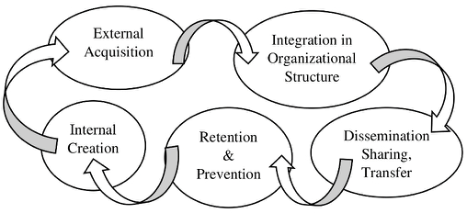
Figure 1: Knowledge management cycle.
infrastructural capabilities are equally important to facilitate knowledge management. Technological capabilities has its own effect on how organi- zations use information for developing knowledge. Structural capability is equally important for coordinating and collaborating knowledge in succes- sion cultural dimensions support knowledge based management process. The process capabilities are dependent of knowledge external acquisition, integra- tion, dissemination and prevention. In Figure 1, all these variables has been taken into consideration for development knowledge management cycle.
RESEARCH DISCUSSION AND FRAMEWORK Organizations creating knowledge internally cannot survive on their own, they equally need to concentrate on managing external sources of knowledge acquisition. Although the home grown knowledge is subjected to absorption and can be directly applied to the existing organizational framework rather than going through with the process of external acquisition, it save time and costs involved in the process (Cohen and Levinthal 1990). In general senior management initiate protocols, establish communication codes, directs infor- mation channels for managing knowledge (Grant 1996; Galbraith, 1973). Intra-organizational behavior, social ties, individual ambiguity, complexity of groups affects knowledge management capabilities (Nonaka, 1994; Albert et al., 2000; Carley, 1999). Subsequently intra-organizational relationship, individual selection, personal objectives influence knowledge management process (Oliver and Marwell, 1988; Bougon et al. 1997). Individual attitu- des and behavioral perspective, equality and level of acceptance, participation and personal interest, procrastination, exchange engagements creates hurdles in managing knowledge capabilities (Nonaka, 1994; Grant, 1996; Szulanki, 1996; Bales, 1950). Similarly the intra-organizational setup, disseminative and absorptive capabilities in the context of knowledge, personal choices and social preference has shown implications (Burt, 1982). Insecurity of pos- session, give away, selectiveness, quantity and quality of knowledge hampers knowledge managing capabilities in intra-organizational environment.
The research has identified step by step process of managing knowledge capabilities starting with internal creation, external acquisition, integrating knowledge, dissemination and retention. Knowledge management in intra- organization environment is cyclic process (Tang, 2011).
Knowledge Management Capabilities in the Intra-Organizational Environment 227
The knowledge cycle comprises of the first most prominent factor looking into internal capabilities of generating and creating knowledge from resou- rces available within the organizational environment. Next step is external acquisition of knowledge, once internal and external knowledge are in place it requires integration in organizational structure. When all the resources are in contention the knowledge is ready for segregation and distribution. Practices like training, workshops, seminars on job leader member exchange followed by retaining the talents and knowledge spill over. Also patents and copyri- ght needed to protect the knowledge along with motivation and incentives given to encourage workers for actively participating in dissemination and prevention.
CONCLUSION
Knowledge management capabilities involves complex process it has moved beyond information management. Efficient development of infrastructure and process capabilities determines the outcome. The initiation begins with organizations realizing and recognizing the importance of knowledge mana- gement, its creation, acquisition, integration, transformation and retention. Researches in knowledge management capabilities are still evolving. There are under covered areas which have not been given enough attention and relevance in discussions. For e.g. the maintenance of knowledge management activities, success and failure of knowledge management, organization’s iden- tification and assessment of preconditions necessary to facilitate capabilities, management layered structure, hierarchical dimensions, absorptive capabili- ties, organizational behavior and attitude towards knowledge management have under discussed. Apart from organizational perspective there are indi- vidual perspective must be taken into account during and after knowledge management process. For e.g. formal and informal settings between workers, management capability, close circle and relational ties, individual attitude and perception towards knowledge management, individual approach and initi- ative, access to external knowledge hubs, effect of retention & prevention and policies of individual career growth. To sustain knowledge management capabilities both organizations and individuals have a part to play. It’s an combined effort and it requires organization and individuals to work together to form an efficient system that will not only facilitate knowledge manage- ment process but also take care of developing new knowledge capabilities in intra-organizational environment.
REFERENCES
Albert, R., Jeong, H., Barabasi, A. L. (2000). Error and attack tolerance of complex networks. Nature, 406, pp. 378–382. Appleyard, M. M., (1996). How does knowledge flow? Interfirm patterns in the
semiconductor industry. Strategic Management Journal, Volume 17, pp. 137–154. Argote, L., and Epple, D. (1990). Learning curves in manufacturing. Science, Volume 247, No. 23, pp. 920–924. Arrow. K., (1962). The economic implications of learning by doing. Review of
Economic Studies, Volume 29, No. 3, pp. 155–173.
228 Chauhan and Kalkis
Bales, K. F. (1950). A set of categories for the analysis of small group interaction.
American Sociological Review, Volume 15, pp. 257–263. Barney, J., (1991). Firm resources and sustained competitive advantage. Journal of Management. Volume 17, No. 1, pp. 99–120. Bougon, M. G., Weick, K. E., Binkhorst, D. (1977). Cognition in organizati-
ons: An analysis of the Utrecht jazz orchestra. Administrative Science Quarterly, Volume 22, pp. 606–639. Brown, J. S., and Duguid, P., (1998). Organising knowledge. California Management Review. Volume 40, No. 3, pp. 90–111. Burt, R. S. (1982). Social contagion and innovation: Cohesion versus structural
equivalence. American Journal of Sociology, 88, pp. 1287–1335. Carley, K. M. (1999). On generating hypotheses using computer simulations. Systems Engineering, Volume 2, No. 2, pp. 69–77. Chesbrough, H. W., Teece, D. J. (1996). When is virtual virtuous? Organizing for
innovation. Harvard Business Review, Volume 74, No. 1, pp. 65–73. Cohen, W., Levinthal, D. (1990). Absorptive capacity: A new perspective on learning and innovation. Administrative Science Quarterly, Volume 35, pp. 128–152. Coleman, J. S. (1990). Foundation of Social theory. Harvard University Press,
Cambridge, MA. Davenport, T., DeLong, D., Beers, M., (1998). Successful knowledge management projects. Sloan Management Review, Volume 39, pp. 43–57. Davenport, T., Jarvenpaa, S., Beers, M., (1996). Improving knowledge work
processes. Sloan Management Review, Volume 37, pp. 53–65. Duncan, R., (1972)., Characteristics of organisational environments and perceived environmental uncertainty. Administrative Science Quarterly. Volume 17, No. 3, pp. 313–327. Galbraith, JR (1973). Designing Complex Organizations Addison-Wesley Reading
MA. Grant, R. M. (1996). Toward, a knowledge-based Theory of the Firm. Strategic Management Journal, Volume 15, pp. 365–385. Ghoshal, S., Korine, H., Szulanski, G. (1994). Interunit communication in multina-
tional corporations, Management Sciences, Volume 40, pp. 96–110. Gold, H. A., Malhotra, A., Segars, H. A., (2001). Knowledge Management: An organisational capabilities perspective. Journal of Information Management Systems, ABI/INFORM Global, Volume 18, No. 1. pp. 185. Gulati, R., Gargiulo, M. (1999). Where do interorganizational networks come from?
Amer. J. Sociology, Volume 104, pp. 1439–1493. Hamel, G., Doz, Y., Prahalad, C. K. (1989). Collaborate with your competitors and win. Harvard Business Review, Volume 67, No. 1, pp. 133–139. Hill, C.W., Hitt, A.M., Hoskisson, E.R.(1992). Cooperative versus competitive stru-
ctures in related and unrelated diversified firms. Organization. Science, Volume 3, pp. 501–521. Homans, G. C. (1950). The Human Group. Harcourt, Brace, and world, New York. Inkpen, A., and Dinur, (1998). A. Knowledge management process and international joint ventures. Organizational Science, Volume 9, No. 4. pp. 454–468. Khanna, T., Gulati, R., Nohria, N. (1998). Dynamics of learning alliance: Competi-
tion, cooperation, and relative scope. Strategic Management Journal, Volume 19, pp. 193–210. Knott A. (2003). The organizational routines factor market paradox. Strategic Management Journal, Special Issue, 24, 929–943. Kogut, B., Zander, U. (1992). Knowledge of the firm, combinative capacities and the
replication of technology. Organization Science, Volume 3, pp. 383–397.
Knowledge Management Capabilities in the Intra-Organizational Environment 229
Kogut, B., Zander, U. (1996). What firms do? Coordination, identity and learning.
Organization Science, Volume 7, No. 5, pp. 502–518. Lado, A. A., Boyd, G. N., Hanlon. C. S., (1997). Competition, cooperation, and search for economic rents: A syncretic model. Academy Management Review, Volume 22, pp. 110–141. Law, K. S., Wong, C., and Mobley, W. H., (1998). Towards a taxonomy of mul-
tidimensional constructs. Academy of Management Journal, Volume 23, No. 4. pp. 741–753. Leonard, D. and Sensiper, S., (1998). The role of tacit knowledge in group innovation.
California Management Review, Volume 40, No. 3, pp. 112–132. Levinthal, D., and March, J., (1993). The myopia of learning. Strategic Management Journal, Volume 14, pp. 95–112. Miles, R., Snow, C., Matthews, J., Miles, G., Coleman, H, Jr., (1997). Organising
in the knowledge age: anticipating the cellular form. Academy of Management Executive. Volume 11, No. 4, pp. 7–24. Minbaeva, D. B., Michailova, S. (2004). Knowledge transfer and expatriation in multinational corporations: The role of disseminative capacity. Employee Relations, Volume 26, No. 6, pp. 663–679. Nonaka, I. (1994). A dynamic theory of organizational knowledge creation. Orga-
nization Science, Volume 5, pp. 14–37. O’Dell, C., Grayson, C., (1998). If only we knew what we know: Identification and transfer of internal best practices. California Management Review, Volume 40, No. 3, pp. 154–174. Oliver, P. E., Marwell, G. (1988). The paradox of group size in collective action: A
Theory of the Critical Mass, American Sociology Review, Volume 53, pp. 1–8. Page MJ, McKenzie JE, Bossuyt PM, Boutron I, Hoffmann TC, Mulrow CD, et al. (2021). The PRISMA 2020 statement: an updated guideline for reporting systematic reviews. BMJ 2021: Volume 372, No. 71, Doi: 10.1136/bmj.n71. Porter-Liebskind, J., (1996). Knowledge, strategy, and the theory of firm. Strategic
Management Journal. Volume 17, pp. 93–107. Reagan, R., McEvily, B. (2003). Network structure and knowledge transfer: The effects of cohesion and range, Administrative Science Quarterly, Volume 48, pp. 240–267. Sanchez, R., Mahoney, J. T., (1996) Modularity, flexibility and knowledge mana-
gement in product and organisation design. Strategic Management Journal. Volume 17, pp. 63–76. Spender, J. C., Grant, M. R. (1996). Knowledge and the firm: Overview. Strategic Management Journal, Volume 17, pp. 5–9. Szulanski, G. (1996). Exploring internal stickness: Impediments to the transfer of best
practice within firm. Strategic Management Journal Winter Special Issue, Volume 17, pp. 27–43. Tang, F. (2011). Knowledge transfer in intra-organizational networks, system Research and Behavioural Science, Volume 28, pp. 270–282. Teece, D., (1998). Capturing value from knowledge assets: the new economy, markets
for know-how and intangible assets. California Management Review, Volume 40, No. 3, pp. 55–79. Tsai, W., Ghoshal, S. (1998). Social capital and value creation: The role of intrafirm networks. Academy of Management Journal, Volume 41. pp. 464–476. Zander, U., Kogut, B. (1995). Knowledge and the speed of the transfer and imitation
of organizational capabilities: An empirical test. Organization Science, Volume 6, No. 1, pp. 76–92.
LISTED IN THE AHFE DIGITAL BOOKSTORE CATALOGUE
Explore the complete digital volume
Human Factors, Business Management and Society
Read this individual research paper free through the original publisher, or explore the full digital proceedings book.
ISBN 978-1-958651-73-5
Explore this ISBN in the AHFE Bookstore ↗Listed in the July 2026 bookstore catalogue; search by ISBN to confirm current availability · Digital book purchase optional