Celina P Leão, Susana Costa, Nuno Coelho, Joana Barbosa (2022). The Ups and Downs of Accidents’ Figures – the Portuguese Case Study Revisited. In: Safety Management and Human Factors. AHFE Open Access, vol. 64, pp. 214–220. https://doi.org/10.54941/ahfe1002648
Safety at work can be considered a current concern, especially when lacking safety results in fatal accidents. In accordance with current Portuguese legislation, companies need to establish a safety management structure to comply with the Occupational Safety and Health (OSH) program objective and to obtain certification. This study has proceeded with the study initiated in 2018 related to accidents’ occurrence reported analysis in Portugal in 2008-2015. In a way, the present analysis allowed not only to update the accident incidence rates (including recent years from 2016 to 2019) and to revise the figures of the Portuguese reality concerning the numbers associated to fatal accidents at work but also to identify what can be done, reflections and solutions that could be used to diminish the data regarding the number of accidents’ occurrence.
On the basis of the available information the International Labour Organi- zation (ILO) estimates that every year 2.3 million workers die from work- related injuries and diseases, 160 million workers suffer from non-fatal work-related diseases and 313 million from non-fatal injuries per year (ILO – International Labour Office, 2016).
Using the definition stated in ESAW methodology, “an accident at work is a discrete occurrence during the course of work which leads to physical or mental harm”, and may result in a variable number of lost working days (from 1 to more than 385 days). A fatal accident at work is an accident that “leads to the death of the victim within one year of taking place” (European Commission, 2013).
Macedo and Silva (Macedo and Silva, 2005) asserted that the number of occupational accidents decreased from 1992 to 1995 though the tendency to stabilize, but at the same time, mention a randomly behaviour of these num- bers. This randomly behaviour is confirmed in Leão et al. study (Leão et al., 2019) based on updated data regarding the total number of mortal accidents at work in Portugal from 2008 to 2015. More recently, from data gathe- red within the framework of the European statistics on accidents at work
The Ups and Downs of Accidents’ Figures – The Portuguese Case Study Revisited 215
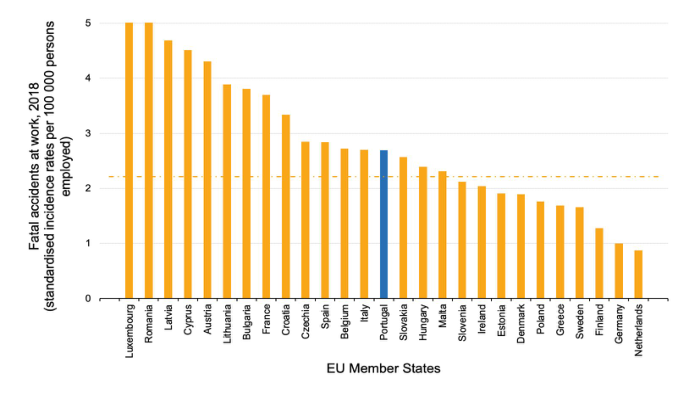
Figure 1: Fatal accident at work in 2018 among the EU member states (standardized incidence rates per 100 000 persons employed), adapted from Eurostat (EUROSTAT, 2022). Horizontal line represents the EU-27 value (2.21).
(ESAW), indicates an increase of fatal accidents from 2017 to 2018 (EURO- STAT, 2022). The data comprises the number of accidents and incidence rates among the EU-27 Member States, also exhibiting a great variability form one year to the next. In the case of Portugal, in particular their position in relation to the other EU-27 members, is located among the countries with standardi- zed fatal accidents per 100 000 persons employed in 2018 above the whole EU-27 (2.21). Ten, out of 27 EU members, show values of standardized fatal accidents below the average of the whole EU-27 members: Netherlands and Germany with the lowest (below 1 per 100 000 persons employed), whereas Luxembourg and Romania show the highest rate (above 5 per 100 000 per- sons employed), as illustrated in Figure 1. Independently of the position of Portugal relatively to the other EU member, between 2017 and 2018, declined by 30%.
When the numbers of occupational accidents are analyzed by econo- mic activity, construction followed by manufacturing, are the two activities that present the highest numbers, even though some tendency to decrease (Macedo and Silva, 2005; Leão et al., 2019). This has also been confirmed when compared within the EU-27, where construction, transportation and storage, manufacturing, and agriculture, forestry and fishing sectors toge- ther accounted for 65.6 % of all fatal accidents at work and 44.3 % of all non-fatal accidents at work in 2018 (EUROSTAT, 2022). However, in other economic activities, namely accommodation and food service activities, shows a sharply upwards trend (Leão et al., 2019). So, it seems important to identify and follow this tendency in order to redefine strategies and imple- mentation of prevention programs more targeted to the economic activities and understanding what can contribute to the non-linear behaviour that some activities show from one year to the next.
The proposed study encompasses a continuation of a previous case study (Leão et al., 2019) analyzing the Portuguese reality regarding the number of accidents’ occurrence, based on data from 2008 to 2019, where certain issues about the behavior of the incidence of occupational accidents (total number of mortal accidents at work) were raised.
With this in mind, the questions which lies at the base of the compiled information: Since then, and till our days, what happened? Has that trend been reversed? And comparatively, with the literature, the Portuguese rea- lity is in line with the literature? These questions are answered considering the data set till 2020. In addition to the non-fatal accidents were further- more considered, and their behavior described and critically analyzed in the following sections.
METHODOLOGY
Based on the available data about “Total Fatal accidents by economic sector” collected from two national institutions INE (INE - Instituto Nacional de Estatística, no date) and PORDATA (PORDATA - Base de Dados Portugal Contemporâneo, no date), the ups and downs of occupational accidents in Portugal, between 2008–2019, will be described and questioned. Firstly, the economic activities sector was divided according to the Classification of Eco- nomic Activities (CEA) used by Statistics Portugal, in the primary (extraction of raw materials or agriculture, production of animals, hunting, forestry and fishing), secondary (manufacturing, construction) and tertiary (service indu- stries like, transport, distribution and sale of goods, electricity and gas, waste, education, human health activities and social supports) sectors for the descri- ptive data statistics. The total number of mortal accidents at work (AW) were tabulated according the years and the Economic activity (EA). The annual number of mortal accidents AW were analyzed by EA,having in consideration the total number of employed population by sector of activity.
RESULTS AND DISCUSSION
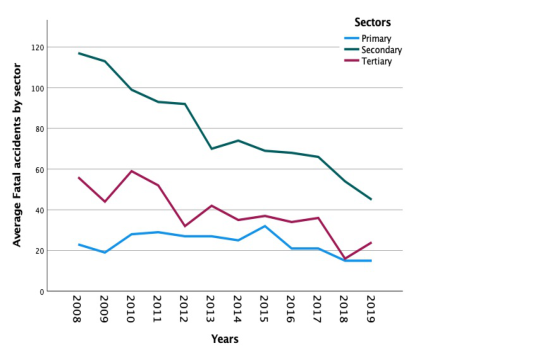
Turning first to the average mortal accidents, data showed a decrease tende- ncy between 2008 to 2019, as illustrated in Figure 2. This downward trend is more expressive in the secondary sector, with almost an average of 120 mortal accidents in 2008, fell to 42 in 2019 (about 35%), and less expressive in the primary sector, with almost an average of 22 mortal accidents in 2008, fell to 18 in 2019 (with some short upward fluctuations namely in 2010 and 2015). The tertiary sector, besides its downward and upward movements over the years, shows a downwards trend. This can be related to the investment made in the prevention acts and the need associated with this change of conduct (Nenonen, 2011). This could explain the significant decrease in the secon- dary sector, as generally know, this sector is composed by the most activities exposed to significant dangers and, at the same time, the one that invested more in prevention on the current time.
In Table 1, the different activities incorporated in the three CEA sectors with the respective number of fatal accidents at work in the time period of
The Ups and Downs of Accidents’ Figures – The Portuguese Case Study Revisited 217
Figure 2: Fatal accident incidence rate evolution in Portugal between 2008-2019 by economic sectors, according to PORDATA (PORDATA, n.d.)
study (2008-2019) considered are presented. In general, the fatal accidents show a decreasing tendency. This downward tendency can be related to the change of mindset related to prevention and the importance of preventing this type of tragedies and in fact related to the idea of changing paradigm and the most important for the top managers-company’s image. Although safety becomes a priority and changes the culture in the organization, mir- rored in, confident occupational hygiene and safety requirements based in implementation of quality, environment, and safety management systems. These aspects also guarantee proper and optimized environments for their workers.
Although the profile regarding the primary sector shows no major changes over the years, the fatal accidents incidence rates for all other activities show as an expressive decreasing tendency.
In general, an overall decrease in the number of accidents throughout the years can be seen, but some increases and non-normal behaviors can also be seen in some economic activities like in Accommodation and food service activities that present a very irregular profile along the years, namely, after 2013. In this case, and once more, results in intelligibility depends on the calculation of respective incidences rates relatively to human resources in the active on the differences years. This is also explained by what has been previ- ously mentioned regarding trans nationalization, globalization and progress processes, a conjuncture to increase the development preventing this cand of tragic accidents.
According to Holte, Kjestveit and Lipscomb (Holte, Kjestveit and Lip- scomb, 2015), is proved that in small company’s workers have an increased risk of sustaining an injury, which is especially evident in the construction industry that in its case is part of the secondary sector. These occurrences can be related to de poor education, the lack of resources and consequen- tly related to the cost-benefit not only because of the human resources but also because of investment in prevention associated with Health and Safety
and restaurants Total
and storage Accommodation
retail trade Transportation
Sectors of economic activity
quarrying Manufacturing Construction Total Wholesale and
Primary Secondary Tertiary
Table 1. Numbers associated to fatal accidents at work (total and by sector of economic activity) between 2000-2019 (source: PORDATA, n.d.).
The Ups and Downs of Accidents’ Figures – The Portuguese Case Study Revisited 219
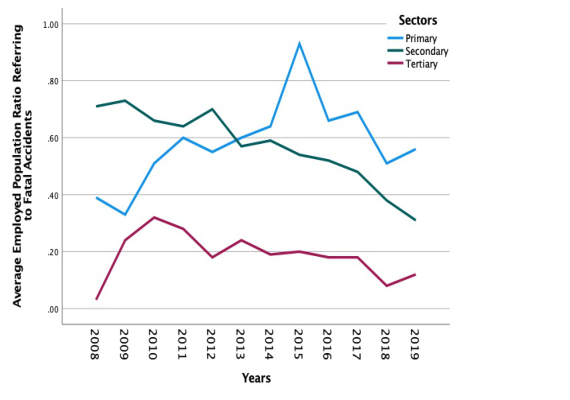
Figure 3: Ration between employed population and fatal accidents by CAE over the years of 2008–2019.
on work have a direct impact not only in fatal accidents but in occupational health and safety (OSH) too. The results obtained tend to converge to theory, in fact, as illustrated in Figure 3, the ratio between the employed population and the fatal accidents show a decreasing trend over the period considered. However, and despite this downward trend, the primary sector is the one that shows the greatest oscillation over time and only in the last nine years has it shown a downward tendency (after an increase in 2011).
FINAL REMARKS Fatal accidents by the Economic Sector in Portugal between the years of 2008 and 2019 have been tending to decrease, in spite of some punctual highs.
Generally, the secondary sector is where most fatal accidents occur in the workplace. Although a considerable decrease was observed in this sector, ran- ging from 117 in 2008 to 45 in 2019, this sector is known also for being exposed to significant dangers. When it comes to fatal accidents at work, “Manufacturing” and “Construction” are the predominant activities.
As for the other two sectors, they do not surpass the 100 fatal accidents barrier. The primary sector is the one that is more stagnant and does not have a high increase in these numbers over the years. While the tertiary sector, is the one with more ups and downs but with a tendency to slowly decrease.
As already stated previously in Portugal the secondary sector tends to have a higher risk of sustaining a fatal injury but, at the same time, it corresponds to the sector where a greater investment is needed in prevention and safety at work making it efficient.
In compliance with the conclusions and orientations provided by the inve- stigation carried out by Morrish (Morrish, 2017) at mine sites, incident investigations and pre-job safety analyses accomplished by experienced and competent individuals can significantly reduce workplace incidents. And,
when these analysis and results are articulated with all the stakeholders (management, supervision and workers), the likelihood of occurrence of acci- dence will be reduced. Another aspect to point out is the importance and need to get all workers groups to work together, showing them the value of their work in preventing accidents, that is, the effect of worker engagement on safety performance plays an important role on safety performance outcomes (Wachter and Yorio, 2014).
ACKNOWLEDGMENT
The authors would like to acknowledge support form FCT – Fundação para a Ciência e Tecnologia thought the project R&D Units Project Scope: UIDB/00319/2020.
REFERENCES
European Commission (2013) European Statistics on Accidents at Work (ESAW) — Summary methodology. doi: 10.2785/40882. EUROSTAT (2022) Accidents at work statistics. Available at: https://ec.europa.eu/e
urostat/statistics-explained/index.php?title=Accidents_at_work_statistics (Acces- sed: 1 February 2022). Holte, K. A., Kjestveit, K. and Lipscomb, H. J. (2015) ‘Company size and differences in injury prevalence among apprentices in building and construction in Norway’, Safety Science, 71(PC), pp. 205–212. doi: 10.1016/j.ssci.2014.01.007. ILO – International Labour Office (2016) Agriculture: a hazardous work. ILO Occu-
pational Safety and Health. Available at: https://www.ilo.org/global/topics/dw4s d/themes/osh/lang--en/index.htm#banner (Accessed: 21 December 2021). INE - Instituto Nacional de Estatística (no date) INE - Instituto Nacional de Estatística. Available at: https://www.ine.pt/ (Accessed: 21 December 2021). Leão, C. P. et al. (2019) ‘Capturing the Ups and Downs of Accidents’ Figures – The
Portuguese Case Study’, in, pp. 675–681. doi: 10.1007/978-3-030-02053-8_103. Macedo, A. C. and Silva, I. L. (2005) ‘Analysis of occupational accidents in Portugal between 1992 and 2001’, Safety Science, 43(5–6), pp. 269–286. doi: 10.1016/j.ssci.2005.06.004. Morrish, C. (2017) ‘Incident prevention tools–incident investigations and pre-job
safety analyses’, International Journal of Mining Science and Technology, 27(4), pp. 635–640. doi: 10.1016/j.ijmst.2017.05.009. Nenonen, S. (2011) ‘Fatal workplace accidents in outsourced operations in the manufacturing industry’, Safety Science, 49(10), pp. 1394–1403. doi: 10.1016/j.ssci.2011.06.004. PORDATA - Base de Dados Portugal Contemporâneo (n. d.). Available at: https: //www.pordata.pt. Wachter, J. K. and Yorio, P. L. (2014) ‘A system of safety management practices
and worker engagement for reducing and preventing accidents: An empirical and theoretical investigation’, Accident Analysis and Prevention, 68, pp. 117–130. doi: 10.1016/j.aap.2013.07.029.
LISTED IN THE AHFE DIGITAL BOOKSTORE CATALOGUE
Explore the complete digital volume
Safety Management and Human Factors
Read this individual research paper free through the original publisher, or explore the full digital proceedings book.
ISBN 978-1-958651-40-7
Explore this ISBN in the AHFE Bookstore ↗Listed in the July 2026 bookstore catalogue; search by ISBN to confirm current availability · Digital book purchase optional