Salama Mostafa, Azizul Azhar Ramli, Mohammed Ahmed Jubair, Saraswathy Shamini Gunasekaran, Aida Mustapha, Mustafa Hamid Hassan (2022). Integrating Human Survival Factor in Optimizing the Routing of Flying Ad-hoc Networks in Search and Rescue Tasks. In: Human Factors in Software and Systems Engineering. AHFE Open Access, vol. 61, pp. 50–56. https://doi.org/10.54941/ahfe1002523
Flying Ad-hoc Network (FANET)'s model operates according to routing protocols along with basic technical routing parameters. One of the FANET's significant challenges is ensuring the resilience of the UAVs' performance by adjusting the operational plan and network routing based on the constraints of operation goals and the limitations of resources. Subsequently, this paper proposes an agent-based Adaptive Zone Routing Protocol (AZRP) that enables the FANET to perform disaster relief missions efficiently. The AZRP operates in economic mode, search mode, or rescue mode according to the operational plan conditions, limitations of resources, and human survival factor. The AZRP is compared with the standard ZRP and AODV to determine the most suitable routing protocol in performing disaster relief missions. The search and rescue simulation is implemented by using the NS2 simulator. The testing and evaluation criteria consider Throughput (TH), Packet Delivery Ratio (PDR), Packet Loss Ratios (PLR), and End-to-End Delay (E2E Delay). The obtained results indicate that the FANET model is able to perform in the three modes effectively and optimizes the search and rescue operations according to the given disaster relief simulation context and constraints. The AZRP outperforms the other two protocols and is able to achieve higher TH, higher PDR, lower PLR, and lower E2E delay.
The availability of accurate and real-time data is a vital requirement to qui- ckly and efficiently respond to the aftermath of a disaster. An earthquake, volcano, massive explosion, or other disaster might expose communication and transportation infrastructure to complete or partial damage (Mohammed
Integrating Human Survival Factor in Optimizing the Routing of Flying Ad-hoc Networks 51
et al. 2022). The advancement of the Unmanned Arial Vehicles (UAVs) tech- nology assist search and rescue operations in disaster areas (Mostafa et al. 2021a). The UAVs are equipped with remote control, autonomous capabili- ties, and flexible maneuverability (Kumari et al. 2015; Mostafa et al. 2017). Moreover, Flying Ad-hoc Network (FANET) aims to provide advanced cha- racteristics and capabilities to a multi-UAV system that allows the UAVs to perform critical missions in complex environments. It manages the UAVs’ wireless communication, mobility, data collection, and group navigation during operations (Bujari et al. 2017; Mostafa et al. 2021b).
Previous works like Sanchez-Garcia et al. 2016; Kumari et al. 2015; Mohammed et al. 2022; Jubair et al. 2021 and Bujari et al. 2017 focus on only technical parameters in FANET routing and operational optimization such as processing power, route distance, battery packs, and other real-time constraints. The main research aim of the routing protocols in disaster aid and emergency response is assisting in choosing and developing suitable rou- ting protocols in disparate disaster cases. This paper represents an attempt to include and study the effect of the human survival factor in a disaster area as essential operational optimization parameters along with the basic tech- nical parameters. The human survival factor in a disaster area may include urgency, speed, coverage distance, and communication sustainability. This paper examines the performance of a proposed Adaptive Zone Routing Pro- tocol (AZRP) FANET routing protocol based on the number of people or detection nodes. The proposed AZRP is implemented in a simulation of disa- ster scenarios. The AZRP is compared with the standard ZRP and AODV to determine the most suitable routing protocol in performing disaster relief missions. The evaluation criteria are Throughput (TH), Packet Delivery Ratio (PDR), Packet Loss Ratios (PLR), and End-to-End Delay (E2E Delay).
METHODS AND MATERIALS Routing Protocols
This part discusses three routing blueprints specifically: Ad-hoc on Demand Distance Vector (AODV), Zone Routing Protocol (ZRP), and a propo- sed Adaptive ZRP (AZRP). These blueprints change networking designs in FANETs to operate according to proactive, reactive, and hybrid routings. The selected routing protocols of FANET in this paper are defined in the following points:
1) AODV: AODV is reactive in communication design which is used in cases without routing paths among the nodes. This reactive scheme is imple- mented in finding a path between them (Jubair et al. 2019; Leonov et al. 2019). With a minimum requirement for execution and storage needs, fewer network activities, and the capability in describing unicast pro- grams from a transmission node to a receiving node with prevention in the communication loop, this protocol copes remarkably and dynami- cally to varying connection conditions (Kumari et al., 2015; Micheletto et al. 2018).
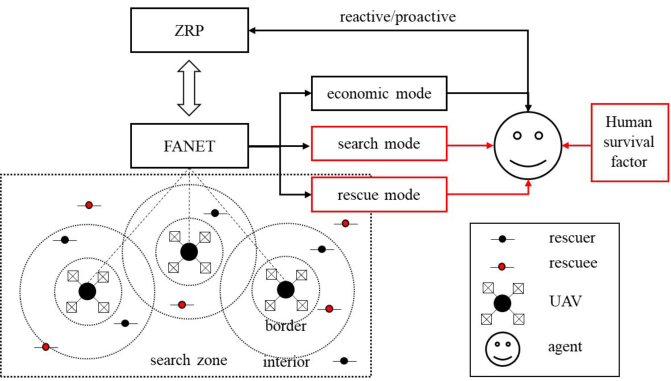
Figure 1: The AZRP in the FANET model.
2) ZRP: ZRP routing protocol is considered as a hybrid routing offering a resolution to the proactive schemes’ constraint of routing cost and the reactive schemes’ significant latency challenge (Mostafa et al. 2021b). Every node in this protocol has its zone, leading to the intersection of nearby nodes’ zones. On the one hand, proactive protocols come in handy in intra-zone routing for routes preservation (Hassan et al. 2021). 3) AZRP: The proposed agent-based Adaptive Zone Routing Protocol (AZRP) is used to direct connections of the FANET model consisting of several UAVs. It aims to improve wireless communication between humans, UAVs, and communication centers in disaster areas during sea- rch and rescue operations (Mohammed et al. 2022). The AZRP can select which node is proactive and which node is reactive based on network resources and constraints, including the human survival factor. Moreo- ver, it is controlled by a software agent algorithm that enables the FANET to operate in economic mode, search mode, or rescue mode according to the operational plan conditions. The software agent receives the plan mode from the FANET cooperative plan of multiple UAVs and, based on the plan mode, assists the AZRP in deciding on the proactiveness and reactiveness of the nodes (Micheletto et al. 2018). Each node maintains local topology knowledge within a zone by exchanging proactive upda- tes with zone members. This can be used to find a route if the destination is within the zone. Otherwise, the reactive routing is used to find a route, as shown in Figure 1. The nodes which are at hop distance and have the same zone radius are referred to as peripheral nodes or border nodes. The nodes that lie at a distance within the zone radius are known as interior nodes. When no active route is available, the nodes raise a query and send it to peripheral nodes. These nodes check if the destination is located in their zone. If so, they send a route reply to the source nodes. If not, they forward the query further to their peripheral nodes until the destination is found or time to live (TTL) reaches zero (Chudasama et al. 2016).
Integrating Human Survival Factor in Optimizing the Routing of Flying Ad-hoc Networks 53
Table 1. Simulation setting.
Table available in the original PDF paper.
Parameter Value Unit Area 1000 m2 UAV nodes 3 UAV Human nodes (10-50:10) Node Queue size 50 Packet Transmission Range 250 Meter Simulation time 100 Second Packet Size 512 Byte Mobility Model Random Way Point - Protocol AZRP, ZRP, and AODV - Traffic type CBR/UDP -
FANET SIMULATION MODEL The designed FANET model consists of three UAVs exploring a specific area and attempting to provide and cover a communication zone between several people (rescuers and rescuees) in the disaster area. The AZRP provides rou- ting data to the FANET that maximizes the communication network between the people in the affected area. The testing scenario considers simulating wire- less communication of varying numbers of people in fixed disaster area sizes. The FANET model simulation is implemented using the NS2 simulator (2.35) (Mostafa et al. 2021b). Table 1 shows the most significant simulation indices and parameters.
RESULTS AND DISCUSSION
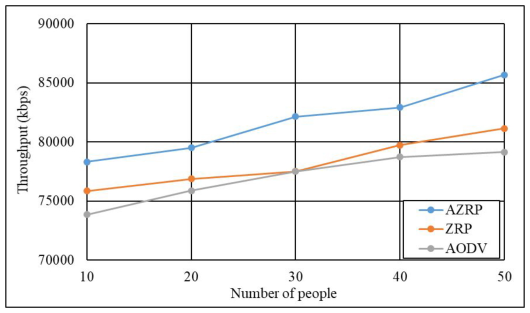
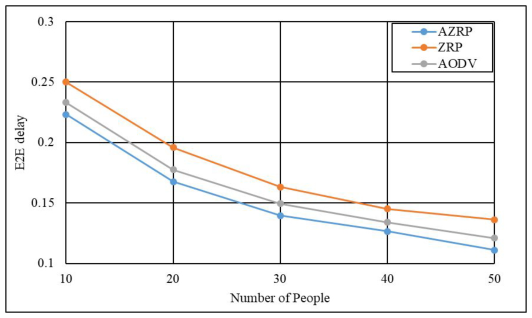
This segment shows the evaluation of the quality of the three routing pro- tocols based on the number of people scenarios. The number of people or human nodes varies from 10-50:10. The protocols’ performance is evaluated based on the TH, PDR, PLR, and E2E delay/lag. Within the variation of the number of people, these protocols show a varying performance. Figures 2 to 6 showcase all the collected results from the FANET model for performance analysis.
Based on Figure 2, the TH varies within the range of 74000 to 86000 kbps depending on the used routing protocol and the number of people (human nodes). The best TH is achieved by the AZRP, in which it offers 79000 kbps when the human nodes are 10 and 86000 kbps when the human nodes are 50.
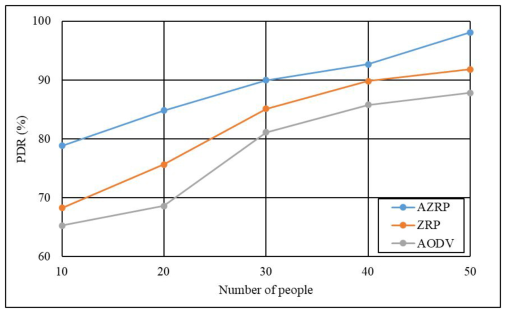
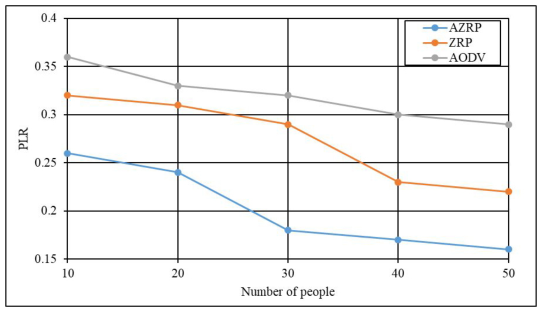
Based on Figure 3, the PDR varies within the range of 65% to 98%. The best PDR is achieved by the AZRP, in which it offers 79% when the human nodes are 10 and 98% when the human nodes are 50. Subsequently, Figure 4 shows the PLR results of the scenario in which the PLR varies within the range of 0.16 to 0.36. The AZRP achieves the best PLR, in which it offers 0.26 when the human nodes are 10 and 0.16 when the human nodes are 50. Figure 5 shows the E2E delay results of the scenario. The E2E delay varies within the range of 0.11 to 0.25 depending on the used routing protocol and
Figure 2: The TH in the number of people scenario.Figure 3: The PDR in the number of people scenario.Figure 4: The PLR in the number of people scenario.
the number of people. The best E2E delay is achieved by the AZRP in which it offers 0.11 when the human nodes are 50 and 0.225 when the human nodes are 10.
Integrating Human Survival Factor in Optimizing the Routing of Flying Ad-hoc Networks 55
Figure 5: The E2E in the number of people scenario.
The four figures show the TP, PDR, PLR, and E2E delay of the AODV, ZRP, and AZRP protocols as the number of nodes/people are varied from 10-50:10. The outcomes have shown that the variation of the human nodes impacts the performance of the three protocols differently. Notable from outcomes is that the increment in the number of human nodes positively affected the performances of the three routing protocols. Also, attaining a high number of nodes is a vital feature of search and rescue activities. How- ever, it causes dynamic changes in the topology of the FANET, which might result in failure in data transmission. According to the outcomes, the pro- posed AZRP is seen as the most appropriate routing protocol in search and rescue missions context as it provides the feature of performing in different modes (economic mode, search mode, or rescue mode) based on the mission progress conditions.
CONCLUSION
The varying dynamic topology of FANET wireless connections of multi- UAVs, allows the UAVs to move arbitrarily freely. Various kinds of routing protocols are proposed to do so, including AODV and ZRP. This work pro- poses an improved agent-based Adaptive ZRP (AZRP) routing protocol that performs in economic, search, or rescue modes and considers increasing human survival during search and rescue missions. The considered survival factor is the number of people that can be connected to the network during disasters. The simulation scenarios of the FANET model are implemented and tested by using the NS2 simulator. The outcomes showcase that the AZRP performed better than the AODV and ZRP for the TH, PDR, PLR, and E2E delay. The future work considers studying the effect of the area size variation on the performance of the FANET model and the routing protocols.
ACKNOWLEDGMENT
This research was supported by the Ministry of Higher Education (MoHE) through the Fundamental Research Grant Scheme (FRGS/1/2021/ICT01/ UTHM/02/1) grant vot number K389.
REFERENCES
Bujari, A., Palazzi, C. E., & Ronzani, D. (2017). FANET application scenarios and mobility models. DroNet 2017 - Proceedings of the 3rd Workshop on Micro Aerial Vehicle Networks, Systems, and Applications, Co-Located with MobiSys 2017, June 2017, 43–46. https://doi.org/10.1145/3086439.3086440 Hassan, Marwan Hamid, Mostafa, S. A., Mahdin, H., Mustapha, A., Ramli, A. A.,
Hassan, M. H., & Jubair, M. A. (2021). Mobile ad-hoc network routing proto- cols of time-critical events for search and rescue missions. Bulletin of Electrical Engineering and Informatics, 10(1), 192–199. https://doi.org/10.11591/eei.v10i 1.2506 Jubair, M. A., Alabdullah, A. I. M., Mostafa, S. A., Mustapha, A., Hassan, M. H., & Gunasekaran, S. S. (2021). Exploring the Roles of Agents and Multi-Agent in Improving Mobile Ad Hoc Networks. In Proceedings - ISAMSR 2021: 4th Inter- national Symposium on Agents, Multi-Agents Systems and Robotics (pp. 91–95). https://doi.org/10.1109/ISAMSR53229.2021.9567772 Jubair, M. A., Mostafa, S. A., Muniyandi, R. C., Mahdin, H., Mustapha, A., Hassan,
M. H., Mahmoud, M. A., Al-Jawhar, Y. A., Al-Khaleefa, A. S., & Mahmood, A. J. (2019). Bat optimized link state routing protocol for energy-aware mobile ad-hoc networks. Symmetry, 11(11). https://doi.org/10.3390/sym11111409 Kumari, K., Sah, B., & Maakar, S. (2015). A Survey : Different Mobility Model for FANET. International Journal Af Advanced Research in Science and Software Engineering, 5(6), 1170–1173. Leonov, A. V., & Litvinov, G. A. (2019). Simulation-Based Performance Evalua-
tion of AODV and OLSR Routing Protocols for Monitoring and SAR Operation Scenarios in FANET with Mini-Uavs. 12th International Scientific and Technical Conference “Dynamics of Systems, Mechanisms and Machines”, Dynamics 2018, November, 1–6. https://doi.org/10.1109/Dynamics.2018.8601494 Micheletto, M., Petrucci, V., Santos, R., Orozco, J., Mosse, D., Ochoa, S. F., & Meseguer, R. (2018). Flying real-time network to coordinate disaster relief acti- vities in urban areas. Sensors (Switzerland), 18(5), 1–20. https://doi.org/10.3390/ s18051662 Mohammed, Ahmed, S. B., Hussain, S. A., Latiff, L. A., Ahmad, N., & Sam, S.
M. (2022). Performance Evaluation of FANET Routing Protocols in Disaster Scenarios. 46–51. https://doi.org/10.1109/softt54252.2021.9673152 Mostafa, S. A., Ahmad, M. S., Mustapha, A., & Mohammed, M. A. (2017). Formulating layered adjustable autonomy for unmanned aerial vehicles. International Journal of Intelligent Computing and Cybernetics, Vol. 10 No. 4, pp. 430–450. https://doi.org/10.1108/IJICC-02-2017-0013 Mostafa, S. A., Mustapha, A., Gunasekaran, S. S., Ahmad, M. S., Mohammed, M.
A., Parwekar, P., & Kadry, S. (2021a). An agent architecture for autonomous UAV flight control in object classification and recognition missions. Soft Computing, 1–14. https://doi.org/10.1007/s00500-021-05613-8 Mostafa, S. A., Mustapha, A., Ramli, A. A., Jubair, M. A., Hassan, M. H., & Abbas, A. H. (2021b). Comparative Analysis to the Performance of Three Mobile Ad- Hoc Network Routing Protocols in Time-Critical Events of Search and Rescue Missions. In Advances in Intelligent Systems and Computing: Vol. 1206 AISC. https://doi.org/10.1007/978-3-030-51064-0_16 Sanchez-Garcia, J., Garcia-Campos, J. M., Toral, S. L., Reina, D. G., & Barrero,
F. (2016). An Intelligent Strategy for Tactical Movements of UAVs in Disaster Scenarios. International Journal of Distributed Sensor Networks, 2016. https://do i.org/10.1155/2016/8132812
LISTED IN THE AHFE DIGITAL BOOKSTORE CATALOGUE
Explore the complete digital volume
Human Factors in Software and Systems Engineering
Read this individual research paper free through the original publisher, or explore the full digital proceedings book.
ISBN 978-1-958651-37-7
Explore this ISBN in the AHFE Bookstore ↗Listed in the July 2026 bookstore catalogue; search by ISBN to confirm current availability · Digital book purchase optional