Benjamin Roehm (2022). Concept for the Selection and Positioning of Sensor Technology in the Development of Advanced Systems. In: Human Factors in Software and Systems Engineering. AHFE Open Access, vol. 61, pp. 15–20. https://doi.org/10.54941/ahfe1002517
This paper contains criteria for evaluating suitable measurement principles of sensors on existing products. The paper's core is a concept with evaluation criteria for sensor selection and the prototypical implementation of a graphical user interface to select a suitable sensor technology. Furthermore, interfering influences on the measurement, energy supply of sensors, data transmission and communication are dealt with to design the concept. The evaluation criteria guide the user through the sensor selection process and recommend suitable sensor measurement principles.
With the steady increase of the products value through functional integra- tion, mechatronic systems and subsequently Cyber-Physical Systems (CPS) and Product Service Systems (PSS) have emerged from classical mechanical systems in recent decades. This development goes along with Lee’s quote: “cyberizing the physical” and “physicalizing the cyber” (Lee, 2010). In other words, merging the physical and the real world. As the range of functions increases, so does the number of sensors in products. In addition to the functional reliability of technical products, product-related digital services require further sensors to provide the corresponding services. A sensor- compatible design must be pursued, especially in product design, with its various design-for-X methods (Vajna et al., 2018a).
State of Art This chapter deals with the topics of Industry 4.0, Cyber-Physical Products (CPS) to the sensor technology.
Industry 4.0 was defined in 2015 by the Platform Industrie 4.0 as the “fourth industrial revolution, a new level of organization and control of the value chain across the entire life cycle of products” (Bitkom e. V. et al.,
2015). The definition articulates the changes brought by advances in infor- mation and communication technologies, as drivers of digitalization along value chains, in companies and society (Czwick et al., 2020). Key drivers for industry on the way to Industry 4.0 are an increasing number of product variants, with simultaneously shorter development cycles and smaller batch sizes (Overbeck et al., 2020).
The complexity of Industry 4.0 and the different requirements for continu- ous data exchange between the hierarchical levels of the product, the levels of the different functional scopes and the individual phases of the product life cycle are illustrated in the Reference Architecture Model Industry 4.0 (RAMI 4.0) (Boss et al., 2015; Massonet et al., 2020). Industry 4.0 components can be located in the reference model architecture 4.0 depending on their functio- nal scope, position within an environment hierarchy and the respective phase in the product life cycle. Cyber-physical Systems (CPS) represent a key compo- nent in the context of Industry 4.0 (Huber and Kaiser, 2015). Cyber-Physical Systems combine computers and physical systems (Lee, 2015). Embedded systems process and control physical systems through an exchange between physical and digital processes (Vajna et al., 2018b). Based on CPS, states of the physical component can be sensed and processed by computers, and the physical process can be influenced via control system. Furthermore, this is not only within the system boundaries of the product but also across systems between different communicating CPSs. These CPS capabilities provide the foundation for a fully CPS-based production environment where all process participants are networked, communicate and respond to each other. Smart sensors are increasingly being incorporated into CPS development. A sensor is a “self-contained component in a technical system connected to the measu- red variable at its input by a suitable sensor and converts it into an electrical signal” (Heinrich et al., 2017) Smart sensors extend this concept by the use of embedded Computers to process the measured variables.
While Design for X methods are developed and applied manifold in product development, the selection of suitable sensors for the design of CPS is underrepresented and mainly based on the experience of the respe- ctive employees. In this work, a method is developed to propose suitable measurement principles from functional product requirements, considering prevailing environmental conditions, to support the product developer in sensor decision-making.
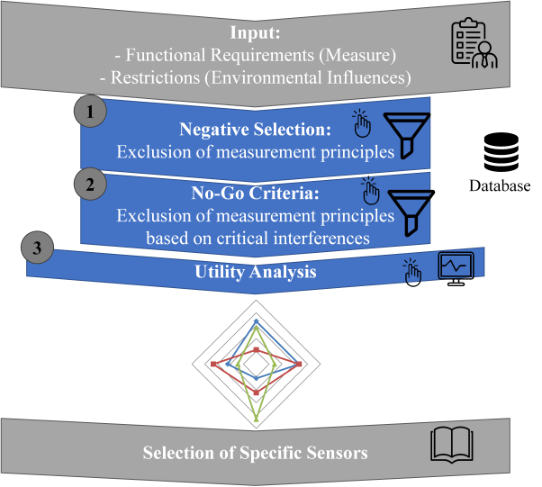
Concept The developed method is divided into four steps and is shown in Figure 1. Starting point is the product planning phase in which a suitable measure is selected based on the existing functional requirements and prevailing restrictions.
In step 1, sensor measurement principles are selected for the functional requirements (measure) that enable the detection of the required measure. This is done based on a corresponding database. The relationship between measurement principles for detecting a specific measure is represented in a
Concept for the Selection and Positioning of Sensor Technology 17
Figure 1: Development method.
database. Selecting one or more measurement principles is a simple, sele- ctive, categorical criterion. Such a criterion in the early steps of the selection pursues the objective of keeping the effort of the following evaluation at a reasonable level since detailed information does not have to be collected for all alternatives (Zirm and Geschka, 2014). Output of this selection is several possible measurement principles.
In the second step of the method, the external interferences on the phy- sical sensor and the resulting disturbance variables are considered. Sensors are available in different classes and shieldings. Therefore, a preselection based on a specific sensor is not possible in a general and comprehensive way. However, the degree of robustness of individual measurement princi- ples to certain interferences varies. Step 2 uses a categorical no-go criterion to filter the measurement principles that react sensitively to the expected envi- ronmental influences. A unified database manages the correlations between the considered measurement principle and critical external interferences.
The remaining measurement principles are taken up in step 3 and subjected to a multistage pair comparison (Verein Deutscher Ingenieure e.V, 1998) In the comparisons, the following areas are considered in detail: Energy, Design, Robustness and Maintenance.
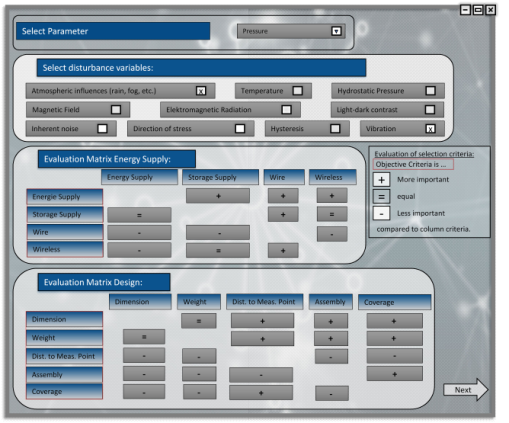
Case Study For the validation of the concept, a graphical user interface (GUI) was desi- gned used for an explicit development process, as an example for the selection of the sensor measurement principle. The considered design process is the further development of an Industry 4.0 application for a cargo bike. The use
Figure 2: Excerpt graphical user interface (GUI).
case of smart tire pressure measurement was defined during product plan- ning. Due to the high loads, low tire pressure can lead to structural damage to tires, rims and frames and affect safety. The control of tire pressure at the valve is transferred to the design phase as a task from the product planning phase.
The databases include 14 physical measurement principles used in indu- strial environments. The user interface can be used to specify the measure (Pressure) to be detected (step 1) and the probable environmental influences (step 2) on the sensor (atmospheric influences and vibration). On the next level (step 3), the energy supply of the sensor can be determined via the first stage of a paired comparison. By choosing the cargo bike as an example and the measurement location, a weighting can be made concerning the energy supply and the design, as shown in Figure 2. The measurement of the pres- sure at the wheel requires a wireless power supply from the sensor and low weight and the smallest possible dimensions for the valve size.
The underlying databases can be filtered from the inputs of the user interfaces and an evaluation can be generated.
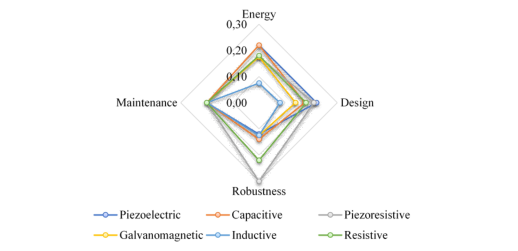
As a result of the applied method, six physical measurement principles for detecting tire pressure are proposed to the developer. In Figure 3, the evaluated principles are weighted according to the inputs. According to the evaluation, inductive solutions perform worst compared to the other mea- surement principles. In contrast, a piezoresistive solution for acquiring tire pressure performs best. The piezoelectric effect occurs when piezoelectric materials are mechanically loaded by an external force or pressure (Hering and Schönfelder, 2018). Thus, the result represents a valid solution to capture the measure. Based on the results, the development engineer can order a sensor with the corresponding measurement principle from its suppliers.
Concept for the Selection and Positioning of Sensor Technology 19
Figure 3: Measurement principal evaluation.
CONCLUSION
With the increasing demand for sensors in Cyber-Physical Systems, product designers must select suitable sensor solutions in addition to their design acti- vities. Currently, no methods exist to support them in this task. With the present work, a method is now available to support product designers in selecting a suiting measurement principle to acquire a measure. The method was validated using an exemplary development process. In addition to the method, a graphical user interface was designed and a knowledge base of industrially used measurement principles was built. The following research steps in this field are developing design methods for product design.
ACKNOWLEDGMENT
This research and CyberTech project is funded by the German Federal Ministry of Education and Research (BMBF) within the “Innovations for Tomorrow’s Production, Services, and Work” Program (02J19B012) and implemented by the Project Management Agency Karlsruhe (PTKA). The author is responsible for the content of this publication.
REFERENCES
Bitkom e. V. VDMA e. V.ZVEI e. V. (2015). Umsetzungsstrategie Industrie 4.0: Ergebnisbericht der Plattform Industrie 4.0. BITKOM e.V., Berlin. Boss, B. Bader, S. Orzelski, A.Hoffmeister, M. (2015). Verwaltungsschale, in: Vogel-
Heuser, B., Bauernhansl, T., Hompel, M. ten (Eds.), Handbuch Industrie 4.0. Produktion, Automatisierung und Logistik. Springer Fachmedien Wiesbaden, Wiesbaden. Czwick, C. Martin, G. Anderl, R.Kirchner, E. (2020). Cyber-Physische Zwillinge.
ZWF 115 (special). Heinrich, B. Linke, P.Glöckler, M. (2017). Grundlagen Automatisierung: Sensorik, Regelung, Steuerung. Springer Vieweg, Wiesbaden, 2nd ed. Hering, E.Schönfelder, G. (2018). Sensoren in Wissenschaft und Technik: Funktion-
sweise und Einsatzgebiete. Springer Vieweg, Wiesbaden, 2nd ed. Huber, D.Kaiser, T. (2015). Wie das Internet der Dinge neue Geschäftsmodelle ermöglicht. HMD 52 (5).
Lee, E.A. (2010). CPS foundations, in: Proceedings of the 47th Design Automation Conference on - DAC, California. Lee, E.A. (2015). The Past, Present and Future of Cyber-Physical Systems: A Focus
on Models. Sensors 15 (3). Massonet, A. Kiesel, R.Schmitt, R.H. (2020). Der Digitale Zwilling über den Produktlebenszyklus. ZWF 115 (special). Overbeck, L. Brützel, O. Stricker, N.Lanza, G. (2020). Digitaler Zwilling des
Produktionssystems. ZWF 115 (special). Vajna, S. Weber, C. Zeman, K. Hehenberger, P. Gerhard, D.Wartzack, S. (2018a). 2.
Methodische Grundlagen, in: Vajna, S., Weber, C., Zeman, K., Hehenberger, P., Gerhard, D., Wartzack, S. (Eds.), CAx für Ingenieure. Springer Berlin Heidelberg. Vajna, S. Weber, C. Zeman, K. Hehenberger, P. Gerhard, D.Wartzack, S. (2018b).
4. Grundlagen der Modellbildung, in: Vajna, S., Weber, C., Zeman, K., Hehen- berger, P., Gerhard, D., Wartzack, S. (Eds.), CAx für Ingenieure. Springer Berlin Heidelberg. Verein Deutscher Ingenieure e.V (1998). 2225 Blatt 3 Konstruktionsmethodik - Technisch-wirtschaftliches Konstruieren - Technisch-wirtschaftliche Bewertung. Beuth Verlag GmbH, Berlin 03.100.40. Zirm, A.Geschka, H. (2014). FAQ - Innovationsmanagement : 100 Fragen - 100
Antworten. Symposium, Düsseldorf, 1st ed.
LISTED IN THE AHFE DIGITAL BOOKSTORE CATALOGUE
Explore the complete digital volume
Human Factors in Software and Systems Engineering
Read this individual research paper free through the original publisher, or explore the full digital proceedings book.
ISBN 978-1-958651-37-7
Explore this ISBN in the AHFE Bookstore ↗Listed in the July 2026 bookstore catalogue; search by ISBN to confirm current availability · Digital book purchase optional