Carlo Andreotti, Pierpaolo Baglietto, Massimo Maresca, Stefano Strada (2022). Assisted text messaging system for maritime emergency communications. In: Human Factors in Transportation. AHFE Open Access, vol. 60, pp. 740–745. https://doi.org/10.54941/ahfe1002512
Effective and clear communication transfers information, creates an experience in others and causes a reaction. In personal or professional relationships, effective communication is hindered by social and cultural inhomogeneities, and this is the main cause of misunderstandings.Misunderstandings in voice communication have also been identified as the main cause of accidents at sea; although English is used and recognized as an official language for maritime communications, an incorrect pronunciation or accent can cause misunderstanding or even change meaning. Therefore, it is extremely useful to adopt models, protocols and rules aimed at reducing misunderstandings as much as possible.During the years, IMO (International Maritime Organization) has developed the Standard Marine Communication Phrases (SMCP), a set of well-defined sentences, written in a very simplified English, aimed at mitigating the aforementioned problem. Past studies have shown that SMCP is not commonly used and difficulties to pronounce and understand English spoken by different nationalities remains.This paper presents an innovative communication system, developed by the University of Genoa with the collaboration of the Italian Coast Guard in the context the Maritime Interreg project ISIDE, that exploits the possibility of sending text messages through the AIS devices that boats are equipped with.Commercial vessels with a gross tonnage equal to or greater than 300 tons and all passenger ships (regardless of their size) are in fact obliged to equip themselves with the Automatic Identification System (AIS), essentially based on digital VHF radios that can transmit, in an automated and continuous manner, information such as ship name, type of ship, position, course and speed over ground, navigation conditions and other safety-related information.A user-friendly interface has been developed to assist the operator in selecting the appropriate message among those provided by the SMCP standard or alternatively to compose a personalized text, both in the beginning of a new conversation and in the reply to a previously received message. The system can be integrated in professional consoles, standard web interfaces and apps and also on wearable devices such as smart watches. The system takes care of transmitting and receiving information AIS device as the communication channel.The user interface has also been implemented in several languages (i.e., English, Italian, French…) and the received/transmitted SMCP messages are automatically translated into the native language of the operator, thus eliminating language barriers and reducing misunderstandings.The system has been tested during several SAR exercise with the support of the Italian Coast Guard and the results are presented in the full paper.In order to extend the application also to smaller leisure boats, the system will be experimented in the near future using Marine VHF devices able to transmit text messages according the RTCM 12301.1 standard proposed by the Radio Technical Commission for Maritime Services.
Effective and clear communication transfers information, creates an experie- nce in others and causes a reaction. In personal or professional relationships, effective communication is hindered by social and cultural inhomogeneities, and this is the main cause of misunderstandings.
Misunderstandings in voice communication have been also identified as one of the main cause of accidents at sea; although English is used and reco- gnized as an official language for maritime communications, an incorrect pronunciation or accent can cause misunderstanding or even change mea- ning. Therefore, it is extremely useful to adopt models, protocols and rules aimed at reducing misunderstandings as much as possible.
During the years, IMO (International Maritime Organization) has deve- loped the Standard Marine Communication Phrases (SMCP), a set of well- defined sentences, written in a very simplified English, aimed at mitigating the aforementioned problem. Past studies have shown that SMCP is not com- monly used and difficulties to pronounce and understand English spoken by different nationalities remains [1].
Commercial vessels with a gross tonnage equal to or greater than 300 tons and all passenger ships (regardless of their size) are in fact obliged to
Assisted Text Messaging System for Emergency Maritime Communications 741
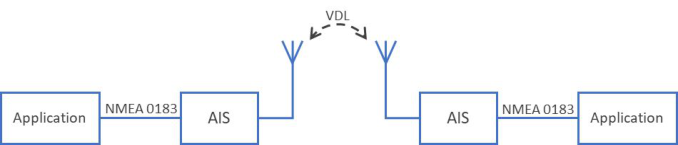
Figure 1: Messaging feature scheme.
equip themselves with the Automatic Identification System (AIS), essenti- ally based on digital VHF radios that can transmit, in an automated and continuous manner, information such as ship name, type of ship, position, course and speed over ground, navigation conditions and other safety-related information.
A user-friendly interface has been developed to assist the operator in sele- cting the appropriate message among those provided by the SMCP standard or alternatively to compose a personalized text, both in the beginning of a new conversation and in the reply to a previously received message. The system can be integrated in professional consoles, standard web interfa- ces and apps and also on wearable devices such as smart watches. The system takes care of transmitting and receiving information AIS device as the communication channel.
The user interface has also been implemented in several languages (i.e., English, Italian, French…) and the received/transmitted SMCP messages are automatically translated into the native language of the operator, thus eliminating language barriers and reducing misunderstandings.
The system has been tested during several SAR exercise with the support of the Italian Coast Guard and the results are presented.
THE ISIDE PROTOTYPE Hardware Setup
AIS, in addition to the main function as a means for positive identification and tracking of vessels by transmitting and receiving static, dynamic, and voyage-related data of vessels, may use binary messages for transmission of Text Messages as a means for certain types of limited communications.
The data content of this text messages is defined by the application. AIS allows the transfer of text messages via the VHF Data Link (VDL) as a communication medium for external applications as specified in ITU-R M.1371. It will be a form of data exchange between externally connected users of two AIS transponders. AIS will just function as the carrier of the information and the relevant AIS transponders act as dedicated modems (see fig. 1).
ITU-R M.1371 specifies that the AIS communicates externally, using the IEC 61162 series protocol. The 61162 series is the international version of the NMEA 0183 protocol.
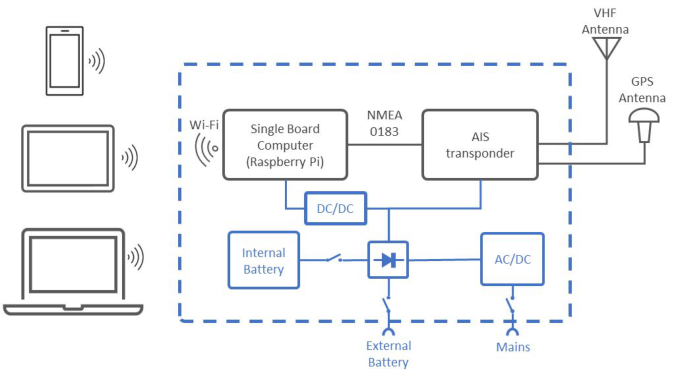
Figure 2: Block diagram of the manufactured device.
The real systems for experimentation have been realized, as a first step, by interfacing a Raspberry Pi, equipped with a RS422 HAT, to the NMEA bus of a commercial AIS transponder. Both devices with their AC/DC converter and backup battery have been integrated in a plastic housing in order to facilitate a quick and easy placement on a flat surface of the vessels used in the experiments (see fig. 2).
As a second step the Raspberry Pi has been configured as a wireless access point to connect an external device and access the application through a simple browser.
Software Application User interface has been implemented as a web application to which operators can connect using any browser-equipped device that is directly connected to the Wi-Fi network provided by the physical device itself.
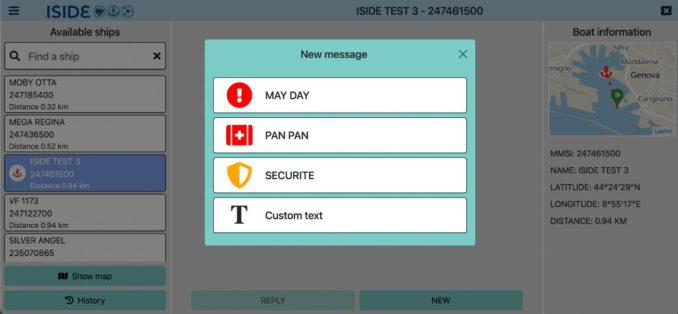
The main window shows, on the left panel, a list of all the ships available nearby, sorted from closest to furthest. Alternatively, nearby ships may be displayed on a map using an offline chart service.
By selecting a vessel, either through the list or through the map visua- lization, user can choose whether to send a new message or to reply to a previously received message.
In case of a new message, the selection of the text to be sent is achieved through a guided mechanism that uses a tree structure to classify the various messages of the SMCP standard into macro categories and subcategories.
By clicking on the desired category, a user can navigate through the selection tree until the specific message is reached (see fig. 3).
All the information that can be retrieved from the on-board devices, such as the name of the vessel, the MMSI code, the current position, etc. are automa- tically pre-compiled by the application without the need for any interaction from the user.
Assisted Text Messaging System for Emergency Maritime Communications 743
Figure 3: A view of the application showing the guided message selection interface.
On the contrary, in case of a reply to a previously received message, the application will propose to the operator only the answers provided by the SMCP standard to reply to the concerned message.
In all cases that do not fall within the situations foreseen by the SMCP stan- dard or that are not implemented in the prototype, it will always be possible to send a free text message.
Sent and received messages, if belonging to the SMCP standard, are automatically translated into the language configured in the application. This allows operators of different nationalities to have a graphical inter- face entirely implemented in their own native language and thus minimizing misunderstandings due to a not perfect knowledge of the English language.
The application also provides the possibility, for the received messages, in addition to being displayed on the screen, to be read through a speech synthesis mechanism, also available in multiple languages.
All the features implemented in the application, including maps and voice synthesis, are designed to be available even in the absence of an internet connection, which is obviously not always available in a maritime scenario.
Validation Through Trials In order to test the correct functioning of the equipment, some experiments have been carried out in Genoa in collaboration with the local Port Autho- rity, and others will be carried out in the coming months as planned by the ISIDE project at the ports of Genoa (I), Cagliari (I), Livorno (I), Bastia (F) and Toulon (F).
Regarding the trials conducted in Genoa, several types of vessels were invo- lved, including a pleasure craft, a fishing boat, a tug, a pilot boat, a ferry and a cruise ship.
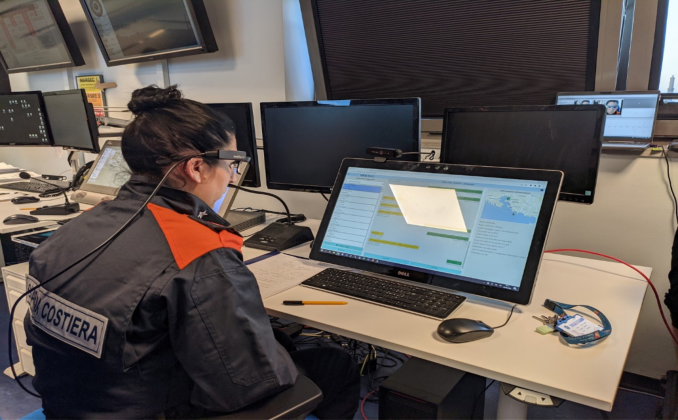
A dedicated workstation equipped with one of the three manufactured devices has been set up at the Operations Room of the Coast Guard of Genoa (see fig. 4). The remaining two devices were installed from time to time on the vessels being tested.
Figure 4: Installed workstation at the operations room of the port authority of Genoa.
Each of the experiments carried out involved the simulation of a problem (e.g. a technical failure, a fire on board, etc.) on one of the involved vessels. An emergency voice communication to the Coast Guard station via VHF radio was then initiated, followed by the introduction of text messages using the features provided by the software application and the AIS devices installed.
Emergency situations were then managed entirely using preconfigured text messages, belonging to the SMCP standard, or through custom messages written each time by the operator.
Finally, the devices have also been tested during one of the periodic Search-and-Rescue training exercises carried out by the Port Authority, which included the involvement of various rescue vehicles, both naval and aerial, during which an accident was simulated on a passenger ferry off the coast of Genoa, resulting in the spillage of pollutants into the sea.
CONCLUSION
The devices have proved to be adequately reliable during all the conducted experiments and have provided an alternative channel of communication to voice communications via VHF bypassing the problems of misunderstanding due to interference or different nationalities, and therefore languages, of the operators involved.
However, the trials have also shown that the use of standard SMCP mes- sages is not as widespread as one might think, both because of the operators’ imperfect knowledge of the standard phrasebook and because it does not fully cover the various emergency situations that may occur.
In order to extend the application also to smaller leisure boats, the system will be experimented in the near future using Marine VHF devices able to
Assisted Text Messaging System for Emergency Maritime Communications 745
transmit text messages according the RTCM 12301.1 standard proposed by the Radio Technical Commission for Maritime Services.
ACKNOWLEDGMENT
This work has been a part of the ISIDE project which is funded by the Euro- pean Union under the Interreg Maritime Initiative. The authors would like also to acknowledge the Italian Coast Guard support for its active con- tribution to the project and the organization of the trials and validation activities.
REFERENCES
IMO, (2015) Guidelines for the onboard operational use of shipborne automatic identification systems (AIS), Resolution A.1106(29), https://wwwcdn.imo.org/loc alresources/en/OurWork/Safety/Documents/AIS/Resolution%20A.1106(29).pdf IMO, Standard Marine Communication Phrases, Resolution A.918(22), Nov.
2001, https://wwwcdn.imo.org/localresources/en/OurWork/Safety/Documents/A. 918(22).pdf Interreg Maritime ISIDE project, http://interreg-maritime.eu/web/iside, (2022). M. Grech, T. Horberry, Thomas Koester, (2008) Human Factors in the Maritime Domain, CRC Press. T. Porathe, P. Eklund and H. Goransson, Voice and text messaging in ship communi-
cation, Advances in Human Aspects of Transportation, Part I; Proceedings of the 5th Applied Human Factors and Ergonomics Conference Krakow (PL), 19–23 July 2014.
LISTED IN THE AHFE DIGITAL BOOKSTORE CATALOGUE
Explore the complete digital volume
Human Factors in Transportation
Read this individual research paper free through the original publisher, or explore the full digital proceedings book.
ISBN 978-1-958651-36-0
Explore this ISBN in the AHFE Bookstore ↗Listed in the July 2026 bookstore catalogue; search by ISBN to confirm current availability · Digital book purchase optional