Gholam Reza Emad, Aditi Kataria (2022). Challenges of simulation training for future engineering seafarers - A qualitative case study. In: Human Factors in Transportation. AHFE Open Access, vol. 60, pp. 647–656. https://doi.org/10.54941/ahfe1002501
Maritime transportation is currently in a transitional period to an impending autonomous future. To that end, novel technologies are increasingly being introduced on-board ships and their engine rooms. At the same time, advancements in digitalization and automation are progressively replacing and reducing the number of marine engineers on-board. Consequently, with increasing automation in machinery spaces and unmanned engine rooms, the role of the marine engineers has been altered to that of monitoring and oversight. The substantial changes in the nature of tools and job description of the marine engineers necessitate the re-assessment and revision of their training and pedagogy. Currently, the simulator is a powerful tool in the training and development of marine operators. Although the literature review reveals some interest in marine engineering simulation training, however, there is a lack of attention to remote and cloud-based simulation training as part of blended learning. This study reveals that imparting marine engineering simulation training online is not free from challenges. This study reports the findings from a qualitative study of marine engineering simulation training, conducted as part of a larger ethnographic study on developing maritime competence. The study utilizes the socio-historical, context-dependent framework of the Activity System (AS) to analyze marine engineering simulation training. The study reveals issues with cloud-based marine engineering simulation training. Firstly, cloud-based training is not seamless to access. Secondly, not all features present in the desktop simulation are present in the cloud version. Thirdly the cloud-based platform affords limited feedback in comparison to the desktop version. Fourthly, cloud-based simulation training does not support peer learning. An understanding of the challenges of cloud-based marine engineering simulation training will help address these concerns. Furthermore, it will facilitate the competence development of marine engineers as they work in increasingly automated workspaces in the transition to autonomous ship operations.
Maritime transportation forms the backbone of global supply chains, and any disruption to it is a cause for international concern. The recent disru- ptions caused by the COVID-19 pandemic highlight both, the crucial nature
of the industry and its vulnerability to disruptive forces. The maritime indu- stry is no stranger to disruptions. Upheavals have been taking place due to the ever-increasing introduction of technology, automation, and digitaliza- tion on-board ships that herald the fully autonomous ships of the future. Currently the industry finds itself in industry 4.0 with tech-saturated, con- nected futuristic workplaces (Sullivan et al. 2020; Shahbakhsh, Emad & Cahoon 2022). A change in the workplace necessitates a change in the role responsibilities of seafarers, and further impacts the design and delivery of Maritime Education and Training (MET). Increasing technology onboard is reflected the increasing adoption of technology in MET, such as simula- tors and cloud-based learning. The process to impart blended learning has been in place in maritime training institutes for some time. However, the COVID-19 pandemic served as a catalyst to accelerate the move to blended learning. This required all teaching and learning to move online, barring the practical components for which the regulatory body required compulsory in- person attendance. In line with this move, marine engineering students at an Australian training institute were provided with the opportunity to remotely access cloud-based marine engineering simulation training. While a lauda- ble move to remotely support student learning when they cannot access the campus, cloud based marine engineering simulation training is not free from challenges.
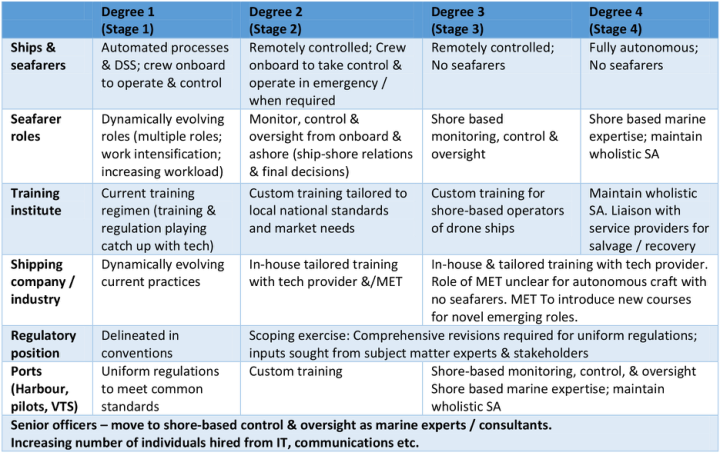
AUTONOMOUS SHIPS OF THE FUTURE Autonomous ships are ships of the future. It is only a matter of time before autonomous ship operations become ubiquitous. However, until then, maritime transport will go through phases of ever-increasing on-board digi- talization and automation. The irreversible trend of increasing technology on-board coupled with reducing crew strength sees its natural culmination in autonomous future ship operations. The International Maritime Organi- zation (IMO), the specialised agency of the United Nations responsible for global shipping has identified four degrees of Maritime Autonomous Surface Ships (MASS) operations. Such ships range from modern ships of today that operate with humans on-board to fully autonomous craft of the future capa- ble of independent decision making and action. The four degrees of MASS correspond to increasing levels of automation on the one hand and a decrea- sing role for the human operators on the other. Seafarers are present on-board in reduced numbers in degrees 1 and 2 of MASS operations and no seafarers will be present on-board in MASS degrees three and four. Shore-based ope- rators will control the vessel in degree 3, whereas a fully autonomous craft as defined in degree 4 will be able to operate independently. Figure 1 below highlights the degrees of autonomy of MASS along with the impact they could have on disparate maritime stakeholders.
The evolving role of seafarers in the different degrees of MASS opera- tions impacts marine engineers and how they will continue to train and work as maritime transport transitions to autonomous ship operations. In addition to regulatory requirements and competition, increasing technology on-board is among the primary drivers of introduction of technology in MET.
Challenges of Simulation Training for Future Engineering Seafarers 649
Figure 1: Maritime autonomous surface ships – 4 stages to full autonomy. Source: Authors (inspired by IMO MASS and industry trends).
Consequently, advances in simulation training for marine engineers including cloud-based training have been embraced by maritime training institutes, however the same is not free from problems.
BRIEF OVERVIEW OF LITERATURE Literature on marine engineering education and training is a subset of the larger field of MET. Within it, simulator training for marine engineers has begun to receive increased attention over the last decade, more so after the comprehensive updating of the Standards of Training, Certification, and Watchkeeping Convention (STCW) by the IMO in 2010. Additionally, simu- lator training for oceangoing/seafaring marine engineers is an even smaller subset. Debates in the literature have focused on simulator fidelity for realistic training (desktop versus full mission simulators), Virtual reality/immersion (Shen et al. 2019; Tan, Niu & Zhang 2020), training objectives, simulator as a tool for training, competency analysis, evaluation, and assessment (Shen, Zhang & Cao 2016; Kandemir, Soner & Celik 2018; Kandemir & Celik 2021), including its efficacy in training for complex operations and emer- gencies in a safe inexpensive manner. Thus far literature has not looked at the challenges of cloud-based marine engineering simulation training in the delivery of blended learning. Going forward this is imperative as distribu- ted teams would need to collaborate via the cloud for learning in the case of autonomous ships.
RESEARCH METHOD This study is a qualitative case study of marine engineering simulation training that is part of a larger ethnographic doctoral study on maritime
650 Emad and Kataria
competence development. The study focuses on the engine room simulation training component of a larger unit on Ship and Engine Resource Mana- gement. The marine engineering simulator training module involves the successful performance of 10 exercises that start with a cold ship, building into the preparation and the starting of generators, the main engine and vari- ous ship systems, followed by the performance of tests and movement until the vessel is ready to full away. The research involves observations in the engine room simulator and interviews with maritime faculty (1-Instructor) and marine engineering students (4 students). Table 1 below highlights the breakdown of the research participants. Of the ten participants, one par- ticipant each was from Mauritius and China and the other eight from Australia.
Table 1. Research participants.
Table available in the original PDF paper.
Research Participants Students Faculty Total Gender Male 8 1 9 Female 1 - 1
Total 9 1 10
Data comprised field notes, audio recordings, short videos, and pictu- res. The field notes, interview data, and videos were transcribed verbatim and analysed with the help of Computer Aided Qualitative Data Analysis Software (CAQDAS), NVivo.
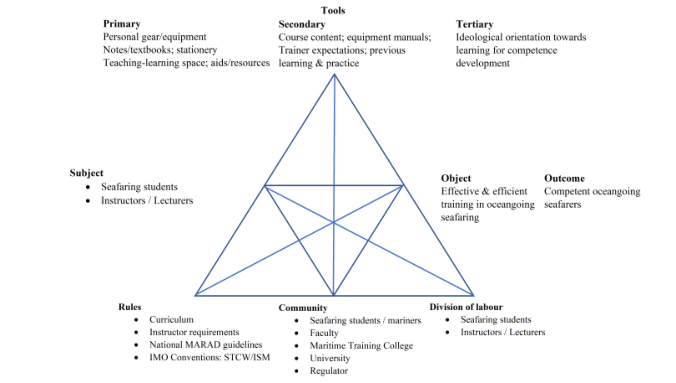
Activity System Analysis of Marine Engineering Simulation Training This research considers maritime higher education as an Activity System (AS) (Engeström 1999) under the overarching umbrella of Cultural Histo- rical Activity Theory (CHAT) (Cole & Engeström 1993; Engeström 1999; Lektorsky 1999). It utilizes the well-established triangle of AS (Engeström 1999; Yamagata-Lynch 2010) to study the marine engineering simulation training wholistically as a situated context dependent undertaking. AS analy- sis is not new to the maritime industry. An analysis of the shipboard AS has previously been published (Rajapakse et al. 2019). Figure 2 depicts the Maritime higher education and training AS.
Figure 2 highlights that a change in any one of the components of the activity system can impact other components. In this study, there was a change in the tool utilised for teaching and learning which has the potential to impact the object and the intended outcome, unless corrective measures are put in place. For the simulation component of the marine engineering training, students had on campus access to a simulator lab equipped with the Galaxy (anonymised) Desktop Simulation (DS) system and a Full Mission (FM) engine room simulator. The DS comprised two monitors and a Central Processing Unit at each workstation. The students also had off campus access to Galaxy Online (anonymised), the cloud-based version of the simulation training system. The data collection for this study took place towards the
Challenges of Simulation Training for Future Engineering Seafarers 651
Figure 2: Maritime education and training (MET) activity system. Source: Authors.
latter half of 2020 when lockdowns were in place and national/state borders were closed in Australia and elsewhere in the world. Until the students retur- ned to campus for the compulsory practicals mandated by the regulatory authority, they had access to the cloud-based simulation training. Supporting the learning of students through the cloud-based simulation training is a step in the right direction however, the study reveals issues with the tool. Tools are innate to AS and achieve meaning through their relation to the subject. The connection between the subject and the object is mediated via the tool in the AS, which was problematic in this case.
EVOLVING ROLE OF MARINE ENGINEERS Over time, the role of the marine engineer seafarer has evolved due to the changing technology on-board. A change in the power and propulsion systems alters the role requirements for the marine engineering crew. Tasks that were performed previously are no longer required in the novel work environment, and accordingly training needs to evolve to meet the new requi- rements. This was the case when ships changed from wind to steam power, and further to diesel engines. Due to the increasing introduction of digitali- zation and automation on-board, in 2010, the IMO identified the role of an Electro Technical Officer (ETOs). Soon after, research on ETO role requi- rements (Mindykowski 2014, 2017) and a model course followed (IMO 2014). Over the decades, the role of the oceangoing marine engineer has evolved from hands-on repair and maintenance, to monitoring, control, and oversight. This can also be seen in the interest maritime administrations are taking around the world in swapping sea service time with simulator time, highlighting the importance of simulator training in MET. Technology plays a disruptive role in maritime transport which is distinctly evident with the advent of MASS (Jo & D’Agostini 2020). When marine engineers will
652 Emad and Kataria
no longer be required on board in degrees 3 and 4 of MASS operations, the content of the training and manner of delivery would need to evolve accordingly.
“I don’t need to know 6 months of machining or 6 months of welding or 6 months of fitting, … You are not really doing these hands-on things like … removing pumps and purifiers…, you just operate things. Today we are talking about autonomous ships, and we don’t have any engineers on- board that ship, so in the STCW there’s a function of repair and maintenance. That function will go out of the window because marine engineers don’t need that. Marine Engineers on autonomous ships will be just an operator…what we need is ...simulators to teach them… We don’t need spanners and chain blocks.” (Faculty Eng1).
The future roles of marine engineer seafarers require them to be trained uti- lising technology that is fit for purpose. In addition to the desktop simulation and full mission simulators, they would need to be trained using cloud-based simulation technology which is currently not seamless.
CHALLENGES OF CLOUD BASED MARINE ENGINEERING SIMULATION TRAINING Over time, shipping companies have pulled back from training provision. They have outsourced training and depend upon nation states to provide them with competent manpower (Bloor, Sampson & Gekara 2014; Tang & Sampson 2018). The National Maritime Administrations have regulatory oversight of training provision in their respective countries. Barring welfare states where maritime training is a state responsibility, in most countries, the responsibility for the training and its expenditure lies with individual stu- dents and their families. In this global neoliberal environment of maritime higher education and training, the responsibility to access online teaching and learning has been passed onto the students.
Accessing Cloud-Based Simulation Training The research shows that accessing the cloud-based simulation tool required for the training may not be straightforward for all. Galaxy Online has spe- cific hardware and software requirements which need to be met to access the system off campus. The students were required to organise hardware of specific compatible configuration. Additionally, they needed to use particular Operating System and software to access it. The costs of procuring the har- dware and software needed to be met by the students. In a couple of cases, despite procuring the required hardware and software the students could not access the system. They could only undertake the training once they returned to campus for the practicals where they were helped to complete their lear- ning in the simulator lab. The lack of access to the tool has a direct bearing on the training object and its outcome. In addition to the access to the tool, modifications to the tool introduce challenges in the teaching and learning.
“It was a bit hard though. I got a new pc and for some reason it didn’t want to work with that either. So, I did find it a bit hard to be able to practice
Challenges of Simulation Training for Future Engineering Seafarers 653
it and to be able to do well… It was only when I came to campus that I could really see it” (Student 4).
Parity in Shore-Based and Cloud-Based Simulation Training The different types of simulation training tools have different affordances and there will not be complete parity between them. Due to their inherent differences, they may have different features even when the same exercise would be accessed from the different platforms. For instance, the shore-based Galaxy DS, is different from the immersive experience available in the FM simulator, and further different from the cloud-based simulation available through Galaxy Online. Overcoming discrepancies requires a constant back and forth between the simulator instructor and the manufacturing company consultant in which case the correction would be included in the next ver- sion. For example, there was a pressure gauge made available “in the desktop system … but not on the full mission system.” (Faculty Eng1). This omis- sion resulted in one instructor failing the exercise in the trial before it was made available to the students. Parity is impacted in shore-based desktop and cloud-based simulation of the same exercise due to the hardware, ban- dwidth, the manner in which it is accessed and manufacturing constraints which may be unable to put each feature of the offline exercises into the cloud-based environment. Students accessing the cloud-based training from different countries in the world would be affected by available bandwidth, internet speeds and the screen size they use to display the exercises. While on campus, the students have access to two large monitors on the desk, whereas at home they are limited by virtue of the hardware they possess. Being mind- ful of parity or the lack of it between the shore based and the cloud-based simulation training environment will help the instructor support the students in their training.
Feedback in Shore-Based and Cloud-Based Simulation Training Providing feedback to students differs between the shore-based and cloud- based simulation training of the same module. The exercises are designed with built-in triggers that turn red if an error is committed. Errors could include overfilling a fuel tank and then draining the excess which could pose a fire hazard as well as waste resources. The shore-based desktop simulation allows the instructor to ‘pinpoint’ the exact location of the error and give detailed feedback to the students, where is this is not the case with Galaxy Online which supports limited feedback. “I can pinpoint and say, no, I’m sorry you have not done it and then they accept it.” (Faculty Eng1). Detailed feedback is important to student learning; however, it is not supported by cloud-based simulation.
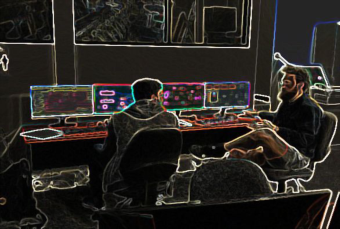
Peer Learning in Shore-Based and Cloud-Based Simulation Peer to peer learning takes place in shore-based simulation training along the lines of Zone of Proximal Development (ZPD) (Vygotsky 1978) in which an experienced peer supports the learning of a less experienced student. The cor- rection should read as ’less experienced student (see Figure 3). Peer to peer
654 Emad and Kataria
Figure 3: Peer to peer learning in shore-based simulation training. Source: Authors.
learning is not available in Galaxy Online as it is not designed for collabo- rative learning. It permits students to go through each exercise individually at their own pace and they need to contact the instructor to receive feedback on performance.
Peer to peer learning is valuable for maritime students. “There was four of us, we would sort of get together, we would study every night… I think that’s a lot harder to do it online…, you know, you know, if you can teach someone else.” (Student 2)
CONCLUSION
Techno-saturated future ships necessitate embracing novel technological solutions for MET. The availability of cloud-based simulation training for marine engineers is a commendable development, however, it has some issues that need to be acknowledged and addressed. There are hardware and sof- tware compatibility issues that limit access. Costs are passed onto individual students which could shut some out. One needs to be mindful of the lack of parity between DS, FM and cloud-based simulation when designing training exercises. The scope for providing feedback in different simulation environ- ments needs to be kept in mind to manage student expectations and learning. Peer/collaborative learning can be built into the online tool to support stu- dent learning. Future ship operations would be undertaken from shore-based monitoring and control centres. Marine engineers, alongside others, would be working in distributed teams ashore that would require robust techno- logical support. Cloud-based simulation training can provide the answer to future MET needs. However, it would need support to improve, evolve, and address the identified concerns. Cloud-based simulation is here to stay and will play a major role in training marine engineers and other operators in future ship operations.
REFERENCES
Bloor, M, Sampson, H & Gekara, V 2014, ‘Global governance of training standards in an outsourced labour forcee: The training double bind in seafarer license and certification assessments’, Regulation & governance, vol. 8, pp. 455–471.
Challenges of Simulation Training for Future Engineering Seafarers 655
Cole, M & Engeström, Y 1993, ‘A cultural-historical approach to distributed cognition’, in G Salomon (ed.), Distributed cognitions - phonological and educational considerations, Cambridge University Press, Cambridge. Engeström, Y 1999, ‘Activity theory and individual and social transformation’, in
Y Engestrmö, R Miettinen & R-L Punamäki (eds), Perspectives on activity theory, Cambridge University Press, Cambridge IMO 1978, 1995, 2010 as amended, International Convention on Standards of Training, Certification and Watchkeeping for Seafarers, IMO, London. IMO 2014, Model course 7.08 Electro-Technical Engineer, IMO, London. IMO 2021, MSC.1/Circ. 1638 Outcome of the regulatory scoping exercise for
the use of Maritime Autonomous Surface Ships (MASS), IMO. Online at: https://wwwcdn.imo.org/localresources/en/MediaCentre/PressBriefings/Docume nts/MSC.1-Circ.1638%20-%20Outcome%20Of%20The%20Regulatory%20S coping%20ExerciseFor%20The%20Use%20Of%20Maritime%20Autonomou s%20Surface%20Ships...%20(Secretariat).pdf, London. Jo, S & D’Agostini, E 2020, ‘Disrupting technologies in the shipping industry: How will MASS development affect the maritime workforce in Korea’, Marine Policy, vol. 120, p. 104139. Kandemir, Cagatay & Celik, M 2021, ‘A Human Reliability Assessment of Marine
Engineering Students through Engine Room Simulator Technology’, Simulation & Gaming, vol. 0, no. 0, p. 10468781211013851. Kandemir, C, Soner, O & Celik, M 2018, ‘Proposing a practical training assessment technique to adopt simulators into marine engineering education’, WMU Journal of Maritime Affairs, vol. 17, no. 1, pp. 1–15. Lektorsky, VA 1999, ‘Activity theory in a new era’, in Y Engestrmö, R Miettinen &
R-L Punamäki (eds), Perspectives on activity theory, Cambridge University Press, Cambridge. Mindykowski, J 2014, ‘Advances in maritime education and training: The case of new competences of electro-technical offcers complying with international regulations’, Journal of Maritime Research, vol. 11, no. 3, pp. 13–19. Mindykowski, J 2017, ‘Towards safety improvement: implementation and asses-
sment of new standards of competence for Electro-Technical Officers on ships’, Maritime Policy and Management, vol. 44, no. 3, pp. 336–357. Rajapakse, A, Emad, GR, Lützhöft, M & Grech, M 2019, ‘A study on time constraints and task deviations at sea leading to accidents – a cultural-historical perspective’, Maritime Policy & Management, vol. 46, no. 4, pp. 436–452. Shahbakhsh, M, Emad, GR & Cahoon, S 2022, ‘Industrial revolutions and transition
of the maritime industry: The case of Seafarer’s role in autonomous shipping’, The Asian Journal of Shipping and Logistics, vol. 38, no. 1, pp. 10–18. Shen, H, Zhang, J & Cao, H 2016, ‘Marine engineering virtual training and evaluation system - a learning tool for marine engineers’, The International journal of engineering education, vol. 32, no. 5, pp. 2097–2105. Shen, H, Zhang, J, Yang, B & Jia, B 2019, ‘Development of an educational virtual rea-
lity training system for marine engineers’, Computer Applications in Engineering Education, vol. 27, no. 3, pp. 580–602. Sullivan, BP, Desai, S, Sole, J, Rossi, M, Ramundo, L & Terzi, S 2020, ‘Maritime 4.0 – Opportunities in Digitalization and Advanced Manufacturing for Vessel Development’, Procedia Manufacturing, vol. 42, pp. 246–253. Tan, Y, Niu, C & Zhang, J 2020, ‘Head-Mounted, Display-Based Immersive Virtual
Reality Marine-Engine Training System: A Fully Immersive and Interactive Virtual Reality Environment’, IEEE Systems, Man, and Cybernetics Magazine, vol. 6, no. 1, pp. 46–51.
656 Emad and Kataria
Tang, L & Sampson, H 2018, ‘Improving training outcomes: the significance of motivation when learning about new shipboard technology’, Journal of Vocational Education & Training, vol. 70, no. 3, pp. 384–398. Vygotsky, LS 1978, Mind in society - the development of higher psychological
processes, Harvard University Press, Cambridge. Yamagata-Lynch, LC 2010, Activity systems analysis methods - understanding complex learning environments, Springer, New York.
LISTED IN THE AHFE DIGITAL BOOKSTORE CATALOGUE
Explore the complete digital volume
Human Factors in Transportation
Read this individual research paper free through the original publisher, or explore the full digital proceedings book.
ISBN 978-1-958651-36-0
Explore this ISBN in the AHFE Bookstore ↗Listed in the July 2026 bookstore catalogue; search by ISBN to confirm current availability · Digital book purchase optional