Xingyi Zhong, Taiwei Sun (2022). Design Strategy Based on Consumers' Cognition of Cantonese Cultural Product in the New Era. In: Cross-Cultural Decision Making. AHFE Open Access, vol. 44, pp. 52–58. https://doi.org/10.54941/ahfe1001855
Cantonese culture is an important part of Chinese culture. From the perspective of the consumer side, with the way of in-depth interview and questionnaire, the paper conducts a research on the consumers’ cognition of Cantonese cultural product, and proposes a corresponding design strategy. The research shows that although consumers are interested in Cantonese culture, not many consumers pay attention to Cantonese cultural product. The main reasons include the lack of category, practicality and innovation of Cantonese cultural product and so on. To strengthen consumers’ attention and consumption of Cantonese cultural product, it is suggested that the appearance, visual symbol of Cantonese, product function diversity and the addition of technology and nostalgic should be considered for designers.
The rapid development of China’ s cultural industry has increasingly become the pillar of national economic development (Jianxin and Penglin, 2021). With more than 2,000 years of cultural history, Cantonese culture has cultiva- ted a good cultural ecology for Guangdong province, becoming an extremely important regional culture which affects the economic development. (Kequn, 2011). As an important part in the cultural industry, how to combine Can- tonese culture with cultural product design is an attracted issue. However, in the specific design, the design end and consumer end is different in terms of age, education, geographical background and so on, so the connotation that the design end gives to cultural product is not such as consumer end expects (Bo Li et al. 2019). Especially in the new era, consumers’ cognition of Cantonese culture has also undergone new changes, making it inevitable that there will be a certain deviation between the cognition of two ends about Cantonese cultural product. Therefore, the paper explores the cognition of Cantonese cultural product in the new era from the perspective of consu- mers, and proposes corresponding design strategies based on research. It is an important research for promoting cross-disciplinary research, enriching
Design Strategy Based on Consumers’ Cognition of Cantonese Cultural Product 53
the connotation of Cantonese cultural research, and promoting cross-cultural design exchanges.
RELATED CONCEPT RESEARCH Cantonese Culture
Cantonese culture is the culture of the Han nationality Cantonese people. It is a kind of Guangdong culture with Guangzhou city as the core, while and the Pearl River Delta and its surrounding areas in western and northern Guangdong as the general range. The academic circles have a relatively wide understanding of the spiritual characteristics of Cantonese culture, which are mainly summarized into three points, compatible with openness, pragmatic avoidance, pioneering and innovative (Lijun, 2020).
According to CNKI data, researches related to Cantonese culture surged in 2007. Since 2008, literature related with Cantonese culture began to incre- ase, which can be summarized as folk culture studies, spiritual characteristics studies and cultural applied studies of Cantonese culture. Cultural applied studies mainly discuss the relationship between urban construction and Can- tonese culture, focusing on guiding the practice and development of culture (Xiaolong and Xuesui, 2016). Cultural product design belongs to the cultural practice guidance.
Culture Product Cultural product is the core element of the cultural industry. The cultural content in cultural product can meet the common emotional needs, spiritual needs, and leisure and entertainment needs to a large extent (Yongwu, 2016). Cultural product has a certain locality and diversity (Zibiao and Jiangong, 2008). Cultural product includes spiritual cultural product, such as film and television, music, novels, etc., and material cultural product, such as food or general industrial product.
Cantonese Culture Product Cantonese cultural product refers to products with Cantonese culture, inclu- ding spiritual and material cultural products. Spiritual cultural product inclu- des Cantonese opera, Cantonese songs, film and television works, books, and visual media on the Cantonese cultural network platform; material cul- tural product includes innovation in traditional industries, Cantonese image product development and other design fields, such as architectural gardens, clothing, jewelry, electronic products and so on (Shan, 2013).
INTERVIEW PROCESS AND SAMPLES Interview Content
The interview was conducted from six aspects: basic personal information, understanding of Cantonese culture, understanding of Cantonese cultural products, the purchase of Cantonese cultural product, the purchase of other
54 Zhong and Sun
Table 1. Basic information of interviewees.
Table available in the original PDF paper.
Entry Project Number of people Proportion Gender Male 6 66.67% Female 3 33.33% Age 24-30 7 77.78% 31-35 2 22.22% Highest education Undergraduate 1 11.11% Postgraduate 8 88.89% Province of birth Guangdong 6 66.67% Non-Guangdong 3 33.33%
cultural product, and expectations for Cantonese cultural product. The pro- cess of purchasing other cultural products is supplementary content, and the purpose is to obtain new ideas for the design of Cantonese cultural product from other angles.
Interview Process The duration of the interview is 30-50 minutes. The main interview steps include: (1) Introduce the interview purpose; (2) Learn about the basic infor- mation and travel situation of interviewees; (3) The travel events are used as an entry point to recall interviewees the feelings about Cantonese cultural product. (4) Thanks.
Interview Samples A total of 9 interviewees were interviewed (see Table 1). All of them like to travel and have plentiful urban travel experience, including the travel to cities of Guangdong province.
INTERVIEW RESULTS Most interviewees’ first reaction to Cantonese culture is Guangzhou Culture. It shows that Guangzhou City has a strong cultural influence on interview- ees, no matter within or outside Guangdong Province. When it comes to the connotation of Cantonese culture, it is believed that Cantonese culture is pra- gmatic, compatible, open and hard-working. When it comes to the explicit features, food is the first thing what interviewees think, followed by the small waist of the Canton Tower.
Understanding of Cantonese Cultural Product Interviewees were confused about the concept of cultural product. After explaining, the interviewees started with Cantonese food, and said that they would buy local specialty dim sum to give away or to taste for themselves. They pay little attention to those cultural and creative products for lack of Uniqueness and Innovation.
Design Strategy Based on Consumers’ Cognition of Cantonese Cultural Product 55
The Purchase of Cantonese Cultural Product Interviewees usually notice a certain Cantonese cultural product out of curio- sity, and then consider buying it based on factors such as whether the price is reasonable, and whether the size and weight is convenient to carry. Generally, they will choose to buy gourmet products with strong practicality. For indu- strial product, they will only choose to buy products that are very visually representative and do not take up space. In addition to gourmet products, the peripheral products of small waist of the Canton Tower are considered as the second representative Cantonese cultural product.
The Purchase of Other Cultural Product Interviewees indicated that interesting or novel experiences can draw their attention to cultural products. One respondent said that when traveling in Shanghai, there is a small machine that prints medals automatically. Out of curiosity, he watched how the machine works, and then found that the price was reasonable, leading to purchase. Another respondent said that he was very impressed when he saw a cultural and creative product designed in the form of Lego toys when traveling abroad. But he gave up buying it conside- ring the price. In addition to the price, the inconvenience of portability can also prompt abandonment of purchases.
Expectations for Cantonese Cultural Product Respondents said that Cantonese culture is a broad and profound culture, but the most concerned about its related products is basically the content of gourmet products. It is suggested that more attention should be taken to cultural marketing and innovation, so that the cognition of Cantonese culture product is not limited to gourmet food. What’s more, forming original brand products focusing on a certain theme can be considered.
QUESTIONNAIRE Questionnaire Samples
The questionnaires were distributed online, and a total of 125 copies were collected. After excluding the data of 2 users whose questionnaires lasted more than 800s, there were 123 valid questionnaires. There is the summary of basic information of the questionnaire (see Table 2).
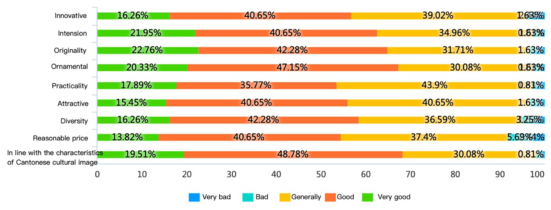
Questionnaire Results The factors considered in the selection of Cantonese cultural product and the current views on the status quo of Cantonese cultural product are investigated with a Likert five-point scale. Reliability analysis was carried out for the two parts respectively, and the coefficients of α were 0.908 and 0.968 respectively, indicating that the questionnaire has high reliability.
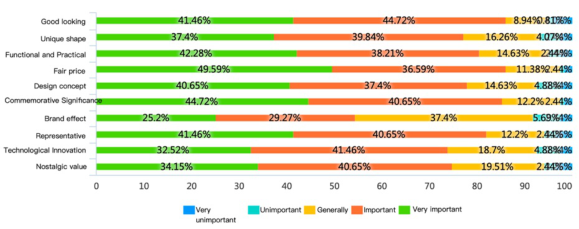
According to the proportion of “Very important”, fair price is the most important factor when choosing Cantonese cultural products. Then, com- memorative significance ranked second. Proportion of good-looking, unique shape, functional and practical, design concept and representativeness is
56 Zhong and Sun
Table 2. Summary of basic information of the questionnaire.
Table available in the original PDF paper.
Entry Project Number of people Proportion Gender Male 51 41.46% Female 72 58.54% Age 18-24 61 49.59% 25-30 38 30.89% 31-40 17 13.82% More than 40 7 5.69% Highest education High school and below 4 3.25% Junior College 53 43.09% Undergraduate 33 26.83% Graduate and above 33 26.83% Province of birth Gender Guangdong 83 67.48% Non-Guangdong 40 32.52%
Figure 1: Factors to consider when choosing Cantonese cultural product.Figure 2: Current views on the status quo of Cantonese cultural product.
close, followed by technological innovation and nostalgic value. The brand effect ranked last. The sum of proportion of “Very important” and “Impor- tant” for other factors significantly exceeds the sum of the proportions of “Generally”, “unimportant” and “Very unimportant”, while the sum of pro- portion of the brand effect is close (see Figure 1). It shows that the brand effect is not the focus of Cantonese cultural product selection.
According to the results (see Figure 2), at present, the attributes of Canto- nese cultural products are not outstanding, especially in terms of attraction, product diversity, reasonable price and originality, which should be taken more attention by designers.
Design Strategy Based on Consumers’ Cognition of Cantonese Cultural Product 57
CANTONESE CULTURAL PRODUCT DESIGN STRATEGY Product Appearance and Cantonese Visual Symbolism are Equally Important
Appearance is an important factor in attracting consumers’ attention, but a good-looking appearance must be combined with the unique visual symbol of Cantonese. Whether it is the outer packaging of food products or cultural and creative products, the most common way is to combine the landmark buildings in Cantonese with Cantonese cultural products, which can visually attract consumers first. In addition to iconic buildings, the color collocation and traditional pattern selection under the visual symbol of Cantonese culture should also be considered.
Integrating Product Functions With Cantonese Cultural and Creative Products Consumers will choose the most satisfactory cultural and craft products as souvenirs, and at other times they are more willing to buy food products with practical value. Therefore, in order to promote the development of Cantonese cultural and creative product and break the deadlock, it is necessary to start with product function innovation. This function needs to be combined with products commonly used in consumers’ lives, such as hooks, shopping bags, refrigerator magnets, notebooks and other products. The product variety should also be as diverse as possible.
The Addition of Technology and Nostalgia Technology and Nostalgia can attract consumers from another angle. As an open area facing the whole country and the world, Cantonese area has obvi- ous technological and information development. Consumers can be attracted by the traditional craftsmanship in Cantonese culture or the first technology in Cantonese area. In addition, we can also consider integrating some histo- rical stories with modern stories to create Cantonese cultural products with story IP as the main line.
CONCLUSION
Combined with user interviews and online questionnaires, the paper explores the consumers’ cognition of Cantonese cultural product in the new era, and proposes the design strategy for Cantonese cultural product. The paper stu- dies Cantonese cultural product from the perspective of users, which makes up for the lack of existing user data to a certain extent. However, there is a problem of insufficient research depth. Cantonese culture is dominant in Lingnan culture, but consumers whether inside or outside Guangdong Pro- vince do not have enough understanding of Cantonese culture, and there is also a lack of attention and understanding of Cantonese cultural product. It is hoped that through the research of the paper, the design end can pay more attention to the innovation of Cantonese cultural product and its marketing methods, promoting the development of Cantonese cultural industry from different angles.
58 Zhong and Sun
ACKNOWLEDGMENT
The research is supported by School-level general research projects of Guan- gdong Construction Polytechnic (Grant No. KY2021-28).
REFERENCES
Bo Li, Chao Ma, Xingyi Zhong and Ting Han. (2019). “Contrast Research on Cognitive Differences Between Design End and Consumption End in Cultural Produ- cts”, in: International Conference on Human-Omputer Interaction International Conference on Cross-Cultural Design, Florida, pp. 60–70. Jianxin Zhou and Penglin Hu. (2021). 2020 Academic Report of Researches on
China’s Cultural Industry, JOURNAL OF SHENZHEN UNIVERSITY (HUMA- NITIES & SOCIAL SCIENCES), Volume 38 No. 1. Kequn Wang. (2011). Characteristics and Influence of Cantonese Culture, JOUR- NAL OF GUANGZHOU INSTITUTE OF SOCIALISM, Volume9 No. 2. Lijun He. (2020). The Role of Guangfu Culture in the Construction of Enter-
prise Culture in Guangdong-Hong Kong-Macao Greater Bay Area, FOREIGN ECONOMIC RELATIONS & TRADE, No. 10. Shan Tan. (2013). Analysis on the characteristics of Cantonese culture and the status quo of industrialization, POPULAR LITERATURE, No. 12. Xiaolong Wang and Xuesui Xu. (2016). The Research on spiritual value of “Canto-
nese culture”, JOURNAL OF JINGDEZHEN UNIVERSITY, Volume31 No. 5. Yongwu Xue. (2016). The economic and social attributes of cultural industries, JOURNAL OF SHANDONG UNIVERSITY(PHILOSOGHY AND SOCIAL SCI- ENCES), No. 5. Zibiao Feng and Jiangong Wang. (2008). JOURNAL OF SHANXI NORMAL
(SOCIAL SCIENCE EDITION), Volume35 No. 2.
LISTED IN THE AHFE DIGITAL BOOKSTORE CATALOGUE
Explore the complete digital volume
Cross-Cultural Decision Making
Read this individual research paper free through the original publisher, or explore the full digital proceedings book.
ISBN 978-1-958651-20-9
Explore this ISBN in the AHFE Bookstore ↗Listed in the July 2026 bookstore catalogue; search by ISBN to confirm current availability · Digital book purchase optional