Ke Liu, Canqun He, Zhelong Hu (2022). Analysis on the preference intention and its influencing factors of standing passengers in subway carriages. In: Cross-Cultural Decision Making. AHFE Open Access, vol. 44, pp. 44–51. https://doi.org/10.54941/ahfe1001854
Rail transit is an important part of urban public transportation and subway bears most of the urban public transportation volume as an important part of urban rail. The uneven density of standing seats in subway cars has always been a common problem. Passengers accustomed to gathering at the door will not only reduce the capacity of the vehicle, but also affect the comfort of passengers. The distribution of passengers in the compartment is affected by the passenger's personal attributes, travel characteristics and the layout of the facilities in the compartment. The first two types are subjective uncontrollable factors, while the third type of layout belongs to objective environmental factors.In this study, the factors influencing the position selection of standing passengers are focused on the differentiated layout of the compartment, and the standing space inside the compartment is divided into three areas, namely the door area, the transition area and the intermediate passage area. Based on the classification and summary of the layout of existing subway functional parts, three different layout factors that affect the preference choice of standing passengers are proposed. Including the number of center pillars (single carriage has 4 and more than 4), the door area handle type (vertical bar and high bar), seat layout (N+N type and N+2 type). A total of 184 people were selected to participate in the investigation of the attitude of preference for standing position. By introducing the concept of the preference degree of the standing position, the preference degree of the passenger standing position under the condition of the differentiated layout was compared, and the differentiated layout was shown on the paper prototype. And use the multivariate ordered Logit model to analyze the data.The results show that the number of central pillars in a single carriage is greater than 4 and the high ring bar in the door area is a risk factor for the transition zone to obtain a higher degree of preference. When the number of mid-pillars is greater than 4 and the door area is a high ring bar, passengers will The preference of the transition zone has declined; the N+2 layout is a risk factor for higher preference in the door area. With the N+2 seat layout, the passenger’s preference for the door area has declined; in a single compartment The number of uprights is greater than 4, the high ring bar in the door area and the N+2 seat layout are the protective factors for a higher degree of preference in the middle aisle area. When the number of columns in a single carriage is more than 4 or the door area is a high bar or the seat layout is N +2, passengers' preference for the middle aisle area will increase. The data results confirm that the layout of the compartment facilities will affect the preferences of passengers for different standing areas. The number and placement of the columns will guide the path of passengers, and the grip comfort of the handrail facilities is also an important factor that affects passengers’ willingness to choose. While, the degree of influence of the transition zone and the intermediate channel zone is exactly the opposite.
As an important part of urban rail, the subway bears most of the public transportation capacity of the city. With the improvement of the functional expression of subway cars, researchers began to pursue a more efficient and comfortable travel experience when considering the space design of subway cars. The phenomenon of uneven density of standing seats in subway cars is a common problem in subway cars. Most passengers say that they prefer to stand near the door, and passengers near the door will be subjected to greater crowding force, which will also lead to low train transfer efficiency (Hirsch et al. 2011). Passengers are accustomed to gathering at the door, which not only reduces the capacity of the vehicle, but also affects the riding comfort.
Analysis on the Preference Intention and Its Influencing Factors of Standing Passengers 45
At present, scholars have begun to pay attention to the uneven distribution of the density of standing seats in the carriage. For example, Zhao Liang et al. obtained the distribution law of the density of standing seats in the carriage by investigating the use of various facilities in the carriage (Zhao et al. 2009). Wu Qibing et al. conducted field observation on Beijing Subway Line 1 and Line 4, obtained the change rule of the density of standing seats in time and space, and proposed the evaluation standard of the density of standing seats (Wu et al. 2014). Most researchers focus on summarizing and discovering the laws of passengers’ standing position selection, but few have conducted in- depth analysis of the impact mechanism behind passengers’ position selection behavior.
Studies have shown that the distribution of passengers in the carriage is also affected by passenger’s personal attributes, travel characteristics and environmental layout (Kim et al. 2014). The first two categories are subjective uncontrollable factors, while the third category is objective environmental factors. It is the arrangement of facilities inside the carriage that affects the distribution of passengers (Wu et al. 2013). At present, there are few related researches on the influence mechanism of objective environmental factors on passengers’ position selection behavior. Therefore, understanding the mech- anism of the differential physical layout inside a subway car on passenger position selection can further guide the design of subway car interior space. In order to explore the influence of objective environmental factors on pas- sengers’ choice of standing area, the preference degree of the passenger station area is used as the evaluation index, and three differentiating factors in the physical layout of the carriage are selected to explore their influence on the preference intention of the passenger station area.
THE EMPIRICAL RESEARCH In this paper, the influencing factors of passengers’ preference for standing position are focused on the carriage layout. Based on the classification and summary of the layout forms of existing subway functional facilities, three layout difference factors are proposed in advance that affect passengers’ pre- ference for standing position (Wei et al. 2016): the number of middle columns (4 or more than 4 in a single carriage), the gripping form of the door area (vertical bar and elevated area handrail), and the seat layout (N + N and N +2) (Berkovich et al. 2013).
Definition of Evaluation Index By introducing the concept of the degree of preference for standing area, passengers’ willingness to choose different standing areas was described. Pas- sengers position preference degree can be divided into four ranks. From high to low, the preference degree of standing area is Level four, Level three, Level two and Level one.
Methods
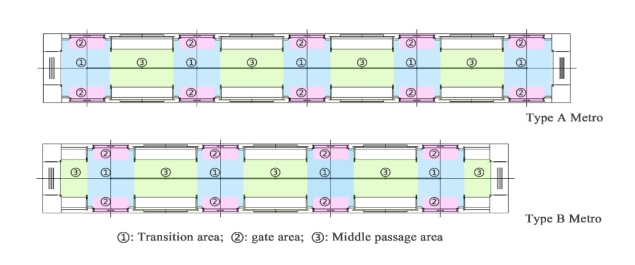
The standing space inside subway cars is divided into three areas, namely transition area, gate area and middle passage area (see Figure 1).
Figure 1: Schematic diagram of compartments space division.
Questionnaire survey was used to obtain the data of passengers’ preference degree to different positions in different scenarios. RP survey and SP survey were used in this study. SP survey is often used in the research field of atti- tude tendency determining mode or route (Wardman et al. 2015). SP survey in this questionnaire is to obtain passengers’ “subjective preference intention in the hypothetical carriage scenario”, and paper prototype method is used to show the respondents different carriage layout scenarios. The survey con- tent includes individual natural characteristics and travel characteristics of passengers, as well as their willingness to choose in different compartment layout scenarios.
Establishing Model Take the degree of passengers’ preference for a stand area as the explained variable, which belongs to the ordered multi-classification variable. There- fore, use the ordered classification Logistic model to analyze the relationship between the probability P of different degree of preference of fixed station area and the influencing factors. The probability that the standing area pre- ference degree is grade is Pi, i = 1, 2, 3, 4, and meet p1, p2, p3, p4 = 1. The cumulative Logistic model is:
Equation reproduced from the original PDF.
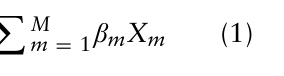
Logit(p(y ≤i)) = ln( p(y ≤i) 1 −p(y ≤i)) = αi + X M Where, in equation (1), i is 1, 2, 3; Xm(m = 1, 2, 3) is the explanatory variable of this paper, the differences in the layout of the three carriages discussed above; αj is the intercept term; βm is the regression coefficient. According to the model, the cumulative probability that the standing area preference degree is gradecan be calculated as:
p(y ≤i) = exp(αi + β1X1 + β2X2 + β3X3) 1 + exp(αi + β1X1 + β2X2 + β3X3) (2) Define the definition and assignment of variables in Formula (2) (see Table 1).
Analysis on the Preference Intention and Its Influencing Factors of Standing Passengers 47
EMPIRICAL ANALYSIS RESULTS SPSS software was used for econometric regression analysis of valid questi- onnaire data, and regression analysis of the influencing factors of explained variable – degree of passenger standing area preference.
Logistic Regression Analysis Results of Standing Area 1 Taking the preference degree of standing area 1 as the explanatory varia- ble, the parameter estimation results of each variable were calculated (see Table 2).
In standing area 1, when the degree of passenger preference increases by at least one grade from low to high, the risk of 4 middle columns in a single carriage is 1.344 times higher than that of more than 4 middle columns. The risk of gate area with middle post was 2.125 times higher than that of ring bar. That is to say, in a column number greater than 4 and the handrail of the door area is a ring bar, passengers have a lower preference for area 1. So the single carriage in more than four pillar and ring bar is a risk factor for area 1 to obtain a higher degree of preference.
Table 3. Regression results of factors influencing the degree of choice preference in area 2 (gate area).
Table available in the original PDF paper.
The independent variables β SE Wald P OR 95%CI Number of central columns (single carriage)
4 0.636 0.300 3.492 0.134 1.346 1.148~1.524 >4 0 1 Holding device for door area Center pillar −0.641 0.300 4.559 0.433 0.895 0.529~1.253 Annular rotary rod 0 1 Seat arrangement type
Logistic Regression Analysis Results of Standing Area 2 Taking the preference degree of standing area 2 as the explanatory varia- ble, the parameter estimation results of each variable were calculated (see Table 3).
The risk of N+N seat layout was 2.086 times higher than that of N + 2 seat layout when the degree of passenger preference increased by at least one grade from low to high in area 2. In other words, under the N + 2 seat layout, passengers have a lower degree of preference for standing area 2, so the N + 2 seat layout is a risk factor for area 2 to obtain a higher degree of preference.
Logistic Regression Analysis Results of Standing Area 3 Taking the preference degree of standing area 3 as the explanatory varia- ble, the parameter estimation results of each variable were calculated (see Table 4).
In station area 3, the degree of passenger preference increases by at least one grade from low to high, the risk of a single carriage with more than 4 middle columns is 2.421 times that of 4 middle columns, and the risk of a
Analysis on the Preference Intention and Its Influencing Factors of Standing Passengers 49
gate area with a ring bar is 2.770 times that of middle columns. The N + 2 seat layout is 1.567 times that of the N+N seat layout. In other words, when the number of central columns is greater than 4, the handrails in the gate area are circular bars, and the seat layout is N +2, passengers have a higher preference for area 3. Therefore, more than 4 middle columns, the circular bar type in the door area and the N + 2 seat layout is the protective factor for area 3 to obtain a higher degree of preference.
DISCUSSION
The Number and Arrangement of the Middle Column can Guide the Choice Behavior of Standing Passengers The results show that when the middle column is evenly set in the middle of the carriage, the extension of the column in the longitudinal line of sight can effectively attract standing passengers to move to the inside of the carriage, thus reducing the gathering of standing passengers near the door. Li Caifeng also came to a similar conclusion in the study of the influence of different layouts on the transfer efficiency of trains, that, the middle column as a small obstacle can play a role of drainage (Li, 2017).
Grasping Comfort of Gripping Facilities is an Important Factor Affecting Passengers’ Choice Intention When the gripping form between two pairs of side doors is circular grip- ping bar, the preference of passengers to choose the transition zone decreases obviously. At the same time, due to the attraction of the middle column in the middle passage area, passengers’ preference for the middle transition area has increased. Jiang Liang et al. found through the study that the grip com- fort of the middle column was higher than that of the high pole (Jiang et al. 2020). Combined with the results of regression analysis, it was proved that the grip comfort of the gripping facilities would affect passengers’ willingness to use them. Setting up different gripping facilities in different areas will form standing areas with different attraction rates (Zhang, 2017).
Variations in the Degree of Preference for Transition Region and Middle Channel Region are Usually Complementary In the compartmentalization of the carriage standing area in this study, the transition zone and the middle passage area are connected vertically, and the transition between the two areas is very close. It is found that the change of preference degree in the transition zone and the middle passage area is usu- ally complementary. The preference degree in the transition zone decreases, corresponding to the preference degree in the middle passage area increa- ses. Therefore, when considering reducing the density of passenger seats in the transition zone, we can make use of the natural connection between the transition zone and the middle passage zone to try to change the direction of thinking: how to improve the passenger attraction rate in the middle passage zone to attract passengers in the transition zone to move naturally.
CONCLUSION
Three potential factors affecting passengers’ intention to choose standing area preference were proposed. 168 random survey samples were selected as the research object, and the degree of choice preference was used as the evalua- tion index of passengers’ intention to choose standing area preference. The influence of these three variables on the degree of passenger standing area preference was analyzed by multivariate ordered Logistic model. The results show that the difference of carriage layout has a significant impact on the degree of preference of passengers in different stations, and the influence of different variables of carriage layout on different area is different. The design of the carriage space can be based on the effect of different facility layouts on the passengers’ preference of standing area. The guiding effect of the environ- ment on the passenger behavior can be used to realize the even distribution of the passenger flow in the compartment, so as to invisibly regulate the public transportation order.
ACKNOWLEDGMENTS
It is supported by Zhejiang provincial key laboratory of integration of healthy smart kitchen system (Grant No: 2014E10014) and Special funds for humanities and social sciences for central universities (Grant No: B220207017).
REFERENCES
Berkovich, A., Lu, A., Levine, B., and Reddy, A. V. (2013), “Observed Customer Seating and Standing Behavior and Seat Preferences on Board Subway Cars in New York City”, Transportation Research Record: Journal of the Transportation Research Board, 2353 (1), 33–46. Hirsch, L., and Thompson, K. (2011), “I can sit but I’d rather stand: Commuter’s
experience of crowdedness and fellow passenger behaviour in carriages on Austra- lian metropolitan trains”, in ATRF 2011 - 34th Australasian Transport Research Forum. Kim, H., Kwon, S., Wu, S. K., and Sohn, K. (2014), “Why do passengers choose a specific car of a metro train during the morning peak hours?”, Transportation research. Part A, Policy and practice, 61, 249–258. Wardman, M., and Murphy, P. (2015), “Passengers’ valuations of train seating
layout, position and occupancy”, Transportation Research Part A: Policy and Practice, 74, 222–238. Wei, F., and Xu, B. (2016), “Application of the Human Geometry Compatibility in the Subway Interior Design”. Wu, Q. B., Chen, F., Fang, J. P., Liu, O. Y., Liu, C., and Zhai, Q. S. (2013), “Investiga-
tion and Study of the Law of Passenger Distribution in One Carriage of Subway in Beijing”, Applied Mechanics and Materials, 2083, 361–363. Jiang, L., Lu, X. T., He, S, J., and An, J. (2020), “Research on design status and optimization of in-car gripping system in Metro”, Design, 33(10), 110–112. Li, C. F. (2017), The effect of passenger room layout on passenger drop efficiency of
intercity trains., Beijing Jiaotong University.
Analysis on the Preference Intention and Its Influencing Factors of Standing Passengers 51
Wu, Q. B., Chen, F., Liu O. Y., Fang, J. P., and Li, X. H. (2014), “Modeling and simulation of spatial comfort of standing Passengers in subway carriages”, Transportation Systems Engineering and Information, 14(05), 126–132. Zhang, Y. (2017), “A brief discussion on the relationship of “man-object-space”
in subway passenger room design”, Science and Technology economic Guide, 18, 250. Zhao, L., Chen, F., and Wu, Q. B. (2009), “Reasonable arrangement of rail transit vehicle service facilities”, Railway transportation and economy, 31(06), 65–68.
LISTED IN THE AHFE DIGITAL BOOKSTORE CATALOGUE
Explore the complete digital volume
Cross-Cultural Decision Making
Read this individual research paper free through the original publisher, or explore the full digital proceedings book.
ISBN 978-1-958651-20-9
Explore this ISBN in the AHFE Bookstore ↗Listed in the July 2026 bookstore catalogue; search by ISBN to confirm current availability · Digital book purchase optional