Yigit Topoglu, Jan Watson, Adrian Curtin, Nicholas Defilippis, Jintao Zhang, Rajneesh Suri, Hasan Ayaz (2022). Exploring the Link Between Emotional Arousal and Player Skill in Video Gaming Using Electrodermal Activity. In: Neuroergonomics and Cognitive Engineering. AHFE Open Access, vol. 42, pp. 134–140. https://doi.org/10.54941/ahfe1001828
1 School of Biomedical Engineering, Science and Health Systems, Drexel University, Philadelphia, PA 19104, USA ↗
2 LeBow College of Business, Drexel University, Philadelphia, PA 19104, USA ↗
3 LeBow College of Business, Drexel University, Philadelphia, PA 19104, USA; Solutions Institute, Drexel University, Philadelphia, PA 19104, USA ↗
4 School of Biomedical Engineering, Science and Health Systems, Drexel University Philadelphia, PA 19104, USA; Solutions Institute, Drexel University, Philadelphia, PA 19104, USA; Department of Psychological and Brain Sciences, Drexel University, Philadelphia, PA 19104, USA; Department of Family and Community Health, University of Pennsylvania Philadelphia, PA 19104, USA ↗
Video games provide a high-octane competitive sports platform where players with diverse skills engage in tasks that require precise control of cognitive skills and emotional responses. Electrodermal activity (EDA) is a portable, non-invasive, and wearable physiological activity sensing modality that captures correlates of emotional responses. In this exploratory study, we analyzed the EDA skin conductance data that we collected from healthy adult participants over their left index and middle fingers, while they were playing a first-person shooter video game. Participants played solo against easy and hard AI opponents, where the objective was to either escort a truck to its destination or prevent the truck from being escorted to win the game. The in-game behavioral performance results showed that, as expected, novice players struggled with the game more than experienced players: novices had fewer kills, died more, and finished the scenarios slower. Furthermore, EDA skin conductance results showed that experienced players showed significantly higher electrodermal activity than novice players while playing the game, both in the context of the phasic and tonic activity.
Emotions play an influential role in our everyday lives, as it guides people’s thoughts and behaviors, affecting cases such as social behavior, decision- making, and hand-eye coordination (Andrade and Ariely, 2009, Trampe et al., 2015, Sin and Prasetia, 2021). This also applies in interactive and competitive environments such as e-sports, where competitors’ cognitive decisions and in-game execution throughout the game have a drastic impact
Exploring the Link Between Emotional Arousal and Player Skill in Video Gaming 135
on the game’s outcome (Jerˇci´c et al., 2012). Since emotions can affect gamers’ decision-making and in-game performance, gaming research has begun to examine the effects of emotion on performance via self-reported questionnai- res or physiological measures (Hughes and Jorda, 2021, Kou and Gui, 2020, Behnke et al., 2020, Poulus et al., 2020, Holm et al., 2021, Passalacqua et al., 2020). Even then, additional empirical work needs to be conducted to expand our understanding regarding the emotional behavior of players of different skill levels in video gaming environments.
As a method to expand this knowledge, electrodermal activity (EDA) can be utilized. EDA is a portable, non-invasive method that measures the ele- ctrical properties of the skin, commonly in the form of skin resistance or skin conductance (Topoglu et al., 2020). EDA shifts occur due to the acti- vity over the eccrine sweat glands, which are regulated by the autonomic nervous system (ANS) (Boucsein, 2012). Because of its relationship with the ANS, EDA is utilized as an indicator for emotional responses such as arou- sal, nervousness, or fear (Dawson et al., 2017). In our recent studies EDA, we have also demonstrated the integration of EDA with electroencephalo- gram (EEG) (Sargent et al., 2020b) and functional near-infrared spectroscopy (fNIRS) wearable neuroimaging (Watson et al., 2019, Sargent et al., 2020a).
In this study, we aim to assess the relationship between player skill and their emotional arousal. We have utilized participants’ EDA data recorded while playing the first-person shooter video game ‘Overwatch’ in short, con- trolled scenarios of easy and difficult conditions. We hypothesized that novice players will show worse in-game performance than experienced players since they have less knowledge about how to play the game. Also, from the perspe- ctive of EDA, experienced players will have more electrodermal activity than novices, as previous literature shows that people with expertise in a task try to anticipate and react to “hazards” more than novices (Chirles et al., 2021, Kinnear et al., 2013).
METHODS
Participants A total of 10 healthy adult participants (5 novices, mean age = 22.44) volun- teered for this study, and data collection is still ongoing. All participants had the requirements of being right-handed with vision correctable to 20/20. Before the study, participants filled and signed the consent form approved by the Institutional Review Board of Drexel University.
Experiment Protocol The study was performed over a single session, and participants sat in front of a computer, played Overwatch, a first-person shooter (FPS) game made by Activision-Blizzard (Santa Monica, CA, www.activisionblizzard.com). Before the session, participants filled out background forms to classify whether they were a novice or experienced regarding playing the video game.
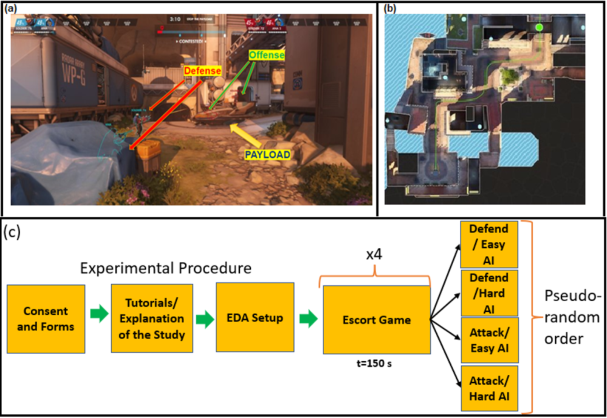
In the experiment, participants played Overwatch individually in ‘Escort Mode’ (shown in Figure 1a and 1b), which is a game mode consisting of two
Figure 1: (a) An example snapshot of the Escort Mode, where the attacking team tran- sports the ‘payload’ by standing close to it while defending team tries to prevent the attacking team escort the ‘payload’. (b) The map for the game scenarios. The green line represents the payload’s path, green dot represents the destination. (c) Overall experimental procedure in order.
teams where the attacking team needed to escort a ‘payload truck’ from a specific point to another to win the game, while the defending team tried to prevent the truck from being escorted to its destination within a time limit. Each trial had a time limit of 150 seconds, the game ended either when the timer expired, or the payload had been successfully escorted to the final point. As seen in Figure 1c, after form completions, the explanation of the study with tutorials, and setting up the EDA sensor, participants played the ‘Escort’ scenario singly in either attacking or defending scenario twice each in a pseu- dorandomized order, either playing against 2 easy or 2 hard AI opponents. Hard AI dealt more damage to the players compared to easy AI while taking less damage from them.
Data Acquisition, Signal Processing, and Analysis Throughout the experiment, participants’ skin conductance was recorded at a sampling rate of 128 Hz in the unit of microSiemens via the Shimmer GSR+ Unit (Shimmer Sensing, www.shimmersensing.com), a portable and wireless EDA sensor by being placed on the participants’ left index and middle fingers. The time blocks where the participants played the game in different scenarios were synchronized using custom MATLAB scripts. Using these synchronized blocks, EDA data was processed via Ledalab, an open-source MATLAB tool- box designed for EDA analysis (Benedek and Kaernbach, 2010a). As for the pre-processing procedure, EDA data was filtered with a zero-phase 2nd order Butterworth low-pass filter with 0.5 Hz cut-off frequency for pre-processing to reduce the high-frequency noise. After low-pass filtering, the continuous
Exploring the Link Between Emotional Arousal and Player Skill in Video Gaming 137
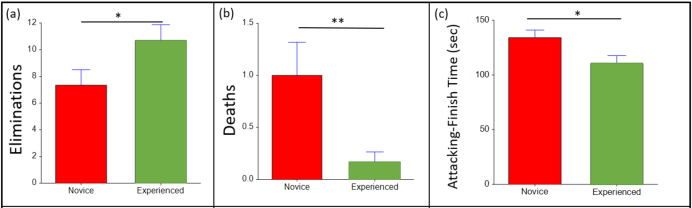
Figure 2: Overall results for the in-game performance stats. Experts have significantly (a) more eliminations and (b) fewer deaths than novices. (c) Experts finish the Attacking scenario in less time than novices. *p<0.05, **p<0.01. Whiskers are SEM.
decomposition analysis method, which uses nonnegative deconvolution to separate the components of EDA data designed by Benedek and Kaernbach (Benedek and Kaernbach, 2010b), was applied to separate EDA data into two different components: phasic and tonic activity. Average event-related pha- sic component (a.k.a. skin conductance response (SCR), which is the small but fast fluctuations as a reaction to an event) and tonic component (a.k.a. skin conductance level (SCL), slower but bigger changes) of EDA data over the time blocks where the participants played each scenario were extracted as a feature. For statistical analysis, linear mixed models are used via NCSS software, with the player skill and scenario difficulty fixed factors.
RESULTS
In-Game Performance Measures For the behavioral results, we examined the in-game performance measures such as the number of eliminations (kills and assists combined) and deaths for each participant in each scenario, alongside finishing time while parti- cipants played the Attacking scenario. In the case of in-game performance measures, as shown in Figure 2a, our results show that experienced pla- yers had significantly more eliminations (F(1,42) = 4.10, p = 0.049*) than novice players. Experts also died significantly fewer than novices across all trials (F(1,42) = 7.34, p < 0.01**), shown in Figure 2b. Furthermore, experts finished the Attacking scenarios in significantly less time than novices (F(1,42) = 5.40, p = 0.03*) (Figure 2c).
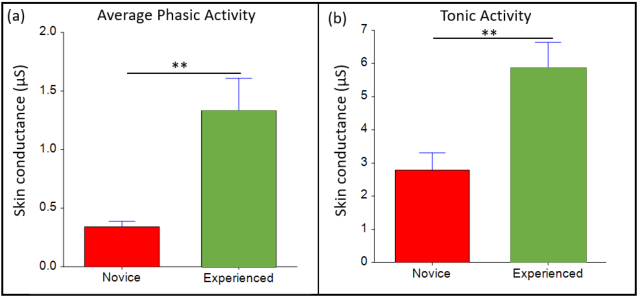
EDA Results For EDA data, we have compared the average event-related skin conductance responses and skin conductance levels for experienced and novice players across all trials. The game difficulty was not a significant factor in neither the average SCR nor SCL, along with the main interaction between game difficulty and player skill. However, seen in Figure 3a, there was a significant difference between the Novice and Experienced group across all scenarios, experienced group having significantly more electrodermal activity than the novice players (F(1,42) =10.33, p < 0.01**). In terms of tonic activity, the
Figure 3: Average event-related skin conductance response of the participants when they played the game. Experienced players have significantly higher EDA (a) phasic activity and (b) tonic activity than novices across all trials. **p<0.01, Whiskers are SEM.
trend in phasic activity also followed the skin conductance levels, experienced players having significantly more tonic activity than novice players (F(1,42) =8.96, p < 0.01**), as shown in Figure 3b.
DISCUSSION
In this study, our goal was to demonstrate EDA as a tool to assess the rela- tionship between player skill and their emotional response. We hypothesized that novice players would have worse in-game performance than the expert players, and experts’ EDA activity would be higher than novice players due to being more attentive in-game. Our first hypothesis was consistent with our results since experts killed more opponents, died fewer times, and finished the scenarios in a shorter amount of time than novice players. This shows that novice participants struggled more while playing the game compared to experienced players. In the case of electrodermal activity, our EDA results also show consistency with our second hypothesis. Our EDA results showed that experienced players showed significantly more electrodermal activity than novices, showing more emotional arousal. The reasons could be that experienced players are more likely to be prepared for different scenarios and situations in the video game than novices, hence they are more prone to anticipate and perceive hazardous situations to appropriately react to them, similar to other cognitive tasks such as driving (Chirles et al., 2021, Kinnear et al., 2013) and air traffic control tasks (Lanini-Maggi and Fabrikant, 2014). In addition, we did not find any significant difference between easy and hard difficulties in EDA, which is also similar to the results in previous literature (Drachen et al., 2010, Kneer et al., 2016).
There are a couple of limitations to this study. The first limitation is that we only used Overwatch, a first-person shooter, as the video game for the assessment. Games from diverse genres (MOBAs, fighting games, real-time strategy games, etc.) may have different impacts on the features examined in this study. The second limitation is that we had a relatively small sample
Exploring the Link Between Emotional Arousal and Player Skill in Video Gaming 139
size (10 participants). Future studies with larger participant cohorts could investigate the effect between group conditions with better precision.
In summary, we used EDA alongside behavioral measures to evaluate the connection between player’s skill and their emotional arousal in a video gaming environment. As expected, the findings show that experienced players performed better and faster in-game than novice players behaviorally. In the context of EDA, experts also show more emotional arousal than novices, due to the “anticipatory period”for dangerous situations. Despite the limitations, this preliminary study is a promising step towards demonstrating EDA as an objective measurement tool to provide valuable information about gamers’ emotional arousal, which can be beneficial in understanding gamers’ emo- tional responses in video gaming environments. A better understanding of the biomarkers related to emotional responses during video gameplay can be used in the training of e-sports athletes and optimization of new game development.
REFERENCES
Andrade, E. B. and Ariely, D. (2009) ‘The enduring impact of transient emotions on decision making’, Organizational Behavior and Human Decision Processes, 109(1), pp. 1–8. doi: https://doi.org/10.1016/j.obhdp.2009.02.003 Behnke, M., Gross, J. J. and Kaczmarek, L. D. (2020) ‘The role of emotions in esports
performance’, Emotion. Benedek, M. and Kaernbach, C. (2010a) ‘A continuous measure of pha- sic electrodermal activity’, J Neurosci Methods, 190(1), pp. 80–91. doi: 10.1016/j.jneumeth.2010.04.028 Benedek, M. and Kaernbach, C. (2010b) ‘Decomposition of skin conductance data by means of nonnegative deconvolution’, Psychophysiology, 47(4), pp. 647–658. doi: https://doi.org/10.1111/j.~1469--8986.2009.00972.x Boucsein, W. (2012) Electrodermal activity, 2nd ed. Electrodermal activity, 2nd ed.
New York, NY, US: Springer Science + Business Media. Chirles, T. J., Ehsani, J. P., Kinnear, N. and Seymour, K. E. (2021) ‘Skin Conductance Responses of Learner and Licensed Drivers During a Hazard Perception Task’, Frontiers in psychology, 12, pp. 619104–619104. doi: 10.3389/fpsyg.2021.619104 Dawson, M. E., Schell, A. M. and Filion, D. L. (2017) ‘The electrodermal system’, Handbook of psychophysiology, 4th ed. Cambridge handbooks in psychology. New York, NY, US: Cambridge University Press, pp. 217–243. Drachen, A., Nacke, L. E., Yannakakis, G. and Pedersen, A. L. (2010) ‘Correlation
between heart rate, electrodermal activity and player experience in first-person shooter games’, Proceedings of the 5th ACM SIGGRAPH Symposium on Video Games, Los Angeles, California: Association for Computing Machinery, 49–54. Holm, S. K., Kaakinen, J. K., Forsström, S. and Surakka, V. (2021) ‘Self-reported playing preferences resonate with emotion-related physiological reactions during playing and watching of first-person shooter videogames’, International Journal of Human-Computer Studies, 155, p. 102690. doi: https://doi.org/10.1016/j.ijhc s.2021.102690 Hughes, A. and Jorda, S. (2021) ‘Applications of Biological and Physiological Signals
in Commercial Video Gaming and Game Research: A Review’, Frontiers in Computer Science, 3. doi: 10.3389/fcomp.2021.557608
Jerˇci´c, P., Astor, P., Adam, M., Hilborn, O., Schaff, K., Lindley, C., Sennersten, C.
and Eriksson, J. (2012) ‘A serious game using physiological interfaces for emotion regulation training in the context of financial decision-making’. 20th European Conference on Information Systems. Kinnear, N., Kelly, S. W., Stradling, S. and Thomson, J. (2013) ‘Understanding how drivers learn to anticipate risk on the road: A laboratory experiment of affective anticipation of road hazards’, Accident Analysis & Prevention, 50, pp. 1025–1033. doi: https://doi.org/10.1016/j.aap.2012.08.008 Kneer, J., Elson, M. and Knapp, F. (2016) ‘Fight fire with rainbows: The effects of
displayed violence, difficulty, and performance in digital games on affect, aggres- sion, and physiological arousal’, Computers in Human Behavior, 54, pp. 142–148. doi: https://doi.org/10.1016/j.chb.2015.07.034 Kou, Y. and Gui, X. (2020) ‘Emotion Regulation in eSports Gaming: A Qualitative Study of League of Legends’, Proc. ACM Hum.-Comput. Interact., 4(CSCW2), pp. Article 158. doi: 10.1145/3415229 Lanini-Maggi, S. and Fabrikant, S. (2014) ‘Embodied Decision Making with Anima-
tions’. 8th International Conference on Geographic Information Science, Vienna, Austria, Sep. 23-26, 2014. Passalacqua, M., Morin, R., Sénécal, S., Nacke, L. E. and Léger, P.-M. (2020) ‘Demystifying the First-Time Experience of Mobile Games: The Presence of a Tutorial Has a Positive Impact on Non-Expert Players’ Flow and Continuous-Use Inten- tions’, Multimodal Technologies and Interaction, 4(3), p. 41. doi. Available at: https://www.mdpi.com/2414-4088/4/3/41 Poulus, D., Coulter, T. J., Trotter, M. G. and Polman, R. (2020) ‘Stress and Coping in
Esports and the Influence of Mental Toughness’, Frontiers in Psychology, 11. doi: 10.3389/fpsyg.2020.00628 Sargent, A., Watson, J., Topoglu, Y., Ye, H., Suri, R. and Ayaz, H. (2020a) ‘Impact of Tea and Coffee Consumption on Cognitive Performance: An fNIRS and EDA Study’, Applied Sciences, 10(7), pp. 2390. doi. Available at: https://www.mdpi.c om/2076-3417/10/7/2390 Sargent, A., Watson, J., Ye, H., Suri, R. and Ayaz, H. (2020b) ‘Neuroergonomic
Assessment of Hot Beverage Preparation and Consumption: An EEG and EDA Study’, Frontiers in Human Neuroscience, 14. doi: 10.3389/fnhum.2020.00175 Sin, T. and Prasetia, I. (2021) Correlation Between Emotional and Eye-Hand Coordination Ability Towards Passing Ability in Volleyball. Atlantis Press. Topoglu, Y., Watson, J., Suri, R. and Ayaz, H. (2020) ‘Electrodermal Activity in
Ambulatory Settings: A Narrative Review of Literature’. Advances in Neuroer- gonomics and Cognitive Engineering. Cham: Springer International Publishing, 91–102. Trampe, D., Quoidbach, J. and Taquet, M. (2015) ‘Emotions in Everyday Life’, PLOS ONE, 10(12), p. e0145450. doi: 10.1371/journal.pone.0145450 Watson, J., Sargent, A., Topoglu, Y., Ye, H., Zhong, W., Suri, R. and Ayaz, H.
(2019) ‘Using fNIRS and EDA to Investigate the Effects of Messaging Related to a Dimensional Theory of Emotion’. AHFE.
LISTED IN THE AHFE DIGITAL BOOKSTORE CATALOGUE
Explore the complete digital volume
Neuroergonomics and Cognitive Engineering
Read this individual research paper free through the original publisher, or explore the full digital proceedings book.
ISBN 978-1-958651-18-6
Explore this ISBN in the AHFE Bookstore ↗Listed in the July 2026 bookstore catalogue; search by ISBN to confirm current availability · Digital book purchase optional