Chiyomi Mizutani, Ryoji Hirota, Kanji Kajiwara (2022). The effect of anti-itch fiber on the quality of sleeping. In: Human Factors for Apparel and Textile Engineering. AHFE Open Access, vol. 32, pp. 186–191. https://doi.org/10.54941/ahfe1001554
For humans, sleeping has a role of restoring mind and body, and is an important function for recovery from fatigue. In recent years, more focus has been put on the quality of sleep rather than the quantity of sleep, and it has been found that the bedding and sleeping garments could disturb the quality of sleep. There are many factors disturbing sleep, and itching during sleep deteriorates the quality of sleeping. Patients with atopic dermatitis are particularly suffering from poor sleep due to itching. Based on the results of our research so far, we have found that weak-acidic polyester, which possesses weak-acidic groups, suppresses itching due to atopic dermatitis. In this study, we adapt weak-acidic polyester to sleeping garments which contact directly with skin and aim to investigate whether the quality of sleeping is improved by suppressing itchiness during sleep. The sleeping garments were prepared with the weak-acidic polyester and untreated polyester fabrics. We asked 7 females with atopic dermatitis in their twenties and 7 healthy females in their twenties as subjects to wear the prepared sleeping garments at home. The quality of sleep was assessed by an electroencephalograph and the Athens insomnia scale, and the degree of itching was scored on a scale of 100 according to the visual analog scale (VAS). Sleep is specified by REM sleep and non-REM sleep according to brain activity at sleep. In REM sleep, the brain is still actively working and memory is organized and established. In non-REM sleep, the cerebrum is considered to be resting and is important for recovery from fatigue of the brain and body. Good sleep is determined by the amount of non-rem sleep. The wear tests confirmed that the weak-acidic polyester scored a higher rate of non-REM sleep than that of the untreated polyester in summer season. All the subjects wearing the weak-acidic polyester had a lower degree of itchiness and a higher proportion of non-REM sleep, confirming the effect of weak-acidic polyester.
For humans, sleep is an essential activity for resting, repairing, and regene- rating the body and brain. Growth-related hormones are secreted 2-3 hours after falling asleep, assisting cell repair and fatigue recovery. However, one in five Japanese suffers from insomnia [Mishima, 2022]. The main cause of insomnia is attributed to the increased time in TV viewing due to the change of night-shifted lifestyle resulted from the spread of the Internet and games as resulted in sleep deprivation and sleep disorders. Sleep deprivation has been shown to be more responsive to negative emotional stimuli and is known to increase anxiety and depression. In addition, it has been pointed out that the accidents and lifestyle-related diseases have worsened. Sleeping quality is just as important as sleep time, and the sleeping environment, such as bedroom
The Effect of Anti-Itch Fiber on the Quality of Sleeping 187
brightness, bed temperature and humidity, is important to improve sleeping quality [Arai et al.2006]. The sleeping quality could also be improved by the tools including the choice of bedding, pajamas and pillows that fit the phy- sique [Kogure, 2005]. The brain activity is reduced during sleeping, but the brain activity can be measured by measuring brain waves. The sleeping brain is divided into two sleep stages of REM sleep and non-REM sleep, as speci- fied by the characteristics of respective brain waves [Kashiwagi et al.2016]. These modes (REM sleep and non-REM sleep) are repeated during sleeping on a regular basis. The brain is still active in REM sleep, and memory is orga- nized and stored. In non-REM sleep, the cerebrum is considered at rest and is preparing for the recovery from brain and body fatigue. Deep sleep results in brain rest, body tissue repair, growth hormone secretion, energy savings, and enhanced immune function. In this context, the sleeping quality, the sleeping quality is assessed in terms of the cycle pattern of REM and non-REM.
Subjects with atopic dermatitis suffer from poor sleep due to itching with their ill-suitable pajamas. A weak-acidic polyester fiber has been developed to maintain the healthy skin condition (pH 5.5) at the contacting boundary with human skin by introducing malic acids (Teijin Co. Ltd.). The fabric made of weak-acidic polyester fiber was found to suppress rash develops and subse- quent itching of the patients with atopic dermatitis [Mizutani et al, 2013]. In the present study, we apply weak acidic polyester to sleeping garments and evaluate its anti-itching effect on sleeping quality.
EXPERIMENT Sample Sleeping Garment
A one-piece type of sleeping garment made of weak-acidic polyester or untre- ated polyester knitted fabric (manufactured by Teijin Co. Ltd.) was used for the sleeping quality evaluation. The seam allowance of the sleeping gar- ment was exposed because it could irritate the skin of patients with atopic dermatitis.
Sleep Experiment Method The subjects are composed of 4 atopic dermatitis patients suffering from itch- ing when sweated and 4 healthy females. The subjects were aged 20 to 26 years each, and participated in the sleep experiment at August – September (summer) in 2021. In the sleep experiment, the subjects were asked to use their daily bedding in their own bedroom in order to avoid the influence of the bedding and floor environment on the sleeping quality. They put on one of the samples of sleeping garment and installed an electroencephalo- graph, Sleep Scope (manufactured by Sleepwell Co., Ltd.) on their forehead and nape to measure the sleeping quality. An ultra-compact temperature / humidity sensor (SHTDL-3) (manufactured by Syscom) was used for the tem- perature / humidity monitoring in the bed room. A sensor was also attached to the chest pocket of the sleeping garment to monitor the temperature and humidity inside the bed during the sleep period. After waking up, the subjects were to answer the questionnaire of the Athens Insomnia Scale to evaluate
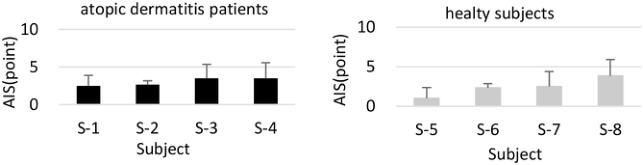
Figure 1: Insomnia assessment of subjects by Athens Insomnia scale.
the degree of insomnia. In addition, the visual analog scale (VAS) was used for the evaluation of the degree of itching, where the strongest itching experi- enced so far was set as 100 and the subjects were asked to indicate the degree of the itching during sleep on a straight line of 10 cm [Yamada et al. 2005]. After wearing the same type of sleeping garment for 3 consecutive days, ano- ther type was worn for 3 days and the same series of sleeping experiments were repeated with the same subjects.
RESULTS AND DISCUSSION
Subjects’ Insomnia The Athens Insomnia Scale (AIS) is widely applied for assessing the degree of sleep insomnia [Okajima et al. 2020]. Figure 1 shows the assessed results of the insomnia of the subjects as the average value for 6 days. The figure on the left shows the results obtained from the patients with atopic dermatitis (S-1 to S-4), who claimed itching during sleep by sweating. The figure on the right shows the AIS scales of healthy subjects (S-5 to S-8) who claimed no itching. All subjects have an AIS value of 6 or less and are not considered to be insomnia, and are judged to be suitable as subjects for this study.
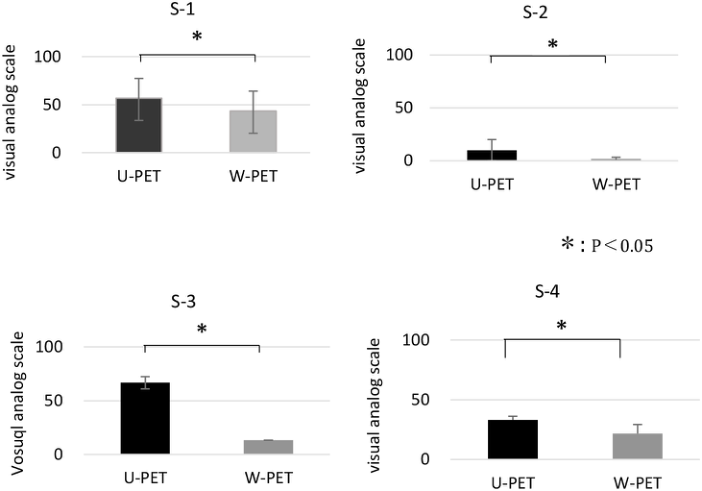
Comparison of Itching During Sleep While Wearing Sample Sleeping Garment The subjects suffering from atopic dermatitis (S-1 to S-4) claimed itching during sleep. Figure 2 shows the average value of the degree of itchiness on the VAS scale when the subjects wore respective sleeping garments made of untreated polyester or weak-acidic polyester for 3 days during sleep. Alth- ough the degree of itching varies due to the subjective judgement depending on the subjects suffering from atopic dermatitis (S-1 to S-4), the degree of itching is lower when wearing weak-acidic polyester for sleeping garment than when wearing untreated polyester for each subject. On the other hand, healthy subjects hardly felt itching (the VAS scale=0) regardless of wearing untreated polyester or weak-acidic polyester.
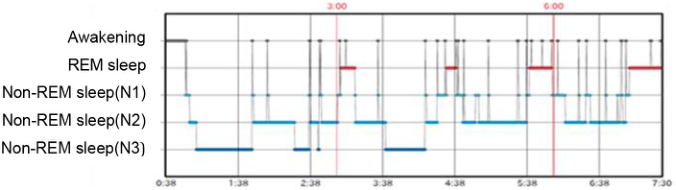
Evaluation of Sleeping Quality by an Electroencephalograph The sleeping brain repeats REM sleep and non-REM sleep periodically, and the sleep stage is characterized by brain waves. When a person falls in sleep, first her brain wave shows the characteristics of non-REM sleep and then goes
The Effect of Anti-Itch Fiber on the Quality of Sleeping 189
Figure 2: Comparison of itching when atopic dermatitis patients wear weak-acidic polyester (W-PET) and untreated polyester (U-PET) during sleep.Figure 3: Typical sleeping pattern comprised of REM sleep and non-REM sleep.
in deeper sleep mode characterized as non-REM sleep before awakening (see Figure 3). A 90-minutes cycle of REM sleep and non-REM sleep is typically repeated 4 to 5 times during sleeping.
Different brain waves are detected depending on the quality of sleep. Brain waves are classified into the α wave (8 to 13 Hz), the β wave (14 to 30 Hz), the θ wave (4 to 7 Hz), and the δ wave (0.5 to 3 Hz) according to the frequency range [Hitomi et al 2014]. The brain waves θ and δ are generated in the sleep stage, while the mixed waves of α and β are observed in the awakening stage. In non-REM sleep, sleep becomes deeper in the order of N1, N2 and N3. The θ wave characterizing light sleep appears in N1, and many δ waves appear in N3 of non-REM. The δ wave is a symptom of deep sleep, that is, the higher amount of δ waves denotes the better sleeping quality.
The δ power is defined as the power spectrum density of the brain δwave in the frequency ranges from 0.5 to 2 Hz. Since the δ wave appears only in deep
Table 1. Effect of weak-acidic PET wear on the δ power value, interrupted sleep time and VAS at the first sleeping cycle evaluated from the subjects with or without atopic dermatitis.
Table available in the original PDF paper.
sleep, the δ wave characterizes deep sleep and thus the δ power evaluates the sleeping quality. Since δ waves appear mostly in the first sleep cycle during sleep, the analysis was conducted for the first sleep cycle in the following discussion.
Table 1 summarizes the results of the electroencephalograph (EEG) (in terms of the δ power), the total interrupted sleep time and the degree of itchiness (in terms of VAS), where the results are based on the data taken in the second day of 3-day consequent wearing tests. The subjects suffering from atopic dermatitis (S-1 to S-4) show a lower degree of itching (VAS) when wearing weak-acidic polyester(W-PET) than when wearing untreated polyester(U-PET), and the corresponding δ power value was found larger when wearing W-PET except for Subject S-2. The results indicate that the weak-acidic polyester garment promotes the sleeping quality by reducing itching during sleeping. Itching interrupts sleeping and deteriorates the slee- ping quality. The interrupted sleep time was also reduced by wearing W-PET garment in the case of the subjects suffering from atopic dermatitis except for S4, confirming that a positive effect of W-PET garment on atopic der- matitis skin. Here the healthy subjects claimed no itching by wearing U-PET or W-PET garments in bed. Although the subject S-8 exhibited longer inter- rupted sleep time and lower δ value, she claimed no itching so that the bad sleeping quality might be caused by another reason.
CONCLUSION
The sleeping quality is deteriorated itching during sleep in the subjects with atopic dermatitis as quantitatively evaluated by an electroencephalograph. The sleeping garment made of the weak-acidic polyester was subjectively con- firmed to suppress itching after awakening, and a shorter interrupted sleep and a higher δ power value of the first sleep cycle during sleep proved this conjecture during sleep semi-quantitatively. The sleeping quality is improved
The Effect of Anti-Itch Fiber on the Quality of Sleeping 191
by releasing atopic itching, and the atopic dermatitis could be suppressed by keeping skin pH at a healthy skin condition. In the future, weak-acidic polyester will be compared with cotton, which is recommended for patients with atopic dermatitis as sleeping garments, with regard to the effect on the quality of sleep.
ACKNOWLEDGMENT
The authors would like to express thank the students of Otsuma Women’s University for accepting the subjects in this study. This work was supported by JSPS KAKENHI Grant Number 19K02325. This study was conducted with the approval of Life Science Research Ethics Committee of the Otsuma Women’s University (reception number 2019-011).
REFERENCES
Chiyomi Mizutani, Momoe Ukaji, Naoki Horikawa, Tomoyoshi Yamamoto, Hideaki Morikawa, Kanji Kajiwara. (2013) Study of weak-acidic clothing materials developed for skin conditioning, SENIGAKKAISHI, Volume 6, No. 4. Hidekazu Yamada, Koichi Yanagishita, Takayuki Kumamoto, Manabu Sawamoto.
(2005) Evaluation of visual analog scale (VAS), Skin Research, Volume 4, No. 5, p. A35-A3. Hirokazu Arai, Tomohiro Nakamura, Atsushi Kiuchi, Ryotaro Urai. (2006) Relationship between subjective sleep quality, physical activity and psychological adjustment, Japanese Society of Psychosomatic Medicine, Volume 46, No. 7, pp. 667–676. Isa Okajima, Towa Miyamato, Ayaka Ubara, Chie Omichi, Arichika Matsuda, Yuki-
yoshi Sumi, Masahiro Matsuo, Kazuki Ito, Hiroshi Kadotani. (2020) Evaluation of severity levels of the athens insomnia scale based on the criterion of inso- mnia severity index, International Journal of Environmental Research and Public Health, Volume 17, No. 23, pp. 8789–8801. Kaori Kashiwagi, Masaki Yoshida. (2016) Development of a small electroencephalograph to accelerate sleep research, Japan Society for Bioscience, Biotechnology, and Agrochemistry, Volume 54, No. 10, pp. 768–772. Mishima, Kazuo (February 21, 2021) e-net health, significance of a healthy sleep,
ministry of health, labor and welfare website: https://www.e-healthnet.mhlw.go. jp/information/heart/k-01-001.html#:~:text Takefumi Hitomi, Akio Ikeda, Basic knowledge of brain waves, Japan Society of clinic neurophysiology, Volume 42, No. 6, pp. 365–370. Takamaza Kogure. (2005) Bedding and sleep, Society of Biomechanisms Japan,
Volume 29, No. 4, pp. 189–193.
LISTED IN THE AHFE DIGITAL BOOKSTORE CATALOGUE
Explore the complete digital volume
Human Factors for Apparel and Textile Engineering
Read this individual research paper free through the original publisher, or explore the full digital proceedings book.
ISBN 978-1-958651-08-7
Explore this ISBN in the AHFE Bookstore ↗Listed in the July 2026 bookstore catalogue; search by ISBN to confirm current availability · Digital book purchase optional