Xin Zhang, Ningrong Xie, Jin-Tu Fan, Tracy Mok (2022). A comprehensive body sizing system for international fashion consumers and apparel manufacturing. In: Human Factors for Apparel and Textile Engineering. AHFE Open Access, vol. 32, pp. 15–22. https://doi.org/10.54941/ahfe1001533
Human body sizing standards are the foundation for apparel mass production. An effective sizing system is vital because it provides a consistent and accurate sizing reference for both manufacturers and consumers. This study aims to develop a comprehensive sizing system in a 3-step process by taking reference to all major national body sizing standards. Firstly, the primary and secondary dimensions are determined. Secondly, coverage of the body shapes, represented by drop vales for upper body (differences of bust and waist) and lower body (differences of waist and hip), are calculated. Thirdly, the size ranges, namely, the upper and lower limits of primary and secondary dimensions, are obtained from each size standard. In this paper, the sizing standards of US, Europe, China, Japan and some other countries were investigated. Based on the analysis results, we consolidated all sizing information into five size charts, from which a comprehensive sizing system covering two size charts for upper body and lower body were lastly constructed. The proposed sizing system covers very board body size ranges as well as a large variety of body shapes, which provide a basis for garment production and body shape classification.
Mass produced ready-to-wear relies much on a solid sizing system to ensure a good fit at a low cost and fast speed (Loker, 2007). Traditionally, a sizing system is developed based on anthropometry surveys and therefore may have differences across countries and areas. The inconsistent sizing standards among different countries may cause problems for customers choosing their right clothing sizes. This may not satisfy consumers’ needs on clothing fit if their sizing systems were developed from anthropometry surveys of only one country or area (Nancy, 2005). This issue may become more compelling in the age of e-commerce.
To achieve a more accurate and effective sizing system, a variety of methods were investigated using sizing standards of various countries, in-depth opti- mization and statistical analysis of human data to solve the existing problems
of low size accuracy and matching rate (Moez,2017; Xia, 2017). Some sophisticated statistical methods were also used to develop sizing systems for different target groups (McCulloch et al, 1998; Gupa et al,2004; Pei et al, 2017). Instead of focusing on the development of a more accurate sizing system, we address the problem of inconsistent sizing in this paper and esta- blish a combined sizing system that satisfies the needs for fit for international consumers.
METHODOLOGY
This paper aims to develop a consolidated sizing system for fashion brands that sell ready-to-wear garments internationally. A 3-phase method is propo- sed; in which the first step is to analyze the body shape differences and size ranges of the mainstream country sizing standards. On this basis, a compre- hensive sizing system with higher compatibility is proposed to ensure that it provides a more valuable reference for international fashion manufacturers. Because of limited space, we only report the female sizing system in this paper.
Phase I: Sizing Standards Comparison Garment sizing standards may vary across countries, as most of them were constructed based on local anthropometry results (Chun, 2001). Currently, there are several mainstream sizing standards in the international market, from the USA, Europe, China, Japan and other countries. The sizing stan- dards are based on a large amount of human body data and can provide consumers with sizing standards to identify body types in order to find the suitable size for their garment. Due to the differences in the ways of judging body types in different countries and regions, this stage made a comprehen- sive comparison of the garment sizing standards in USA, Europe, China and Japan, etc.
In US women’s garment sizing standard (ASTM D5586 2010/ASTM D5585 2011/ ASTM D7878 2013), the hip-bust drop value and height are used as the discriminant rules to divide the female body type into four types: Miss, women ’s, Half-size and Junior. Miss size is divided into curvy Miss size and straight Miss size. The bust-waist drop values of two types are 24.8cm to 28.6cm and 19.1cm to 22.9cm respectively The US women’s garment sizing standard covers a wide range of bust girth from 77.5cm to 148cm and waist girth from 61cm to 102cm.
The European women’s garment sizing standard (BS EN 13402-3:2013) provides a wide range of bust and hip sizes and divides the human body into upper body and lower body. Bust sizes of upper body are given from 74cm to 156cm with 4cm or 6cm intervals. Hip sizes are ranged from 74cm to 159cm with a 4cm interval. For lower body sizes, waist sizes range from 41cm to 151cm and hip sizes cover from 66cm to 159cm. For European body types, the minimum hip-waist drop was 3cm.
Chinese women’s garment sizing standard (GB/T 1335.2 2008) has pro- vided four body types: Y, A, B and C based on bust-waist drop value. The interval size for bust is 4cm and the waist interval is 2cm or 4cm. The bust- waist drop value of Y type is 19cm-24cm. From 14cm to 18cm drop value is
A Comprehensive Body Sizing System for International Fashion Consumers 17
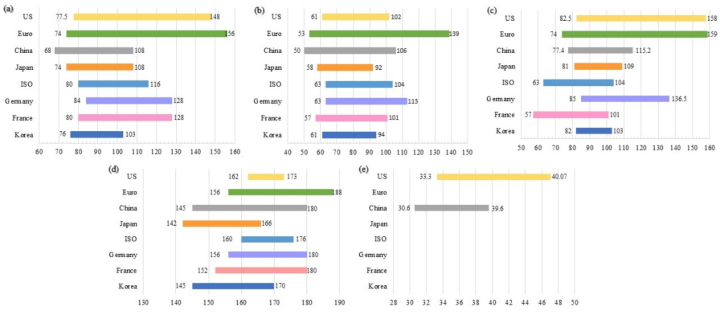
Figure 1: Size range comparison of national garment sizing standards for females: (a) bust sizes, (b) wait sizes, (c) hip sizes; (d) height; and (e) neck sizes.
given for A type. The bust-waist drop value of B type and C type is relatively small, 9cm-13cm and 4cm-8cm respectively. At the same time, height, neck, shoulder width and sleeve length are also recorded in detail in Chinese gar- ment sizing standard. Height is classified by 5cm. Neck, shoulder width and sleeve length are classified by 0.8cm,1cm and 1.5cm respectively.
In the Japanese women’s garment sizing standard (JIS L 4005: 2001), four body types are defined by is height and hip proportion. The height sizes are ranged from 142cm to 166cm. The hip-bust drop values are classified into four types: −3cm-14cm, −3cm-8cm, 1cm-16cm and 9cm-17cm. Bust sizes are given from 74cm-108cm.
Several national and regional sizing standards are also organized and com- pared (Chun, 2001). The garment sizing standard of ISO has proposed three body types for women: A, M and H. All body types (A, M and H) are classi- fied by hip-bust drop value with 12cm, 8cm, and 0cm. The German garment sizing standard suggests nine body types for women: SL, SM, SS, RL, RM, RS, TL, TM and TS, defined by height and hip proportion. It covers bust girth from 84cm to 128cm and waist girth 63cm to 113cm. The French women’s garment sizing standard gives coverage of key dimensions. Bust girth covers from 80cm to 128cm and waist girth is 57cm to 101cm. Hip girth ranges from 57cm to 101cm and height range is 152cm to 180cm. The women’s garment sizing standard of Korea defines three types (N, A and H) by hip-bust drop value. Bust girth covers from 76cm to 103cm with a 3cm interval, and hip girth is 82cm to 103cm with a 3cm interval. However, the Korea sizing stan- dard has the largest hip-waist drop value of 33cm. The mainstream country sizing standards are summarized (Figure 1).
Figure 1 shows the different coverage of key dimensions in the garment sizing standards of the selected countries. In the international garment sizing standards, the overall bust girth covers from 68cm to 159cm and waist girth covers a range of 50cm to 139cm. The coverage of hip girth is more diverse, ranging from 57cm to 158cm. Different international standards have diffe- rent definitions of height, starting from 142cm to 188cm. For neck girth,
Table 1. Rules of sub-chart a) and d) construction.
it is also a key dimension in some specific garments, whereas only the US and China have clear explanations and definitions for neck. Combine with the sizing standards of the US and China, the neck starts from 30.6cm and ends at 47.06cm. Due to incomplete size information in some standards, on this basis, it can be summarized that the bust-waist drop value ranges from 4cn to 28.6cm and the hip-waist drop value covers from 3cm to 33cm. The size information collected in this stage can provide data support for the compilation of comprehensive size system in the third stage.
Phase II: Develop a Combined Size Chart Based on Analysis of Current Mainstream Sizing Standards Three steps were followed to create the combined size chart that can cover all body shapes and size ranges of the selected size standards. Firstly, the control dimensions were determined. Control dimensions are divided into primary dimension and secondary dimension, which is the key to classifying the population and developing the sizing system (Petrova, 2007). Secondly, ranges of body shapes were calculated separately for upper body (differe- nces of bust and waist) and lower body (differences of waist and hip). Based on the analysis of the phase II, the drop value of bust girth of upper body was concentrated between 4cm to 28.6cm. For lower body, the drop value of waist and hip ranged between 3cm to 33 cm. Thirdly, the upper and lower limits of primary and secondary dimensions were found after going through each size standard. With the information collected from the three steps, a combined size chart which contains five sub-charts was constructed. The five sub-charts are: a). Bust (primary) – Waist (secondary) Chart, b). Bust (primary) – Neck (secondary) Chart, c). Bust (primary) – Height (secon- dary) Chart, d). Waist (primary) – Hip (secondary) Chart, Waist (primary) – Height (secondary) Chart. The rules of size chart construction were a lit- tle bit different among sub-charts. Sub-chart a) (Bust -Waist) and Sub-chart d) (Waist - Hip) shared the same rules as body shapes rules were contained in these two sub-charts, which are briefly explained as follows (Take Sub- chart a) (Bust -Waist) for instance). For the three rests: Sub-charts b) (Bust - Neck), Sub-charts c) (Bust - Height) and Sub-charts e) (Waist – Height), the rules are the same except that neck interval is 1cm while height interval is 5cm.
A Comprehensive Body Sizing System for International Fashion Consumers 19
Since the developed size chart covered all sizes ranges and all body shapes of the selected standards, it is possible to mark the ranges of each standard in this chart so that the differences and similarities among these standards could be indicated.
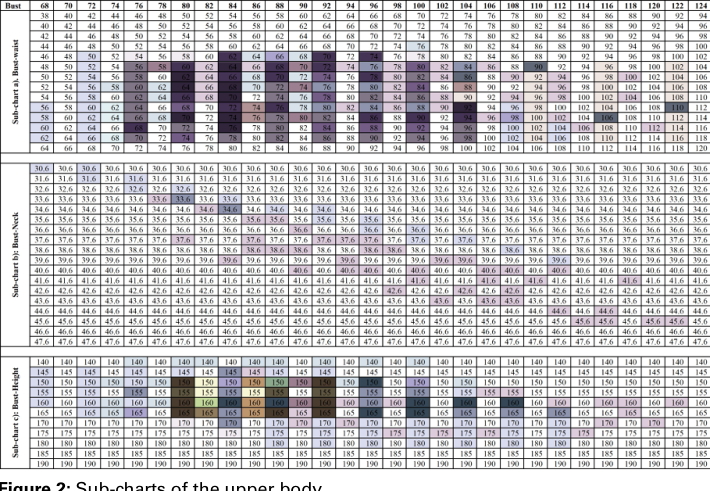
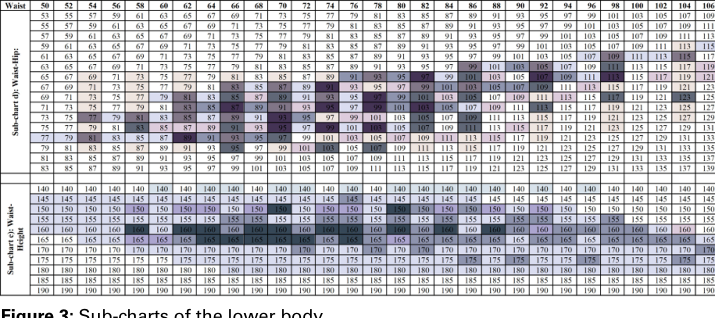
Phase III: Overview of the Comprehensive Sizing System All combined size charts were shown in Figures 2-4. Three sub-charts (Figure 2) were constructed for upper body, in which bust was the primary dimension, and waist, neck and height were the secondary dimensions. Each secondary dimension corresponds to the bust range.
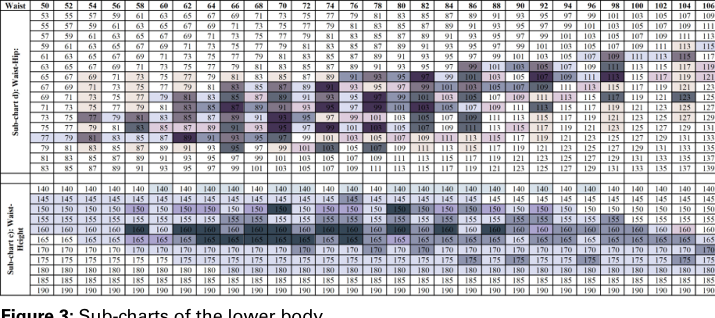
In sub-chart a), bust girth shows a central tendency between 76cm and 104 cm which corresponds to the waist range from 54cm to 98 cm. It can be seen that standard of China locates at the left side of the table meaning it starts with a relatively smaller bust girth (from 68cm to 112 cm). The Japa- nese standard starts at 74cm. The range of bust girth in the US and Europe are relatively large, it covers from 76-148cm and 76-152cm respectively. Besides, majority of these standards located in the lower middle of the table, indicate that the difference between the bust and waist of most standards (roughly from 2cm to 22 cm) is more uniform compared to the original range (2cm to 30 cm). Sub-chart b) shows the information of bust and neck, ranging from 68cm to 160 cm and 30.6cm to 47.6 cm respectively. Similar to bust and waist in sub-chart a), neck girth grows along with the increment of bust girth. The neck growth extent differs a bit among the standards. China and US showed a similar growth extent, but the neck interval is larger under the same bust girth. Sub-chart c) shows the information of bust and height. It can be seen that the height is generally concentrated in the range from 145cm to 170cm. Among the listed international standards, bust girth and height in Chinese garment sizing standard are relatively large, ranging from 68cm to 112cm and 145cm to 180cm respectively. The height range in the Uni- ted States is relatively scattered, concentrated between 160 cm and 175cm. Japanese standard divides height into four groups. The Korean standard classifies height into three groups based on different intervals: 150cm- 165cm, 160-165cm, and 150-160cm, which covers the actual height from 150cm to 165cm. For lower body, waist is the primary dimension, and hip and height are the secondary dimensions (Figure 3). Sub-chart d) shows the information of waist and hip, their difference defines the body shape of lower body. In general, the hip and waist difference decrease along with the increase of bust. China standard shows a relatively smaller waist range starting with 50cm and ending with 114 cm. US standard started at a larger waist (60cm to 106 cm). Europe standard shows the largest waist range from
Figure 2: Sub-charts of the upper body.Figure 3: Sub-charts of the lower body.
Labels
Figure 4: Colour legends of Figures 2-3.
54cm to 140 cm. Sub-chart e) shows the information of waist and hei- ght. Similar to other sub-charts, Chinese standard is located in the front of the size system, the distribution is more concentrated. The US standard starts with a large waist and covers the widest range. Japanese standard is shown to be more diffuse in the size system and related to the height group.
A Comprehensive Body Sizing System for International Fashion Consumers 21
CONCLUSION
To conclude, a combined sizing system has been developed by analyzing and integrating mainstream sizing standards across the world. Through the con- struction of the comprehensive sizing system, the result showed it can be seen that along with the increasing of control dimension (bust for upper body, waist for lower body), the differences between bust and waist, and waist and hip decreased. China and japan standards covered the smaller dimensions (population with smaller figures). Europe and US standards covered the lar- ger dimensions with wider range (population with larger figures). This study will benefit international manufacturers in terms of specifying the sizing gap among current standards of different countries and provide a solution with a combined new size chart. Meanwhile, it will benefit customers by providing a consistent size chart reference so that they know how to consistently cho- ose their size among fashion brands of different countries. In the context of rapid growth of international fashion e-commerce in recent years, this study can provide a consistent sizing system to take international valuable refere- nces for fashion manufacturers aiming at the global market. Limitation of the study is lack of experiments to test the accuracy of the sizing system. There- fore, we will further verify the validity and accuracy of the sizing system and develop the method of pattern grading in subsequent studies
ACKNOWLEDGMENT
The work described in this paper was partially supported by the Innovation and Technology Commission of Hong Kong under grant ITP/028/21TP. This research is also funded by the Laboratory for Artificial Intelligence in Design (Project Code: RP1-1) under the InnoHK Research Clusters, Hong Kong.
REFERENCES
ASTM International (2010), ASTM D5586/D5586M-10 Standard Table of Body Measurements for Women Aged 55 and Older (All Figure Types). ASTM International (2011), ASTM D5585-11 Standard Table of Body Measure-
ments for Adult Female Misses Figure Type, Sizes 0–20. ASTM International (2013). ASTM D7878. Standard Tables for Body Measurements for Adult Female Misses Petite Figure Type, Size Range 00P – 20P1. British Standards Institution (2004), BS EN 13402-3 Size Designation of Clothes –
Part 3: Measurements and intervals, London: British Standards Institution. Chinese Standards (2008).GB/T 1335. 2–2008. Standard Sizing Systems for Garment: Women. D. Gupta and B.R. Gangadhar (2004). A statistical model for developing body size
charts for garments. International Journal of Clothing Science and Technology. pp. 458–469. Japanese Standards Association (2001), JIS L 4005:2001. Sizing system for women’s garment, Japanese Standard Association, Tokyo. J. CHUN. International apparel sizing systems and standardization of apparel sizes.
South Korea. pp. 274–303. Jie Pei, Huiju Park, Susan P, Ashdown, Arzu Vuruskan (2017). A Sizing Improvement Methodology Based on Adjustment of Interior Accommodation Rates
Across Measurements Categories Within A Size Chart. International Journal of Clothing Science and Technology. Loker, S (2007). Mass customization and sizing. In S. Ashdown (Ed.), Sizing in clothing. Cambridge, England: Woodhead. pp. 246–263. Moez Hamad, Sebastien Thomassry, Pascal Bruniaux (2017). A new sizing System
based on 3D shape descriptor for morphology clustering. Computer & Industrial Engineering.pp. 683–692. N.A. Schofield, K.L. Labat (2005). Exploring the relationships of grading, sizing, and anthropometric data. International Textile & Apparel Association. Pp. 13–27. Petrova (2007). A creating sizing system. In S. Ashdown (Ed.), Sizing in cloth-
ing: Developing effective sizing systems for ready-to-wear clothing(pp. 57–87). Cambridge, England: Woodhead. Sibei Xia, Cythia Istook (2017). A Method to Create Body Sizing Systems. Clothing and Textiles Research Journal. pp. 235–248.
LISTED IN THE AHFE DIGITAL BOOKSTORE CATALOGUE
Explore the complete digital volume
Human Factors for Apparel and Textile Engineering
Read this individual research paper free through the original publisher, or explore the full digital proceedings book.
ISBN 978-1-958651-08-7
Explore this ISBN in the AHFE Bookstore ↗Listed in the July 2026 bookstore catalogue; search by ISBN to confirm current availability · Digital book purchase optional