Carla Paisv, Demétrio Matos, André Perrotta, Miguel Vieira (2022). Monetary Reward Effects in Discrimination and Neurophysiological Activity During Use of a Tactile Stimulation Sleeve. In: Human Interaction & Emerging Technologies (IHIET-AI 2022): Artificial Intelligence & Future Applications. AHFE Open Access, vol. 23. https://doi.org/10.54941/ahfe100913
1 ID+ Research Institute for Design, Media and Culture, School of Design, Polytechnic Institute of Cavado and Ave.- Campus do IPCA - Lugar do, Aldão, 4750-810 Vila Frescainha, Portugal ↗
2 Centre for Informatics and Systems of the University of Coimbra, Department of Informatics Engineering, University of Coimbra, 3030-290, Coimbra, Portugal ↗
3 Centro de Investigação Interdiscilinar em Saúde, Instituto de Ciências da Saúde – Porto, Universidade Católica Portuguesa, Rua de Diogo Botelho 1327, 4169-005 Porto Portugal ↗
The development of devices capable of delivering tactile and thermal feed-back have the potential to improve brain-machine interfaces for neuroreha-bilitation protocols. Monetary rewards are known to improve some types of passive tactile processing. The aim of this study was to describe the perfor-mance and neural activity of subjects receiving tactile stimuli through a tac-tile stimulation sleeve in the presence or absence of monetary rewards. Healthy subjects were required to discriminate between different tactile stim-ulation patterns delivered through a stimulation sleeve while their neural ac-tivity was recorded with Electroencephalography (EEG). Behaviorally, no significant differences were observed in the performances of subjects wear-ing the sleeve. Meanwhile, analysis of neural activity revealed that the intro-duction of monetary rewards consistently generated significant differences in theta frequency band for occipital electrodes. These results support the no-tion that monetary rewards can significantly influence tactile information processing.
Tactile feedback and tactile information processing have gained increased relevance in Brain-machine Interfaces (BMIs) (Lebedev and Nicolelis, 2017, Donati et al., 2016; Pais-Vieira et al., 2013; Pais-Vieira et al., 2015) and other human-machine interfaces (Pais-Vieira et al., 2020; Perrotta et al., 2020) due to the ability to quickly improve the user performance as well as due to their potential to induce neural plasticity (Donati et al., 2016; Pais-Vieira et al., 2013; Pais-Vieira et al., 2015). For example, a previous study combining brain control of avatars and exoskeletons in the context of rehabilitation, has demonstrated significant improvement in SCI patients in a variety of parameters (Donati et al., 2016). According to unpublished reports of users of our own system (healthy n=3, and neurological patient n=1), the tactile feedback delivered through these sleeves is particularly useful because it constitutes a validation of the user’s estimation of the moment when the “sole of the foot” (of the avatar) has touched the ground. This has been described by these users as a “rewarding experience”. Such results support the notion that tactile stimulation and reward processing may share relevant neural paths which, if properly associated, have the potential to improve BMI control. Here, we asked if the introduction of monetary rewards could help improve subject’s ability to discriminate between tactile stimuli during the use of a thermal and tactile stimulation sleeve. Although, it has been previously demonstrated that the use of monetary rewards can significantly improve passive tactile discrimination in a frequency discrimination task (Pleger et al., 2008), there are, to our best knowledge, no other studies describing the effect of monetary rewards in other types of tactile processing such as width discrimination or complex tactile stimulation patterns (e.g., mimicking the footsteps of an avatar or exoskeleton). In this study we present the results from a small sample of subjects tested in different tactile stimulation patterns delivered to the forearm through the thermal-tactile sleeve.
The present study was approved by the local ethics committee (SECVS 148/2016). A small sample (n=6 participants, 1 female) without history of severe neurological disease or motor deficit to the upper limbs with ages between 18-42 years old was studied here. All participants were initially introduced to the full set up and allowed to interact with it before experimenting started. The setup included a thermal-tactile sleeve controlled by a central unit, separated of the user; an EEG cap, and a computer for the participant to indicate the behavioral response. Throughout the session, the temperature varied between 25ºC and 37ºC. As the subjects reported that they were not able to detect these variations in temperature, this data will not be analyzed in the present study. The study design included a session with two experiments for each subject. The first experiment consisted in discriminating between medial and lateral stimulation, while second experiment consisted in discriminating between proximal stimulation and distal stimulation. A total of 40 trials were performed in each experiment; 20 trials without reward and 20 trials with reward (counterbalanced across subjects). Neural data was recorded using a 16 channel EEG (V-Amp, actiCAP; Brain Products GmbH, Gilching, Germany) and analyzed offline using Brain Vision Analyzer (version 2.2.1, Brain Products, Gilching, Germany) and Matlab (Mathworks, 2018b, Natick, USA). Pre-processing included re-referencing using all channels as reference, then a notch filter was applied (50Hz), followed by ocular correction (built in Visual Analyzer) and data segmentation to include the tactile stimulation period. Power was studied using a Fast Fourier Transform in the delta, theta, alpha, and beta frequency bands. The gamma frequency band was not analyzed here due to the presence of noise generated by the thermal-tactile controlling device. Lastly, an overall normalization across subjects was performed. Paired samples t-test or the non-parametric equivalent were used to compare behavior and neural activity within-subjects in rewarded and non-rewarded versions of the task.
Figure 1. Experimental design and setup. a) An initial (Pause) between trials lasted for 2 seconds. Tactile (Stimulation) was delivered for another 2 seconds. The subject was then required to make a response (Response) regarding the existence, location, and direction of the stimuli. B) A total of 20 non-rewarded trials (No reward) and 20 rewarded (Reward) trials were performed in the (Horizontal) and (Vertical) versions of the task. C) Disposition of tactile vibrators in the sleeve.
Figure available in the original PDF paper.
RESULTS
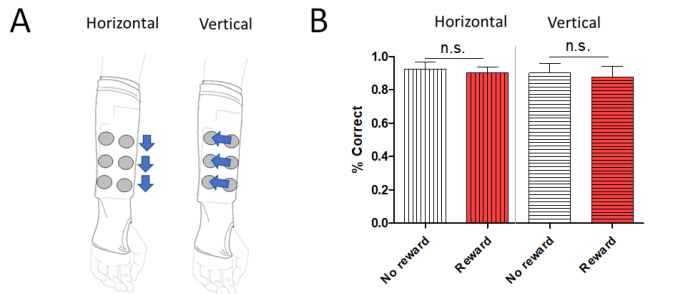
The average results for the tactile discrimination sessions are presented in Figure 2 a. No significant differences were observed in the performances of subjects wearing the sleeve when they were tested in the Vertical (t=0.7454, df=5, P=0.4896, n.s.; paired samples t-test) or Horizontal (t=0.8305, df=5, P=0.4441, n.s.; paired samples t-test) versions of the task. Subjects indicated that the “Vertical” (i.e., medial-lateral stimulation) version of the task was more difficult than the “Horizontal” (i.e., proximal-distal) version of the task.
Figure 2. Results from sessions. a) Tactile stimulation (Horizontal - easy) indicates the orientation of proximal to distal stimulation. (Vertical- difficult) indicates the orientation from medial to lateral. b) Results from the behavioral performances were not significantly different for either version of the task.
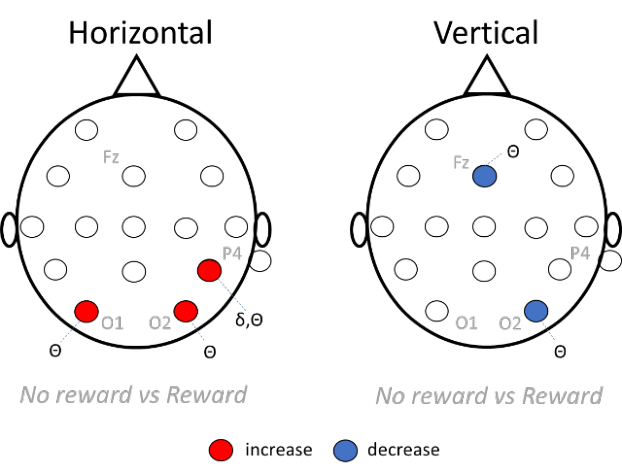
Analysis of neural activity (see Figure 3) revealed that the introduction of monetary rewards generated significant differences in neural activity mainly in the theta and delta frequency bands. In the Horizontal version of the task, the rewarded version increased the power in electrodes: P4 (increase in Delta: t=2.650, df=5, P=0.0454; increase in Theta: t=2.601, df=5, P=0.0482; paired samples t-test), O1 (increase in Theta: t=2.908, df=5, P=0.0335; paired samples t-test), and O2 (increase in Theta: t=3.070, df=5, P=0.0278; paired samples t-test).
Figure 3. Differences in power of frequency bands. On the left (Horizontal) electrodes P4, O1 and O2 presented significant increases in power for theta and/or delta frequency bands. On the right (Vertical) significant decreases in power were found for Fz, and O2 for the theta frequency band.
Meanwhile, in the Vertical version of the task (see Figure 3, right panel) significant differences were found in: Fz (reduction of Theta during reward: t=2.856, df=5, P=0.0356; paired samples t-test), and O2 (reduction of Theta during reward: t=4.070, df=5, P=0.0096; paired samples t-test). Therefore, Horizontal and Vertical versions of the task presented different types of neurophysiological modulations.
DISCUSSION
The effects of monetary rewards were tested in a small sample of subjects wearing a tactile stimulation sleeve. The introduction of monetary regards did not change the performance of subjects, even though it significantly changed neural activity in multiple electrodes recording mostly from parietal and occipital regions.
Our results are not in line with previous results where monetary rewards were reported to improve tactile discrimination performance (Pleger et al., 2008). Several variables could account for this difference. First, we have tested only a small sample of subjects in tactile sleeve, which could account for the lack of differences between rewarded and non-rewarded versions of the task. Second, the type of stimulus delivered by the tactile sleeve, is significantly different from the one tested previously. At this point it is of interest to note that, in two separate experiments not yet published, we have tested a total of 40 subjects in a tactile width discrimination task (Perrrotta et al., 2020) and, also no differences were found for behavioral performances in rewarded and non-rewarded trials. Therefore, the role of monetary rewards in tactile processing requires further detailed investigation on the key variables involved (Zink et al., 2004; Pleger et al., 2008). Subjects reported that the medial-lateral stimulation version of the task was more difficult than the proximal-distal version of the task. Such difference may, in part be explained by the fact that proximal to distal stimulation (and vice-versa) requires the activation of vibrators in three different steps (i.e., proximal vibrators, center vibrators, and lastly, the two distal vibrators) while the medial to lateral requires only two steps (i.e., three medial vibrators, followed by three lateral vibrators). This finding is relevant for serious games and brain-machine interface developers since this type of stimulation interfere with behavioral performances (Lebedev and Nicolelis, 2017; Donati et al., 2016; Vieira et al., 2021). Analysis of neurophysiological activity indicated a fundamental role for occipital electrodes in the theta frequency band. Namely, electrodes P4, O1, and O2 presented an increase in power for the rewarded horizontal version, while Fz and O2 presented a decrease for the vertical rewarded version of the task. A previous study of tactile function has proposed that theta frequency band in parietal regions may be associated with attentional and emotional mechanisms (von Mohr et al., 2018). Also, in rodents performing a tactile width discrimination task, a complex network of regions involving fronto-parieto-occipital regions has also been described (Kunicki et al., 2019). While these results seem to be in line with our present neurophysiological findings, they should be considered with care due to the limited number of electrodes and subjects recorded here (see below). Also, it is not clear from the present results why the horizontal and vertical versions were associated with an increase and a decrease, respectively in power for these electrodes. A number of limitations should be considered when analyzing the present results. The sample studied here was relatively small and gender-biased (small number of females). Noise generated by the mechatronic devices prevented analysis of the gamma frequency band. Lastly, as the setup used was limited to 16 electrodes, source analysis was not be performed (Cohen, 2014), and therefore, it cannot be assumed that the changes in activity recorded from a particular electrode, necessarily correspond to changes occurring in the cortical region beneath it. Despite these limitations, the neurophysiological findings reported here are mostly in line with previous reports of tactile function and reward processing (von Mohr et al., 2018; Kunicki et al., 2019).
The present study could not reject the null hypothesis that monetary rewards do not affect tactile discrimination performance. However, it supports the notion that monetary rewards significantly modulate information processing in electrodes recording from occipital locations.
ACKNOWLEDGMENTS
The authors would like to thank Santa Casa Neurociências, Prémio MELO e CASTRO (SCM-12/18) for support for this study. FCT - iBiMED – Institute of Biomedicine (UIDB/04501/2020); FCT/MCTES Center for Interdisciplinary Research in Health (UIDB/04279/2020); FCT – Fundação para a Ciência e a Tecnologia, I.P., within the project CISUC - UID/CEC/00326/2020 and by the Fundo Social Europeu through the Programa Operacional Regional Centro 2020. Bial Foundation, Grant 95/16.
REFERENCES
Lebedev, M.A. and Nicolelis, M.A., (2017) “Brain-machine interfaces: From basic science to neuroprostheses and neurorehabilitation”. Physiological reviews, 97(2), 767-837. Donati, A, Solaiman S. Edgard Morya, Debora SF Campos, Renan C. Moioli, Claudia
M. Gitti, Patricia B. Augusto et al. (2016), “Long-term training with a brain- machine interface-based gait protocol induces partial neurological recovery in paraplegic patients”. Scientific reports 6, no. 1, 1-16. Pais-Vieira, C., Chiuffa, G., Lebedev, M., Yadav, A. and Nicolelis, M.A., (2015) “Building an organic computing device with multiple interconnected brains”. Scientific reports, 5(1), 1-15. Pais-Vieira, M., Lebedev, M., Kunicki, C., Wang, J. and Nicolelis, M.A., (2013) “A
brain-to-brain interface for real-time sharing of sensorimotor information”. Scientific reports, 3(1), 1-10. Pais-Vieira, C., Allahdad, M., Neves-Amado, J., Perrotta, A., Morya, E., Moioli, R., Shapkova, E. and Pais-Vieira, M., (2020), “Method for positioning and rehabilitation training with the ExoAtlet® powered exoskeleton”. MethodsX, 7, 100849. Perrotta, A., Pais-Vieira, C., Allahdad, M.K., Bicho, E. and Pais-Vieira, M., (2020),
“Differential width discrimination task for active and passive tactile discrimination in humans”. MethodsX, 7, 100852.
Pleger, B., Blankenburg, F., Ruff, C.C., Driver, J. and Dolan, R.J., (2008) “Reward facilitates tactile judgments and modulates hemodynamic responses in human primary somatosensory cortex”. Journal of Neuroscience, 28(33), 8161-8168. Zink, C.F., Pagnoni, G., Martin-Skurski, M.E., Chappelow, J.C. and Berns, G.S.,
(2004), “Human striatal responses to monetary reward depend on saliency”. Neuron, 42(3), 509-517. Pleger, B., Ruff, C.C., Blankenburg, F., Klöppel, S., Driver, J. and Dolan, R.J., (2009), “Influence of dopaminergically mediated reward on somatosensory decision-making”. PLoS biology, 7(7), p.e1000164. Vieira, C., da Silva Pais-Vieira, C.F., Novais, J. and Perrotta, A., (2021), “Serious
Game Design and Clinical Improvement in Physical Rehabilitation: Systematic Review”. JMIR Serious Games, 9(3), p.e20066. von Mohr, M., Crowley, M.J., Walthall, J., Mayes, L.C., Pelphrey, K.A. and Rutherford, H.J., (2018), “EEG captures affective touch: CT-optimal touch and neural oscillations”. Cognitive, Affective, & Behavioral Neuroscience, 18(1), 155-166. Kunicki, C., Moioli, R.C., Pais-Vieira, M., Peres, A.S.C., Morya, E. and Nicolelis,
M.A., (2019), “Frequency-specific coupling in fronto-parieto-occipital cortical circuits underlie active tactile discrimination”. Scientific reports, 9(1), 1-14. Cohen, M.X., (2014), “Analyzing neural time series data: theory and practice”. MIT press.
Read this individual research paper free through the original publisher, or explore the full digital proceedings book.
ISBN 978-1-7923-8989-4
Explore this ISBN in the AHFE Bookstore ↗Listed in the July 2026 bookstore catalogue; search by ISBN to confirm current availability · Digital book purchase optional