This research seeks to identify how to design accessible training for semi-literate immigrants that promotes the learning of the Finnish language, culture and digital skills. Semi-structured interviews with 12 semi-literate learners, the teacher and two native language speakers were conducted. The dataset was collected from a private service provider, and it includes a digital footprint of training. The training was a 20 weeks pilot experiment, and it was implemented in early 2020. The design was based on the user's previous experience. The perceived major crucial success factors are empathic and equal interaction, encouragement, ease, trust, security, multilingual and technological support, and competencies of the parts of training. The empathy-based, carefully planned interactive digital design may be effective, attractive and easy for semi-literate learners. The case study of the tablet course encourages further investigation and the development of online training for low-literate learners.
INTRODUCTION AND RESEARCH OBJECTIVES Immigration for humanitarian reasons has increased and thousands of people have arrived in labour shortage countries in recent decades (Mäkinen & Sihvonen, 2016)
(Migri, 2021). They are an important resource that has not been sufficiently exploited. The illiteracy and digital competence of immigrants are challenging, especially in online learning (Heponiemi, et al., 2021). Finnish integration training for immigrants aims to improve social inclusion in Finnish society and promote employment (Finnish National Agency for Education, 2012: 1). An integration plan is drawn up for all unemployed moving to Finland. In Finland, that means learning the Finnish language and knowledge of society and working life. There are slow, basic, and fast paths in training. The slow path is intended for semi-literate people or those with low literacy or a little educational background. (Finnish National Agency of Education, 2012: 2). The first full-day and still ongoing online immigrant integration training in Finland was organized in 2015 and was deemed successful. Learners with low literacy also attended the training. (Hartikainen, et al., 2020). Based on the positive experiences gained from the previous research, the first experiment of semi-literate learners was implemented as a part of integration training in 2020 and is the case of this research. The research will identify the crucial elements under which the training can be successfully implemented. The research question is "How to produce an accessible and successful digital education service for semi-literate immigrants in Finland to promote integration and inclusion?" In addition, this paper will discuss the experiences of students, native speaker assistants, teachers, the learning outputs, and how the design of this case promoted the digital competence of the learners.
BACKGROUND
Since 2001, the number of quota refugees admitted to Finland has been 750 per year. In 2020, the number was 850 and in 2021 the number will be 1,050 (Migri, 2021). The number of immigrants with humanitarian reasons has increased, but Finland still has one of the lowest receptions compared to other EU countries (Eurostat, 2021). In Finland, integration training is provided in all major municipalities. An unemployed immigrant has the right and obligation to participate in integration training. (Hartikainen, et al., 2020). Semi-literate immigrants are offered literacy training before transitioning to integration training, or as part of integration training in slow groups. Semi-literacy means that the learner has little written proficiency in the Latin alphabet. Literacy is not sufficient from the requirements of the information society. (Finnish National Agency of Education, 2012: 2). Previous research on semi-literate users of digital services is limited to small case studies in the fields of agriculture and employment management. Flanders experiences of online learning as a second language have produced encouraging results: it is well suited for semi-literate learners. The results refute the previous notion that online learning would only be suitable for students who already have independent language skills and advanced study skills. The main constraints on organizing online learning have been negative prejudices and lack of support, as well as a lack of digital skills among teachers. The key factors for success were detailed planning, technical, financial and pedagogical support, developing
Human Interaction & Emerging Technologies (IHIET-AI 2022) Artificial Intelligence & Future Applications https://openaccess.cms-conferences.org/#/publications/book/978-1-7923-8989-4 students’ skills, changing attitudes and developing guidance. (De Paepe, et al., 2018). Former research found that a teacher's ability to facilitate learning situations in synchronous online learning differs from classroom instruction, and high-quality implementation requires an understanding of a user’s desire and detailed planning in advance (Arrosagaray, et al., 2019). The conditions, skills and aspirations of the students shape the training from the beginning and the in-depth knowledge improves the quality of the service. Interactivity and accessibility must be a priority in all design planning (Hartikainen, et al., 2020). In inclusive learning, responsibility gradually shifts to students as their understanding and skills develop. Students learn communicative skills in a social context and through interaction (Jumaat & Tasir, 2014). Empathy is a basic skill for learning interaction. Design science and user interface design have moved toward more adaptable, playful, creative, and meaningful applications that transcend the boundaries of work and home. (Wambsganss, et al., 2021). Empathy-based design requires an open attitude, familiarity with the user, and participatory planning (Jiancaro, 2021). Observations of technical and lingual accessibility have brought significant information system user experiences to low-literacy users (Hartikainen, et al., 2020). Rege & Nagarkar (2010) explore a user-driven ICT solution in rural farming communities in India to increase the efficiency of farming. The user-friendly service, which utilizes audiovisual elements and metaphors understood by the semi- literate population, was designed together with the users. Similar experience has been gained also in Pakistan. The interface took advantage of graphics, animations, videos, and sounds. (Kamran, et al., 2016). New forms of digital job search can solve the economic problems of low-income regions. Low-literacy applications for job search have been developed in South Africa, where a job search service developed an inclusive method that is suitable for low-literacy users, which helps them to create their own employment opportunities, projects and reduce costs (Gitau, 2013), and Bangladesh (Islam, et al., 2020), where semi-literate service users were satisfied that the job application was easy to use and effective.
Case Semi-literates Tablet Course in Finland The research is an empathy-based (Jiancaro, 2021), descriptive and exploratory case study (Runeson & Höst, 2009) that utilizes user experience design methods within a framework of The digital competence framework for citizens (Carretero, et al., 2017.). Empathy-based design gains insight into the learning experience of low- literacy learners, which must be taken into account with particular care when there is no common language. The approach is experimental research and observation. A case study is an applied approach to the research of short-term pilot training for semi-literates conducted by a private service provider (Runeson & Höst, 2009). Its purpose is to find out whether the design of a tablet course for immigrants is suitable for a semi-literate group. To ensure the quality and accuracy of the research results, the researchers used
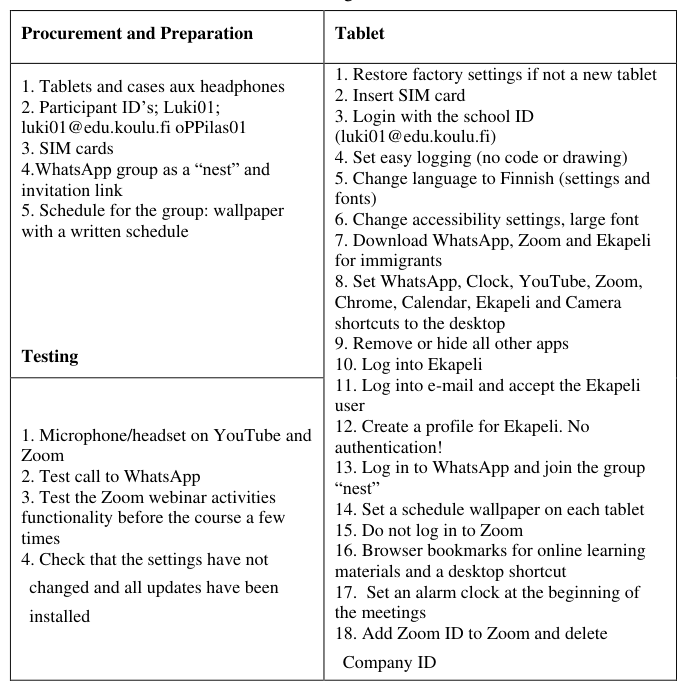
Human Interaction & Emerging Technologies (IHIET-AI 2022) Artificial Intelligence & Future Applications https://openaccess.cms-conferences.org/#/publications/book/978-1-7923-8989-4 triangulation: the provider, funder, and researcher of the training were involved in the observation. The interviews were conducted by researchers. Both quantitative and qualitative data were collected, to obtain the information related to the design process. (Runeson & Höst, 2009). The dataset was collected from a provider, system of The Centre for Economic Development, Transport and the Environment (ELY Center), interviews with 12 semi-literate language learners and a teacher, and a digital footprint of training that includes online materials, report (Kylander, 2020), exercises and chats. At the beginning of the training, most of the students were at the language level 0 or A1.1, according to The Common European Framework of Reference for Languages (CEFR) (Council of Europe, 2001). The ELY Center purchased a pilot experiment targeting semi-literacy immigrants. The company outsourced to a designer with in-depth experience in designing digital learning solutions for immigrants. The design process began in December 2019, and the data collection and crucial elements identification started simultaneously. The participants were selected by the Employment Office, the representative of the funder. The native language assistants contacted participants. The designer found out the information of the participants’ equipment, digital habits and attitude towards online learning. The designer planned the accessibility of training so that every student could easily participate. The provider ordered the necessary equipment. Equipment was prepared according to a plan: installation of the necessary applications and SIM cards for each tablet and removal of all unnecessary before the course began. Anonymous IDs were installed for each tablet and connected to the WhatsApp group, thus there was the opportunity to communicate with the teacher and peers with anonymous ID's. One learner said that he took a pen in his hand for the first time in Finland. Five participants had no educational background at all and had studied literacy skills in Finland for two to three years. Three of them had been in school for three to four years, and two of them 10-12 years in their home country. Everyone had studied reading and writing skills in Finland for two to ten months. Native language assistants prepared participants in their own language. The designer prepared teachers and assistants to conduct the training, which was started with a joint orientation onsite meeting. Training was scheduled into three daily interactive lessons in a group, and independent assignments. The primary materials were saved on the open website, where the schedule and tasks were opened every morning by clicking the same link. Recordings of lessons was available for learners. In addition, they had an ABC textbook. At the end of the training, teachers, learners and assistants were interviewed. Participants were guided in the use of the required technology. They participated with tablets, and in the onsite meeting, and they were instructed in the use of the necessary applications. The learning functions focused on language, culture, working-life and everyday activities, as well as digital skills. Participants learned to recognize the phonetic
Human Interaction & Emerging Technologies (IHIET-AI 2022) Artificial Intelligence & Future Applications https://openaccess.cms-conferences.org/#/publications/book/978-1-7923-8989-4 sounds and letters. Literacy skills were at the focus of daily activities. Most of the participants recognized only individual letters and words at the beginning of training. The provider observed the training on the basis of the agreed indicators. Assistants collected the research permits and ensured that participants understood that they were involved in the research and the anonymous data collected could be used in it. They had the opportunity to cancel their participation at all stages of the process. The teacher and assistants interviewed the participants by using open-ended questions. The researchers interviewed the teacher and assistants and ensured from the provider that the research was authorized. The service provider reported the training to the employment administration.
Table 1: Procurement and Preparation of tablet course for semi-literate immigrants
Analysis The aim of this research is to identify the crucial elements which may help to re- create similar courses in the future. Three significant accessibility categories were founded: pedagogical, technological, and lingual accessibility. The first pedagogical accessibility element was to build trust. An onsite meeting at the beginning was crucial for building trust which made digital behaviour more confident, and ensured the learning outcomes would be better. Learners were satisfied with the studies when the interaction was peaceful and empathic. The security and sense of empowerment of the learning situation created self-confidence in developing personal skills, and the shame and tension of failure disappeared, e.g. posting emojis that describe joy and success to a conversation increased the courage to participate. Secondly, attracting the motivation of three different types of learners was the crucial element. 1. Mathematical learners should be approached with numbers. For them, learning to read and write was boring. 2. Quiet hard-working learners without an educational background but a strong desire to read and write. They did all the tasks assigned, but the interaction required constant encouragement and enabling learning experiences. 3. Active learner types who had more educational background and competencies. The teacher offered more challenges to this type. The third pedagogical accessibility element was that the difficulty of the tasks was gradually raised. The repetition and gradual enrichment of familiar things reinforced the students' positive perception. The equal participation of the learning dialogue was successful when the teacher facilitated it systematically. Pedagogy was based on sensitivity to identify a learner’s situation in a Zone of Proximal Development (Vygotsky, 1934). The resources and skills increased step by step. Fourthly, teaching and materials had to be thought of more carefully than classroom teaching. The purpose was to produce a lot of learning outcomes while minimizing the changes. As the learners’ abilities progressed, the teacher deliberately changed the implementation e.g. initially, the teacher shared tasks only in WhatsApp, but later tasks were shared via a web link located on an open website. The teacher shared a small amount of information at a time and added more written discussion in the chat as the skills improved. In the beginning, learners imitated written assignments, then they imitated each other. At the end of the training, they produced their own answers. Fifthly, contact with the surrounding society and the communities in one's residential area was an essential element identified. The conditions during the pandemic were not optimal. The teacher used authentic learning functions, and the training included an opportunity to participate in an internship for two days a week. Design based on the user's previous experience was the first crucial factor of technical accessibility. Assistants investigated learners' digital habits before the training, which influenced the choices of devices, applications, and the implementation. The devices and wifi worked flawlessly, and all participants found the right place at the right time. The digital skills of participants developed during the training. They learned to navigate services even though literacy was still low.
Before the course, participants had primarily used smartphones to make calls. One participant shared that she couldn’t even write her phone number or run errands. Only one had used a computer before. After the course use of the phone had diversified: learners knew how to write, send messages and pictures, and run errands and tasks digitally. One participant said he began to use the tablet for all daily errands. Secondly, technical support, especially at the beginning of the training, was essential. In the first week, the native language assistant called the students every day. Initially, opening the tablets and links, joining and leaving Zoom meetings, and uploading an image to chat was challenging. The technical support helped with device updates. Thirdly, security and anonymity created trust between all. Revealing their identity may be dangerous for some participants. In this case, security risks were minimized. The first identified element of lingual accessibility was multilingual support, through the use of native-speaking assistants, especially at the beginning of the training. Assistants explained the instructions and techniques. Secondly, empathy-based interaction that perceives the stage of learner learning and strives for equal dialogue was one of the main identified elements. Clear language, multi-channels, and the ability to convey meanings in an unambiguous way were essential. The teacher was a professional in the immersion method of language learning. The participants learned to communicate, although learning to read was low. After the 20 weeks training, almost all students could read individual words, the majority also sentences. One student was left at such a level that mechanical reading was difficult or impossible. A total of 11 students completed the training. At the end of the training, students achieved the following general language proficiency levels: A1.1: five, A1.2: three, A1.3: two learners, and 0: one learner (CEFR) (Council of Europe, 2001). Learners' knowledge of Latin letters progressed well, and reading and writing skills strengthened.
DISCUSSION AND CONCLUSIONS As this case study shows, low-literacy learners can study online. The claim that semi-literates could not learn online is worth re-examining. The result of this research is that empathy-based and carefully planned interactive digital design may be attractive and enjoyable for semi-literate learners. They use mobile devices fluently, even if they are unfamiliar with reading and writing. An understanding of digital experiences and practices are particularly important in the design of a digital service. In addition, the safety of the service must be taken into account. The empathy-based design adds knowledge of the crucial elements that make training empowering, comfortable, and safe for a semi-literate user. The purpose of the training was to try out the possibilities of teaching literacy online and thus to offer the learning on a personal proficiency level. The experiment was a great success. Teaching literacy online was effortless when the learning
Human Interaction & Emerging Technologies (IHIET-AI 2022) Artificial Intelligence & Future Applications https://openaccess.cms-conferences.org/#/publications/book/978-1-7923-8989-4 design was accessible. The learners found that studying online was easy and said they were familiar with the alphabet at the end of the training. They also mentioned that they practiced speaking a lot during the course. The Finnish pedagogy showed its strength and depth in this case, and cooperation with an experienced designer played a significant role. The socio-cultural, learner- centred approach and interaction-driven digital design, combined with accessible and empathic design, made the learning experience effective for the semi-literate in both literacy and digital competence development. The case study of the tablet course encourages the development of online training for low-literate learners.
REFERENCES
Arrosagaray, M., González-Peiteado, M., Pino-Juste, M. & Rodríguez-López, B. (2019). A comparative study of Spanish adult students’ attitudes to ICT in classroom, blended and distance language learning modes. Computers & Education, Issue 134. Elsevier Ltd. pp. 31-40. Carretero, S., Vuorikari, R. & Punie, Y. (2017). The digital competence framework for citizens. Publications Office of the European Union. Council of Europe. (2001). The CEFR Levels. Common European Framework of Reference for Languages: Learning, Teaching, Assessment (CEFR). De Paepe, L., Zhu, C. & Depryck, K. (2018). Learner characteristics, learner achievement and time investment in online courses for Dutch L2 in adult education. s.l.:TOJET: The Turkish Online Journal of Educational Technology. De Paepe, L., Zhu, C. & Depryck, K. (2019). Development and implementation of online Dutch L2 courses in adult education: educators’ and providers’ perceptions of constraints and critical success factors.. Innovation in language learning and teaching, pp. 13(3), 277-291. Eurostat. (Dec 5. 2021). Asylum quarterly report - Statistics Explained. Eurostat Website: https://ec.europa.eu/eurostat/statistics- explained/index.php?title=Asylum_quarterly_report#Where_do_asylum_applicants _go_to.3F Finnish National Agency for Education. (2012): 1. Fundamentals of the Integration Plan for Adult Immigrants. Principles of the Teaching Plan for Adult Migrants' Integration Education 2012 Regulations and Guidelines. In Finnish. Juvenes Print - Tampereen Yliopistopaino Oy. Finnish National Agency for Education. (2019). The Competences and Skills in 2035. The first results of the National Forum for Skills Anticipation’s anticipation work, Volume 3. Finnish National Agency of Education. (2012): 2. Figures for adult immigrants in literacy training - basics of the curriculum 2012. Regulations and Guidelines. In Finnish. Juvenes Print - Tampereen Yliopistopaino. Gitau, S. W. (2013). Designing Ummeli a case for mediated design, a participatory approach to designing interactive systems for semi-literate users. University of Cape Town. Hartikainen, A., Ahola, M., Apiola, M. & Sutinen, E., 2020. The immigrant integration online training program in Finland. IEEE. pp. 872-877
Heponiemi, T. et al. (2021). Digital inequality in Finland: Access, skills and attitudes as social impact mediators. New Media & Society. Islam, M. N., Ahmed, A. & Islam, A. N. (2020). Chakuri-Bazaar: A Mobile Application for Illiterate and Semi-Literate People for Searching Employment. International Journal of Mobile Human Computer Interaction 12(2). pp. 22-39 Jiancaro, T. (2021). Empathy-Based Design Approaches. In New Directions in Third Wave Human-Computer Interaction: Volume 2-Methodologies. Springer, Cham. pp. 43-60 Jumaat, N. & Tasir, Z. (2014). Instructional Scaffolding in Online Learning Environment: A Meta-analysis. 2014 International Conference on Teaching and Learning in Computing and Engineering. pp. 74-77 Kamran, M. et al., 2016. Agriculture E-Finance System for Semi-literate farmers - a case study of Pakistan. International Journal of Computer Science and Information Security. p. 417. Kylander, S. (2020). Promoting Latin Alphabets Online, In Finnish.: Reports of Arffman Finland Ltd. URA 687464, 687731, 687752, 684948. Mäkinen, M. & Sihvonen, M. (2016). Lack of IT skills as a challenge for the integration of immigrants.. Aikuiskasvatus. In Finnish. 36(4)(vol. 36, no. 4), pp. 279-287 Migri. (Dec 5, 2021). Statistics on immigration 2020. Most immigrants come to Finland to work, the coronavirus affected the number of applications. Migri - Finnish Immigration Service Website https://migri.fi/en/-/statistics- on-immigration-2020-most-immigrants-come-to-finland-to-work-the- coronavirus-affected-the-number-of-applications Rege, R. & Nagarkar, S. (2010). Krishi-Mitra: Case Study of a User-centric ICT Solution for Semi-literate and Illiterate Farmers in India. India HCI 2010/Interaction Design & International Development 2010. Runeson, P. & Höst, M. (2009). Guidelines for conducting and reporting case study research in software engineering. p. 131 The Ministry of Employment and the Economy. (2021). Working Diversity Program. Program of measures to promote diversity in working life from the point of view of immigration and integration. Ministry of Employment and the Economy, Labor Migration and Integration Unit. Volume 10. Wambsganss, T., Weber, F. & Söllner, M. (2021). Design and Evaluation of an Adaptive Empathy Learning Tool. p. 54 Vygotsky, L. (1934). Thinking and Speech.
Read this individual research paper free through the original publisher, or explore the full digital proceedings book.
ISBN 978-1-7923-8989-4
Explore this ISBN in the AHFE Bookstore ↗Listed in the July 2026 bookstore catalogue; search by ISBN to confirm current availability · Digital book purchase optional