Shichao Meng (2022). An overview of the development of cloud-based CAE software in the context of industrial Internet. In: Intelligent Human Systems Integration (IHSI 2022): Integrating People and Intelligent Systems. AHFE Open Access, vol. 22. https://doi.org/10.54941/ahfe100999
Industrial Internet is a new industrial pattern developed by the integration of the new round of information technology revolution and traditional industrial manufacturing system. And industrial software is the software basis for modern industrial functioning, along with the development of the industrial Internet, industrial software also has a new product form, based on the cloud computing platform of various types of industrial software began to rapidly appear. This paper analyzes the main functions and interaction methods of several existing mature cloud-based CAE software in current, and proposes the basic product features and software forms of current cloud-based CAE. It is a guideline for more complete and mature cloud-based CAE software in the future.
Intelligent Human Systems Integration (IHSI 2022): Integrating People and Intelligent Systems https://openaccess.cms-conferences.org/#/publications/book/978-1-7923-8988-7
INTRODUCTION
Industrial Internet is a new industrial form of the integration and development of the new round of information technology revolution and traditional industrial manufacturing system. The intelligence and networking of industrial manufacturing are considered the future direction of industrial development. The biggest difference between this future form of industrial development and the previous industrial form is the connection and innovation of digital platform. Relying on the development of Internet of Things (IoT), artificial intelligence technology, and communication technology, the future industry will achieve the integration of digital platform connection in the whole process of production R&D and manufacturing as well as the remote smart control of the factory under the digital twin to guide the manufacturing. The development of the industrial Internet is inseparable from the support of a new generation of industrial software.
Based on the production process, Traditional industrial software can be initially divided into CAD, CAE, and CAM, which directly serve the R&D and manufacturing. In addition, there are also industrial software such as PDM and ERP, which are used to manage the product life cycle and customer resources, all these constitute a complex industrial software system. And in the context of the Industrial Internet, industrial software has also tentatively shown a new pattern, especially in the production and manufacturing stage. For example, from the traditional production management software from the chart text information display to 3D visual production management (Jiang, Z and Xu, X, 2019), and some studies on monitoring plant data security(Ma, D. and Shi, Y, 2019). However, as the core of the R & D process of CAE software because of its high threshold for research and development, and are comparatively separated from production processes, the use of fewer people, and other reasons, the development status has been relatively lagging behind. In addition to the research of CAE simulation algorithms, the cloud deployment of CAE software is a development direction that various vendors are actively trying, which is also in line with the future development requirements of industry. This paper presents a functional analysis of several relatively mature cloud CAE software on the current market through the composition and usage patterns of CAE software, and proposes the basic features and forms of cloud CAE products, which will serve as a guide for the future development of cloud CAE software.
PAPER PREPARATION CAE means Computer Aided Engineering, generally speaking, CAE refers to the use of computer simulation analysis to solve design, verification and optimization problems in practical engineering applications. Since the publication of the first CAE
Intelligent Human Systems Integration (IHSI 2022): Integrating People and Intelligent Systems https://openaccess.cms-conferences.org/#/publications/book/978-1-7923-8988-7 software, Nastran, in 1966, CAE simulation and analysis has become an integral part of modern industrial manufacturing.
CAE WORKFLOW According to the user's process, CAE software can be divided into three modules, pre-processing, solver, and post-processing. Pre-processing is the process of importing model data and setting analysis parameters by the user. The general steps are importing (or creating) the geometric model, cleaning and repairing the model, setting model materials, loads, boundary conditions, and gridding the model.As simulation analysis is increasingly used across different subject areas, the pre- processing methods are becoming more diverse. The solver is the computational core of CAE software, a library of functions with finite element algorithms as the core, including different sub-analysis systems, such as static analysis, collision analysis, fatigue analysis, thermodynamic analysis, etc. Post-processing is the process of smoothing the results calculated by the solver, visualizing them on the model body, and providing different data and display contents according to user requirements. CAE development has a high technical threshold, after decades of development of mergers and acquisitions, the global CAE market has been occupied by Siemens, Ansys, Dassault and several other leading manufacturers.
RELATE WORK Some scholars have done research on remote CAE platform based on web platform. A web platform-based CAE remote control method, enabled data sharing on the web platform between Ansys and Fluent, and completed the basic web platform-based CAE sharing prototype system (Na, H. et al. 2000). Someone(NI, X.-y. et al. 2004) propose a technical path to transplant traditional complex CAE software to the Web environment, and point out the advantages of collaborative analysis, and implement a simple application example through ASP technology. However, due to the limitations of the Web platform technology and network transmission speed, as well as the use of fewer people, most of these studies remain in the theoretical and demonstration stage, without the formation of a real large-scale commercial CAE software. With the rapid development of industrial Internet and cloud computing platforms in recent years, enterprises have increasingly high demand for data interoperability of industrial software platforms, and web-based platforms for the whole process of industrial software platforms began to be proposed, Sun Shoubao(SU, S.-b. et al,2009) researched the future integration and application mode of CAD/CAM/CAE/CAPP and proposed three software integration forms based on different technologies, among which is the web-based cloud-based PDM product data management system. At the same time, due to the development of H5, webGl and other web technologies, the visual appearance and interactive behaviors supported by the web platform are getting better, algorithms can convert traditional CAE data
Intelligent Human Systems Integration (IHSI 2022): Integrating People and Intelligent Systems https://openaccess.cms-conferences.org/#/publications/book/978-1-7923-8988-7 models into Json data format and display CAE models on VR devices after rendering by webGL(Chen, T. et al.,2017). Kuruvilla Luko se et al.(Lukose, K. et al.,2019) applied theModel based Testing method to quality testing of CAE software and developed the testing tool Pathfinder, which makes quality testing of CAE more objective and controllable and provides tools to support collaborative testing. All these provide a realistic basis for the development of cloud-based CAE platform.
At present, most of the major manufacturers have tried to develop the cloud-based CAE, and the leading companies such as Siemens and Dassault have released their own cloud integrated PLM platform, and some emerging companies have also seized the opportunity of this revolution to develop cloud CAE tools with their own advantages and characteristics. However, from the perspective of software maturity, user habits and market share, the development of cloud-based CAE is still at a relatively early stage, and there is not a standard definition of the use of processes and functions, mainly regarded as a desktop platform CAE process auxiliary and part of the role of functional substitution.
CASE STUDY Cloud-based CAE products have gained greater momentum in recent years , depending on the field and the purpose of use, the product form of cloud-based CAE differs greatly. There is no standard classification method to define the categories of cloud-based CAE. In this paper, the cloud-based CAE products can be simply divided into three categories based on the cloud-based degree of CAE software, and the software usage process and development vendors have similar characteristics according to the different cloud-based degrees.
Based on the degree of cloudiness, there are three categories of cloud-based CAE products: 1.Platform cloud-based product, clouding of the whole process of R&D and manufacturing software including CAE software to form a cloud-based PLM platform.
2.Independent cloud-based CAE product, all processes for conducting CAE analysis are run independently in the cloud CAE product, realizing the complete cloudization of a single CAE product.
3.Parts of cloud-based CAE product, some of the pre-processing processes still require local CAE software and need to upload analysis data to the cloud-based platform in order to achieve CAE optimization tasks.
The following will list typical products in each category and describe their usage processes and product characteristics.
Intelligent Human Systems Integration (IHSI 2022): Integrating People and Intelligent Systems https://openaccess.cms-conferences.org/#/publications/book/978-1-7923-8988-7
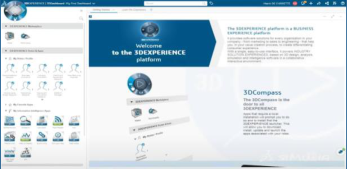
PLATFORM CLOUD-BASED PRODUCT -- DASSAULT 3DEXPERIENC(3DE) 3DE is a cloud PLM platform that integrates Dassault Aviation's industrial software and brings together applications for 3D modeling, simulation optimization, data management and process management functions to create a one-stop full process experience for users.
The process of using 3DE is the same as traditional desktop industrial software, which Dassault has clouded in web, integrating Dassault's industrial software in one cloud- based PLM platform. Users can directly create new team and projects in 3DE and search for the corresponding industrial software to use. The projects and data created in 3DE can be interconnected within the same organization and can also be used directly in the desktop software. The full lifecycle PLM platform represented by 3DE is the future direction of the major industrial software giants. Such full-platform cloud-based products can enable the R&D and manufacturing processes of large manufacturing industries to achieve actual cloud sharing, with all projects and data results stored in the cloud, providing a platform for online collaboration between staff in different positions, while cloud-based CAE simulation is an integral part of such cloud-based PLM. However, because of this, the full platform cloud brings the relative redundancy of the system, which is not suitable for the simple task of agile test optimization,and the payment model and usage process of these are relatively complicated for small enterprises and individual users. In addition, these products mainly focus on 3D model-based mechanical development and manufacturing processes, and may not have sufficient functionality for other CAE optimization objectives. (Fig. 1)
Figure 1. Dassault 3DE's software interface, main platform interface on the left, CAE interface on the right (Source: https://3dex.com/project/3d-experience-platform/ )
Intelligent Human Systems Integration (IHSI 2022): Integrating People and Intelligent Systems https://openaccess.cms-conferences.org/#/publications/book/978-1-7923-8988-7
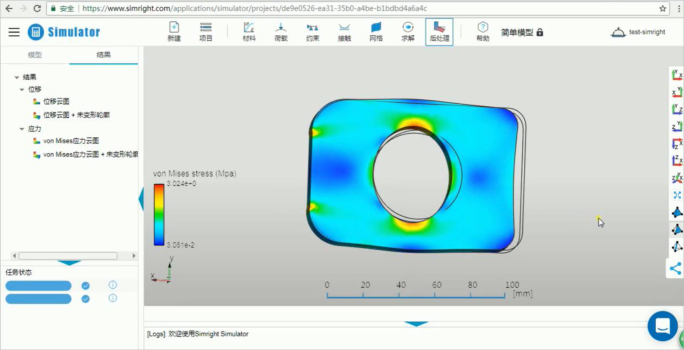
INDEPENDENT CLOUD-BASED CAE PRODUCT - SIMRIGHT Simright is a cloud-based CAE simulation software and collaborative R&D platform technology company from China that has developed a series of public cloud-based CAE simulation solutions, for example, Simright Simulator (structural analysis), Simright Toptimizer (topology optimization), WebMesher (model pre-processing), etc.
Similar to local CAE software, Simright only needs to upload the local model file to the cloud platform, followed by pre-processing, sending the processing parameters to the cloud solver, and then waiting for the results to be returned. This is the same process as using CAE on the desktop, without adding additional learning costs. Such independent cloud-based CAE products are a new trend formed by the trend of cloud computing, which has also created a group of emerging cloud-based CAE developers, such as Simscale, CAEplex, etc. Compared with traditional CAE platforms, such independent cloud-based CAE products are lower in the threshold of use, mainly in the simple functional logic and flexible charging model, most of which are immediately ready to use and only require registration of accounts. At the same time, this also brings the respective disadvantages of simple functions, generally only with basic CAE analysis functions, or only in a specific area to achieve a certain demand, can not cope with the complex CAE analysis needs.(Fig. 2).
Figure 2. Simright Simulator user interface, this fig shows the finished effect of post-processing (Source: https://www.simright.com/apps/simright-simulator )
Intelligent Human Systems Integration (IHSI 2022): Integrating People and Intelligent Systems https://openaccess.cms-conferences.org/#/publications/book/978-1-7923-8988-7
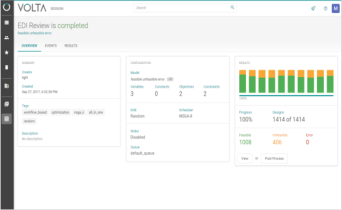
PARTS OF CLOUD-BASED CAE PRODUCT -- VOLTA VOLTA is a cloud-based CAE product to solve enterprise optimization project developed by ESTECO, the developer of modeFRONTIER. VOLTA focuses on the collaboration between staff in various departments in multi-objective optimization, it must carry out multi-departmental collaborative optimization based on modeFRONTIER's pre-set model, which enables the sharing of computational resources and optimization results.
The process of using VOLTA is different from the first two patterns. According to the requirements of multi-objective optimization, users need to build optimization models with different objectives in the local CAE software (modeFRONTIER) in advance.Uploaded the different optimization models to the web platform VOLTA, according to the pre-established analysis model, establish the suitable analysis process, set the analysis parameters and the weight of each analysis target, and allocate the cloud computing resources for analysis sequence. After the analysis is completed, the optimization results are returned to the VOLTA platform and displayed visually, the data results are shared and managed, and an analysis report is generated to finalize the optimization plan. The pre-processing of multi-objective optimization is more complicated than ordinary single-objective optimization. In addition to importing models and setting constraints, multi-objective optimization requires more pre-processing processes, which are more complicated to implement in WEB platform. VOLTA is a unique solution to the problem of multi-objective optimization and collaboration between engineers from different disciplines, enabling distributed control and data sharing of multi-objective optimization processes through a cloud-based platform.But VOLTA is essentially just a clouding of the post- processing process, inseparable from the model built locally by modeFRONTIER, the adjustment of its parameters and the setting of the process are dependent on the creation of a local optimization model.(Fig. 3)
Figure 3. VOLTA's User Interface, the project management interface on the left, the resource allocation interface on the right (Source: https://engineering.esteco.com/volta/volta- capabilities/#content )
Intelligent Human Systems Integration (IHSI 2022): Integrating People and Intelligent Systems https://openaccess.cms-conferences.org/#/publications/book/978-1-7923-8988-7
DISCUSSION AND CONCLUSION From these three types of CAE products with different degrees of cloudization, cloud- based CAE products do not move forward with the same path of development, and different product features of cloud CAE cater to customers with different usage goals. The cloud-based PLM provides an industrial connected application platform for large manufacturing industries.Independent cloud-based CAE product provides easy and convenient fast optimization applications for lightweight users,and parts of cloud- based CAE products provide a new collaborative way of thinking in solving multi- objective optimization problems. Based on the development of cloud computing, cloud-based CAE products provide a variety of options for different optimization objectives, which also provides the direction for CAE to be popularized to the general public.
The development of cloud-based CAE products is still in a relatively primitive state, and there is a large gap in response speed as well as functional support compared with local CAE software. But in any case, cloud-based CAE products are evolving in a different path from traditional CEA development, which allows emerging CAE vendors to find a way to avoid competing with the giant vendors.
REFERENCES
Chen, T., Liao, D., Ling, D., Sun, F., Xue, B., & Zhang, J. CN107248194-A. Jiang, Z., & Xu, X. (2019). Research on 3D Visualization Design of Industrial Production Management Software. IOP Conference Series: Materials Science and Engineering, 688(5), 055084. doi:10.1088/1757-899x/688/5/055084 Lukose, K., Agarwal, S., Rao, V. N., & Sreevalsan-Nair, J. (2018). Design Study for
Creating Pathfinder: A Visualization Tool for Generating Software Test Plans using Model based Testing. Paper presented at the VISIGRAPP (3: IVAPP). Ma, D., & Shi, Y. (2019). A lightweight encryption algorithm for edge networks in software-defined industrial Internet of Things. Paper presented at the 2019 IEEE 5th International Conference on Computer and Communications (ICCC). Na, H. Y. W. Y. L., & Tianyuan, H. M. P. Z. X. (2002). Sharing Technology for CAE
Applications Based on Web Distributed Computing Environment [J]. Computer Engineering and Applications, 13. NI, X.-y., TANG, W.-c., & NI, Z.-h. (2004). Research on the web-based collaborative CAE system and its related key technologies. Computer Integrated Manufacturing Systems, 10(S1), 51-55. SU, S.-b., FAN, W.-k., YU, S.-h., YIN, X.-b., & ZHENG, D.-t. (2009). Research on
integration of CAx and applied patterns [J]. Modern Manufacturing Engineering, 4.
Intelligent Human Systems Integration (IHSI 2022): Integrating People and Intelligent Systems https://openaccess.cms-conferences.org/#/publications/book/978-1-7923-8988-7
LISTED IN THE AHFE DIGITAL BOOKSTORE CATALOGUE
Explore the complete digital volume
Intelligent Human Systems Integration (IHSI 2022): Integrating People and Intelligent Systems
Read this individual research paper free through the original publisher, or explore the full digital proceedings book.
ISBN 978-1-7923-8988-7
Explore this ISBN in the AHFE Bookstore ↗Listed in the July 2026 bookstore catalogue; search by ISBN to confirm current availability · Digital book purchase optional