Martins Danusevics, Liga Braslina, Daine Skiltere, Anda Batraga, Girts Braslins (2022). Modular construction cost forecasting design to support continuous construction system improvements. In: Intelligent Human Systems Integration (IHSI 2022): Integrating People and Intelligent Systems. AHFE Open Access, vol. 22. https://doi.org/10.54941/ahfe1001066
Problem statement. The development of construction projects requires a relatively long period of time, during which, according to historical data, construction costs change significantly even on an annual basis, which significantly affects the commercial opportunities of participants in the construction industry. Sometimes an inaccurate forecast can lead to the liquidation of a company or the suspension of a construction project. Many construction forecasting methods have been developed in recent decades, but their accuracy is fragmented. The latest machine learning methods are not yet able to produce accurate predictable calculations due to the high degree of uncertainty and variability in cost factors in the construction industry.Research aim. To further improve the quality of construction forecasting systems, the aim of the study was to develop and test a new modular prediction model of construction costs dynamics, which can forecast changes in the next 12M as accurately as possible, as well as to provide precise guidelines for five-year forecasts.Research methods used. The combined methodology of the study was developed in 2018 and for 3 years was approbated to assess changes in the costs and volume of the Latvian, EU member state, construction sectors. Each year during the summer period, a forecast was developed, and after a year, the results were compared, and the methodology was adjusted. The methodology is modular - it includes the use of both statistical and expert methods, a combination of methods. In total, more than 200 experts were interviewed over the 3-year survey, while the 2020 phase survey includes the opinions of 59 experts from 56 organizations according to the Quadruple Helix methodological approach. The quantitative data array consists of statistical data blocks by historical changes in the costs and volume of construction sub-sectors.Main results and findings of the study. Based on the improved methodology, the 2020 projections differed from the actual changes in 2020 by 0.4 percentage points in volume and 1.4 percentage points in costs in context where changes over the last decade have fluctuated in double-digit ranges. The results of the study identify high-precision construction cost and volume methodology.Theoretical and practical implications of the work and conclusions. The developed methodology can be applied in practical forecasts of construction costs and volume in both the public and private sectors. The developed methodology can be applied to the improvement of future construction forecasting, including the development of machine learning algorithms. The proposed forecasting method offers a new direction for construction cost forecasting research and will provide construction planners with an additional effective tool to manage the risks associated with construction project costs.
Intelligent Human Systems Integration (IHSI 2022): Integrating People and Intelligent Systems https://openaccess.cms-conferences.org/#/publications/book/978-1-7923-8988-7
INTRODUCTION
Completion of construction projects requires a relatively long period of time, during which, according to historical experience, construction costs change significantly even within one year. This has a significant impact on the commercial opportunities of the players in the construction industry. Sometimes an inaccurate forecast can lead to the liquidation of a company or the suspension of a construction project. For the public sector, inaccurate construction costs can cause millions in losses to national budgets. Many construction forecasting methods have been developed in recent decades; however, their accuracy is fragmented. Most of them are based on statistical regression models. The latest machine learning methods, on the other hand, are in the development stages and are not yet able to make accurate predictable calculations due to the high level of uncertainty in the construction industry and the variability of cost factors.
The aim of the study is to improve the quality of construction forecasting systems. The task of the study was to develop and test a new combined model for forecasting construction costs, which can forecast changes for the next 12 months as accurately as possible as well as provide precise guidelines for five-year forecasts.
Research Methods The modular methodological design of the study was developed in 2018 and it was subjected to approbation for a period of 3 years in the assessment of changes in the costs and the volume of the Latvian (an EU Member state) construction sectors. Each year a forecast for the following year and the following five years was devel-oped during the summer period on this basis. Each year the forecast results were compared with the actual ones and methodological improvements were made. The methodology is modular - it involves the use of both statistical and expert methods, as well as a combination of both approaches.
Overall, more than 200 construction and economic experts were interviewed over the 3-year study, while the latest study for the period 2020 includes 59 expert assess-ments from 56 organizations according to the Quadruple Helix methodological ap-proach, where experts are grouped in public administration, industry, academic and civic sector groups.
The quantitative data array consists of historical construction cost and volume statistical data blocks by construction subsector, according to the Eurostat construc-tion classification. The study used in-depth interviews to identify factors and survey experts. Various methods were used to analyse the obtained statistical data and ex-pert evaluations. To determine the further development of cost changes, different types of models were used, which characterize the further development of the main trends of time series, based on the extrapolation of previous trends. The obtained models were evaluated for quality with variance indicators. Depending on the form and scale of the questions used, the calculations of total means, structure means, scatter and variation indicators were used in the processing of expert evaluations.
Intelligent Human Systems Integration (IHSI 2022): Integrating People and Intelligent Systems https://openaccess.cms-conferences.org/#/publications/book/978-1-7923-8988-7
In addition to a separate analysis of statistical information and expert assessment, combined forecasts were used as a tool for the final forecast, combining different sources of information, providing the opportunity to compensate for errors and im-prove the final forecasts.
Related Studies Construction forecasting in research is related to three types of basic methodological approaches. Two approaches are related to econometric causality and time series methods that have been widely tested in research, while the third approach is related to the artificial neural network (ANN) based on machine learning.
The quantitative method - the artificial neural network (ANN) is one of the artificial intelligence computing systems that simulates the learning abilities of the brain. The ANN consists of many closely related information processing elements or neurons, which together perform specific tasks, trend recognition and prediction, optimization, or data classification [1]. The method allows to more accurately predict construction costs [2]. Recent ANN forecasts use real-time web data, which is one of the most important advantages over other construction forecasting approaches [3]. Many studies have been conducted on ANN construction forecasting [4, 5, 6, 7] and other approaches, where intensive searches are performed to obtain increasingly accurate construction forecasts.
The causality method has been significantly tested in construction forecasting [5] and assumes that the predicted variable is determined by independent explanatory variables. Multiple regression analyses with variables such as material costs, transport costs, the loan interest rate, the consumer price index, house purchase prices and others are mainly used to forecast construction costs. Hwang [9] and Ashuri [10] in their studies emphasized the importance of crude oil prices, the producer price index, GDP, employment in construction, the number of building permits for more accurate costs. The Hwang and Ashuri variable models have shown better forecast results than the seasonal Autoregressive Integrated Moving Average (ARIMA) and HoltWinters simple exponential smoothing models. Many studies have been conducted on the interactions of variables [11, 12, 3] and other models that have highlighted that success in the forecasts using the causal analysis is determined by carefully selected variables [3].
Time series forecasting methods predict future data values based on the analysis of past data and using internal statistics between data. Future values depend on past values and corresponding errors, where the exponential smoothing (ES), the auto-regressive and moving average (ARMA), the autoregressive integrated moving aver-age (ARIMA) and the seasonal ARIMA are well known and widely used methods for time series forecasting [13,14, 15]. Time series data, such as economic and social indices, often have autocorrelation, where current data are influenced by past data [16]. In general, time series analysis is divided into two approaches: single-factor and multi-factor time series analysis. Unlike causality analysis, which determines relationships between different variables, one-way time series analysis uses the past time series of a dependent variable to predict future values [16]. The multifactor
Intelligent Human Systems Integration (IHSI 2022): Integrating People and Intelligent Systems https://openaccess.cms-conferences.org/#/publications/book/978-1-7923-8988-7 time series analysis includes several variables using the mutual time series relationships be- tween independent and dependent variables. Multifactor time series forecasts, using economic and social indices as variables, have higher forecasting results than traditional single-factor time series approaches [16]. In construction predictions this was demonstrated by Hwang [17] with a vector autoregressive model, which had more accurate prediction values than the ARIMA, Holt-Winter's simple exponential smoothing, and Williams neural network models. Relatively accurate construction predictions are reported by Siggiridou [18] using variables selected by applying Granger causality and cointegration tests, and by Zhang [19] using graphical models. The modular methodology of construction forecasting described below is based on a multifactor conceptual approach to time series, based on complex social and economic factors, their variables and time series.
Methodology Validation The main result of the research is an improved methodology for forecasting the construction output and costs based on a modular systemic approach. For validation of the level of precision of methods authors compare the actual situation in five different categories and the forecasts created in 2018 and 2020. The categories observed are the overall construction output, overall construction costs, construction workers’ wage costs, construction material costs and cost of machinery and equipment. The forecasts created with the modular forecasting method in 2018 has a longer validation period of three years and 2020 forecasts can be validated only against the actual situation in 2020.
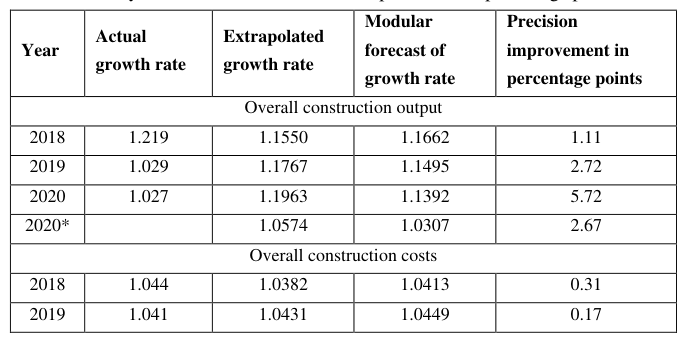
The validation criteria of the methodology are the assessment of the increased forecast precision. The base approach is defined as a purely extrapolation forecast and the improved methodology is the modular construction forecasting method implemented in 2018. An imitation has been used to create a forecast as if only the statistical approach was used, and results are summarized in Table 1.
Table 1: Growth rates of analysed overall indicators for the Latvian construction industry, forecasts for validation and improvement in percentage points
Intelligent Human Systems Integration (IHSI 2022): Integrating People and Intelligent Systems https://openaccess.cms-conferences.org/#/publications/book/978-1-7923-8988-7
By comparing the forecasts for the baseline comparison and the modular forecasts we can determine that there is a consistent improvement of forecasting precision across the board. A higher improvement is gained in overall forecasting of the construction output by having a 5.72 percentage points improvement in forecasting the 2020 level approbated in 2018. There is a lower improvement of quality in forecasting overall construction costs. The difference can be explained by comparatively more stable dynamics of costs compared to the outcome. Hence the forecasts by different means tend to be more homogenous. Nevertheless, there is still a significant improvement in the 2020 forecast done in 2020 and the improvement was 2.15 percentage points.
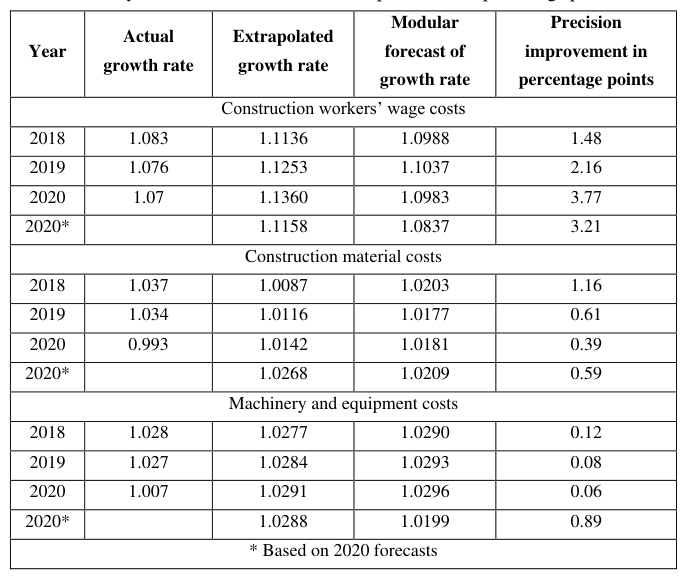
The overview of the improvement in analysing specific resources used in construction industry is summarised in Table 2.
Table 2: Growth rates of analysed resources indicators for the Latvian construction industry, forecasts for validation and improvement in percentage points.
Intelligent Human Systems Integration (IHSI 2022): Integrating People and Intelligent Systems https://openaccess.cms-conferences.org/#/publications/book/978-1-7923-8988-7
The best improvement in using the modular construction forecasting has been observed in analysing construction workers’ wages with an improvement in the range from 1.48 to 3.77 percentage points. An almost non-existent improvement has been observed in forecasting machinery and equipment costs in a range from 0.06 to 0.89 percentage points. It can be explained by a continuous stagnation in costs of machinery and equipment in Latvia thus leading to very similar forecasts based on varying approaches.
Based on the improved methodology, the 2020 projections differed from the actual changes in 2020 by 0.4 percentage points in volume and 1.4 percentage points in costs in the context where changes over the last decade have fluctuated in double-digit ranges. The examination of other categories reveals that the forecasts for construction wages costs gain a precision of 1.4 percentage points. For the construction material costs the precision was 2.8 percentage points and for machinery and equipment costs 1.3 percentage points. The results of the study identify high-precision of short term construction cost and volume forecasting methodology.
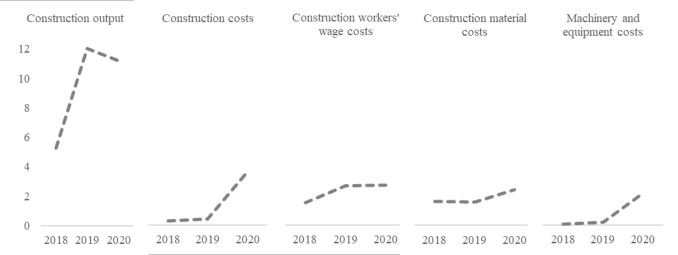
Another aspect of assessing the precision of given forecasts is the tendency of declining precision. A general assumption would be that forecasts are becoming less precise by increasing the forecasting horizon. To validate this assumption authors have examined the tendencies for 2018 forecasts compared to 2018-2020 actual development. This can be practically observed in Figure 1 as a general increase of deviation from the historical data. That should be considered to be a normal tendency for forecasts.
Figure 1. Precision of the modular forecasting method for different construction indicators in Latvia in percentage points compared to historical data.
Based on the observed deviation it can be deduced that these projections can be used as a tool for assessing possible future intervals of cost scenarios.
CONCLUSIONS
The developed methodology can be applied in practical forecasts of construction costs and volume in both the public and private sectors. The developed methodology can be applied to the improvement of future construction forecasting, including the development of machine
Intelligent Human Systems Integration (IHSI 2022): Integrating People and Intelligent Systems https://openaccess.cms-conferences.org/#/publications/book/978-1-7923-8988-7 learning algorithms. The proposed forecasting method offers a new direction for construction cost forecasting research and will provide construction planners with an additional effective tool to manage the risks associated with construction project costs.
Authors acknowledge that the modular construction forecasting approach gives comparatively less trustworthy results when analysing the overall construction output. At the same time this indicator has a lower practicability for industry planners since cost estimation is used more often.
The validation and improvement of the method should be continued to acquire a larger test dataset. Due to the fact that the first analysis was performed in 2018 there is still necessity to continue the analysis of the construction market and continue improving the methodology.
ACKNOWLEDGMENTS
The complex long-term research has been possible thanks to the financial contribution of the Ministry of Economics of the Republic of Latvia and the support of the Faculty of Business, Management and Economics of the University of Latvia.
REFERENCES
Jain, A.K., Mao, J., Mohiuddin, K.: Artificial neural networks: a tutorial. Computer, vol. 29, no. 3, pp. 31--44 (1996) Mao, S., Xiao, F.: A novel method for forecasting Construction Cost Index based on complex
network. Physica A: Statistical Mechanics and its Applications, vol. 527 (2019) Moon, T., Shin, D.H.: Forecasting Model of Construction Cost Index Based on VECM with Search Query. KSCE Journal of Civil Engineering, vol. 22, pp. 2726--2734 (2018) Li, H., Shen, L.Y, Love, P.E.D.: ANN-based mark-up estimation system with self-
explanatory capacities. Journal of construction engineering and management, vol. 125 (3), pp. 185--189 (1999) Maya, R., Hassan, B., Hassan, A.: Develop an artificial neural network (ANN) model to predict construction projects performance in Syria. Journal of King Saud University, Engneer-ing Sciences (2021) Kumar, S., Karmakar, A., Nath, S.K.: Construction of hot deformation processing maps for
9Cr-1Mo steel through conventional and ANN approach. Materials Today Communications, vol. 26, 101903 (2021) Nourani, V., Sayyah-Fard, M., Alami, M.A., Sharghi, E.: Data pre-processing effect on ANN-based prediction intervals construction of the evaporation process at different climate regions in Iran. Journal of Hydrology, vol. 588, 125078 (2020) Elfahham, Y.: Estimation and prediction of construction cost index using neural networks,
time series, and regression. Structural Engineering Dep., Alexandria University, Egypt, AEJ Journal, Elseviere (2019) Hwang, S.: Dynamic regression models for prediction of construction costs. Journal of Construction Engineering and Management, vol. 135 (5), pp. 360--367 (2009)
Intelligent Human Systems Integration (IHSI 2022): Integrating People and Intelligent Systems https://openaccess.cms-conferences.org/#/publications/book/978-1-7923-8988-7
Ashuri, B., Shahandashti, S.M., Lu, J.: Empirical tests for identifying leading indicators of ENR Construction Cost Index. Construction Management and Economics, vol. 30 (11), pp. 917--927 (2012) Joukar, A., Nahmens, I.: Volatility forecast of construction cost index using general
autoregressive conditional heteroskedastic method. Journal of Construction Engineering and Management, vol. 142 (1) (2016) Xu, J., Moon, S.: Stochastic forecast of construction cost index using a cointegrated vector autoregression model. Journal of Management in Engineering, vol. 29 (1), pp. 10--18 (2013) Hwang, S.: Time series models for forecasting construction costs using time series indexes.
Journal of Construction Engineering and Management, vol. 137 (9), pp. 656--662 (2011) Shahandashti S., Ashuri, B.: Forecasting engineering news-record construction cost index using multivariate time series models. Journal of Construction Engineering and Management, vol. 139 (9), pp. 1237--1243 (2013) Enders,W.: Applied Econometric Time Series. Wiley, NewYork (2008) Vasermanis, E., Skiltere, D.: Forecasting methods. University of Latvia (2004) Hwang, S.: Time series models for forecasting construction costs using time series indexes.
Journal of Construction Engineering and Management, vol. 137 (9), pp. 656—662 (2011)
Intelligent Human Systems Integration (IHSI 2022): Integrating People and Intelligent Systems https://openaccess.cms-conferences.org/#/publications/book/978-1-7923-8988-7
LISTED IN THE AHFE DIGITAL BOOKSTORE CATALOGUE
Explore the complete digital volume
Intelligent Human Systems Integration (IHSI 2022): Integrating People and Intelligent Systems
Read this individual research paper free through the original publisher, or explore the full digital proceedings book.
ISBN 978-1-7923-8988-7
Explore this ISBN in the AHFE Bookstore ↗Listed in the July 2026 bookstore catalogue; search by ISBN to confirm current availability · Digital book purchase optional