Alexis Suárez Del Villar Labastida, Mireya Zapata Rodríguez, Ana Alvarez (2021). Musculoskeletal Injuries which Masapan Craftsmen are Exposed. In: Human Systems Engineering and Design (IHSED2021): Future Trends and Applications. AHFE Open Access, vol. 21. https://doi.org/10.54941/ahfe1001157
The results of repetitive and prolonged trauma are reflected in most musculoskeletal injuries, which are pathologies that can be articular, due to the maintenance of forced postures or the excessive use of the affected joint; and bone when the relationship is with the bones. Regardless of the classification, these injuries affect the intervertebral ligaments or discs, tendons, bones, and muscles. The study was carried out on marzipan artisans in the Calderón parish in Ecuador (located north of 277 Quito canton), a place where these figures have survived over time; The results associated four risks in this regard: Lifting weights with overexertion very frequently; Operate the marzipan sheeter manually until the dough reaches the consistency necessary to develop the crafts; Maintain forced or fixed postures for hours, and perform the same movement pattern every few seconds for hours at a time. With the BIOMEC Software application, the areas of the body that have overload were determined: Shoulder and Hip. To maintain and manipulate the 4kg load, the posture must be corrected since the limitation, in this case, is the ankle, which is the joint that can least support these conditions with repetitive levels in inappropriate postures.
MATERIALS AND METHODS The calculation tool offered in Ergonauts (BIOMEC) performs biomechanical evaluations of static coplanar stresses based on the posture adopted, the load and the frequency and duration of the stresses. It allows to know the risk of overloading per joint, the maximum recommended load, and the stability of the posture [6] allows to perform physical calculations and the application of the biomechanics model based on a series of data about the task: Sex of the worker, Height, Weight, Angle of the body segments in the analyzed posture, Weight of the supported load or exerted force, If the load is supported with one or two hands, Time during which the efforts are made and Frequency of the efforts; providing as a result: the level of effort in each joint, the maximum recommended load, the percentage of protected population, in addition to the stability of the posture, the possibility of slipping and the possibility of overturning of the worker under the supported loads (S, 2020) The BIOMEC calculation tool is offered in Ergonauts and also allows to perform the physical calculations and the application of the model from the input data, providing as results: the level of effort in each joint, the maximum recommended
Human Systems Engineering and Design (IHSED 2021) https://openaccess.cms-conferences.org/#/publications/book/978-1-7923-8987-0 load, the percentage of protected population, in addition to the posture stability, the possibility of sliding and the possibility of overturning of the worker under the supported loads.
PRINCIPLE Recent research has been incorporating ergonomic principles into design processes, as a strategy to anticipate solutions to problems and include users in decision making processes (S, 2020). For the case study, a large part of the working day of masapan craftsmen are in a sitting position, carrying out their daily work activities (P. Salazar, 2019). The diagram of the process of making the dough and kneading is shown in Fig. 1. In order to carry out this operation, the craftsman stands up for ten minutes, an activity that is repetitive in each production cycle, and in relation to the demand they have will be the number of times they perform it in the 8-hour workday (Diego-Mas J. A., 2021). Constantly mixing the ingredients without stopping is considered a forced posture, that is, they go from a natural position to a position of articular hyper rotation, then they remain standing to give the dough homogeneity in a period of 10 minutes more (Guillén, 2015) (R. Vasconez, 2020)
Figure1: Dough and kneading manufacturing process diagram DEVELOPMENT Body distribution can be carried out in multiple ways depending on the object of study (Unidas, 1948) (Barzola, 2017). Figure 2 shows this human model; although 8 segments are usually used that are assumed to be non-deformable (Head + neck, trunk, thighs, legs, feet, arms, forearms and hands).
Figure available in the original PDF paper.
Human Systems Engineering and Design (IHSED 2021) https://openaccess.cms-conferences.org/#/publications/book/978-1-7923-8987-0
Figure 2: Segments of the human model.
Figure available in the original PDF paper.
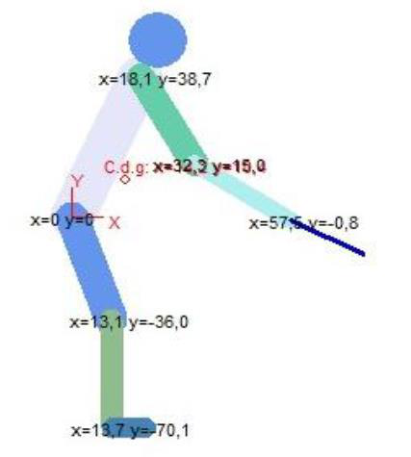
The application of the BioMec model for the evaluation of efforts in the different joints previously collects a series of data on the kneading operation such as: 95% of the craftsmen are women (Larrea, 2018). Therefore, the study was framed in females, with average heights of 1.65 meters, body weight of 75 kg, plus analysis of angles of the body segments in the acquired posture and the weight of the sustained load of 4 kg (Á.Estévez, 2018). It is considered the time of 10 minutes that the effort is made with simultaneous and repetitive movements with an operation frequency of once each productive cycle (S. Chancusi, 2018) RESULTS Having determined the human model and the way to obtain the inertial parameters, it is possible to calculate the moments generated by the load and the self- weight of the different body segments (Cuenca, 2017) (Vives, 2016). The current angle analysis is performed in the kneading operation. As shown in Fig. 3, the 161o knee angle is significant, at bottom dead center the angle of the knee to the tibia should be close to 145 degrees and at top dead center it should be greater than 70 degrees. Fig. 4 shows the resulting posture that should be adopted taking into consideration that the sample taken are craftswomen of the elderly and they already have certain postural deformations, so it is not recommended to force the knees.
Human Systems Engineering and Design (IHSED 2021) https://openaccess.cms-conferences.org/#/publications/book/978-1-7923-8987-0
Figure 3: Angular and biomechanical analysis for kneading forced position.
Figure available in the original PDF paper.
Figure 4: Resulting posture for kneading operation, (centimeter units).
Human Systems Engineering and Design (IHSED 2021) https://openaccess.cms-conferences.org/#/publications/book/978-1-7923-8987-0
Figure 5: Protected population percentage (%) = 90%.
Figure available in the original PDF paper.
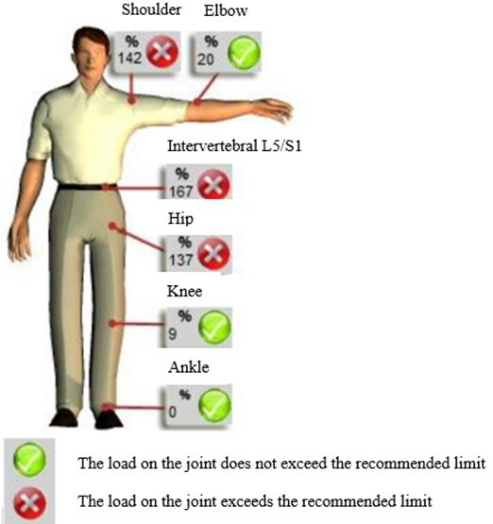
Figure 6: Overloaded areas of the body
Fig. 5 and 6 show the results obtained with the application of the BIOMEC software. The results obtained in shoulder, lumbar and hip show that people evaluated exceed the admissible loads, while elbow, knee and ankle efforts are kept within recommended limits (BUN-CA, 2011)
Table 1: Maximum recommended loads, overloads and risk per joint.
Table available in the original PDF paper.
Human Systems Engineering and Design (IHSED 2021) https://openaccess.cms-conferences.org/#/publications/book/978-1-7923-8987-0
To maintain and manipulate 4kg load, posture must be corrected since the limiting factor for this case is the ankle, which is the joint that can least bear in these conditions as shown in Table 1. Given the duration and frequency of the efforts of the elderly craftswomen, who spend 10 minutes with a standing posture in the baking of the dough and then develop the kneading operation for 10 minutes more, and considering that, the dough is molded hot, with rotations in the two workplaces, we can protect 90% of the population (Orlando, 2014) (Gama, 2018) The experiment is based on using the BIOMEC software from these data, the tension and the moments generated in each joint were calculated compared with the maximum permissible posture obtained from the model previously exposed, modified according to effort duration and frequency, and 90% percentage of the population to be protected. From the difference between the acting moment and the permissible moment in each joint, the program determined the existing risk (Mora, 2017) (Celín, 2018) CONCLUSIONS BIOMEC Software allowed us to validate musculoskeletal injuries caused to masapan craftsmen. In the physical calculations it is assumed that no part of the body is supported, that is, the operator is supported only by feet on the ground, being a limitation for the results, because in a period of six seconds during the ten minutes that the operation lasts the craftsman leans on the marbled table to turn the dough, however it is considered that this condition will not significantly change the results obtained. The results obtained from the ergonomic evaluation indicate that the tasks performed by the craftsmen in masapan figures elaboration present a risk to the musculoskeletal system. A correction of the standing posture is needed in the kneading operation and to reduce repetitive movements in each cycle. ACKNOWLEDGEMENTS The agreement between the Universidad Tecnológica Indoamérica and the MASARTE Association to carry out the community service internship project: "OWN TECHNOLOGICAL INNOVATION IN THE PRODUCTIVE PROCESSES IN THE MANUFACTURE OF CRAFTS: CASE SECTOR CALDERÓN, QUITO- ECUADOR" was the opening to carry out this research, thank you to all members of MASARTE, to the authorities of such a prestigious university and to the researchers for their support, thank you.
Human Systems Engineering and Design (IHSED 2021) https://openaccess.cms-conferences.org/#/publications/book/978-1-7923-8987-0
REFERENCES
Human Systems Engineering and Design (IHSED 2021) https://openaccess.cms-conferences.org/#/publications/book/978-1-7923-8987-0
Human Systems Engineering and Design (IHSED 2021) https://openaccess.cms-conferences.org/#/publications/book/978-1-7923-8987-0
LISTED IN THE AHFE DIGITAL BOOKSTORE CATALOGUE
Explore the complete digital volume
Human Systems Engineering and Design (IHSED2021): Future Trends and Applications
Read this individual research paper free through the original publisher, or explore the full digital proceedings book.
ISBN 978-1-7923-8987-0
Explore this ISBN in the AHFE Bookstore ↗Listed in the July 2026 bookstore catalogue; search by ISBN to confirm current availability · Digital book purchase optional