Manutchanok Jongprasithporn, Nantakrit Yodpijit, Thanaporn Nunthawarasilp, Nopphavee Treekanjanothai (2021). Understanding Harmful Blue Light in a group of Thai People. In: Human Systems Engineering and Design (IHSED2021): Future Trends and Applications. AHFE Open Access, vol. 21. https://doi.org/10.54941/ahfe1001205
1 Department of Industrial Engineering, School of Engineering, King Mongkut's Institute of Technology Ladkrabang ↗
2 Center for Innovation in Human Factors Engineering and Ergonomics (CIHFE^2), Department of Industrial Engineering, Faculty of Engineering King Mongkut's University of Technology North Bangkok ↗
Blue light is harmful to health in the long term and exposure. Therefore, knowing about the dangers from the Blue light is the prevention of hazards that might occur. This research aims to study the dangers of blue light and how it harms people by using electronic devices as well as to assess the level of knowledge about usage and dangers of blue light. Moreover, the producer team provides corrective recommendations direction for everyone. The research team studies the behavior of using electronic devices and collecting data by using a questionnaire. The target population is 150 peoples. The questionnaire consists of four parts: Personal information, Evaluation form of knowledge about the dangers of blue light and how they prevent it. According to data analysis, the majority of the sample is knowledgeable about blue light. In the second part of the questionnaire: how they prevent the blue light danger. For the third part of the questionnaire, we found that our sample group in every age range clearly understand in good level the knowledge that we gave via the infographics and for the last part of our questionnaire we found that people in 18-30 years old are most damaged by blue light more than 30 years old and less than 18 years old respectively. If the people do not protect their eyes to have good eyes health enough, would be very regretful that they might have to wear glasses or have blurred vision for a long time or in the worst case they might lose their vision. Therefore, the producer team hopes that this research will make everyone interested and take care of their eyes health as much as they can to decreasing the risk which can cause a bad situation.
Human Systems Engineering and Design (IHSED 2021) https://openaccess.cms-conferences.org/#/publications/book/978-1-7923-8987-0
INTRODUCTION
The world is increasing the number of screen device users, monitor screen also increasing the number of users as well (Statista Research Department.2018). Many users are not concerned about the dangers of blue light effects from the electronic devices. Very few people are clearly understanding the danger of blue light and few seriously protect their eyes from the blue light harm. The dangers of blue light are ignored because it isn't a problem that immediately happens, it takes a long time to reveal the obvious symptoms (Preventing Bliness.2021, Bahl, Rajiv.2018).
The common symptoms are affected by blue light are eyestrain, headaches or migraines, blurry vision, and disrupts sleep patterns (Pixeleyewear. 2020). All of the common symptoms have badly affected our body either physically or mentally (Frequency Distribution Table: Examples, How to Make One. 2021). When sleep pattern is disrupted, it will affect the work of hormones in our brain that causing our brain has low efficiency or our emotion is not stable. Physically, if we have a problem with the eyes whether it is a problem with seeing colors or myopia problems, it is a very serious injure because the eye is an important organ of our bodies, so we have to protect and prevent our eye from the dangerous of blue light. The objective of this study is to educate the dangers of blue light, to protect and prevent the dangers of blue light perfectly, to offer the correct way to use electronic devices, and to survey the percentage of people who know and concern about the dangers of blue light. The questionnaire was provided to survey the sample group of 150 people, including 50 people 15-17 years old, 50 people from 18-30 years old, and 50 people 31-60 years old. Therefore, this study aims to increase awareness of blue light and how to the take care their eye health as much as possible to decrease the risk of harmful blue light.
THEORY Blue light Blue light is everywhere in our world. It is a color in the visible light spectrum that can be seen by human eyes. It is considered as a short wavelength, which means it produces higher amounts of energy. We have brought blue light inside by way of digital screens (found on TVs, Smartphones, computers, laptops, tablets, and gaming systems), electronic devices, LED, and fluorescent lighting (Blutech Lenses.2020). Effects from blue light Eyestrain is a symptom, not an eye disease, it occurs when your eyes get tired from intense use, such as reading, or working at the computer for long time (Thera specs.2020).
Headache, people who are prone to headaches or mi-graine attacks. It is exposed to this blue light that leads to high discomfort, a greater perception of pain and
Human Systems Engineering and Design (IHSED 2021) https://openaccess.cms-conferences.org/#/publications/book/978-1-7923-8987-0 throbbing and even enhanced spreading headache pain across the brain (Harvard Health Publishing.2018).
Blindness is the inability to see anything, including light. If you’re partially blind, you have limited vision. You may have blurry vision or the inability to distinguish the shapes of objects (Statistic How to.2021).
METHODOLOGY
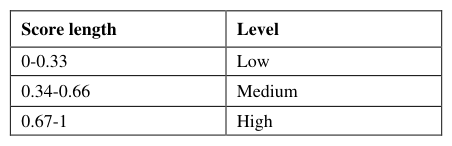
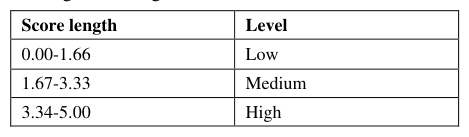
In this study, the data were collected by questionnaire to survey the basic knowledge of the sample group about the dangers of blue light and survey the solution that the sample group chooses to protect themselves from the dangers of blue light. 50 participants from 3 groups, aged 15-17 years old, 18-30 years old, and 31-60 years old. The questionnaires were distributed through the link on the Google form. It consists of 4 sections, Section 1: The question about general information of answerer. Section 2: The question about the dangers of blue light. Scoring of each section of the questionnaire will consider from the average score that we separate in 3 levels by use class interval which can calculate through maximum data subtract minimum data then divided by the length of the class interval.
Table 1: The range of average score calculates from the data in section2 both subsection1 and subsection2.Table 2: The range of average score that calculates from the data in section3 Score length Level
Human Systems Engineering and Design (IHSED 2021) https://openaccess.cms-conferences.org/#/publications/book/978-1-7923-8987-0
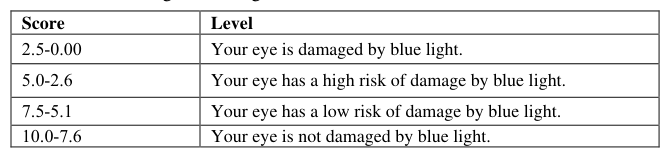
Section 4: We give 5 questions to our sample group to check themselves that are damaged by blue light or not?
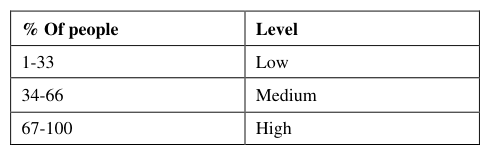
Table 3: The range of average score that calculates from the data in section4 Score Level 0.00 - 2.5 Your eye is damaged by blue light.Table 4: The range of people who answer correctly and level of people that calculate from the data in section3 and section4.
RESULTS
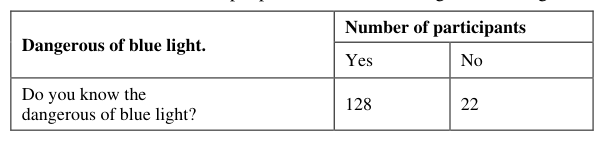
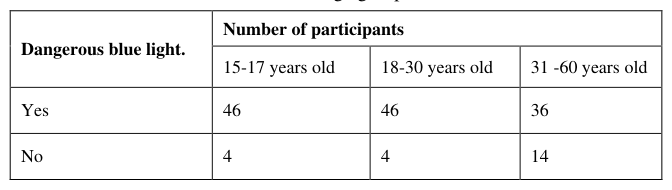
The results in this session showed how well the participants have the basic understanding about blue light. The section 1 showed the number of sample group who know the danger of blue light, in section 2, the questions are related with the dangers of blue light. The results are shown in Table 5 and table 6, respectively.
Table 5: The number of people who know the danger of blue light.
Human Systems Engineering and Design (IHSED 2021) https://openaccess.cms-conferences.org/#/publications/book/978-1-7923-8987-0
Table 6: The number of people who know the danger of blue light in each age group.
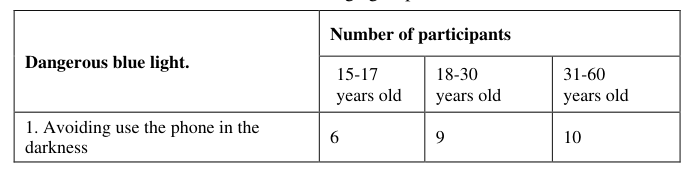
Table 7 : The number of people who prevent their eyes from the danger of blue light.
As shown in table 7, There were only three people who applying all 4 methods including avoiding using to prevent themselves including avoiding using phone in the dark, using devices less than 2 hours, turn on night mode, and wearing blue light glasses.
Table 8: The number of people prevents their eyes from blue light danger in each age group.
Human Systems Engineering and Design (IHSED 2021) https://openaccess.cms-conferences.org/#/publications/book/978-1-7923-8987-0
Table 9: The number of participants that being aware of dangerous blue light in each age group after providing about the basic knowledge of blue light.
Human Systems Engineering and Design (IHSED 2021) https://openaccess.cms-conferences.org/#/publications/book/978-1-7923-8987-0
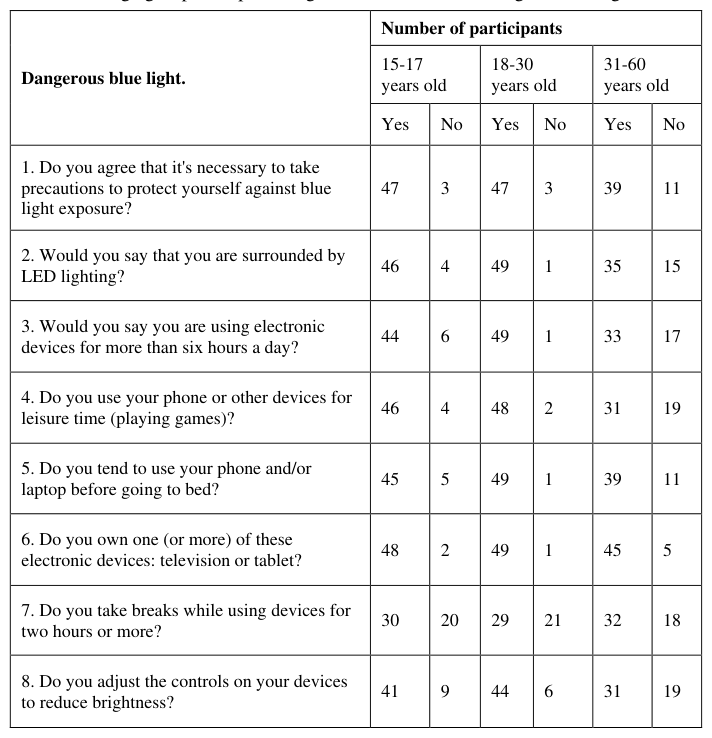
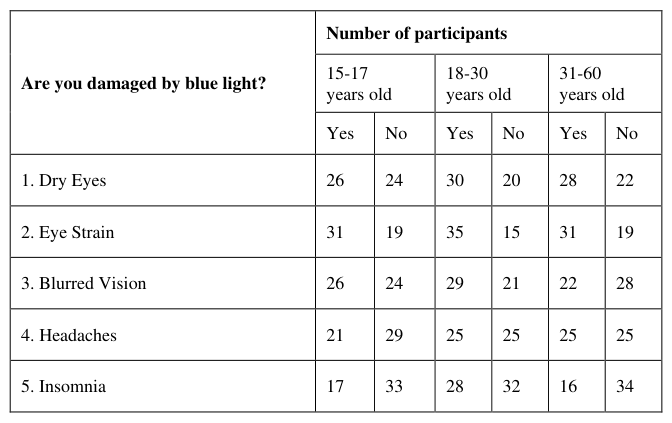
Table10: The result shows that how many people in each age interval who damaged by blue light
DISCUSSION
In section 1 of our questionnaire, the questions about the dangers of blue light, we found that the people who know about the dangers of blue light is 85.3%, so the level of our sampling is high and about another 14.7% are people who do not know about the dangers of blue light mostly in the people who 31-60 years old, accounted for 9.3% out of 14.7%, leveling is high who do not know about the dangers of blue light. For the answer about how to protect their eyes from blue light danger, we found that the people have many ways to protect themselves, accounted for 75%, so the level is high. In the whole picture, the way that people use to do to protect themselves the most is using the mobile phone less than 2 hours per day, accounted for 33.33%, so the level is low. The lowest way that persons use to do to protect themselves is an open night shift this method is easy to do but only 8.67% of our sample group use the night mode to protect themselves, it is very low level compare with other methods. However, surprising that there also have a few groups of people in our sample who
Human Systems Engineering and Design (IHSED 2021) https://openaccess.cms-conferences.org/#/publications/book/978-1-7923-8987-0 know the dangers of blue light, but they do not have any way to protect themselves, it is about 24.67%, so the level of our sampling is low. For section3 of our question, after giving the basic knowledge infographics to our participants, then we were scoring the data by using the criteria in Table 4. The results of this section show in Table 9, consisting of 10 items. According to the results, it shows that people 15-17 years old choose the correct answer 80%, it is a high level, the people 18-30 years old choose the correct answer 83%, it is high level, and people in 31-60 years old choose correct answer 69%. It is still in high and most likely to medium, so the first priority group that needs to be concern is 31-60 years old. For the last part of our questionnaire, the basic symptoms about blue light were asked and scored in Table3. People in 15-17 years old answered yes, which means they have some basic symptoms of damage by blue light 121 times out of 250 times. People in 18-30 years old answered yes, which means they have some basic symptoms of damage by blue light 147 times out of 250 times, and people in 31-60 years old answered yes, which means they have some basic symptoms of damaged by blue light 122 times out of 250 times. In terms of different ages, the method that the people who are 15-17 years old choose to do the most is using mobile phones for less than 2 hours per day. Unfortunately, the method that the people who 18-30 years old choose the most is doing nothing. Lastly, the method that the people who 31-60 years old choose to do the most is using the mobile phone for less than 2 hours per day. In section3 people have more knowledge about the dangers of blue light both what is the effect that caused by blue light danger and how to protect themselves from the danger, people in 15-17 years old and 18-30 years old answer the correct high level. However, people who 31-60 years old also answer correctly at a high level, but it is at a low interval of high level. In section4 the last part of our questionnaire, all of our sample group is on the same level, but the most age range that has the highest percentage of people who has symptoms that show they might be damaged by blue light is 18-30 years old group.
CONCLUSIONS
As refer to our results that is analyzed, mostly people have the basic knowledge about the dangers of blue light, and they are concerned about the problem that causes from blue light danger and they try to protect themselves from the risk that causes harm or danger that can get them unhealthy. Although in the whole picture is like the people can control their behavior to use the electronic devices correctly, but when we consider the small details, we can find that the people do not have enough protection. However, it is a pleasant story that people in 18-30 years old and 15-17 years old have people who very concern about the problem causing by blue light, they use many ways (all of our choices) to protect themselves and reduce the risk that can cause harm. 31-60 years old should care about and control in priority because they do not have the basic knowledge about the dangers of blue light in high level. It might be affected their health too much and the consequence of this problem is exactly not satisfied, it might be the minor injuries (headache or eye strain) that can take more rest time to care about it but do not forget that the serious injury is also happening, they might be blinded or lost visible, this is the injured that you cannot control and
Human Systems Engineering and Design (IHSED 2021) https://openaccess.cms-conferences.org/#/publications/book/978-1-7923-8987-0 cannot be treated. After we give the infographics, the result is satisfactory, our answerer can choose the correct choice in our questionnaire that means they understand the infographics that we present, and they have more understanding about the dangers of blue light. When they apply all suggestions in their real-life, they also reduce the risk that can cause any injury as well. In summary, most people have a good way to protect themselves from the dangers of blue light at a high level, but the quality of protection is not good enough because everyone can choose more than only one way to protect themselves but only 2% who use more than one way to protect themselves, so that is the decision point to give the knowledge about the effect of blue light to everyone. The producer team hopes that our project will make the reader more awareness about blue light danger. This project might not a good result enough because of the limitation. We have the limit of our sample group, it is only a few groups of people, we will not divide the age range thoroughly so in the future if we have the opportunity to improve this project again, we might show the better result of people who damaged by blue light, and we may not be able to provide as much useful information as we should because, with online questionnaires.
REFERENCES
Bahl, Rajiv. “Blue Light from Your Phone May Be Permanently Damaging Your Eyes.” Healthline, 2 Sept. 2018, www.healthline.com/health-news/phone-may- be-damaging-your-eyes#1. “Eye Strain Treatment, Causes, Symptoms, Relief & Prevention”. MedicineNet,
www.medicinenet.com/eye_strain/article.htm. “Four Ways Blue Light Impacts Your Eyes and Brain”. Thera Specs, https://www.theraspecs.com/blog/how-blue-light-impacts-eyes-brain/ Frequency Distribution Table: Examples, How to Make One. Statistics How To.
(2021, January 11). https://www.statisticshowto.com/probability-and- statistics/descriptive-statistics/frequency-distribution-table/ Harvard Health Publishing. “Blue Light Has a Dark Side.” Harvard Health, www.health.harvard.edu/staying-healthy/blue-light-has-a-dark-side. “Medical Information and Health Advice You Can Trust.” Healthline, Healthline “Medical Information and Health Advice You Can Trust.” Healthline, Healthline
Media, www.healthline.com/. Person. “The Human Body.” Healthline, Healthline Media, 17 July 2018, www.healthline.com/human-body-maps. Pixeleyewear. Six Common Symptoms Your Body Is Affected by Blue Light,
www.pixeleyewear.com/blogs/blog/six-common-symptoms-your-body-is- affected-by-blue-light. Prevent Blindness. “Blue Light and Your Eyes”. (2021, February 17).
https://preventblindness.org/blue-light-and-your-eyes/. Statista Research Department. “Number of Mobile Phone Users Worldwide 2015- 2020”. Statista,2Aug.2018, www.statista.com/statistics/274774/forecast-of- mobile-phone-users-worldwide/. “What Is Blue Light?” BluTech Lenses, 11 Feb. 2020,
blutechlenses.com/blog/what-is-blue-light/
Human Systems Engineering and Design (IHSED 2021) https://openaccess.cms-conferences.org/#/publications/book/978-1-7923-8987-0
LISTED IN THE AHFE DIGITAL BOOKSTORE CATALOGUE
Explore the complete digital volume
Human Systems Engineering and Design (IHSED2021): Future Trends and Applications
Read this individual research paper free through the original publisher, or explore the full digital proceedings book.
ISBN 978-1-7923-8987-0
Explore this ISBN in the AHFE Bookstore ↗Listed in the July 2026 bookstore catalogue; search by ISBN to confirm current availability · Digital book purchase optional