Alexandre Crespo Coelho da Silva Pinto, Francisco Felipe da Silva Júnior, Diogo Cunha dos Reis (2022). Analysis of Baggage Handling in Airplane Cargo Hold of Commercial Airplane: A Case Study in Ergonomics. In: Advances in Ergonomics In Design, Usability & Special Populations: Part I. AHFE Open Access, vol. 18. https://doi.org/10.54941/ahfe100782
1 Laboratório de Biomecânica - Universidade Federal de Santa Catarina Florianópolis, SC 3721-8530, Brasil; Centro Tecnólogico - Universidade Federal de Santa Catarina Florianópolis, SC 3721-9000, Brasil; Centro de Ciêcias da Saúde - Universidade Federal do Pampa Uruguaiana, RS 3413-4321, Brasil ↗
2 Centro Tecnólogico - Universidade Federal de Santa Catarina Florianópolis, SC 3721-9000, Brasil ↗
3 Laboratório de Biomecânica - Universidade Federal de Santa Catarina Florianópolis, SC 3721-8530, Brasil ↗
Ergonomic studies related to commercial aviation have focused on improvements related to drivers’ commands and cockpit. However, a small number of studies are devoted to the ground manual transport related to the airplane cargo hold. This study aimed to analyze the biomechanical overload in manual load lifting tasks among ramp operators of commercial airplanes through the application of NIOSH and RULA methods. Two cases involving luggage loading and unloading activities were observed. Data collection was performed with a ramp operator, which photos and filming of activities and workplace during passenger boarding and disembarking of passengers. The biomechanical factors observed and analyzed in this study, with the application of NIOSH and RULA methods, allowed generating values that indicated that luggage loading and unloading activities bring high biomechanical risk for both the manual load lifting activity and for the postures used during luggage handling, which may cause health problems to ramp operators.
Ergonomic studies related to aviation have focused on improving the driver's commands and passenger's comfort (Antony and Keir, 2010; Dell, 1998; Vaz Junior, 2012; Mcfadden and Towell, 1999). However, only few studies have been focused on the manual transport of cargo related to the airplane cargo hold when airplanes are on the ground (Dell, 1998; Korkmaz et al., 2006; Kuiper et al., 1999; Tapley and Riley, 2005). Even though this is not the focus of most of studies, this activity has caused a large number of injuries to workers every year (Dell, 1998; Vaz Junior, 2012; Tapley and Riley, 2005). Postures in the standing position with the trunk bent forward and bent knees adopted while handling materials have often been associated with the onset of back pain and musculoskeletal disorders. Baggage handlers, miners, carpenters, car mechanics and farm workers are some of the many professionals that use such postures (Splittstosser et al., 2007). Injuries and accidents are usually caused by multiple adverse factors and specific circumstances (Dempsey and Mathiassen, 2006). The activities of airport services, in which musculoskeletal injuries are recurring and have well-defined characteristics, are directly related to biomechanical overload (Dempsey and Mathiassen, 2006; Tapley and Riley, 2005). Injuries arise from short- Ergonomics In Design, Usability & Special Populations I (2022) duration movements that can be repetitive or occasional such as movements of lifting, lowering, pulling or pushing a luggage volume in the airplane cargo hold, as well as long-duration movements such as maintaining posture while waiting for a volume to be accommodated in the airplane cargo hold (Vaz Junior, 2012). The unloading of airplanes, whose activity requires reverse movements, can also cause injuries when the muscle capacity is exceeded. In loading and unloading activities, there is no weight standardization per volume and type of luggage, thus demonstrating the importance of establishing limits for handling luggage volumes in order to reduce overload in the musculoskeletal system (Korkmaz et al., 2006; Tapley and Riley, 2005). One of the instruments to evaluate the limit load that could be handled by a single worker is the equation of the National Institute for Occupational Safety and Health (NIOSH, 1994). Thus, this study aimed to analyze the biomechanical overload in manual load lifting tasks performed by ramp operators of Airbus A-319 commercial aircraft through the application of the NIOSH equation and RULA method (Rapid Upper Limb Assessment).
METHOD
This is a case study characterized as an exploratory research. The method used in this study was based on the concepts of the NIOSH equation, a tool developed by the National Institute for Occupational Safety and Health - NIOSH (1994), a federal agency of the U.S. Department of Labor, responsible for the development and application of health and safety standards at work. The equation is intended to determine the maximum load to be supported by the worker under unfavorable conditions. The RULA (Rapid Upper Limb Assessment) method, developed by McAtamney and Corlett (1993), was also used to quickly assess the biomechanical load of work postures and determine which level of risk work postures offer for the development of musculoskeletal disorders.
NIOSH Equation The NIOSH survey equation is based on a multiplicative model that provides a weight for each of the six task variables. The weights are expressed as coefficients that serve to reduce the load constant, which is the maximum recommended weight to be lifted under ideal conditions. The Recommended Weight Limit (RWL) is the product of the equation and is defined as the weight that nearly all healthy workers could lift for a period of up to 8 hours per day without increasing their risk of work-related low back pain NIOSH (1994). RWL is obtained by the following equation:
Equation reproduced from the original PDF.
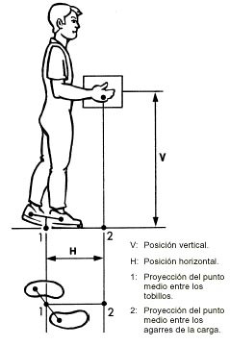
H = horizontal distance in centimeters between the position of hands at the beginning of the lifting movement and the midpoint on an imaginary line connecting both ankles V = Vertical distance in centimeters from hands in relation to the ground at the beginning of the lifting movement
D = Vertical distance traveled from the beginning to the end of the lifting movement A = Rotation in degrees during load transportation
FFL = Frequency Factor HF = Handle Factor Each of the coefficients is established from the value of each variable found in the specific task (Figure 1): horizontal distance (H), vertical distance (V), vertical distance traveled by the load (D), angle of asymmetry (A), lifting frequency (F) and handle (H). Each factor can be calculated according to the equation previously shown [9].
Ergonomics In Design, Usability & Special Populations I (2022)
Figure 1. Graphical representation of variables H, V. (Source: NIOSH, 1994)
Once the RWL is calculated for a given load lifting task, it is compared with the actual weight of the lifted load. This relationship provides the Lifting Index (LI), which determines if an activity presents risk of musculoskeletal injury and also quantifies this risk where : LI = LW / RWL
LW = Load weight RWL = Recommended Weight Limit
LI less than 1.0 > safe condition - low risk of injury.
LI between 1.0 and 2.0 > unsafe condition - moderate risk of injury.
LI above 2.0 > unsafe condition - high risk of injury.
RULA Method The RULA (Rapid Upper Limb Assessment) method was developed to assess people exposed to postures that contribute to musculoskeletal disorders in the upper limbs. It uses observations adopted by upper limbs such as neck, back and arms, forearms and wrists. This method evaluates the posture and movements associated with sedentary tasks such as working with a computer (Mcatamney and Corlett, 1993). The main applications of the RULA method are:
To evaluate musculoskeletal risks;
To compare musculoskeletal effort between current and modified workplace design;
To advise workers about musculoskeletal risks provided by different working postures.
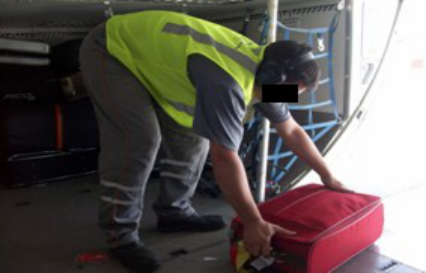
When handling a heavy load or doing it incorrectly, mechanical moments are triggered in the spine area, mainly at the region of union of the L5/S1 vertebral segments, compression, torsion and shear forces, and it is considered that the compression of this disk is the main risk of low-back pain. Figure 2 shows an example of manual load lifting that provides overload in the L5/S1 region.
Ergonomics In Design, Usability & Special Populations I (2022)
Figure 2. Manual load lifting - overload in the L5/S1 region. (Source: Researcher, 2014) Procedures
A study was conducted to analyze the manual load lifting during baggage loading / unloading activities in the Airbus A-319 airplane cargo hold, verifying through the application of the NIOSH equation, aspects such as frequency of activities, horizontal/vertical displacement and asymmetries while performing these activities. Two cases involving luggage loading and unloading activities were observed. Data collection was performed with a ramp operator during the period in which the airplane was on the ground at the airport. Filming and photos of activities and workplace were made during the boarding and disembarkation of passengers, at which loading and unloading of luggage is performed at the airplane cargo hold. The data allowed determining the Recommended Weight Limit (RWL), Lifting Index (LI) and analyze the posture of operators through the RULA method during baggage handling and if they offer some biomechanical risk for developing musculoskeletal disorders in upper limbs.
Case Study - Aspects observed It was found that the working day was 8 hours, with a break of 1 hour for meal. The workplace showed a cart with the luggage, positioned 60 cm above the ground at the entrance of the airplane cargo hold for the loading / unloading activities. The operator worked on foot all the time. Each bag weighted approximately 15 kg. It was also observed that there are no accessories for mechanized lifting of bags (conveyor belts). The lifting method was fully manual. Two activities were analyzed in the workplace studied.
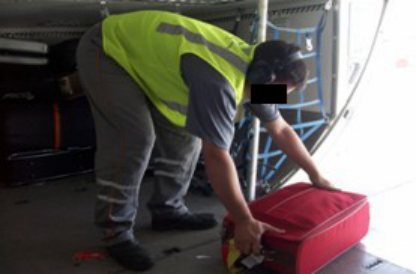
Activity 1 (luggage loading) Activity 1 consisted of picking up the luggage from the cart and putting them into the airplane cargo hold (Figure 3). The operator performed 8 lifts per minute and moved the trunk at an angle of 90°. The distance from him to the work plan was 30cm. The luggage was displaced 60 cm vertically between the soil and the amount of luggage.
Figure 3. Operator picking up the luggage from the ground at the entrance of the airplane cargo hold and placing it at the bottom of the compartment. (Source: Researcher, 2014)
Ergonomics In Design, Usability & Special Populations I (2022)
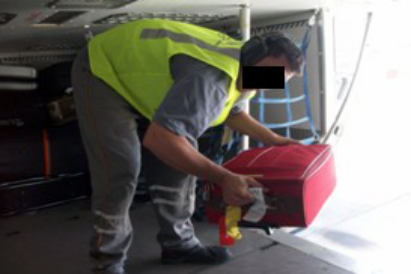
Activity 2 (luggage unloading) Activity 2 consisted of removing the baggage from the airplane cargo hold and putting them on the ground near the entrance to the airplane cargo hold to be put on the cart (Figure 4). The operator performed 8 lifts per minute and moved the trunk at an angle of 90°. The distance from him to the work plan was 30cm. The luggage was displaced 60 cm vertically between the soil and the amount of luggage.
Figure 4. Removing the bags and placing them at the entrance of the airplane cargo hold. (Source: Researcher, 2014)
RESULTS AND DISCUSSION
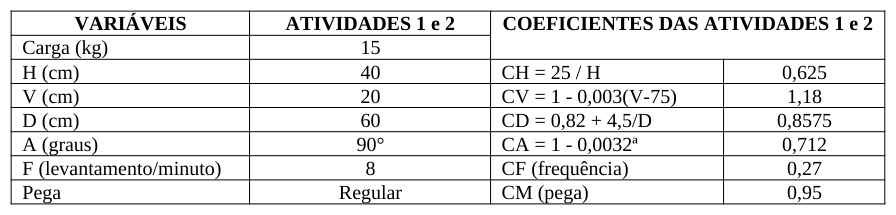
Table 1 shows the variables related to activities (1 and 2) and the values of coefficients of the NIOSH equation.
Table 1: Variables for activities 1 and 2 and coefficients (Source: Research data, 2014) VARIÁVEIS ATIVIDADES 1 e 2 COEFICIENTES DAS ATIVIDADES 1 e 2 Carga (kg) 15 H (cm) 40 CH = 25 / H 0,625 V (cm) 20 CV = 1 - 0,003(V-75) 1,18 D (cm) 60 CD = 0,82 + 4,5/D 0,8575 A (graus) 90° CA = 1 - 0,0032ª 0,712 F (levantamento/minuto) 8 CF (frequência) 0,27 Pega Regular CM (pega) 0,95
From the reference values, the Recommended Weight Limit (RWL) was determined by the product of seven variables described in the equation below: RWL = 23 x [25/H] x [1 - 0.003(V-75)] x [0.82 + (4.5/D)] x [1 - (0.0032 x A)] x FFL x FP
Applying the NIOSH equation with coefficients of table 1, RWL was obtained for activities 1 and 2: Where:
RWL = 23 x [25/40] x [1 – 0.003 x (20 - 75)] x [0.82 + (4.5/60)] x [1 - (0.0032 x 90)] x 0.27 x 0.95 RWL = 2.73
With RWL of activities 1 and 2, it was possible to obtain the Lifting Index (LI) with its respective risk classification for the activities analyzed: Where:
LI = Load Weight ( kg ) / RWL / LI = 15 / 2.73 / LI = 5.49 Ergonomics In Design, Usability & Special Populations I (2022)
Risk Classification using the NIOSH Lifting Index (LI):
LI < 1 Low Risk
1 < LI < 2 Moderate Risk
LI > 2 High Risk
According to the risk classification using the NIOSH Lifting Index, it was possible to identify the degree of risk of activities 1 and 2 and rank them high risk, because the LI was higher than two. In this context, this type of activity is considered unacceptable from the ergonomic standpoint, and its redesigning is required. In order to evaluate the biomechanical risk in manual load lifting activities in ramp operators, the RULA spreadsheet was used, which assessed the level of exposure to risk factors and whether or not there was a need for research and change the work activities analyzed. Table 2 shows the application of the RULA spreadsheet for activities 1 and 2 with the following partial scores of tables A, B and C and the final score.
Table 2: Scores of the RULA spreadsheet for activities 1 and 2 (Source: Research data, 2014)
Table available in the original PDF paper.
POSTURAS ESCORES ESCORE FINAL Tabela A 3
Tabela B 8 Tabela C 7 7
(necessidade de investigações e mudanças imediatas)
According to RULA spreadsheet scores, the analyzed activities were classified in situations of risk level 4, obtaining final score 7 as a result, which means that there is need for investigation and immediate changes in the workplace analyzed (airplane cargo hold) and its respective luggage loading and unloading activities.
CONCLUSION
In the loading and unloading activities in the airplane cargo hold, the operator works most of the time standing and bent forward forming an angle of approximately 90° between trunk and lower limbs (the maximum height inside the airplane cargo hold is 1.24m), performing flexion, rotation and lateral bending movements of the spine, in addition to elevation and abduction movements of the upper limbs and flexion of hip and knees. Short-duration repetitive or occasional movements (lifting, lowering, pushing or pulling) and long-duration movements (maintaining posture) while handling or waiting for a load to be moved from the cart to the airplane cargo hold. These biomechanical factors observed and analyzed using NIOSH and RULA methods allowed generating values that indicated that the loading and unloading activities are of high biomechanical risk both in relation to the manual load lifting activity and to the postures used for baggage management, which may cause health problems to ramp operators. Thus, the redesigning of the activities analyzed is recommended, including factors such as rotation of activities.
REFERENCES
Antony, N.T., Keir, P. J. (2010), “Effects of posture, movement and hand load on shoulder muscle activity”, JOURNAL OF ELECTROMYOGRAPHY AND KINESIOLOGY. Volume 20. No. 2. pp. 191-198. Dell, G. (1998), “Airline Baggage Handler Back Injuries: A Survey of Baggage Handler Opinion on Causes and Prevention”,
SAFETY SCIENCE MONITOR. Volume 2. No. 2. pp. 1-12. Dempsey, P.G., Mathiassen, S.E. (2006), “On the evolution of task-based analysis of manual materials handling, and its applicability in contemporary ergonomics”, APPLIED ERGONOMICS. Volume 37. No. 1. pp. 33-43. Vaz Junior, C.A. (2012), “The manual transport of load and the commercial aviation in Brazil”, WORK. Volume 41. pp. 597-
604. Korkmaz, S.V., Hoyle, J.A., Knapik, G.G., Splittstoesser, R.E., Yang, G., Trippany, D.R., Lahoti, P., Sommerich, C.M., Lavender, S.A., Marras, W.S. (2006). “Baggage handling in an airplane cargo hold: An ergonomic intervention study”. Ergonomics In Design, Usability & Special Populations I (2022)
INTERNATIONAL JOURNAL OF INDUSTRIAL ERGONOMICS. Volume 36. No. 4. pp. 301-312. Kuiper, J.I., Burdorf, A., Verbeek, J.H., Frings-Dresen, M.H., Van Der Beek, A.J., Viikari-Juntura, E.R. (1999), “Epidemiologic evidence on manual materials handling as a risk factor for back disorders: a systematic review”, INTERNATIONAL JOURNAL OF INDUSTRIAL ERGONOMICS. Volume 24. No. 4. pp. 389-404. Mcatamney,L., Corlett, E.N. (1993), “RULA: a survey method for the investigation of work-related upper limb disorders”.
APPLIED ERGONOMICS. Volume 24. No. 2. pp. 91-99. Mcfadden, K.L., Towell, E.R. (1999), “Aviation human factors: a framework for the new millennium”. JOURNAL OF AIR TRANSPORT MANAGEMENT. Volume 5. No. 4. pp. 177-184. National Institute for Occupational Safety and Health (NIOSH) (1994), “Applications manual for the revised NIOSH lifting
equation”. U.S. Dept. of Health and Human Services (NIOSH), Public health Service, Cincinnati, OH. Splittstoesser, R.E., Yang, G., Knapik, G.G., Trippany, D.R., Hoyle, J.A., Lahoti, P., Korkmaz, S.V., Sommerich, C.M., Lavender, S.A., Marras, W.S. (2007), “Spinal loading during manual materials handling in a kneeling posture”, JOURNAL OF ELECTROMYOGRAPHY AND KINESIOLOGY. Volume 17. No. 1. pp. 25-34. Tapley, S., Riley, D. (2005), “Baggage handling in narrow-bodied aircraft: Identification and assessment of musculoskeletal
injury risk factors”. Health and Safety Executive.
Ergonomics In Design, Usability & Special Populations I (2022)
LISTED IN THE AHFE DIGITAL BOOKSTORE CATALOGUE
Explore the complete digital volume
Advances in Ergonomics In Design, Usability & Special Populations: Part I
Read this individual research paper free through the original publisher, or explore the full digital proceedings book.
ISBN 978-1-4951-2106-7
Explore this ISBN in the AHFE Bookstore ↗Listed in the July 2026 bookstore catalogue; search by ISBN to confirm current availability · Digital book purchase optional