Atsushi Nishino, Masatomi Suzuki, Yume Inokuchi, Satoshi Hashimoto (2019). A Study on BEMS Based on Behavioral Economics for Small and Medium-Sized Buildings. In: Advances in The Human Side of Service Engineering. AHFE Open Access, vol. 8. https://doi.org/10.54941/ahfe100275
The authors have researched and developed Building Energy Management Systems (BEMS) to promote energy-savings in small and medium-sized office buildings. In order to accelerate the installation of BEMS into these buildings, it is important to develop BEMS which meets the following two requirements;1) To achieve the system configuration through the ease of installation.2) To have functions of inducing energy-saving behaviors of people in the office.For the purpose of developing practical BEMS, it is essential to examine the above from a viewpoint of the human side. In this paper, a concept of the system developed by the authors is briefly introduced, and followed by the discussion on users' energy-saving behaviors induced by the information providing method. First, the outline and features of the system are introduced. Next, the research on the information providing method for inducing energy-saving behaviors is explained. Finally, based on these researches, we propose a design policy for the information providing method to induce energy-saving behaviors. It is to provide information that increases the motivation before actions are taken and to reduce the occurrences of dissatisfaction after taking such actions. Currently, the effects of the system are under validation regarding whether it maintains and induces energy-saving behaviors.
In recent years, global climate changes caused by global warming have become a serious issue. Carbon dioxide (CO2) emissions produced by the consumption of fossil fuels have been considered as one of the causes of global warming. It is clear that developing energy-saving systems is essential for preventing global warming. From such a background, many energy-saving systems are proposed and installed into buildings (Hashimoto et al., 2008). However, many small and medium-sized buildings have failed to make progress in saving energy (Ministry of Economy, Trade and Industry, 2013). One factor behind the failure is that these buildings, different from larger buildings, are not subjected to stricter legal regulations and lack operators with expertise. Operators of small and medium-sized buildings also fail to identify the sources of energy loss or promptly devise improvements. These actions are difficult to be taken for such buildings.
The authors have researched and developed Building Energy Management Systems (BEMS) to promote energy- savings in small and medium-sized office buildings (Nishino and Hashimoto, 2013, Suzuki et al., 2013). Figure 1 shows a positioning of new concept of BEMS. In order to accelerate the installation of BEMS into these buildings, it is important to develop BEMS which meets the following two requirements;
1) To achieve the system configuration through the ease of installation 2) To have functions of inducing energy-saving behaviors of people in the office For the purpose of developing practical BEMS, it is essential to examine the above from a viewpoint of human side. In this paper, concept of the system developed by the authors is briefly introduced, and followed by the discussion on users' energy-saving behaviors induced by the information providing method.
Easiness of BEMS:Building Energy Management System installation
Construction-free is required
Easy construction is accepted Regulatory compliance (Act on the Rational Use of Energy)
Any construction
is accepted Conventional
Short-term payback
Low cost Medium-term payback period period is essential (2-10years) is accepted
Figure 1. Positioning of new concept of BEMS
Figure available in the original PDF paper.
BEMS FOR SMALL AND MEDIUM-SIZED BUILDINGS Outline and Features of Proposed BEMS
We have proposed a concept of new BEMS (proposed BEMS). That is “to visualize energy losses in real time by only attaching sensor terminals to ceilings” and “to propose countermeasures to promote energy-savings”. Figure 2 shows an overview of the system. Figure 3 illustrates its concept. The outline and features of the system are below;
This system is composed of ultra-small sensor terminals and visualization application.
The sensor terminal is easy to install by simply attaching it to the ceiling since a tiny photovoltaic panel is integrated with the wireless sensor.
The application notifies where the energy loss occurred and how to save energy in real time, which were unclear in conventional BEMS.
<Client's office>
<Cloud server>
Automatic controller air conditioner Tablet terminal
【Energy-saving Measures】 Applications ・Mitigation of air-conditioning ・Analysis
for unoccupied area ・Control of ventilation rate ・Opening and closing of windows ・Improvement of thermal insula- ・Automatic control
Wi-Fi cordless handset
tion performance
Visualization Wi-Fi LTE or 3G
M2M Cloud
Infrared array sensor specified low power radio(920MHz band)
Concentrator
Sensor data
LTE or 3G
DB Control command data Data storage
Measurement and processing
Data collection and data transfer 【Technology 1: Smart Sensor 】 ・Powered by PV and with wireless capability, no wiring is needed ・The distributed processing that enables real-time processing
【Technology 2: Smart Applications】 ・Multiple apps are operated by a single type sensor ・Visualization that induce energy-saving behavior
Figure 2. System configuration of proposed BEMS
Figure available in the original PDF paper.
Figure 3. Concept of proposed BEMS
Figure available in the original PDF paper.
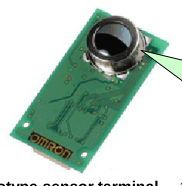
16x16 Infrared array sensor element Prototype sensor terminal
Figure 4. Prototype of infrared sensor array
Visualization Application of Proposed BEMS
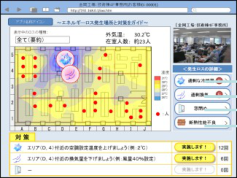
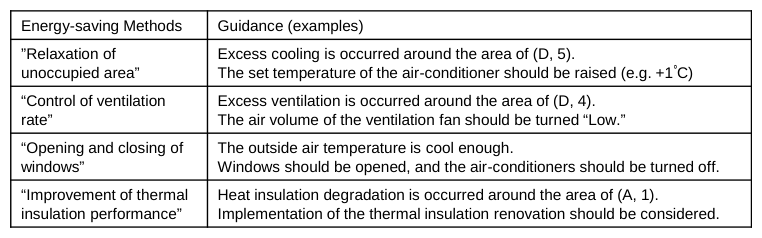
Figure 5 shows an overview of the visualization application. It notifies where the energy loss occurred and how to save energy in real time, which the information was unclear in conventional BEMS. It consists of a summary report and four kinds of detailed reports to inform the area where the energy loss occurred. The summary report shows the indoor temperature distribution and position of the occupants. As for areas where the energy loss has occurred, it superimposed one or two icons above the locations. Furthermore, in order to induce energy-saving behaviors, guidance shown in Table 1 is presented in the lower column. Finally, the four kinds of detailed reports show the following information.
- Area where excess cooling or warming occurred and guidance on how to improve it. - Area where excess ventilation occurred and guidance on how to improve it. - Guidance for open-window recommendation with information of outdoor and indoor temperature displayed. - Area where heat insulation degradation occurred and guidance on how to improve it.
Visualization
<Detailed Reports> Contents <Summary Report > Application configuration ■”Mitigation of air-conditioning for unoccupied area” 【icons / indicators】 The location of the energy loss
The positions of
Show the area where excess cooling or warming occurred, and the guidance how to improve it. ■“Control of ventilation rate”
occupants The temperature distribution
Show the area where excess ventilation occurred, and the guidance how to improve it.
■“Opening and closing of windows”
Contents ・The temperature distribution and
Show the guidance to recommend the open window while showing outdoor and indoor temperature.
the positions of occupants ・The location of the energy loss
■“Improvement of thermal insulation performance”
(Icons are superimposed) ・The energy-saving guidance (presented in the lower column)
Show the area where heat insulation degradation occurred, and the guidance how to improve it.
… Control the air conditioners on a regular basis Automatic control according to the guidance displayed on the summary report.
Figure 5. Overview of visualization applicationTable 1. Examples of the guidance for inducing energy-saving behaviors Energy-saving Methods Guidance (examples)
INFORMATION PROVIDING METHOD TO INDUCE ENERGY-SAVING BEHAVIORS For the purpose of developing practical BEMS, it is essential to examine the above from a viewpoint of human side. In this section, in order to clarify insufficiencies of conventional BEMS, two researches on the information providing method for inducing energy-saving behaviors are introduced. One is the interviews regarding the proposed BEMS. The other is a survey on recent studies of information providing method based on behavioral economics. The summary of these researches is below.
Summary of Interviews Regarding Proposed BEMS The interviews on the summary report and detailed reports shown in Figure 5 were performed to the visitors at the exhibition to introduce products such as BEMS. It was asked to the visitors whether the proposed reports can induce energy-saving behaviors more than conventional BEMS. The summary of the interviews is presented in Figure 6. The main comments are below;
In conventional BEMS, actions for saving energy were barely initiated since there was no information regarding where the lost occurred and how to reduce further loss. On the contrary, it was improved by the proposed reports.
Users tended not to initiate actions actively since there were no reward gimmicks for persons who saved energy. In this issue, the proposed report also did not improve it. New approach to improve motivation is required.
These comments suggest the necessity for the introduction of behavioral economics.
Question: ”Do you think that proposed BEMS induces your energy-saving behaviors more than conventional BEMS?”
・Inconspicuous the guidance. (7)
・Easy to understand the information both
・Lack the reward gimmicks for
of the room’s situation and energy-saving measures at a glance. (37)
persons who saved energy. (5)
・Easy to agree with the energy-saving guidance
・Not voluntarily to check the Disagree
Agree
since the thermal contour map and position of the person of the entire room are provided.(12)
【32%】 【68%】
・Easy to induce energy-saving actions since the
reports at the places such as offices since occupants spend all their time on their main missions. (3)
icons are effectively superimposed on the spot of energy-losses. (8)
※( ): number of the comments
Figure 6. Result of interviews about required improvements on BEMS
Figure available in the original PDF paper.
Recent Studies on Information Providing Method based on Behavioral Economics Recently, in order to induce energy-saving behaviors, information providing method based on behavioral economics has been studied. Behavioral economics explores why people sometimes make irrational decisions, and why and how their behaviors do not follow the predictions of economic models. It is important how information is provided, how information is understood by the people, and how motivation of energy-saving action is improved. Summary of the recent studies is below.
In the demonstration test for household energy-savings in the U.S, their innovative combination of feedback and normative data can achieve low-cost energy savings of 1.2 to 2.5% (Alcott, 2009, Ayers et al., 2009). This approach provides households with monthly Home Energy Reports including; 1) Household level data on current and comparative historical energy consumption, 2) Semi-tailored energy saving tips, and 3) Information concerning the energy consumption patterns of other households similar to their own. The third component gives households the social or normative valuation basis for comparing and assessing their own energy consumption patterns. Households can evaluate whether their consumption was abnormally high or low and spontaneously save energy as necessary.
In Japan, the energy-saving system for office is introduced, which allows office workers to choose the control target from air conditioning equipment or lighting equipment (Dazai et al., 2012). The system releases control for air- conditioning via occupants' actions to turn off the lighting. As the result, the occupants are able to obtain more comfortable environment by turning off the light. It means that gives non-economic incentives such as comfortable environment. In other words, it is suggested that occupants become more cooperative for the energy-savings to avoid uncomfortable environment.
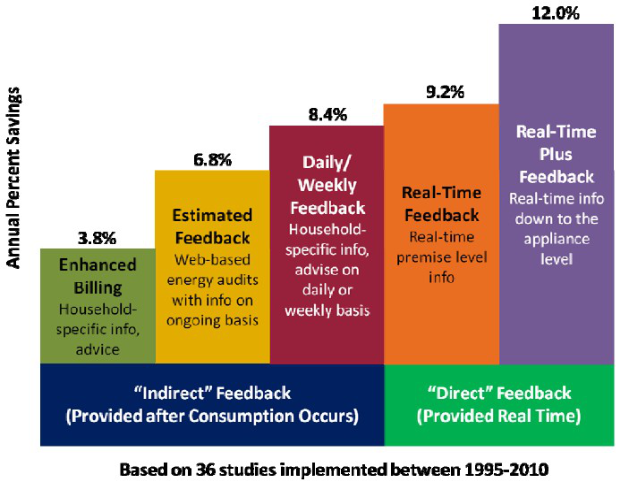
Effective information for household energy-savings is reviewed by ACEEE (Karen et al., 2010). This report summarizes a more useful feedback method. Figure 7 shows the summary. It is suggested that Real-time and Real- time Plus Feedback become an increasingly viable and cost–effective approach.
Figure 7. Average Household Electricity Savings (4-12%) by Feedback Type (Karen et al., 2010) ・Standard Billing – An energy bill that displays the monthly kilowatt-hour(kWh)of consumption and the unit rate ($/kWh), the corresponding total cost and other billing charges, as well as the total amount due. This form of feedback generally lacks comparative statistics of any detailed information about the temporal aspects of consumption ・Enhanced Billing – Provides more detailed information about energy consumption patterns, and often includes comparative statistics –comparing the most current monthly electricity usage and expenditures together with historical consumption and/or a comparison to other households. ・Estimated Feedback – This approach uses statistical techniques to disaggregate the total energy usage based on a customer’s household type, appliance information, and billing data. The resulting feedback provides a detailed account of electricity use by major appliances and devices. These most commonly take the form of web-based “home energy audit” tools, offered by a utility to its customers. ・Daily/Weekly Feedback – These reports use averaged data and often include consumer self-read studies (in which individuals read their meter and record the energy usage themselves) as well as studies in which individuals are provided with daily or weekly consumption reports from the utility or research entity. ・Real-Time Feedback – In home energy display devices that provide real-time or near real-time energy consumption and energy cost data at the aggregate household level. ・Real-Time Plus – In home energy display devices that provide real-time or near real-time energy consumption and energy cost data disaggregated by appliance.
Moreover, the use of motivational elements such as goal setting, competitions, and commitments could be much more practical and effective when it comes to information providing method for small and medium-sized buildings. To summarize their researches, it is important to contain the following information; ・Real-time feedback concerning energy loss.
・Competitive elements concerning the energy consumption.
・Giving choices concerning the thermal environment.
As noted above, we propose a design policy for the information providing method.
Design Policy for the Information Providing Method Based on the above, we propose a design policy for the information providing method to induce energy-saving behaviors. It is to provide information that increases the motivation and reduces the occurrences of dissatisfaction. The contents are as follows;
(1) Notify where the loss occurred and how to save energy as soon as the loss occurred (Real-time visualization) (2) Display the amount of the loss in comparison with the office where a behavior pattern resembles (Comparison with the similar offices) (3) Display the temperature distribution of the area for individuals to choose a preferable temperature zone (Giving
choices)
A model of inducing energy-saving behaviors by using this design policy is shown in Figure 8. It is explained below: The vertical axis shows the energy-saving effect induced by the information providing method, and the horizontal axis shows the degree of the users’ motivation induced by it. The conventional BEMS is positioned at the lower left as “Standard BEMS”, and the system at the upper right is valued as a more effective system to induce energy-saving behaviors. A right up solid line arrow means the increase of the energy-saving behaviors, and a left down dashed line arrow means the decrease of that behaviors.
The information (1) which is mentioned above corresponds to the first right up solid line arrow. By being informed what action can save energy at present, it becomes possible for the users with no expertise to save energy, which the information was not provided by the conventional BEMS. The contents of it are shown in Figure 5 and Table 1. The necessity and the effectiveness of that information are suggested by the summary of interviews regarding proposed BEMS and the report by ACEEE mentioned above. The “Standard BEMS” is improved as the “Effective BEMS” by adding this information.
The information (2) which is mentioned above corresponds to the second right up solid line arrow. The aim is to utilize the competitive psychology by showing a rival that can be compared with easily. Specifically, the office where a presence rate of occupants is nearly the same can be chosen as a rival. It is suggested by the result of the demonstration test mentioned above taken place in the U.S. that competition is one of the means for motivating behavioral changes. By adding this information, the “Effective BEMS” is improved as the “More effective BEMS”.
The information (3) which is mentioned above corresponds to the curved arrow at the upper right side. The aim is to defuse users’ feeling of dissatisfaction and prevent such users from becoming less cooperative so that their energy- saving behaviors are not decreased. The effectiveness of this information is suggested by the study in Japan mentioned above.
Figure 8. Model of inducing energy-saving behaviors
Figure available in the original PDF paper.
By providing this information successfully, occupants’ energy-saving behaviors are induced as shown in Figure 9. The information providing method has the role as the trigger for energy-saving. First, the occupants confirm this information. Then, they notice the loss and moves to the notified area. Subsequently, they take actions to minimize the loss according to the guidance informed by the system. At this point, it is important to take means for catching occupants' eyes in order to provide the trigger successfully. One of the means is to locate the information monitor near the place where occupants are likely to be gathered (e.g. near the copy machine).
Notice the loss Move to the notified area Minimize the loss
Behavior of an occupant
Provide a trigger 【Means of catching occupants' eyes 】
ロスの程度(室平均値):4.09 % ロスの程度(室平均値):4.09 % ・The monitor is set near the place where 警告 (20%) 警告 (20%) 注意 (10%) 注意 (10%) ロスなし ロスなし The information providing method occupants are likely to be gathered. (e.g. near the copy machine)
Figure 9. Action flow of an occupant required to save energy
Figure available in the original PDF paper.
However, even if the information such as above is provided, there are some users who may not transform it to energy-saving behaviors. Generally, behaviors or actions are taken when their merits are greater than their demerits. However, such pattern is not always followed even when the merits are greater than the demerits. One of the reasons is considered that the merit is judged small because of the lack of the users’ interest. For instance, they may initiate energy-saving behaviors from their curiosity at initial stage, but that may decrease with time. The interest varies as a function of time. It is important to keep the interest in order to maintain the energy-saving behaviors. As the means of keeping the interest, some approaches are proposed as follows; changing information regularly, giving attractive rewards, and proposing incidental actions. Currently, the concrete methods about these approaches are under examination.
CONCLUSIONS
The concept of the Building Energy Management Systems system developed by the authors were introduced, and followed by the discussion on users' energy-saving behaviors induced by the information providing method. Based on the result of interviews regarding the proposed BEMS and the recent study applying behavioral economics, a design policy for the information providing method to induce energy-saving behaviors was proposed. It is to provide information that increases the motivation and reduces the occurrences of dissatisfaction. The contents are as follows;
Notify where the loss occurred and how to save energy as soon as the loss occurred (Real-time visualization)
Display the amount of the loss in comparison with the office where a behavior pattern resembles (Comparison with the similar offices)
Display the temperature distribution of the area for individuals to choose a preferable temperature zone (Giving choices) Currently, the effects of the system are under validation regarding whether it maintains and induces energy-saving behaviors.
ACKNOWLEDGMENT
This work is supported by New Energy and Industrial Technology Development Organization (NEDO) through Green Sensor Network System Project.
REFERENCES
Alcott, H. (2009), “Social Norms and Energy Conservation”, Massachusetts Institute of Technology Website: http://web.mit.edu/ceepr/www/publications/workingpapers/2009-014.pdf. Ayers, I., Raseman, S., Shih, A. (2009), “Evidence from Two Large Field Experiments that Peer Comparison Feedback can
Reduce Residential Energy Usage.” Working Paper 15386. Cambrige, MA: National Bureau of Economic Research Website: http://www.nber.org/papers/w15386. Dazai, R., Kaseda, C., Mizutani, K., Imanishi, T. (2012), “Electricity Saving Measures in Office Building keeping Indoor Thermal Environment”, Technical papers of annual meeting, the Society of Heating, Air-Conditioning and Sanitary Engineers of Japan 2012. pp.1267-1270 Hashimoto, S., Matsuda, T., Shinbayashi, H., Yoshida, H., Wang, F., Shiota, K. (2008), “An energy-saving method for air-
conditioning system by using weather forecast”, Proceedings of Conference: Air Conditioning and the Low Carbon Cooling Challenge, Windsor, UK. Honda, M., Tanaka, J. (2013), “The Development of the Environment Sensing Device”, IEEJ Journal Vol.133-4. pp210-213. Martinez, K. E., Donnelly, K. A., Laitner, J. A. (2010), “Advanced Metering Initiatives and Residential Feedback Programs: A meta-Review for Household Electricity-Saving Opportunities”, ACEEE Report Nmber E105. Ministry of Economy, Trade and Industry. (2013), “Sensors to Conserve Electricity!”, METI Journal 2013 July. p8. Nishino, A., Hashimoto, S. (2013), “Sensor Network and its Energy-saving Application for Air-conditioning System”, IEEJ
Journal Vol.133-4. pp206-209 Suzuki, M., Nishino, A., Nishimura, T., Hiei, T., Imamoto, H., Hashimoto, S. (2013), “Development of the energy-saving imformation system for small and medium-sized buildings”, Technical papers of annual meeting, the Society of Heating, Air-Conditioning and Sanitary Engineers of Japan 2013 Vol.9. pp85-88
LISTED IN THE AHFE DIGITAL BOOKSTORE CATALOGUE
Explore the complete digital volume
Advances in The Human Side of Service Engineering
Read this individual research paper free through the original publisher, or explore the full digital proceedings book.
ISBN 978-1-4951-2091-6
Explore this ISBN in the AHFE Bookstore ↗Listed in the July 2026 bookstore catalogue; search by ISBN to confirm current availability · Digital book purchase optional