Eylem Thron, Duncan Ki-Aries, Martin Freer, Huseyin Dogan, Shamal Faily (2026). A Human Factors-Cyber-Safety Framework for Risk and Requirements in Critical Infrastructure. In: Human Factors in Cybersecurity. AHFE Open Access, vol. 208, pp. 1–10. https://doi.org/10.54941/ahfe1007407
Cyber-attacks on critical infrastructure are increasing in scale and sophistication, yet cybersecurity practice remains dominated by technology-centric assessments that insufficiently represent human contributions to risk. In cyber-physical systems (CPS), non-malicious human actions -including slips, mistakes, workarounds, training gaps, and misaligned procedures- frequently create, amplify or fail to detect vulnerabilities.This paper presents an integrated socio-technical framework that combines Human Factors (HF) methods, safety analysis, and cybersecurity modelling within a Secure-by-Design approach. The framework models how human performance variability influences cyber vulnerability and safety outcomes, enabling structured, scenario-based risk assessment and the derivation of traceable engineering requirements. An illustrative application demonstrates how HF findings are translated into human error mechanisms, cyber effects, unsafe control actions, safety impacts, and prioritised Secure-by-Design controls. By operationalising HF methods as cybersecurity engineering tools, the approach reframes cybersecurity as a socio-technical reliability problem comparable to safety engineering.
Cybersecurity risk in critical infrastructure is increasingly shaped by how humans interact with complex cyber-physical systems. High levels of automation, tightly coupled safety-critical functions, and operational pressures mean that human actions often accelerate the transition from a cyber disturbance to a safety consequence. Slips, lapses, rule-based mistakes, workarounds, or misinterpretation of procedures - particularly under high workload, fatigue, or degraded system states - can create, expose, or amplify cyber vulnerabilities (Pollini, 2021; Khadka, & Ullah, 2025).
Human Factors (HF) research provides established methods for analysing task demands, cognitive workload, interface design and organisational pressures. However, structured pathways for translating HF outputs into cybersecurity engineering artefacts remain limited (Thron et al., 2024).
Cyber risk assessment typically assumes stable human performance, while safety analysis often treats human actions as simplified elements within control structures. As a result, socio-technical interactions that drive cyber risk escalation are under-represented in Secure-by-Design practice.
CONTRIBUTIONS This work addresses this gap by providing:
A modelling workflow that translates HF performance variability into cybersecurity and safety artefacts.
A structured mapping between Human Reliability Analysis (HRA) outputs and System-Theoretic Process Analysis (STPA) unsafe control actions.
Scenario-based modelling of performance degradation under cyber- degraded operational conditions.
Tool-supported implementation in the open-source platform Computer Aided Integration of Requirements and Information Security (CAIRIS) enabling traceable Secure-by-Design requirements (Faily, 2018).
The framework treats human performance as a dynamic system component rather than a background factor, enabling cybersecurity to be analysed as a socio-technical reliability problem.
BACKGROUND
Human performance in CPS emerges from interactions between operators, technology, tasks, and organisational context. Errors are system phenomena rather than solely individual failings.
HF distinguishes between:
Slips and lapses (execution failures)
Rule-based mistakes (misapplication of procedures)
Knowledge-based mistakes (errors in novel or complex situations) Performance Shaping Factors (PSFs) such as workload, time pressure, fatigue, situation awareness, usability, training, and organisational constraints influence performance variability. Under adverse PSFs, variability can become performance degradation, increasing the likelihood of error mechanisms.
During cybersecurity incidents, these PSFs can rapidly degrade human performance, increasing the likelihood that human actions introduce vulnerabilities, delay detection or weaken safety barriers.
Disciplinary Modelling Traditions and Gaps Cyber-physical systems are typically analysed using methods from distinct traditions: HF, safety, and cybersecurity.
Human Factors (HF) methods focus on understanding and shaping human performance. Examples include task analysis (Kirwan, 1994), cognitive work analysis (Vicente, 1999), and human reliability analysis
A Human Factors-Cyber-Safety Framework 3 (HRA) (Hollnagel, 1998), which quantify the likelihood of slips, lapses, rule-based mistakes, or knowledge-based errors under varying conditions. While these methods provide rich insights into operator behaviour, they rarely link directly to system-level hazards or cyber threats.
Safety methods aim to identify hazards and unsafe system behaviours. STPA and its security extension STPA-Sec analyse unsafe control actions and the causal pathways linking system behaviour to hazards or security breaches (Leveson, 2011), while Bow-Tie analysis provides a structured visual overview of threat pathways and barrier effectiveness (de Ruijter, & Guldenmund, 2016). Although these methods effectively map risks and controls, human contributions are often simplified or assumed to be stable (Hulme et al., 2022; Hollnagel, 2017).
Cybersecurity methods (e.g., attack trees, STRIDE (Howard & LeBlanc, 2003), PASTA (UcedaVelez & Morana, 2015), ISO/IEC 27005) focus primarily on technical vulnerabilities and assume relatively stable human behaviour rather than the socio-technical interactions that may amplify cybersecurity risk.
Because these approaches evolved from different disciplinary priorities, they are rarely integrated. Human error is not systematically represented in cybersecurity risk models, and HF findings rarely translate directly into engineering requirements. This separation constrains Secure-by-Design effectiveness in safety-critical systems.
Table 1 lists some of the analytical approaches in different disciplines together with their limitations when used alone and how this work integrates them to overcome their limitations.
Table 1: Different disciplines model parts of the socio-technical risk space.
Table available in the original PDF paper.
Discipline Focus Limitation When Used Alone
Contribution of This Work
Rarely linked to system hazards or cyber threats
HF / HRA Human performance variability
Connects HRA outputs to cyber vulnerabilities
Safety (STPA, Bow- Tie)
Hazards, control structures, barriers
Human performance often simplified
Integrates PSF-driven human error
Cybersecurity (STRIDE, ISO 27005)
Assumes normal human behaviour
Technical vulnerabilities and threats
Models degraded human performance states
PROPOSED HF-SECURITY-SAFETY MODELLING FRAMEWORK To address this gap, we propose a structured workflow that links HF modelling, cybersecurity analysis, and safety reasoning into a unified requirement derivation process. The workflow is applied through a structured sequence linking task analysis, PSF characterisation, HRA-based error identification, STPA mapping to unsafe control actions, and requirement derivation within CAIRIS.
Task and Cognitive Modelling Hierarchical Task Analysis (HTA) is used to define operator tasks, decompose operational goals, and identify task steps where cyber-relevant errors may occur (Stanton, 2006). Cognitive Task Analysis (CTA) captures operators’ mental processes, situation awareness demands, and decision-making under uncertainty, revealing the cognitive actions and workload associated with complex tasks (Knisely, Joyner & Vaughn-Cooke, 2021). Performance shaping factors (PSFs) are explicitly represented to model workload, fatigue, time pressure, automation reliance, usability constraints, training adequacy, and organisational pressures that shape performance variability and risk in human-system interactions (Knisely, Joyner & Vaughn-Cooke, 2021; Stanton, 2006).
Human Error Characterisation Human Reliability Analysis (HRA) is used qualitatively to characterise how changes in PSFs influence the relative likelihood of slips, rule-based mistakes, or knowledge-based errors. Rather than estimating numerical probabilities, the framework uses structured comparison across operational states (e.g., normal, cyber-degraded, prolonged degraded) to represent escalation in human error likelihood. This approach avoids reliance on precise probability values while preserving analytical rigour and traceability.
Linking to STPA and Cybersecurity Human error mechanisms are mapped onto unsafe control actions using System-Theoretic Process Analysis (STPA), enabling analysis of how performance variability propagates through control structures to influence cyber system states and safety hazards (Leveson, 2011). STPA systematically models controllers, control actions, feedback loops, and causal scenarios so that inadequate or incorrect control actions - including those arising from human cognitive or procedural errors - can be linked to hazardous system states and potential losses, thus making risk pathways explicit for safety and cybersecurity integration.
The key distinction from standalone STPA-Sec is that unsafe control actions are not treated as static failure points; instead, they are explicitly linked to dynamically changing performance shaping factors. Thus, the framework extends STPA-Sec by:
1. Modelling how degraded human performance states emerge. 2. Explicitly linking PSFs to error mechanisms. 3. Using operational scenarios to prioritise derived requirements.
Unsafe control actions are therefore analysed not only structurally but also behaviourally. In this approach, HRA-identified error mechanisms are treated as causal contributors to unsafe control actions and are explicitly represented within CAIRIS to maintain traceability from human performance conditions to derived security requirements.
A Human Factors-Cyber-Safety Framework 5 Tool-Supported Implementation (CAIRIS)
The workflow is implemented in CAIRIS, which supports representation of:
Tasks and cognitive demands
Performance shaping factors
Vulnerabilities and threats
Hazards and unsafe control actions
Traceable Secure-by-Design requirements This implementation allows HF-informed requirements to be embedded early in system design, rather than treated as retrospective mitigations. From these relationships, Secure-by-Design requirements are derived, including interface improvements, procedural controls, organisational safeguards, and training or decision-support measures. The framework does not depend on visual CAIRIS artefacts for validity. However, CAIRIS enables structured traceability across these elements, improving repeatability and auditability of the modelling process.
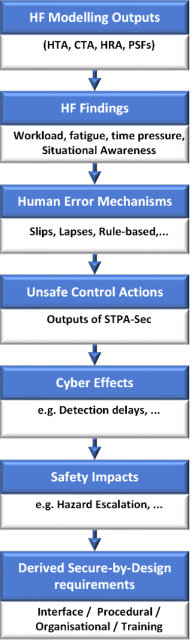
Figure 1 illustrates the HF–Security–Safety Requirement Flow proposed in this work. Human Factors modelling outputs are translated into human error mechanisms, which shape unsafe control actions, influence cyber system states, and lead to safety impacts from which explicit design requirements are generated.
Figure 1: HF–security–safety requirement flow.
Table 2 illustrates how cyber-degraded conditions shift human performance states, altering key Performance Shaping Factors such as workload, time pressure, fatigue, and situational awareness.
Table 2: Human performance state shift under cyber-degraded operations.
Table available in the original PDF paper.
Cyber-Degraded Operations
Normal Operations Human Performance State Shift Moderate Workload High
Low Time pressure High Controlled (Low) Fatigue High (Extended shifts/ops)
High Situational awareness Reduced (Low) Routine (Normal) Interface use Degraded (Emergency Mode)
Predictable Automation behaviour Degraded (Unexpected) Low Human error probability High
Rare (Low) Unsafe control actions More Frequent (Moderate-high) Limited (Normal) Cyber vulnerability exposure Expanded (High risk)
Maintained (Normal) Safety barrier integrity Degraded (High risk) These changes increase the likelihood of human error and unsafe control actions, exposing systems to cyber vulnerabilities and weakening safety barriers. This pathway from cyber disturbance to safety consequence underpins the Human Error-Security-Safety Requirement Flow in Table 3, showing how HF outputs are translated into error mechanisms, cyber effects, safety impacts and traceable Secure-by-Design requirements.
High workload + alarm overload increases misinterpretation risk
Knowledge- based mistake in alarm prioritisation
The system shall prioritise and visually differentiate security- critical alerts from operational alarms.
Rule-based mistake
Misconfiguration of access control
Procedural Control
Safety barrier weakened
Fatigue increases probability of incorrect configuration actions
Configuration changes shall require confirmation prompts and automated validation checks during degraded operations.
(Continued)
Table 3: Continued.
Table available in the original PDF paper.
Error Mechanism
Cyber Effect Safety Impact
Example Requirement
HF Finding (from Modelling)
Derived Requirement Type
Omission error
Incident response delay
Time pressure leads to skipped escalation steps
Process / Organisational inc. Training
Failure to mitigate escalating hazard
Incident response procedures shall include automated escalation triggers when alerts remain unresolved beyond threshold time.
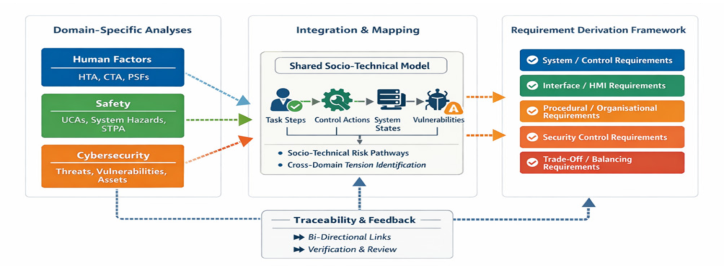
Figure 2 shows the workflow and underlying mechanics of the system and the various components / elements (i.e., in Table 3) demonstrating the operational integration of HF, safety and security analysis to generate requirement / outcomes.
Figure 2: Integrated secure-by-design workflow.
Together, the tables and the figure demonstrate how transient human performance degradation is translated into structured risk artefacts and actionable design controls. This mechanism is illustrated with a scenario, as below.
ILLUSTRATIVE APPLICATION OF THE HF-SECURITY-SAFETY FRAMEWORK Scenario Context
An operator supervising a safety-critical CPS receives multiple simultaneous alarms during a suspected cyber intrusion. Operational and security alerts share a common display format. The operator is working under elevated workload and time pressure and must determine whether the alert pattern
represents system fault or malicious activity. Table 4 shows how operational states alter PSFs in this scenario.
Table 4: Operational states vs PSFs.
Table available in the original PDF paper.
Operational State Workload Alarm Density Time Pressure Cognitive Effect Normal Moderate Manageable Adequate Stable interpretation
Cyber-degraded High Dense High Diagnostic strain High + fatigue
Sustained density
Prolonged degraded
Persistent Uncertainty, reduced verification
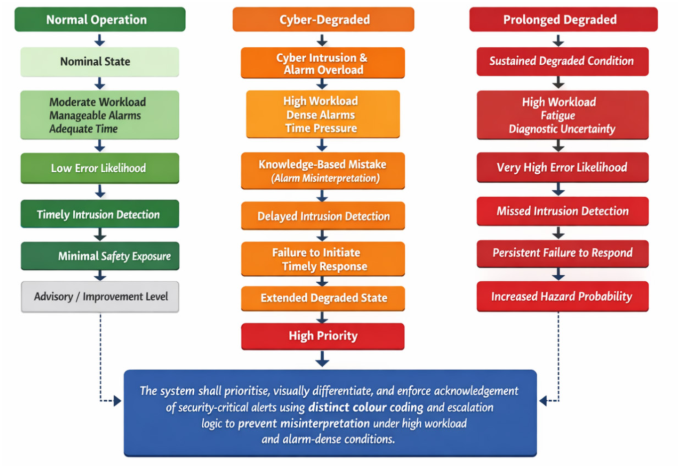
Propagation to Error and Risk Under cyber-degraded conditions, elevated workload and alarm density increase cognitive demand. This creates a higher likelihood of a knowledge- based mistake in alarm interpretation. Within the control structure, this manifests as failure to initiate timely incident response an unsafe control action. The system remains in a degraded state, increasing exposure to safety hazards.
Figure 3 below illustrates how the scenario propagates across normal, cyber-degraded and prolonged degraded states, showing how performance shaping factors influence error likelihood and ultimately generate the derived Secure-by-Design requirement.
Figure 3: Escalation of performance shaping factors across normal, cyber-degraded, and prolonged degraded states and their propagation through human error mechanisms, unsafe control actions, cyber effects and safety exposure, generating the derived Secure-by-Design requirement.
A Human Factors-Cyber-Safety Framework 9 Derived Secure-by-Design Requirement
The system shall prioritise, visually differentiate, and enforce acknowledgement of security-critical alerts using distinct colour coding and escalation logic to prevent misinterpretation under high workload and alarm-dense conditions.
DISCUSSION
The framework explicitly maps the dynamic behavioural pathways connecting cyber disturbances to safety consequences. Unlike standalone STPA-Sec analyses, which focus mainly on control structure adequacy, this approach captures how performance shaping factors (PSFs) - such as workload, fatigue, and time pressure - degrade over time and influence unsafe control actions. By linking PSFs to human error mechanisms, cyber effects, and operational hazards, the framework provides a structured basis for deriving and prioritising Secure-by-Design controls under degraded conditions, rather than assuming stable human performance.
The implementation within CAIRIS strengthens traceability by representing tasks, PSFs, vulnerabilities, hazards, and requirements within a unified socio- technical model. This improves transparency, repeatability, and scalability of the analysis. The use of CAIRIS to operationalise similar socio-technical modelling approaches has been demonstrated in prior work (e.g., Altaf et al., 2024), and its application here provides structured support for integrating HF, cybersecurity, and safety artefacts within a single traceable environment.
Overall, the approach reframes cybersecurity as a socio-technical reliability problem and produces structured engineering outputs rather than advisory observations.
This work provides a proof-of-concept demonstration through an illustrative scenario. Future research will focus on empirical validation in operational environments to assess scalability, usability and the impact of the framework on the quality and effectiveness of derived requirements.
CONCLUSION
Human actions are a central, and often overlooked, source of cyber risk in critical infrastructure. The proposed HF-Security-Safety framework models how human error propagates into cyber vulnerabilities and safety consequences, generates traceable Secure-by-Design requirements, and supports scenario-based resilience planning.
The derived requirements are Secure-by-Design because they are based on early modelling of human–system interaction rather than post-incident fixes. The framework enables scenario-based assessment by modelling how cyber incidents change workload, fatigue, and situational awareness, and therefore human error likelihood. This supports proactive resilience planning by anticipating socio-technical risk conditions rather than reacting to known failures. While demonstrated through an illustrative scenario, the framework establishes a foundation for future empirical validation in real-world safety- critical systems.
REFERENCES
Altaf, A., Faily, S., Dogan, H., Thron, E. and Mylonas, A. (2021) ‘Integrated design framework for facilitating systems-theoretic process analysis’, in European Symposium on Research in Computer Security, Cham: Springer International Publishing, pp. 58–73. de Ruijter, A. and Guldenmund, F., 2016. The bowtie method: A review. Safety
science, 88, pp. 211–218. Faily, S. (2018) Designing usable and secure software with IRIS and CAIRIS. New York, NY: Springer International Publishing. Hollnagel, E. (1998) Cognitive reliability and error analysis method (CREAM).
Elsevier. Hollnagel, E. (2017) Barriers and safety management. CRC Press. Howard, M. and LeBlanc, D. (2003) Writing secure code. Microsoft Press. Hulme, S., et al. (2022) ‘Reliability of STPA in complex systems hazard analysis’, Safety Science, 150, 105699. ISO/IEC 27005:2022 (2022) Information security risk management. ISO. Khadka, K. and Ullah, A.B., 2025. Human factors in cybersecurity: an interdisciplinary
review and framework proposal: K. Khadka, AB Ullah. International Journal of Information Security, 24(3), p. 119. Kirwan, B. (1994) A guide to practical human reliability assessment. Taylor & Francis. Knisely, B.M., Joyner, J.S. and Vaughn-Cooke, M. (2021) ‘Cognitive task analysis
and workload classification’, MethodsX, 8, p. 101235. Available at: https://doi. org/10.1016/j.mex.2021.101235 (Accessed: [11/01/2026]). Leveson, N. (2011) Engineering a safer world: Systems thinking applied to safety.
Cambridge, MA: MIT Press. Pan, X. and Wu, Z. (2020) ‘Performance shaping factors in the human error probability modification of human reliability analysis’, International Journal of Occupational Safety and Ergonomics, 26(3), pp. 538–550. Available at: https:// doi.org/10.1080/10803548.2018.1498655 (Accessed: [11/01/2026]). Pollini, A., Callari, T.C., Tedeschi, A., Ruscio, D., Save, L., Chiarugi, F. and Guerri, D.,
2022. Leveraging human factors in cybersecurity: an integrated methodological approach. Cognition, Technology & Work, 24(2), pp. 371–390. Stanton, N.A. (2006) ‘Hierarchical task analysis: developments, applications, and extensions’, Applied Ergonomics, 37(1), pp. 55–79. Available at: https://doi. org/10.1016/j.apergo.2005.06.003 (Accessed: [18/01/2026]). Thron, E., Faily, S., Dogan, H. and Freer, M. (2024) ‘Human factors and cyber-
security risks on the railway – the critical role played by signalling operations’, Information & Computer Security, 32(2), pp. 236–263. UcedaVelez, T. and Morana, M.M., 2015. Risk Centric Threat Modeling: process for attack simulation and threat analysis. John Wiley & Sons. Vicente, K.J. (1999) Cognitive work analysis: Toward safe, productive, and healthy
computer-based work. CRC Press.
LISTED IN THE AHFE DIGITAL BOOKSTORE CATALOGUE
Explore the complete digital volume
Human Factors in Cybersecurity
Read this individual research paper free through the original publisher, or explore the full digital proceedings book.
ISBN 978-1-964867-84-7
Explore this ISBN in the AHFE Bookstore ↗Listed in the July 2026 bookstore catalogue; search by ISBN to confirm current availability · Digital book purchase optional