Wan-Chen Lee (2026). AI Narrative Co-creation in Interaction Design Education: A Thing-Perspective Pedagogical Framework with MacGuffin Creative Cards. In: Human Interaction and Emerging Technologies (IHIET-AI 2026): Artificial Intelligence and Future Applications. AHFE Open Access, vol. 201, pp. 536–547. https://doi.org/10.54941/ahfe1007207
The rapid integration of generative AI into interaction design education presents both opportunities and challenges for cultivating creativity, narrative competence, and speculative imagination. Traditional human-centered design pedagogies often limit students’ ability to critically reimagine emerging technologies from nonhuman perspectives. Grounded in Object-Oriented Ontology and Thing-Centered Design, this study explores how AI can function as a pedagogical collaborator in interaction design education through narrative co-creation from a Thing-Perspective. A MacGuffin Interactive Imagination Workshop was developed, integrating MacGuffin Creative Cards with ChatGPT across five stages: Recalling Evocative Objects, Card-Based Association, Co-Speculation and Narrative Construction, AI-Assisted Narrative Generation, and Thing-Perspective Writing. Qualitative data from design students and practitioners reveal five pedagogical strategies: Divergent–Convergent Creative Cycles, Effective Perspective-Shifting, MacGuffin-Driven Thing-Oriented Narrative Enrichment, Narrative Prototyping Concretization, and Structured Scaffolding for AI Co-Creation. The findings suggest that a Card-AI Integrated Framework can support Thing-Perspective learning and expand speculative interaction design practices, offering a practical pedagogical model for AI-enhanced design education in HCI contexts.
AI, IoT, and Challenges in Interaction Design Education As generative AI and Internet of Things (IoT) technologies increasingly shape everyday environments, interaction design education must address how designers engage with autonomous and intelligent artifacts. Smart objects now exhibit forms of agency, responsiveness, and contextual awareness that complicate conventional human-centered interaction models. Within Human-Computer Interaction (HCI), this shift raises pedagogical challenges, as traditional design curricula-largely focused on usability and user needs-often fail to prepare students to imagine interactions beyond direct human control.
AI Narrative Co-Creation in Interaction Design Education 537 Beyond Human-Centered Design: Toward a Thing Perspective
While human-centered design remains foundational in HCI education, its uncritical application can reinforce anthropocentric assumptions that frame objects as passive tools. In AI-driven and autonomous systems, such assumptions limit students’ capacity to consider how objects sense, respond, and participate in interaction. This study adopts a Thing Perspective grounded in Object-Oriented Ontology and Thing-Centered Design, which conceptualizes objects as entities with their own modes of existence and agency. By repositioning objects as narrative and experiential agents, the Thing Perspective enables students to explore interaction scenarios from nonhuman viewpoints, supporting speculative engagement with future technologies.
AI Narrative Co-Creation and Research Contributions Generative AI systems such as ChatGPT offer new opportunities for narrative exploration in design education, but also risk reinforcing anthropocentric bias if left unstructured. This study positions AI as a pedagogical collaborator embedded within a structured narrative framework. Through the design and implementation of the MacGuffin Interactive Imagination Workshop, this research contributes to HCI education by:
(1) Proposing a structured Card-AI integrated workshop model; (2) Demonstrating how Thing-Perspective writing supports perspective shifting; (3) Identifying five pedagogical strategies for AI-assisted narrative
co-creation; (4) Articulating how structured scaffolding preserves authorship and critical agency in AI-supported design learning.
THEORETICAL BACKGROUND AND RELATED WORK This study draws on research in Human-Computer Interaction (HCI), design education, and emerging AI-supported creative practices to establish a focused theoretical foundation for Thing-Perspective narrative co-creation. Rather than offering an exhaustive philosophical discussion, this section concentrates on concepts that directly inform the proposed pedagogical framework: Object-Oriented Ontology and Thing-Centered Design, narrative and speculative approaches in HCI, evocative objects and emotional engagement, and AI-supported co-creation in design education.
Object-Oriented Ontology and Thing-Centered Design Object-Oriented Ontology (OOO) challenges anthropocentric assumptions by asserting that objects exist independently of human perception or use (Harman, 2002; Bryant, 2011). From this perspective, objects cannot be fully reduced to their functions or meanings for humans, as they retain aspects
538 Lee that withdraw from direct access. This stance questions design approaches that frame objects solely as instruments optimized for user needs. Building on these ideas, Thing-Centered Design shifts attention from users to things as active participants in interaction (Giaccardi et al., 2016; Wakkary et al., 2017). In HCI contexts, this perspective reframes interaction as a relational process in which objects sense, respond, and coexist with humans. For interaction design education, these ideas provide a conceptual basis for encouraging students to engage with object agency and nonhuman perspectives without abandoning human-centered concerns.
Narrative, Speculative Design, and Diegetic Prototypes in HCI Narrative-based approaches such as Speculative Design and Design Fiction have been widely adopted in HCI to explore alternative technological futures and provoke critical reflection (Dunne & Raby, 2013; Markussen & Knutz, 2013). These approaches employ fictional scenarios and artifacts to make emerging technologies experientially accessible rather than predictive. A key concept linking narrative and HCI practice is the diegetic prototype, which refers to fictional artifacts embedded within narrative worlds that illustrate how technologies might function in everyday contexts (Kirby, 2010). Diegetic prototypes enable designers and learners to examine interaction dynamics, social implications, and ethical tensions without requiring immediate technical implementation. Within interaction design education, narrative prototyping supports communication and critique by translating abstract ideas into situated scenarios.
Evocative Objects and Emotional Engagement Emotional engagement is a central dimension of meaningful interaction design. Turkle’s (2007) concept of evocative objects highlights how everyday artifacts can carry personal memories and cultural meanings that invite reflection. Such objects function not only as tools but also as emotional anchors that connect individual experience with broader social contexts. In design education, evocative objects have been used to support reflective practice and autobiographical exploration. When integrated into speculative design activities, they help ground imaginative scenarios in lived experience, enhancing narrative plausibility and emotional resonance. In this study, evocative objects serve as entry points for Thing-Perspective narratives, supporting a transition from personal reflection to speculative interaction design.
AI-Supported Co-Creation in Design Education Generative AI systems have increasingly been introduced into creative and educational contexts to support ideation, writing, and scenario generation. In design education, AI tools can accelerate exploration and diversify perspectives, but they also raise concerns regarding authorship, bias, and overreliance on automated outputs. Recent HCI research emphasizes framing AI as an interactive collaborator rather than a neutral tool. From a pedagogical
AI Narrative Co-Creation in Interaction Design Education 539 perspective, this framing requires structured scaffolding to ensure that learners remain critically engaged and retain creative control. Without such structure, AI-generated narratives may reinforce anthropocentric assumptions or obscure design intent. This study conceptualizes AI as a pedagogical collaborator embedded within a narrative framework that constrains and guides AI output. By integrating prompt design, revision stages, and Thing- Perspective requirements, AI-supported co-creation functions as a catalyst for exploration rather than a substitute for human judgment.
RESEARCH METHODOLOGY This study adopts a qualitative, design-oriented approach to examine how AI-assisted narrative co-creation supports Thing-Perspective learning in interaction design education. Given the exploratory focus on creative practice and pedagogy, the research is grounded in Research through Design (RtD) and implemented through a workshop-based format. This section outlines the research context, workshop design, and data collection and analysis procedures.
Research Approach: Research Through Design Research through Design (RtD) is widely used in HCI and design research to generate knowledge through design practice. Rather than treating design artifacts as final outcomes, RtD emphasizes making, reflection, and iteration as sources of insight. In this study, RtD provides an appropriate framework for investigating emerging practices such as Thing-Perspective narrative design and AI-supported co-creation, which are difficult to capture through controlled experimental methods alone.
Research Context and Participants The study was conducted within a graduate-level interaction design course at a university of science and technology in Taiwan. Participants included design students and early-stage practitioners with backgrounds in visual communication design, product design, and related creative fields. While participants possessed foundational design skills, most had limited prior exposure to Object-Oriented Ontology or Thing-Centered Design. The workshop was integrated into regular coursework and aligned with learning objectives related to speculative design, narrative thinking, and emerging technologies. Introductory briefings ensured that participants shared a basic conceptual understanding before engaging in the workshop activities.
Workshop Design and Procedure The MacGuffin Interactive Imagination Workshop was designed as both a pedagogical intervention and a research instrument. It followed a structured five- stage procedure: (1) Recalling evocative objects; (2) MacGuffin card association activities; (3) Co-speculation and narrative construction; (4) AI-assisted
540 Lee narrative generation using ChatGPT; (5) Thing-Perspective writing and narrative revision. Participants worked individually and in small groups, progressing from personal reflection to collaborative narrative construction. The five stages scaffolded a gradual shift from human-centered thinking toward thing-centered imagination while maintaining creative authorship.
Data Collection and Analysis Multiple qualitative data sources were collected, including Thing-Perspective narrative texts, AI-generated outputs and prompts, visual artifacts (e.g., sketches and storyboards), speculative design proposals, and post- workshop questionnaires and interviews. Data analysis combined thematic analysis and narrative analysis, focusing on patterns related to perspective shifting, creative processes, AI collaboration, and the translation of narratives into interaction design concepts. Triangulation across data sources supported interpretive rigor.
Methodological Considerations As a qualitative, practice-based study, the research does not aim for statistical generalization. Instead, it offers transferable insights into how Thing- Perspective pedagogy and AI narrative co-creation can be implemented in interaction design education. Throughout the study, attention was given to balancing AI assistance with human judgment to preserve creative agency and critical reflection.
THE MacGuffin INTERACTIVE IMAGINATION WORKSHOP The MacGuffin Interactive Imagination Workshop constitutes the core pedagogical intervention of this study. It operationalizes a Card-AI integrated framework that combines evocative objects, MacGuffin Creative Cards, and AI-assisted narrative generation to support Thing-Perspective learning in interaction design education. Rather than presenting the workshop as a sequence of isolated steps, this section describes it as an integrated learning process that supports speculative imagination and perspective shifting.
Conceptual Rationale The concept of the MacGuffin, originating from film theory, refers to an object that drives narrative progression while remaining symbolically indeterminate. Its ambiguity makes it a productive catalyst for imaginative exploration, as it motivates narrative development without prescribing meaning. In this study, the MacGuffin is reframed as a design-oriented narrative device that supports speculative thinking beyond functional interpretation. Materialized as MacGuffin Creative Cards, the MacGuffin introduces symbolic prompts that resist immediate problem-solution framing. When combined with Thing-Centered Design, these prompts
AI Narrative Co-Creation in Interaction Design Education 541 encourage participants to consider objects as narrative agents that initiate events, shape situations, or hold perspectives. This reframing supports a shift from user-centered design toward thing-centered speculation, aligning with post-anthropocentric concerns in HCI.
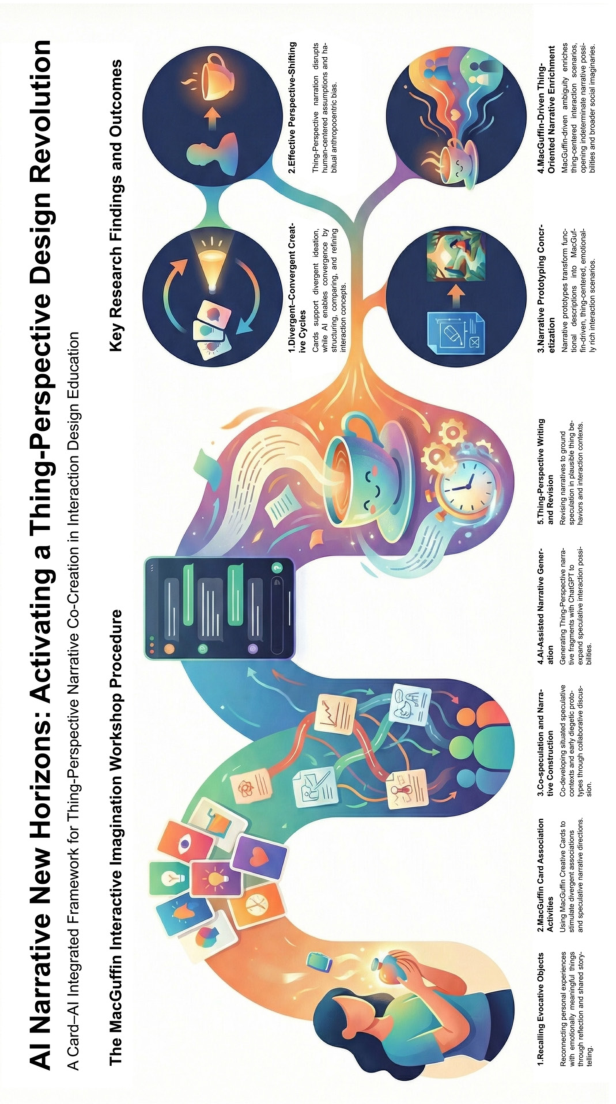
Workshop Structure and Learning Flow The workshop follows a five-stage structure designed to scaffold a gradual transition from personal experience to Thing-Perspective interaction design. As illustrated in Figure 1, the framework integrates card-based prompts and AI narrative generation into alternating divergent and convergent creative phases. Participants move between individual reflection and collaborative exploration, as well as between human-authored and AI-assisted storytelling. Rather than treating each stage as a discrete instructional unit, the workshop emphasizes continuity across activities. Insights generated in earlier phases inform later narrative construction and design reflection, allowing participants to iteratively refine interaction concepts while maintaining conceptual coherence.
Integrated Narrative and Design Process The workshop begins by grounding design imagination in evocative objects-everyday artifacts with personal emotional significance. Through brief reflection and sharing, participants articulate the material qualities and memories associated with these objects, establishing an experiential anchor for subsequent speculation. MacGuffin Creative Cards are then introduced to disrupt habitual interpretations by adding symbolic attributes and narrative tensions, supporting divergent ideation without premature convergence on design solutions. Building on these associations, participants engage in co-speculation, collaboratively constructing fictional contexts and preliminary diegetic prototypes. These narratives situate objects within imagined interaction environments, often involving AI-enabled or IoT-based futures, and emphasize relational dynamics and experiential qualities rather than technical feasibility. Narrative prototyping enables participants to externalize assumptions about interaction, agency, and temporality in an accessible form. AI-assisted narrative generation is subsequently introduced through ChatGPT, with participants designing prompts that incorporate object attributes, MacGuffin cues, and first-thing narrative constraints. AI-generated texts function as provocations that expand narrative possibilities while remaining subject to human interpretation. In the final phase, participants critically revise these narratives through Thing-Perspective writing, grounding speculative elements in plausible thing behaviors and situated interaction contexts, and translating narratives into conceptual interaction design proposals.
Figure 1: AI narrative new horizons: Activating a thing-perspective design revolution.
This figure illustrates the five-stage MacGuffin Interactive Imagination Workshop and the Card-AI Integrated Framework, showing how evocative objects, MacGuffin Creative Cards, and AI-assisted narrative generation support Thing-Perspective learning in interaction design education. (Note. The figure was created by the author with assistance from the NotebookLM tool.)
AI Narrative Co-Creation in Interaction Design Education 543 The Card-AI Integrated Framework
Across the workshop, the Card-AI integrated framework supports a balance between openness and structure. MacGuffin cards facilitate divergent exploration, while AI narrative generation supports articulation and synthesis. Human participants remain responsible for interpretation, revision, and design judgment, ensuring that creative authorship and critical reflection are preserved. By embedding AI within a structured narrative process rather than positioning it as an autonomous creator, the framework addresses common challenges in AI-supported design education, including overreliance on automated outputs and loss of agency. This design ensures that AI functions as a pedagogical collaborator aligned with HCI educational objectives.
FINDINGS: FIVE PEDAGOGICAL STRATEGIES OF THE THING-PERSPECTIVE FRAMEWORK Analysis of the workshop outcomes revealed five interrelated pedagogical strategies that characterize how AI-assisted narrative co-creation supported Thing-Perspective learning in interaction design education. Rather than reporting individual cases in detail, the findings are presented as analytical patterns derived from participants’ narratives, AI interaction records, design artifacts, and reflective responses.
Divergent–Convergent Creative Cycles A central finding concerns the formation of Divergent–Convergent Creative Cycles enabled by the Card–AI Integrated Framework. During the early phases of the workshop, MacGuffin Creative Cards encouraged open-ended association and speculative exploration, allowing participants to generate multiple narrative directions without being constrained by immediate functional requirements. AI-assisted narrative generation subsequently supported convergence by helping participants articulate, compare, and organize emerging ideas into coherent narrative forms. Rather than fixing design solutions, AI outputs provided linguistic structure that enabled iterative refinement across alternative interaction concepts. This alternating rhythm between divergence and convergence emerged as a repeatable creative pattern across participant groups.
Effective Perspective-Shifting The second strategy involves the framework’s capacity to facilitate Effective Perspective-Shifting beyond habitual human-centered viewpoints. By requiring narratives to be written explicitly from a Thing-Perspective, participants were prompted to reconsider interaction scenarios from the standpoint of things rather than users. Participants’ narratives demonstrated a clear shift in focus from user goals and interface efficiency toward thing experiences, such as sensing environmental change, enduring temporal processes, or responding to contextual conditions. Structured Thing-Perspective constraints also
544 Lee counteracted anthropocentric tendencies in AI-generated content, ensuring that both human- and AI-authored narratives consistently maintained thing- centered viewpoints.
Narrative Prototyping Concretization The third strategy highlights the role of Narrative Prototyping Concretization in translating speculative interaction ideas into communicable design forms. Through co-speculation and diegetic prototyping, participants transformed abstract concepts into situated narrative scenarios that described how things behave and interact within imagined contexts. Compared to conventional functional descriptions, narrative prototypes enabled participants to articulate temporal dynamics, relational change, and experiential qualities of interaction. These narratives functioned as intermediate design artifacts that supported interaction concept concretization, discussion, critique, and further development without requiring immediate technical implementation.
MacGuffin-Driven Thing-Oriented Narrative Enrichment The fourth strategy concerns MacGuffin-Driven Thing-Oriented Narrative Enrichment, which distinguishes this framework from more generic forms of emotional engagement. By activating the cinematic concept of the MacGuffin, evocative objects were not treated merely as affective triggers, but as narrative catalysts that opened multiple, indeterminate interaction possibilities from a thing-oriented perspective. This narrative openness enabled participants to construct interaction scenarios rich in object subjectivity and speculative tension. Rather than anchoring meaning solely in personal emotion, MacGuffin-driven narratives expanded the imaginative space in which things could initiate events, shape situations, and sustain interaction trajectories. This enrichment supported the generation of interaction concepts that extended beyond individual use cases toward broader social and cultural imaginaries.
Structured Scaffolding for AI Co-Creation The final strategy emphasizes the importance of Structured Scaffolding for AI Co-Creation. While participants valued AI’s ability to expand narrative possibilities, unstructured use risked overreliance and diminished authorship. Two forms of scaffolding proved particularly effective: prompt design that foregrounded Thing-Perspective constraints, and iterative revision stages that required participants to critically reinterpret AI-generated content. These mechanisms ensured that AI functioned as a pedagogical collaborator rather than an authoritative creator, preserving creative agency and reflective judgment within AI co-creation processes.
Synthesis of Findings Together, the five strategies form an integrated pedagogical framework that supports Thing-Perspective learning through AI-assisted narrative co-creation. Rather than operating independently, these strategies reinforce
AI Narrative Co-Creation in Interaction Design Education 545 one another by balancing imaginative openness, structural guidance, and creative authorship. The findings demonstrate that when pedagogically structured, AI narrative co-creation can expand speculative thinking and design agency within HCI-oriented interaction design education.
DISCUSSION
This study demonstrates how AI-assisted narrative co-creation can be pedagogically structured to support a Thing-Perspective approach in interaction design education. Rather than challenging human-centered design as a foundational paradigm, the proposed framework extends HCI pedagogy by introducing thing-centered viewpoints that are increasingly relevant in AI- and IoT-mediated contexts. From an educational perspective, the findings suggest that Thing-Perspective narrative practices enable learners to move beyond conventional user-oriented problem framing. By engaging with objects as narrative agents, participants explored interaction scenarios that foregrounded material presence, temporal change, and relational dynamics. These dimensions are often difficult to articulate through usability-driven methods alone, yet are critical for understanding intelligent and autonomous systems. The study also contributes to ongoing discussions of AI’s role in design education. The findings indicate that generative AI can support creative exploration when positioned as a pedagogical collaborator rather than an autonomous creator. Structured scaffolding-such as prompt constraints and iterative revision-proved essential for maintaining authorship and critical engagement. For HCI pedagogy, this highlights the importance of designing learning environments that foster reflective human-AI interaction rather than tool-centric efficiency. Finally, the use of narrative as a mediating practice enabled abstract theoretical concepts, such as object agency and nonhuman perspectives, to be translated into concrete design activity. Narrative prototyping functioned as an accessible bridge between theory and practice, suggesting its value for introducing post-anthropocentric perspectives in interaction design curricula.
CONCLUSION
This paper proposed a Thing-Perspective Pedagogical Framework for interaction design education by integrating MacGuffin Creative Cards with AI-assisted narrative co-creation. Through the design and implementation of the MacGuffin Interactive Imagination Workshop, the study demonstrated how narrative, material reflection, and structured human-AI collaboration can support speculative learning in HCI contexts. The findings identified five pedagogical strategies that foster perspective shifting, narrative prototyping, emotional engagement, and sustained creative agency within AI-supported design processes. By repositioning objects as narrative agents and embedding AI within a carefully scaffolded framework, this approach extends interaction design pedagogy beyond purely human-centered paradigms without diminishing human authorship. Rather than treating AI as an autonomous creator, the proposed model frames AI as a pedagogical collaborator that
546 Lee amplifies imaginative exploration while remaining accountable to design intent. As AI-enabled systems increasingly participate in everyday life, interaction design education must equip future designers to critically engage with complex human-AI-thing relationships. Thing-Perspective AI narrative co-creation offers a practical, adaptable, and pedagogically grounded pathway for cultivating this capability, contributing to ongoing efforts in HCI to rethink interaction from, with, and alongside things.
ACKNOWLEDGMENT
This study was supported by the National Science and Technology Council (NSTC113-2410-H-218-003-) and the Ministry of Education (PHA1136134), whose funding made the research possible and more complete. The author extends sincere appreciation to all assistants and workshop participants for their invaluable support. Special gratitude is given to Associate Professor Zi-Ru Chen for her dedicated collaboration throughout the workshop, as well as to Assistant Professor Ta-Chi Liu and Mr. Chia-Hsuan Hsieh, Secretary-General of the Tainan Ceramic Society, for their generous technical guidance, material support, and practical design advice that greatly enriched the participants’ interaction design activities.
REFERENCES
Bryant, L.R., 2011. The democracy of objects. Ann Arbor, MI: Open Humanities Press. Desjardins, A., Key, C., Biggs, H.R. and Aschenbeck, K., 2019. Bespoke booklets:
A method for situated co-speculation. In: Proceedings of the 2019 Designing Interactive Systems Conference (DIS’19). New York: ACM, pp. 697–709. https:// doi.org/10.1145/3322276.3322311 Dunne, A. and Raby, F., 2013. Speculative everything: Design, fiction, and social dreaming. Cambridge, MA: MIT Press. Giaccardi, E., Cila, N., Speed, C. and Caldwell, M., 2016. Things as co-ethnographers:
Implications of a thing perspective for design and anthropology. In: Smith, R.C., Vangkilde, K.T., Kjaersgaard, M.G., Otto, T., Halse, J. and Binder, T. (eds.), Design anthropological futures. London: Bloomsbury Academic, pp. 235–248. Harman, G., 2002. Tool-being: Heidegger and the metaphysics of objects. Chicago, IL: Open Court. Kirby, D., 2010. The future is now: Diegetic prototypes and the role of popular films
in generating real-world technological development. Social Studies of Science, 40(1), pp. 41–70. https://doi.org/10.1177/0306312709338325 Lee, W.-C., Chen, Z.-R. and Liang, R.-H., 2025. Exploring MacGuffin interactions in IoT smart objects: A narrative approach to design education research. International Journal of Art & Design Education. Advance online publication. https://doi.org/10.1111/jade.12595 Markussen, T. and Knutz, E., 2013. The poetics of design fiction. In: Proceedings
of the 6th International Conference on Designing Pleasurable Products and Interfaces (DPPI’13). New York: ACM, pp. 231–240. https://doi. org/10.1145/2513506.2513531
AI Narrative Co-Creation in Interaction Design Education 547 Turkle, S. (ed.), 2007. Evocative objects: Things we think with. Cambridge, MA:
MIT Press. Wakkary, R., Oogjes, D., Hauser, S. and Lin, H., 2017. Morse things: A design inquiry into the gap between things and us. In: Proceedings of the 2017 Designing Interactive Systems Conference (DIS’17). New York: ACM, pp. 503–514. https:// doi.org/10.1145/3064663.3064734 Wells, P., 2014. Chairy tales: Object and materiality in animation. Alphaville: Journal
of Film and Screen Media, 8, pp. 6–23.
LISTED IN THE AHFE DIGITAL BOOKSTORE CATALOGUE
Explore the complete digital volume
Human Interaction and Emerging Technologies (IHIET-AI 2026): Artificial Intelligence and Future Applications
Read this individual research paper free through the original publisher, or explore the full digital proceedings book.
ISBN 978-1-964867-77-9
Explore this ISBN in the AHFE Bookstore ↗Listed in the July 2026 bookstore catalogue; search by ISBN to confirm current availability · Digital book purchase optional