Mingyi Wang, Shuzhen Luo, Chi-bok Lee, Andy Jaeyeon Jung, Joao Souza Dias Garcia, Yanbing Chen (2025). Flight Safety - Alcohol Detection assisted by AI Facial Recognition Technology. In: Advances in Human Factors of Transportation. AHFE Open Access, vol. 186, pp. 84–88. https://doi.org/10.54941/ahfe1006496
The Federal Aviation Administration’s (FAA) “Bottle to Throttle” rule requires that a pilot may not use alcohol within 8 hours of a flight and cannot have a blood alcohol content above 0.04% to ensure safety. However, a pilot could still feel intoxicated, even after the 8-hour window has expired. Some studies have shown decrements in pilot performance after 10 hours of drinking alcohol using a flight simulator. According to the FAA, aviation employees performing safety-sensitive functions are subject to random alcohol testing. Usually, a screening test and a confirmation test are administered to determine a prohibited alcohol concentration of a pilot. When a screening test is above the allowed limit, a confirmation test is conducted after 15 minutes. If the test can be conducted in a rapid and accurate manner before all pilots’ flights, the probability that a pilot is still under influence of alcohol, or drugs will be dramatically reduced. This project aims to develop an AI facial recognition technique using Human-Centered Computing (HCC) to more accurately identify if the pilot is still under influence of alcohol, instead of using the uniformed standard of 0.04% blood alcohol that may not apply for each individual.Rationale1) Blood alcohol level has a strong negative relationship with cognitive/ flight performance. For example, if an individual pilot is under the influence of alcohol use, their cognitive performance will be significantly impacted, as well as their flight performance will be significantly impacted.2) If an individual pilot is under the influence of alcohol use, the associated minor characteristics expressed on their faces. Those characteristics may not be able to be identified by human beings but can be detected by the AI facial recognition technique using HCC.3) Considering heterogeneity, the uniformed standard of 0.04% blood alcohol after 8 hours from drinking may not accurately reflect each individual pilot’s readiness to fly. The trained AI can detect whether an individual pilot is still under the influence of alcohol, regardless of blood alcohol concentration, which can serve as a rapid census test to ensure pilots’ safety to fly.MethodologyTask 1: Train the AI classification model by publicly available datasets of alcohol users’ facial images. Data source: Collect publicly available datasets containing facial images of individuals in various states of alcohol consumption (sober, mildly intoxicated, and heavily intoxicated). Images will be preprocessed using facial landmark detection and attention-based image segmentation to isolate key regions such as the eyes, nose, mouth, and skin tone changes that are sensitive to alcohol-induced variations. Model training: A deep convolutional neural network will be trained to classify the images and learn the relationship between facial features and alcohol-induced influences.Task 2: Examine the AI Facial Recognition algorithm among healthy average people (n=20) before and after certain amount of alcoholic beverage consumption. Specifically, the cognitive performance will be examined through a series of cognitive tasks focusing on deductive reasoning, working memory, concentration, associate-learning and spatial planning. The data will be used to fine-tune the AI facial recognition algorithm to more accurately identify alcohol influence. Task 3: Examine the AI facial recognition algorithm among pilots using flight simulator. The parameters of performance will be extracted from the simulator both before and after pilots’ alcohol consumption (n=20). The data will be used to customize the AI algorithm to customize it to pilots’ readiness to fly.Experiment ProceduresFor an average person, the capability of absorbing alcohol is 0.015 g/100ml/hour. In most healthy people, blood circulates through the body in 90 seconds, thereby allowing alcohol to affect cognitive function immediately, but full effects of a drink are felt within 15 to 45 minutes depending on the speed of absorption. In both experimental, each participant will spend 0.5-hour drinking, so the blood alcohol concentration will be around 0.018 % when they start their performances. Since participants’ alcohol absorbing rate varies (e.g., some participants may consume refreshments when drinking), their blood alcohol concentration will also be detected at several time points during the experiment by an alcohol breathalyzer tester as a reference.Significance1) Using HCC AI facial recognition, the alcohol test can be conducted on all pilots by simply scanning their faces, which improves flight safety compared to traditional spot-checking approaches.2) the AI facial recognition can also serve as the census screening test, before confirmation test by breath-testing device.3) the technology can more accurately identify if the pilot is still under influence of alcohol use, instead using the uniformed standard of 0.04% blood alcohol may not apply for each individual.
Human factors, including illness, medication, alcohol consumption, fatigue, stress, and emotional state, play critical roles in transportation safety (Alavi et al., 2017; Shandhana Rashmi and Marisamynathan, 2023). Even minor illnesses can severely impair pilot performance by reducing judgment, alertness, memory, and coordination. While medications may control symptoms, they can introduce side effects that degrade cognitive and motor abilities (Hafez et al., 2023).
In aviation, the Federal Aviation Administration (FAA) enforces the “Bottle to Throttle” rule, prohibiting pilots from consuming alcohol within eight hours of a flight and setting a blood alcohol limit of 0.04% to ensure
Flight Safety - Alcohol Detection Assisted by AI Facial Recognition Technology 85
flight safety. However, a pilot may still experience impairment even after the eight-hour period has passed. Previous research has demonstrated that pilots can experience performance impairments in a flight simulator even 10 hours after consuming alcohol (Bates, 2001).
According to the Department of Transportation (DOT) and FAA, aviation employees performing safety-sensitive functions are subject to random alcohol testing to ensure compliance with safety regulations (As per the FAA’s Drug Abatement Division, random drug/alcohol testing program in 14 Code of Federal Regulations part 120, §§ 120.109(b) and 120.217(c) apply to all air carriers and operators certificated under part 119 and authorized to conduct operations under part 121 or part 135). Typically, determining a pilot’s prohibited alcohol concentration involves a two-step process: a screening test followed by a confirmation test if the initial result exceeds the allowable limit. The confirmation test is conducted 15 minutes later to verify the findings. Implementing a rapid and accurate testing method before each flight would significantly reduce the likelihood of a pilot operating under the influence of alcohol or other substances. Artificial Intelligence (AI) driven facial recognition model has been used in other industries to assess human subjects’ health status (Chan et al., 2024) and cognitive workload (Iarlori et al., 2024). However, this technology has yet to be widely implemented in aviation or other transportation sectors to address alcohol-related issues, highlighting a significant opportunity for innovation in ensuring safety.
METHODOLOGY
This study aims to develop an AI model utilizing facial recognition to determine whether pilots are under the influence of alcohol, enhancing aviation safety through rapid and non-invasive assessment.
AI Facial Recognition System The rationale for this research is rooted in the critical link between alcohol consumption and aviation safety, underscoring the need for precise and individualized assessment tools.
First, extensive research has established a strong negative correlation between blood alcohol levels and both cognitive and flight performance, demonstrating alcohol’s detrimental effects.
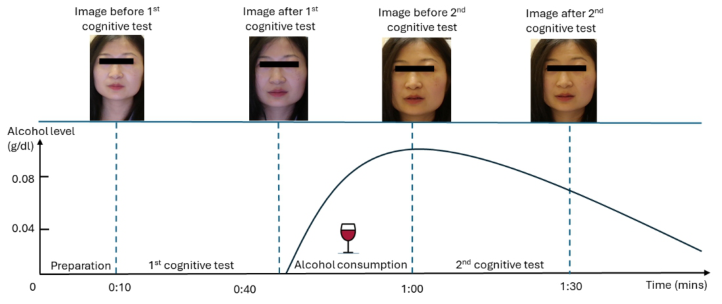
Second, while alcohol-induced facial changes may be too subtle for human detection, AI-powered facial recognition using Human-Centered Computing (HCC) can accurately identify these indicators (Chan et al., 2024). Figure 1 is a flowchart in which subtle changes of facial images can be observed at certain time points before and after alcohol consumption.
Third, the current standardized limit of 0.04% blood alcohol concentration within 8 hours may not necessarily determine a pilot’s fitness to fly due to individual physiological differences. Thus, this study aims to develop an AI-driven, rapid, and accurate screening method to enhance aviation safety by providing a more personalized assessment of alcohol influence. The proposed research follows a three-step approach to develop
and refine an AI facial recognition system for assessing alcohol-induced impairments, with each task building upon the previous one to enhance the algorithm’s accuracy and real-world applicability.
Figure 1: Facial images took at different time point during the experiment.
Study Design Task 1 (Model Building – Secondary Data): This phase involves training an AI classification model using publicly available datasets of facial images from individuals at different levels of alcohol consumption (sober, mildly intoxicated, and heavily intoxicated). Image preprocessing techniques, such as facial landmark detection and attention-based segmentation, will be used to isolate key regions (e.g., eyes, nose, mouth, and skin tone) that are sensitive to alcohol-induced changes. A deep convolutional neural network (CNN) will be trained to classify images and establish relationships between facial features and alcohol influence.
Task 2 (Experiment – Repeated Measures Design: Cognitive Testing): This task aims to evaluate the initial AI facial recognition algorithm on a group of healthy participants (n = 20) before and after alcohol consumption. Participants will complete a series of cognitive tests assessing deductive reasoning, working memory, concentration, associative learning, and spatial planning. Their baseline and post-alcohol cognitive performance scores will be recorded, alongside facial images captured via the computer’s camera. Alcohol concentration data, collected through a breathalyzer at multiple time points, will be integrated to refine the AI model, enhancing its accuracy in detecting alcohol-related impairments.
Task 3 (Experiment – Repeated Measures Design: Flight Simulation): In this phase, the AI facial recognition algorithm will be further fine-tuned using pilots’ flight simulation data. Licensed pilots (n = 20) will perform flight simulator tasks before and after alcohol consumption. Their facial images will be recorded using an onboard camera, and alcohol concentration levels will be measured with a breathalyzer throughout the experiment. Performance metrics extracted from the flight simulator will be used to
Flight Safety - Alcohol Detection Assisted by AI Facial Recognition Technology 87
customize the AI model for aviation applications, ensuring it accurately assesses pilots’ readiness to fly.
Ethic Approval This research project has been granted ethical clearance by the Embry-Riddle Aeronautical University Institutional Review Board (IRB) under approval #25-096.
More Details About Experiments In most healthy individuals, blood circulates throughout the body within 90 seconds, allowing alcohol to begin affecting cognitive functions almost immediately. However, the full effects of alcohol consumption are typically felt within 15 to 45 minutes, depending on the speed of absorption. For both Task 2 and Task 3 experiments, each participant will spend approximately 30 minutes consuming alcohol, resulting in a blood alcohol concentration (BAC) around 0.018% when they begin their performance tasks (cognitive testing in Task 2 and flight simulation in Task 3). Since participants’ alcohol absorption rates can vary (for example, some may consume refreshments alongside alcohol), BAC will be measured at multiple time points during the experiments using a breathalyzer as a reference. Task 2 will focus on testing and fine-tuning the AI algorithm in a controlled laboratory setting, where healthy participants will complete cognitive tasks before and after alcohol consumption, allowing the AI’s detection capabilities to be aligned with observable changes in cognitive performance. Task 3 will refine the algorithm further by utilizing performance data from flight simulators, ensuring its applicability to aviation safety, particularly for pilots.
CONCLUSION
This research develops a robust AI system using HCC facial recognition to assess pilots’ alcohol influence, offering a significant improvement over traditional spot-checking methods. By enabling alcohol testing through simple facial scans, the system enhances flight safety and can serve as an initial screening test before breathalyzer confirmation. More importantly, the technology provides a more accurate way to determine if a pilot is still under the influence, addressing the limitations of the standard 0.04% blood alcohol concentration threshold, which may not apply to all individuals. This system has the potential for broad applications, not only in aviation but also in road safety, offering a new approach to detecting alcohol impairment in drivers and contributing to safer transportation environments overall. Moreover, similar to alcohol, medicine, and drug use, impairment compounds risk by impairing judgment and coordination while increasing susceptibility to disorientation and hypoxia (Dom, Hulstijn and Sabbe, 2006; Finn et al., 2009). Therefore, this technology could also be expanded to detect the influence of other substances, including prescription medications, narcotics, and recreational drugs, providing a comprehensive solution to ensure transportation safety.
ACKNOWLEDGMENT
The authors would like to acknowledge Embry-Riddle Aeronautical University - College of Aviation Strategic Initiative Grants Program for the funding provided. The authors would also like to acknowledge the consistent support from College of Aviation - School of Graduate Studies and College of Engineering - Mechanical Engineering department.
REFERENCES
Alavi, S. S. et al. (2017) ‘Personality, Driving Behavior and Mental Disorders Factors as Predictors of Road Traffic Accidents Based on Logistic Regression’, Iranian Journal of Medical Sciences, 42(1), p. 24. Available at: https:// pmc.ncbi.nlm.nih.gov/articles/PMC5337762/ (Accessed: 19 January 2025). Bates, J. (2001) ‘An Examination of Hangover Effects on Pilot Performance’, Theses
and Dissertations [Preprint]. Available at: https://commons.und.edu/theses/434 (Accessed: 26 January 2025). Chan, J. J. H. et al. (2024) ‘Facial artificial intelligence in ophthalmology and medicine: Fundamental and transformative applications’, Therapeutic Advances in Ophthalmology, 16, p. 25158414241302870. Available at: https://doi.org/ 10.1177/25158414241302871. Dom, G., Hulstijn, W. and Sabbe, B. (2006) ‘Differences in impulsivity and sensation
seeking between early- and late-onset alcoholics’, Addictive Behaviors, 31(2), pp. 298–308. Available at: https://doi.org/10.1016/j.addbeh.2005.05.009. Finn, P. R. et al. (2009) ‘Reduced Cognitive Ability in Alcohol Dependence: Examining the Role of Covarying Externalizing Psychopathology’, Journal of abnormal psychology, 118(1), p. 100. Available at: https://doi.org/10.1037/ A0014656. Hafez, G. et al. (2023) ‘Drugs with a negative impact on cognitive functions (Part 2):
Drug classes to consider while prescribing in CKD patients’, Clinical Kidney Journal, 16(12), p. 2378. Available at: https://doi.org/10.1093/CKJ/SFAD239. Iarlori, S. et al. (2024) ‘An Overview of Approaches and Methods for the Cognitive Workload Estimation in Human–Machine Interaction Scenarios through Wearables Sensors’, BioMedInformatics 2024, Vol. 4, Pages 1155-1173, 4(2), pp. 1155–1173. Available at: https://doi.org/10.3390/ BIOMEDINFORMATICS4020064. Shandhana Rashmi, B. and Marisamynathan, S. (2023) ‘Factors affecting truck
driver behavior on a road safety context: A critical systematic review of the evidence’, Journal of Traffic and Transportation Engineering (English Edition), 10(5), pp. 835–865. Available at: https://doi.org/10.1016/J. JTTE.2023.04.006.
LISTED IN THE AHFE DIGITAL BOOKSTORE CATALOGUE
Explore the complete digital volume
Advances in Human Factors of Transportation
Read this individual research paper free through the original publisher, or explore the full digital proceedings book.
ISBN 978-1-964867-62-5
Explore this ISBN in the AHFE Bookstore ↗Listed in the July 2026 bookstore catalogue; search by ISBN to confirm current availability · Digital book purchase optional