Gift Bassey, Susan Ebaretonbofa-okonji, Kjetil Nordby, Etienne Gernez, Steven Mallam (2025). A Systematic Curriculum Review of Ship Energy Efficiency Content Across Global Maritime Education and Training Institutions. In: Advances in Human Factors of Transportation. AHFE Open Access, vol. 186, pp. 565–573. https://doi.org/10.54941/ahfe1006546
The maritime industry is a significant contributor of total energy consumption worldwide and by extension, environmental impact. In the effort to transition towards more sustainable operations, a multifaceted approach is being taken to address energy management issues, new and alternative energy sources from regulatory, technological, and organizational applications. Seafarers, particularly deck officers and marine engineers, play a pivotal role in ship operations, managing and executing missions and onboard systems. The different aspects of energy utilization as related to maritime operations are continuously evolving for better efficiency and reduced impact on the environment therefore the seafarers who operate these systems require updated trainings with new and differing competencies and skillsets to ensure they are prepared for operating and maintaining these different systems. This may include, but not limited to, alternative energy sources, power generation and storage, fuel consumption estimation, energy consumption optimization, route and operation optimization, air pollution and resulting fuel residue. This paper investigates the extent to which maritime education and training (MET) institutions incorporate energy efficiency management into their curricula for seafarers. The primary goal of this paper is to determine the current education content, identify gaps, assess the readiness, and propose a pathway forward for MET institutions to better prepare current and future seafarers to implement energy efficiency strategies onboard ships.The review assessed the current state of training curriculum of deck officers and marine engineers across 69 maritime institutions from around the world which are members of the International Association of Maritime Universities (IAMU), assessing the integration of energy efficiency management into their marine engineering and nautical science programs. The online curriculum review revealed that 16% of the marine engineering programs included direct references to energy efficiency management, while 58% had no related courses listed. The remaining 22% had potential relevance to energy efficiency through courses on automation, ship design, environmental management; and 4% were related through the description of program results. For nautical science programs, the result showed even less relatable courses to energy efficiency management, with 7% of the reviewed programs including related courses. The majority (71%) had no relevant courses, while 19% were indirectly related through modules on environmental regulation or maritime law and 3% were related through the description of program results. The results of this curriculum review reveal lack of comprehensive energy management courses which may leave future seafarers unprepared to meet industry expectations or regulatory requirements once graduated. The global maritime industry’s regulator, the International Maritime Organization, has developed a number of relevant courses on the topics of climate change and shipping response, energy efficiency regulations and related guidelines, from management to operation, shipboard energy management, ship-port interface and energy efficiency, energy management plans and systems. These courses can serve as a guide for maritime institutions to develop effective modules and educational content on energy efficiency management and imbed more centrally within seafarer curricula. This initial mapping of current MET curricula on energy efficiency topics serves as a basis for further development of education and training program content within our research project to ultimately meet the evolving needs and demands of the industry, while ensuring MET institutions stay relevant and develop well equipped and skilled graduates to enter the industry.
The global energy shift from traditional fossil fuels to cleaner and more sustainable energy sources have led to a worldwide industrial campaign with the maritime domain playing a pivotal role (IMO, 2022). Approximately 80% of global trade by volume is carried by ships, translating to over 10 billion tonnes of goods annually (Kosowska-Stamirowska, 2020). Shipping produces approximately 14% of nitrogen emissions from global fuel combustion sources, 16% of sulfur emissions of global petroleum use (Corbett & Fischbeck, 1997), and 3% of total global greenhouse gas emissions (Chen et al., 2019).
Energy efficiency in the maritime industry is crucial due to the industry’s significant contribution to global emissions, while also ensuring economic competitiveness. In recent years, the industry’s highest international governing body, the International Maritime Organization (IMO) has increasingly focused on decarbonizing shipping, setting ambitious targets including a 20% reduction of greenhouse gas emissions across international shipping by 2030, 70% reduction by 2040 and reaching net-zero “close to 2050” (IMO, 2023). The IMO’s International Convention for the Prevention of Pollution from Ships (MARPOL) is one of the most important international conventions requiring industry compliance (IMO, 1973). Furthermore, the introduction of instruments such as the IMO’s Ship Energy Efficiency Management Plan (SEEMP) aims at reducing greenhouse gas emissions from ships and improve energy efficiency through mandatory tracking and reporting (IMO, 2022). Further international, national and regional regulations and requirements related to emissions have been established and are enforced within certain waters and ports depending on jurisdiction, reiterating the maritime domain, and overall society’s ambition to reduce its overall environmental impact. As ships have long design, build and operational lifecycles, efforts to introduce cleaner energy sources in shipping must account both for futuristic design and implementation of new systems and emerging alternative energy sources, as well as viable transitional processes, and retrofitting to reduce emissions for currently operating and legacy systems.
Seafarers, particularly deck officers and marine engineers, play a pivotal role in ship operations, managing and executing missions and onboard systems safely and efficiently. As technology and procedures evolve with the introduction of new equipment and capabilities, like any profession, seafarers routinely require updated trainings for new and differing competencies and skillsets on technical operational and management levels. This is particularly relevant in relation to current energy efficiency-related developments in shipping, as seafarers need to be equipped with adequate skills to safely operate and maintain advancing vessels and operational systems. This may include, but not limited to, alternative fuels (e.g. LNG, ethane, methanol, hydrogen, ammonia, LPG, biofuels, etc.), new types of propulsion systems (e.g. wind-assisted, nuclear, battery, etc.), energy efficient technologies (e.g. hybrid-electric, solar, waste-heat recovery, etc.), as well as new tracking and reporting requirements related to fuel consumption estimation, energy consumption optimization and emissions output, route optimization, and an overall increased breadth and depth of knowledge and compliance with differing environmental regulations and laws.
Phewa et al. (2021) emphasizes the need for Maritime Education and Training (MET) institutions to incorporate emerging technologies into their curricula. The IMO has designed a number of online training and model courses to cover general areas, such as climate change and the shipping response, IMO energy efficiency regulations and related guidelines, from management to operation, shipboard energy management, ship- port interface and energy efficiency and energy management plans and systems (IMO, n.d.). Furthermore, courses related to carbon reduction
A Systematic Curriculum Review of Ship Energy Efficiency Content Across Global MET 567
specifically in shipping have been developed through the United Nations Change Learning Partnership (UN CC: Learn, n.d.), as well as various initiatives developed through classification societies, professional bodies, equipment manufacturers and sector- or company-specific education and training.
Emerging new technologies, and modern methods of conducting maritime operations ultimately require updated skills and competencies for those operating, monitoring and maintaining these systems. Thus, updated MET programs and curricula are critical to ensure cadets and seafarers receive relevant education and training and are equipped with relevant skills to enter the workforce and meet the demands and expectations of a constantly evolving maritime industry.
PURPOSE OF THE STUDY This study focuses on investigating the extent to which MET institutions incorporate energy efficiency management into their curricula for seafarers, specifically focusing on nautical science and marine engineering programs. The primary goal of this paper is to determine the current education content, identify gaps, assess the readiness, and propose a pathway forward for MET institutions to better prepare current and future seafarers to implement energy efficiency strategies onboard ships.
METHODOLOGY
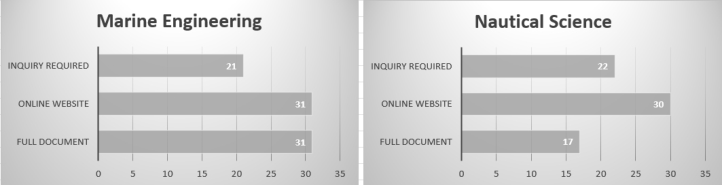
This study reviewed the curricula of 69 maritime institutions that are part of the 79 members of International Association of Maritime Universities (IAMU, 2024). A total of 44 marine engineering programs and 35 nautical science programs across 42 countries were identified, assessed, and evaluated for their inclusion of energy efficiency related content. The assessment was based on program documentation available online or directly provided by the institutions on request (see Figure 1).
Key indicators for course content identification included, but not limited to: energy efficiency management, alternative fuels and energy sources, power generation and storage, fuel and energy consumption, route and operation optimization, environmental regulation & compliance, pollution prevention, marine law and environmental stewardship, green energy engineering, automation and control, marine energy systems designs, fuel and lubrication, marine environment management, atmospheric environmental studies and environmental material science.
The programs were categorized based on their direct relevance to energy efficiency, potential relevance, or no relevance. The potential relevance considered was based on courses indirectly related to energy efficiency or the description of program result including proficiency in energy management systems.
Figure 1: Marine engineering & nautical science reference file obtained for training institutions.
RESULTS
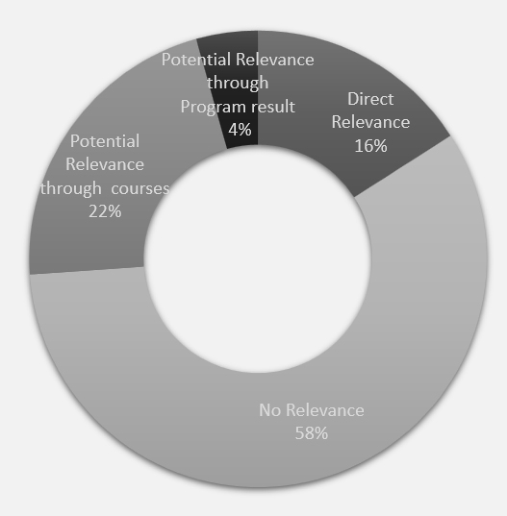
Marine Engineering The curricula review revealed that 11 out of 69 (16%) of the marine engineering programs included direct references to energy efficiency management; 40 out of 69 (58%) had no related courses; 15 out of 69 (22%) had potential relevance to energy efficiency through courses on automation, ship design and environmental management; while 3 out of 69 (4%) were related through the description of program results as indicated by institution’s websites (see Figure 2).
Figure 2: Marine engineering program relatability to energy efficiency.
The training institutions whose curricula were reviewed made a total of 44 curricula out of 69 entries; 25 were not reviewed as 7 institutions did not
A Systematic Curriculum Review of Ship Energy Efficiency Content Across Global MET 569
offer marine engineering related programs and 18 did not respond to our enquiries or did not have information of their programs or courses online.
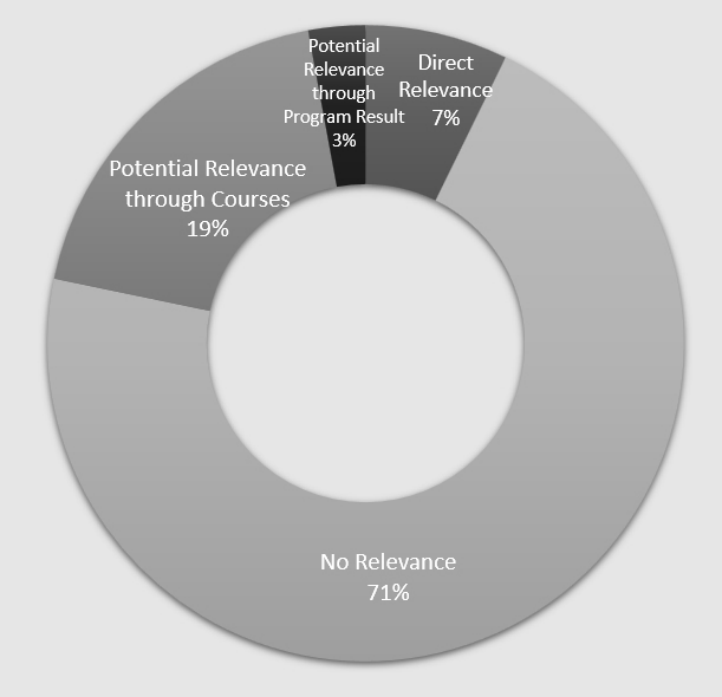
Nautical Science The result for nautical science programs showed 5 out of 69 (7%) of the reviewed programs including key indicator courses relating to energy efficiency management; 49 out of 69 (71%) had no relevant courses; 13 out of 69 (19%) were indirectly related through modules on environmental regulation or maritime law while 2 out of 69 (3%) were related through the description of program results as indicated on institution websites (see Figure 3).
Figure 3: Nautical science program relatability to energy efficiency.
A total of 38 curricula out of 69 entries were reviewed; 31 were not reviewed as 10 institutions did not offer nautical science related programs and 21 did not respond to our enquiries or did not have information of their programs or courses online.
DISCUSSION
The findings of this review highlight a significant gap in the current international maritime education system for marine engineering and nautical science students. Despite the growing importance of energy efficiency in maritime operations, most institutions have not yet fully integrated this type of learning content into their education and training programs. The following highlight the implications of the current knowledge gap on differing maritime stakeholders, including MET, industry and regulation.
Implications for Maritime Education and Training Maritime educators, industry stakeholders, and regulatory bodies require collaboration to ensure the curriculum aligns with the regulatory requirements and the industry demands. Innovation and technological integration have a considerable influence on the design of the curriculum in the 21st Century (Phewa et al., 2021). The development of a standard training curriculum for handling alternative fuels, such as methanol, ammonia, and hydrogen, as well as certification processes and regularly updated training materials and online resources, are needed to ensure safety and efficiency in maritime operations. However, this is a capital-intensive process for MET institutions, as investment in new and different training equipment, educator updates, and course materials is required. With such an array of differing technologies being developed and introduced (some with success and promise to be scaled throughout the industry, while some will not) it is difficult for MET institutions to invest resources to develop new curricula without better knowledge and information on what will be most in demand and relevant.
As this review found, the lack of comprehensive energy management courses may leave current and future seafarers unprepared to meet academic and regulatory requirements, as well as industry expectations. Institutions that offer relevant courses tend to focus on broad topics like environmental management, without delving deeply into specific energy efficiency techniques, such as speed optimization, fuel management, or alternative energy sources. This may lead to a general awareness without deep understanding of practical concepts which in itself will not achieve much. Seafarer competency development also requires hands-on practical knowledge, skillsets and experience that can be directly implemented and relatable onboard. One solution to partly address this gap is in the structure of MET, where many programs require extended “sea-time” for cadets in training throughout their program, where, depending on the company and type of ship deployed would receive hands-on training with specific types of equipment and systems not necessarily part of their formal MET training at their home institution.
The International Maritime Organization’s “train the trainer” program may also serve as a guide for MET institutions to develop effective modules on energy efficiency (IMO, 2013). It comprises of six modules including climate change and the shipping response, IMO energy efficiency regulations and related guidelines, from management to operation, shipboard energy management, ship port interface and energy efficiency and energy
A Systematic Curriculum Review of Ship Energy Efficiency Content Across Global MET 571
management plans and systems. Other courses designed by the IMO, classification societies and other public and private institutions are also available as a guide for MET institutions to refer to.
Implications for Industry The maritime industry is constantly evolving with growing awareness and technological improvement therefore hiring seafarers with adequate competency is important. This review also reveals a potential gap in knowledge of current seafarers, even those with onboard operational experience. As companies update the operating systems of their vessels, it is pertinent to ensure the seafarers are trained to enhance and apply knowledge on energy efficiency. Courses and on-the-job training to meet required competencies for operational efficiency are essential. It may be assumed that in a company’s investment into new technology they also require investment for in-house specialized training for equipment and systems above and beyond the MET “norm”.
Many shipping companies are also affiliated with specific MET institutions for hiring purposes and can therefore specify the need for inclusion of energy efficiency components in their curricula in other to meet industry needs, thus investing in MET institutions in order to meet their specific industry or company needs. Ultimately shipping companies stand to benefit from updated training curricula as the knowledge improves cost savings in the long run in terms of reduced fuel consumption and emissions compliance. Therefore, industry stakeholders should work closely with MET institutions to outline current needs and anticipated challenges, ensuring that graduates possess relevant skills for modern vessels.
Implications on Regulations Regulators like the IMO, national authorities and classification societies must issue guidelines encouraging mandatory integration of energy efficiency topics into maritime education programs. This includes setting minimum standards for energy efficiency training within MET institutions or other training providers. Establishing frameworks to assess how well training programs align with regulatory requirements ensures that institutions remain accountable. Additionally, offering incentives for MET institutions and shipping companies that implement robust energy efficiency education can accelerate adoption rates. Making energy efficiency one of the required competencies for seafarers especially before taking up a managerial role, can help ensure the knowledge gap is closed. This will require revision of regulations regularly to reflect technological advances, ensuring that seafarer training stays aligned with evolving global expectations.
Regulatory policies play a significant role in shaping curricula reviews and updates in MET institutions globally. The international seafarer training framework (STCW Convention) provides a foundation for international standardization, while national regulations adapt these standards to specific contexts. MET institutions must navigate this complex regulatory landscape to ensure their curricula remain relevant, effective, and aligned with industry
needs and safety requirements. Addressing the challenges and embracing the opportunities presented by technological advancements will be crucial for fostering a dynamic and responsive MET system that prepares seafarers for the maritime industry’s future. Further research could explore the specific national and regional regulations that govern MET curriculum updates and the effectiveness of different curriculum development models in meeting the evolving needs of the maritime sector.
Limitations of the Study This study was conducted primarily through an online curriculum review and may not be a full or completely accurate representation of the actual education and training content covered within individual programs or specific courses. Informal or hidden content beyond the formally published and public program and course descriptions is likely to exist where instructors may indeed be covering energy efficient topics in relation to sharp-end operations. Further, throughout the review, where curricula information was missing or inadequate to make an informed assessment, the authors directly contacted individual MET institutions for clarification and further details on specific programs and courses, however, as reported in the results section, we did not receive complete feedback and information requested.
CONCLUSION
This study concludes that there is a need for significant curriculum review and development in maritime institutions to adequately prepare future seafarers for energy efficiency challenges. The maritime industry is highly dynamic and energy efficiency management is an important pressing issue considering the industry’s significant contribution to global energy consumption and emissions. The current low integration of energy efficiency courses, particularly in nautical science programs, suggests that future officers may lack the necessary knowledge to implement energy-saving measures onboard ships.
Based on this review it is recommended, and inevitable, that maritime institutions revise their programs to include dedicated modules on energy efficiency management, covering topics such as emissions control, fuel optimization, carbon tracking and capture, heat recovery, alternative fuels, differing emissions prediction, and tracking and reporting indices. This initial mapping of current MET curricula on energy efficiency topics serves as a basis for further, and more relevant, development of education and training programs. Effective collaboration with regulatory bodies like the IMO and industry stakeholders, can help align MET programs to meet evolving industry needs and better prepare current and future seafarers for the demands required in real-world operations.
A Systematic Curriculum Review of Ship Energy Efficiency Content Across Global MET 573
ACKNOWLEDGMENT
This work was partially funded by the Research Council of Norway through “OpenZero – Digital user interface design for energy-conscious and safe maritime operations” (project no. 344160).
REFERENCES
Chen, J., Fei, Y., & Wan, Z. (2019). The relationship between the development of global maritime fleets and GHG emission from shipping. Journal of Environmental Management, 242, 31–39. https://doi.org/10.1016/ j.jenvman.2019.03.136 Corbett, J., & Fischbeck, P. (1997). Emissions from Ships. Science, 278, 823–824.
https://doi.org/10.1126/SCIENCE.278.5339.823 International Association of Maritime Universities. (2024, October 9). Members.
Retrieved from: https://iamu-edu.org/about-iamu/members/ International Maritime Organization. (2023). 2023 IMO Strategy on Reduction of GHG Emissions from Ships (MEPC 80/WP.12). Retrieved from: https:// wwwcdn.imo.org/localresources/en/MediaCentre/PressBriefings/Documents/ Clean%20version%20of%20Annex%201.pdf. International Maritime Organization. (2022, June 10). 2022 Guidelines for the
development of a Ship Energy Efficiency Management Plan (SEEMP) (MEPC 346(78)). Retrieved from: https://wwwcdn.imo.org/localresources/en/OurWork/ Environment/Documents/Air%20pollution/MEPC.346(78).pdf. International Maritime Organization. (2013). IMO Train the Trainer (TTT) Course on Energy Efficient Ship Operation. Retrieved from: https://www.imo.org/en/ OurWork/Environment/Pages/IMO-Train-the-Trainer-Course.aspx. International Maritime Organization. (1973). International Convention for the Prevention of Pollution from Ships (MARPOL). Retrieved from: https:// www.imo.org/en/about/Conventions/Pages/International-Convention-for-the- Prevention-of-Pollution-from-Ships-(MARPOL).aspx. International Maritime Organization. (n.d.). E-Learning and Training Packages.
Retrieved from: https://futurefuels.imo.org/home/training-and-cooperation/ e-learning-training-packages/. Kosowska-Stamirowska, Z. (2020). Network effects govern the evolution of maritime trade. Proceedings of the National Academy of Sciences, 117, 12719–12728. https://doi.org/10.1073/pnas.1906670117 Phewa, N. C., Bauk, S., & Ilˇcev, S. D. (2021). Maritime Education and Training (MET) Curriculum Challenges in the Twenty-First Century. In The 1st International Conference on Maritime Education and Development, 163–171. https://doi.org/10.1007/978-3-030-64088-0_15 UN CC: Learn. (n.d.). Energy efficiency in shipping. Retrieved from: https://
Read this individual research paper free through the original publisher, or explore the full digital proceedings book.
ISBN 978-1-964867-62-5
Explore this ISBN in the AHFE Bookstore ↗Listed in the July 2026 bookstore catalogue; search by ISBN to confirm current availability · Digital book purchase optional