Keely Gibb, Michael Avarello, Patrick Kehoe, Andrew Law, Eric Chen, Eleanor Gerson, Kim Greenwood, Andrew Ibey, Jean Ngoie, Stephanie Redpath, Adrian Chan, James Green, Robert Langlois (2025). Vibration Exposure During Neonatal Patient Transport by Ground and Air Ambulance. In: Advances in Human Factors of Transportation. AHFE Open Access, vol. 186, pp. 178–188. https://doi.org/10.54941/ahfe1006507
Neonatal transport is often necessary when newborn patients require specialized medical care. In Ontario, Canada, a standardized Neonatal Patient Transport System (NPTS) is used to ensure consistency and interoperability across healthcare facilities. Whether transport is conducted via ground ambulance, fixed-wing, or rotary-wing air ambulances, the transport system and patient are subjected to unique, and often high, levels of vibration. Vibration is transmitted throughout the NPTS and interface systems such that the patients may experience a different ride quality than transport team members, pilots, or drivers. We have investigated the vibration amplitudes and spectra from 1-150 Hz at multiple locations (floor, NPTS, pilot/driver floor, and pilot/driver seat) within four different vehicles used for neonatal transportation in Ontario (one ground ambulance, one helicopter, and two fixed-wing aircraft). Kinematics were used to evaluate locations where sensors were not present during data collection. A low-frequency range of 1-20 Hz was used for comparison of measured and predicted results, to reduce noise in kinematic acceleration evaluation while focusing on the range of human body resonance. The largest amplitude vibrations were measured in the vertical direction in all vehicles, with the ground ambulance acceleration being greatest. Amplification of ground vehicle motion to the patient location was present across much of frequency range of interest, although the highest transmissibility occurred in the helicopter vertical direction at 10 Hz. The vibration in the air ambulances was heavily dominated by the rotor or propeller frequency, while in the ground ambulance it was more significant at low frequencies related to vehicle suspension. Differing response spectra suggest efforts to improve ride quality for patients may need to be tailored to the vehicle type, in order to prevent patient exposure to high amplitude vibration.
Vibration Exposure During Neonatal Patient Transport by Ground and Air Ambulance 179
INTRODUCTION
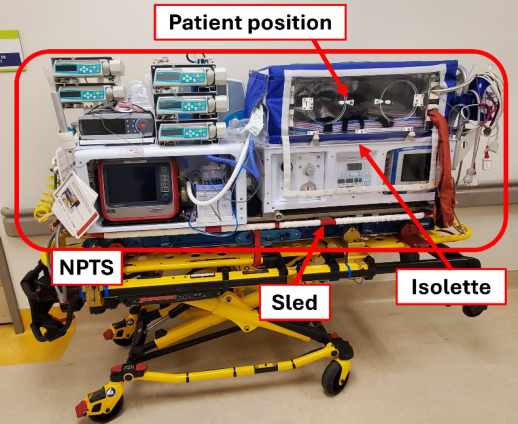
Neonatal patients in need of a higher level of care than their current facility can provide must be transferred to a facility equipped with the necessary resources and expertise. While transportation is essential, it exposes these at-risk patients to increased levels of noise and vibration, which can be harmful (Mohamed, 2010; Gupta, 2019). In Ontario, Canada more than 2000 neonates require transportation every year (Ontario Ministry of Health, 2019). Therefore, the transportation of these patients is a vital part of perinatal care. Transportation of neonates across the province is provided using a standardized Neonatal Patient Transport System (NPTS) (Ramirez, 2014), see Figure 1.
Figure 1: Ontario’s neonatal patient transport system.
The NPTS comprises the medical and monitoring equipment necessary to provide crucial support to the patient, including the isolette in which the patient is secured. An advantage of this system is its compatibility with multiple securing interfaces and vehicle types. Depending on the remoteness of the region, distance, and urgency, a ground, fixed-wing, or rotary-wing ambulance will be dispatched, staffed by a specialized neonate transport team. In some instances, multiple modes of transport may be required.
Transport teams have reported a noticeable increase in the vibration experienced by the patient during transport (Green, 2018). A collaborative health research project was initiated with the goal of quantifying and analyzing the vibration and noise exposure of the various transport environments. The project is divided into three pillars: 1) characterization, which involves quantifying the vibration and sound level within the ground, fixed-wing, and rotary-wing ambulances; 2) experimentation, to establish standardized laboratory test procedures to replicate each ambulance’s motion
and perform detailed vibration studies; and 3) mitigation, to explore strategies for attenuating vibration and sound levels during transport.
Quantifying the vibration exposure of patients is necessary for identifying whether the levels experienced exceed recommended values. It is also valuable to understand how the exposure at the patient location differs from that of transport team members, drivers, and pilots. This may provide more insight to caregivers on how the conditions they experience may translate to those of the patient.
Vibrations resulting from the ambulance’s motion are propagated through the floor interfaces and the NPTS to the neonates. Each ambulance and type of mechanical interface used to secure the NPTS to the vehicle has its own unique vibration profile, resulting in a different patient ride quality for each mode of transportation. We aim to investigate the relative exposure levels due to different vehicle types and positions within the ambulances. The objective is to evaluate vibration amplitudes and spectra for different locations in these vehicles, and identify how patient exposure may differ from that of adult occupants.
METHODOLOGY
Field tests were conducted on four vehicle types used in Ontario for neonatal transport: one ground ambulance (Demers MX-164 Type III Ambulance with a Ford E-450 chassis), one helicopter (Leonardo AW-139), and two fixed- wing aircraft (Pilatus PC-12 and Beechcraft 1900D).
Data Collection Due to the high-demand equipment and ambulances that are used for such time sensitive patient transfers, vehicle data were measured in individualized tests, using different approaches for each vehicle type. Some data were collected during dedicated full-vehicle field tests, whereas other data were collected passively during real transport operations. Dedicated tests were performed on the ground ambulance and PC-12, as these vehicles could be reserved for testing periods. The ground ambulance was available for 3 days, while the PC-12 testing occurred over a single morning. Passive measurements were taken on board the AW-139 and Beechcraft 1900D, without any interruption to service. The time available with each vehicle dictated the extent of instrumentation that could be used.
Ground ambulance data were recorded during multiple days of testing across the city of Ottawa (Kehoe, 2023). The instrumented vehicle included accelerometers (PCB Piezotronics, Model 356A01, NY, USA) and inertial measurement units (IMUs) (RaceTechnology, model SPEEDBOX IMU+GPS2RTK, Nottingham, UK) on the floor and NPTS sled, and a sampling rate of 2000 Hz was used. The sample of data used in this analysis is a segment of driving from the hospital campus, down arterial, highway, and collector road types, and was approximately 36 minutes in duration. A 2.5 kg neonatal manikin (Laerdal NRN High Fidelity NewB Doll, Stavanger, Norway) was harnessed in the isolette, as would be a patient, for all road
Vibration Exposure During Neonatal Patient Transport by Ground and Air Ambulance 181
tests. The IMU measurements taken from the vehicle floor and NPTS sled were used for this comparison.
PC-12 data were gathered on a dedicated 1.5-hour flight on a Royal Canadian Mounted Police (RCMP) aircraft. The aircraft was not configured for medical transport, and did not include the NPTS. Instead, six triaxial accelerometers (PCB Piezotronics, Depew, NY, USA) were secured to the floor in the position the NPTS would be loaded, and a seventh was mounted within a seat pad to capture vertical motion at the pilot’s seat. A SCADAS XS (Siemens, Munich, Germany) was used for data acquisition, and measurements were taken at a sampling rate of 12.8 kHz. The segments of the flight that are considered in this investigation include: runway taxi, takeoff, climb, cruise, descent, normal approach, and landing. Significant turbulence was observed during the cruise and descent phases. The vertical pilot seat and one triaxial floor sensor were considered in this analysis.
During the passive data collection flights, small, stand-alone enDAQ S3- D40 (enDAQ, Woburn, MA, USA) data loggers were deployed on these aircraft by transport team members. The Beechcraft 1900D was in service when measurements were taken, and the AW-139 was performing a scheduled flight with no patient onboard. One logger was positioned on the vehicle floor and one on the NPTS sled using double-sided tape. The data loggers were set to record three-axis acceleration data at 1000 Hz; three-axis gyroscope data at 400 Hz; and pressure, temperature, and humidity at 10 Hz. It was noted that the AW-139 flight conditions were very calm, possibly more so than a typical journey with a patient.
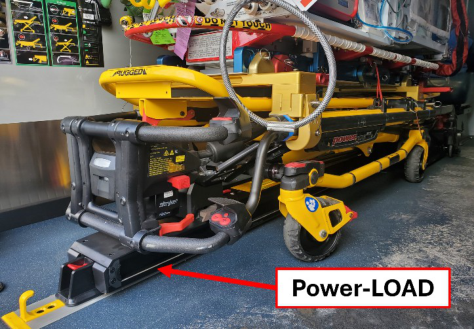
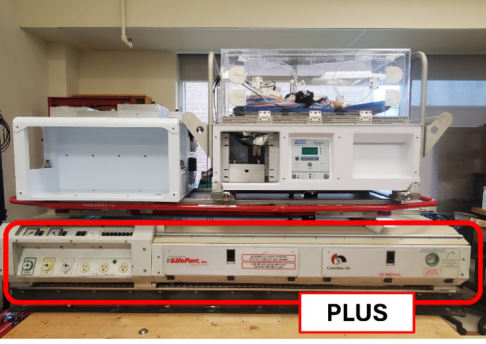
The means for securing the NPTS varies depending on vehicle. In the ground ambulance and AW-139 helicopter, a Stryker Power-LOAD (Kalamazoo, MI, USA) system is used to secure the stretcher to the floor. In both fixed-wing aircraft, a Lifeport Patient Loading Utility System (PLUS) (Woodland, WA, USA) is used, which fastens directly to the NPTS sled. These interfaces are presented in Figures 2 and 3. The NPTS is aligned with the longitudinal axis in all vehicles of interest, except for the helicopter, where it is mounted laterally.
Figure 2: Stryker Power-LOAD, used in ground ambulance and AW-139 helicopter.Figure 3: Lifeport PLUS, used in Beechcraft and PC-12 fixed-wing aircraft.
Data Processing The sensor locations being compared include the cabin floor, representing the transport crew members’ position, the driver/pilot seat, the driver/pilot floor position, and below the incubator, on the red sled of the NPTS.
ISO 2631 describes methods for evaluating whole-body vibration (WBV) in terms of root mean square (RMS) acceleration (ISO 2631, 1997). This standard considers motion in the frequency range of 0.5−80 Hz for comfort, health, and perception analysis. ISO 2631 defines frequency weightings to be applied for evaluating comfort or health. These weightings are direction- and orientation-specific, and are applicable to adult bodies. Further scaling factors depending on direction are also provided. Given that the orientation of the patient is recumbent during transport, no weightings for health are available for the recumbent body, and the patient of interest is not an adult, weightings have not been applied in this analysis. Instead, RMS acceleration was evaluated for comparison of the pure mechanical vibration, which could then be further analysed with the appropriate weightings to evaluate patient, driver, and passenger risk. RMS acceleration was evaluated in the range of 1– 150 Hz after applying a bandpass Butterworth filter. The lower bound of 1 Hz as opposed to 0.5 Hz was needed for PC-12 data to further filter transient vehicle motion, and was applied to other vehicle data for consistency. The upper bound of 150 Hz was used to capture high energy harmonics caused by the fixed-wing aircraft propellers. Acceleration was measured in units of g, and findings are presented in GRMS.
The frequency responses of the measured positions were evaluated using the acceleration Power Spectral Density (PSD), computed using the pwelch function in MATLAB, with a 1 Hz resolution and 1 second window sizing. The transmissibility of the floor-to-NPTS interface was computed between pairs of sensors at the cabin floor and NPTS sled, as the ratio of T = PSDout/PSDin, using the floor signal as the input.
Given the varying data collection methods, some gaps in measurement locations exist, such as the PC-12 NPTS vibration. An attempt to predict
Vibration Exposure During Neonatal Patient Transport by Ground and Air Ambulance 183
vibration exposure at these locations has also been performed. The transmissibility evaluated between the Beechcraft floor and NPTS was used as an estimation for the vibration transmitted across the LifePort PLUS interface. Using Ry(f) = T(f)Rx(f) where Rx is the input PC-12 PSD, measured from the floor, and T(f) is the LifePort PLUS transmissibility, the resultant PSD at the NPTS location within the PC-12, Ry, was estimated.
To estimate exposure at the pilot and driver locations, kinematic acceleration was computed at those locations using the acceleration difference equation applicable to rigid bodes with measured translational and angular motions at the sensor location (Ginsberg, 1998). The geometry of the ground ambulance and sensor locations was complete; however, only approximate sensor locations were known for the Beechcraft and AW-139 flights More information was known regarding the Beechcraft NPTS sensor position than the floor sensor, so this location was used as the input position and rigid attachment of the NPTS to the floor was assumed. Given the PC-12 test did not involve collecting angular rate gyroscope data, this vehicle was excluded from this stage of evaluating floor motion at the pilot location. The validation of this acceleration calculation process in the ground ambulance has been previously reported (Kehoe, 2022). Since high frequency content contributed significantly to noise in the resulting motion, low-pass filters with cut-off frequencies of 20 Hz for accelerometer and 5 Hz for gyroscope data were used in order to better represent the vehicles’ rigid body motion. Although this does not encapsulate the full frequency range of interest, the resonant frequency of the human body has been shown to fall within the 1–20 Hz range across various ages and sizes (Fairley, 1989; Huang, 2009). A separate comparison of GRMS values for the 1–20 Hz frequency range has also been made.
RESULTS
The unweighted GRMS for measured and predicted positions, filtered between 1–150 Hz and 1–20 Hz, are presented in Tables 1–3 in the x, y, and z directions, respectively, where x is the longitudinal direction of the vehicle, y is lateral, and z is vertical. Values computed directly from measured data are in black, and extrapolated values are presented in italicized blue text.
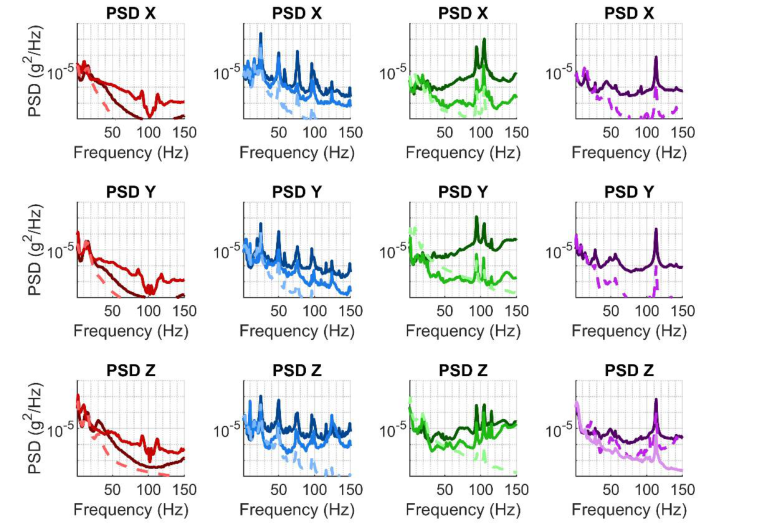
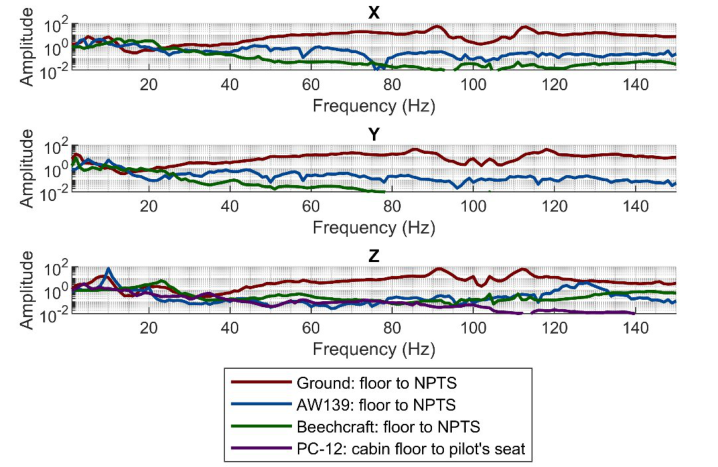
The PSD of each position in the x, y, and z directions are presented in Figure 4. The transmissibility between multiple signals within the same vehicle are presented in Figure 5.
Figure 4: Acceleration power spectral densities.
Vibration Exposure During Neonatal Patient Transport by Ground and Air Ambulance 185
Figure 5: Transmissibility.
DISCUSSION
Reported findings often identify the vertical direction to be the most dominant axis of vibration in vehicles (Campbell, 1984; Browning, 2008; Darwaish, 2021). In the 1–20 Hz range, we found the vertical accelerations were the most prominent when considering the cabin floor measurements. The ground ambulance exhibited the greatest vertical acceleration, followed by the PC-12. Some vehicle comparison studies have reported the highest WBV in helicopters (Bouchut, 2011; Bailey, 2019; Campbell, 1984). We found the helicopter vertical GRMS was higher than other vehicles in the 1–150 Hz range, but lower than other vehicles in the 1–20 Hz range. In the 1–20 Hz range, the greatest NPTS acceleration occurred during ground transport. Although acceleration of the NPTS on the Beechcraft is lower than the other vehicles, there is an increase in GRMS value in all vehicles when moving from the floor to NPTS position, in all three axes.
Considering the spectral findings, there is a clear difference in which frequencies dominate the system response in each vehicle type. The aircraft exhibit greater energy around the rotor frequencies and their subsequent harmonics (the N/rev harmonic where N is the number of blades on each rotor being 25 Hz for the AW-139, 112 Hz for the PC-12, and 94 Hz for the Beechcraft), while the ground ambulance peaks at lower frequencies associated with wheel-hop and vehicle body vibration.
The greatest transmissibility occurred in the helicopter vertical direction, followed by all directions in the ground ambulance. Lateral motion of the NPTS in the ground ambulance aligns with the observations made of it noticeably rocking about the floor interface. The different orientation of the PowerLoad within the ground ambulance and AW-139 may contribute
to the distinct vibration transmission between the two vehicles. While the PC-12 pilot’s seat response exceeds that of the cabin floor, the concentration of energy at this position is very low on the frequency spectrum, below 5 Hz. The seat appears to dampen the higher energy peaks caused by the rotor. This indicates that vibration exposure of the pilot, crew, and patient differs, and highlights the importance of seat design when considering vibration isolation (Paddan, 2002). This same principle may be relevant when considering the NPTS mounting methods. What is effective at isolating the patient from floor-level vibration in one environment may not be optimal in all vehicle types.
A limitation of using the transmissibility generated between positions within a vehicle is that they were established using a vehicle-specific excitation spectrum. It may under-represent the response of the system at frequencies that were less prevalent in that vehicle, and when applying this transmissibility to other vehicles, the predicted response may differ from a measured response. The use of a standard excitation profile, such as a sinusoidal frequency sweep of constant amplitude, would be better suited for characterizing the dynamic properties of the NPTS and floor interface further. Laboratory experiments which examine such analysis will be presented in future work.
Additionally, this vibration investigation compared the responses across entire journeys, and does not illustrate the changing conditions depending on phase of flight, type of road, or speed of travel. Treating these phases individually and then evaluating for equivalent exposure over the entire journey would provide a more complete depiction, and this method has been explored in past and ongoing work (Kehoe, 2023). This averaging across the entire journey duration may under-represent higher energy, short duration conditions. However, the intention of this analysis is to provide an overview of a baseline “realistic” transport, from start to finish.
CONCLUSION
We aimed to characterize the vibration environment in multiple modes of neonatal patient transportation. In addition, we predicted responses at different positions within the vehicles. The findings highlight the different vibration signatures of these vehicles, and how vibration is transmitted differently from the floor to the NPTS depending on the interface method and orientation within the vehicle. The ground ambulance exhibits higher amplitude vibration at low frequencies, while the vibration spectra of the aircraft are significantly dominated by propeller and rotor frequencies. However, the transmissibility of vibration from the floor to the NPTS is lower at high frequencies, which attenuates the vibrations coming from propeller or rotor harmonics. Passenger and driver seat design plays an important role in improving ride quality for adult occupants, and the experiences of these individuals differ from those of the neonate patients. Approaches to mitigate potentially harmful levels of vibration at the patient level must consider the response of these very different environments, and likely require individualized vibration isolation solutions.
Vibration Exposure During Neonatal Patient Transport by Ground and Air Ambulance 187
ACKNOWLEDGMENT
The authors acknowledge the joint support of the Natural Sciences and Engineering Research Council of Canada (NSERC) and the Canadian Institutes of Health Research (CIHR) for this Collaborative Health Research Project [CHRPJ-2020-549669]. We greatly appreciate the contributions from NRC, OPS, Ornge, and RCMP for helping make this study possible.
REFERENCES
Bailey, V. et al. (2019). “Modern Neonatal Transport: Sound and Vibration Levels and Their Impact on Physiological Stability”, American Journal of Perinatology. Volume 36, No. 4, pp. 352–359. Bouchut, J.-C. et al. (2011). “Physical stressors during neonatal transport: Helicopter
compared with ground ambulance”, Air Medical Journal. Volume 30, No. 3, pp. 134–139. Browning, J. et al. (2008), “Vibration issues of neonatal incubators during in-hospital transport”, J Clinical Engineering. Volume 33, No. 2, pp. 74–77. Campbell, A. N. et al. (1984). “Mechanical vibration and sound levels experienced
in neonatal transport”, American Journal of Diseases of Children. Volume 138, No. 10, pp. 967–970. Darwaish, F. et al. (2021). “Characterizing on-road vibrations in Ontario’s neonatal patient transport”, IEEE International Symposium on Medical Measurements and Applications (MeMeA). pp. 1–6. Fairley, T. E. and Griffin, M. J. (1989). “The apparent mass of the seated human
body: Vertical vibration”, J Biomech. Volume 22, No. 2, pp. 81–94. Ginsberg, J. (1998) Advanced Engineering Dynamics, 2nd edn, New York, NY: Cambridge University Press. Green, J. R. et al. (2018). “Measurement of Vibration Levels on Neonatal Transport
Systems Using a Custom Data Logger”, IEEE International Symposium on Medical Measurements and Applications (MeMeA), pp. 1–6. Gupta, N. et al. (2019). “Neurocritical care of high-risk infants during interhospital transport”, Acta Paediatrica. Volume 108, No. 11, pp. 1965–1971. Huang, Y. and Griffin, M. J. (2009). Nonlinearity in apparent mass and transmissibility of the supine human body during vertical whole-body vibration. Journal of Sound and Vibration, Volume 324, No. 1–2, pp. 429–452. International Organization for Standardization (1997). ISO 2631-1:1997 Mechanical vibration and shock. Kehoe, P. et al. (2022). “Vibration Profiles of a Road Ambulance Using Equivalent
Acceleration”, Proceedings of the Canadian Society for Mechanical Engineering International Congress. Kehoe, P. et al. (2023). “Characterization of Noise and Vibration in a Ground Ambulance by Road Classification” In: Huang, W., Ahmadian, M. (eds) Advances in Dynamics of Vehicles on Roads and Tracks III. IAVSD 2023. Lecture Notes in Mechanical Engineering. Springer, Cham. pp. 471–480. Mohamed, A. M. and Aly, H. (2010). “Transport of premature infants is associated
with increased risk for intraventricular haemorrhage”, Archives of Disease in Childhood: Fetal and Neonatal Edition. Volume 95, No. 6, F403–F407. Ontario Ministry of Health (2019). “Newsroom : Helping Critically-ill Newborns Access Safe and Timely Transportation in Eastern Ontario”. Available at: https:// news.ontario.ca/en/release/52838/helping-critically-illnewborns-access-safe-and- timely-transportation-in-eastern-ontario.
Paddan, G. S. and Griffin, M. J. (2002). “Effect of seating on exposures to wholebody vibration in vehicles”, Journal of Sound and Vibration. Volume 253, No. 1, pp. 215–241. Ramirez, M. (2014). “A provincial neonatal transport incubator for Ontario”,
Proceedings of the 37th Canadian Medical and Biological Engineering Conference. Volume 37.
LISTED IN THE AHFE DIGITAL BOOKSTORE CATALOGUE
Explore the complete digital volume
Advances in Human Factors of Transportation
Read this individual research paper free through the original publisher, or explore the full digital proceedings book.
ISBN 978-1-964867-62-5
Explore this ISBN in the AHFE Bookstore ↗Listed in the July 2026 bookstore catalogue; search by ISBN to confirm current availability · Digital book purchase optional