Elena Stefana, Natalia Guskova, Giulio Di Gravio, Riccardo Patriarca (2024). Should I board this Advanced Air Mobility vehicle? A systemic risk assessment of eVTOL in a vertiport. In: Advances in Human Factors of Transportation. AHFE Open Access, vol. 148, pp. 66–76. https://doi.org/10.54941/ahfe1005196
Advanced Air Mobility (AAM) vehicles can serve a wide range of operations, supporting passenger and cargo movements within and between urban and rural environments. Novel risks emerge from AAM systems with respect to both airborne and ground segments, calling for the adoption of systems theory and a systemic perspective for safety risk management. In this domain, Systems Theoretic Accident Modelling and Processes (STAMP) is an accident causality model that considers safety as a continuous control task. The scientific literature already offers some applications of STAMP and its nested techniques, i.e., System-Theoretic Process Analysis (STPA) and Causal Analysis based on System Theory (CAST), for investigating the safety management in the AAM domain. However, to the best of our knowledge, no contributions use as a unit of analysis the management of safe operations for an AAM system by adopting an integrated perspective to account for the interactions among different kinds of vehicles within vertiports and airports. For this reason, the manuscript proposes a systemic analysis for the safety management of electric Vertical Take-Off and Landing (eVTOL) vehicles operating at a vertiport located inside an airport. We employed the STPA technique, whose usage has been enhanced thanks to a standardized and neutralized taxonomy describing human factors involved in the operations. This allowed for embracing a no-blame and non-judgemental human perspective, which benefits from the systemic view offered by STPA.
Advanced Air Mobility (AAM) aims at reinventing the idea of air travel (EU, 2012) and being integrated in current transportation systems in cities and regions (Garrow et al., 2022). Such air transportation ecosystem can serve a wide range of operations and offer various use cases: e.g., transporting peo- ple and goods within and between cities, air ambulance services, emergency
Should I Board This Advanced Air Mobility Vehicle? A Systemic Risk Assessment 67
supply delivery, transportation of organs, and search and rescue operations (Kiesewetter et al., 2023). Typical AAM vehicles are Vertical Take-Off and Landing (VTOL) and electric Vertical Take-Off and Landing (eVTOL) air- craft, i.e., power-driven, heavier-than-air aircraft, other than aeroplane or rotorcraft, capable of performing vertical take-off and landing by means of more than two lift or thrust units used to provide lift during take-off and landing (EASA, 2022a, 2022b).
The operations carried out by VTOL-capable aircraft requires a level of safety that is at least as high as that applicable to missions performed with conventional aeroplanes or helicopters (EASA, 2022a). These systems shall be compliant with relevant regulations and meet safety requirements in order to be certified before starting air operations, and their operators shall receive an Air Operator Certificate (AOC) (EASA, 2022a; Markov et al., 2022). Fur- thermore, VTOL vehicles should be safely integrated into air and ground infrastructures. As such, their operation requires proper assessment and man- agement of the main and emergent risks to occupants, ground risks, and air risks connected to their operations (EASA, 2022a).
As a consequence, the integrated system represents a system of systems, where any system interacts with each other within the existing rule and reg- ulation framework (Stanton et al., 2019). In such a context, it becomes necessary to adopt a full-fledged systemic perspective for safety risk man- agement, moving towards systems theory to capture hazardous scenarios otherwise not identifiable by traditional hazard analysis and safety assess- ment techniques based on the superimposition principle (Dakwat & Villani, 2018). Systems theory focuses on both system operations and management processes related to the system under investigation (Leveson, 2011). In this domain, Systems Theoretic Accident Modelling and Processes (STAMP) is an accident causality model based on systems theory, which considers safety as a continuous control task managed by a control structure embedded in an adaptive socio-technical system (Leveson, 2004). In STAMP, systems are made up of interrelated components that are kept in a state of dynamic equilibrium by feedback loops of information and control.
The scientific literature offers different contributions dealing with the use of STAMP and its nested techniques, i.e., System-Theoretic Process Anal- ysis (STPA) and Causal Analysis based on System Theory (CAST), for the safety management of AAM systems (e.g., Chen et al., 2015; Elks et al., 2022; Plioutsias et al., 2018) and, in particular, of eVTOL vehicles (Graydon et al., 2020; Markov et al., 2022). However, to the best of our knowledge, no contributions investigated already their safe operability when accounting for the interactions among different kinds of vehicles within traditional and novel infrastructures (i.e., airports and vertiports). For this reason, this paper proposes a systemic analysis for the safety management of operations and risks of AAM and their associated infrastructure, considering the European regulations currently available, and rules, procedures, and technical specifica- tions developed by any aviation authority. Specifically, the study focuses on a proactive hazard analysis based on the STPA technique about eVTOL vehicles
operating at a vertiport located inside an airport. This analysis is performed by implementing a no-blame and non-judgemental human perspective to comprehend the roles and behaviours of Human Factors (HF) involved in the operations. The adoption of such a neutralized HF approach is aligned with the principle of equivalence promoted by the Resilience Engineering (Patriarca et al., 2019).
METHODOLOGY
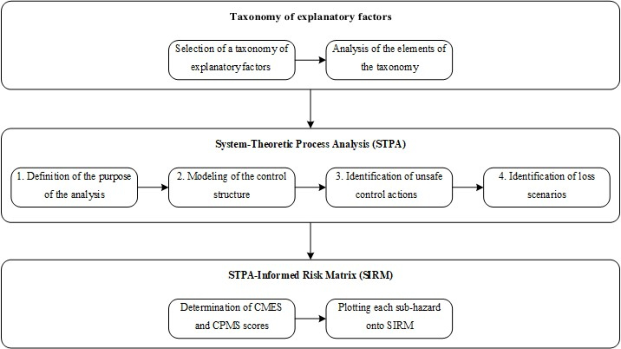
The methodology employed for the risk assessment of eVTOL in a vertiport is depicted in Figure 1. This is based on coupling the STPA technique with a taxonomy of explanatory factors able to describe the various interactions among the system components in a standardized and neutralized way. Finally, a STPA-Informed Risk Matrix (SIRM) has been developed for understanding whether the risks related to system operations are acceptable.
Figure 1: Methodology combining STPA, a taxonomy of explanatory factors, and SIRM.
STPA is fully described in Leveson & Thomas (2018), and it is composed of the following steps:
1. definition of the purpose of the analysis to clarify the system and its boundary, the types of losses, system-level hazards and constraints; 2. modelling of the control structure, i.e., a hierarchical system model cap- turing the functional relationships and interactions in terms of control actions and feedback loops among controllers and controlled processes; 3. identification of Unsafe Control Actions (UCAs) that are used to create functional requirements and constraints for the system, and can lead to a hazard in particular conditions; 4. identification of loss scenarios, which describe the causal factors that can lead to the UCAs and to hazards.
Should I Board This Advanced Air Mobility Vehicle? A Systemic Risk Assessment 69
STPA could be supplemented by the development of the SIRM that con- siders the mitigation effectiveness. This allows analysing and evaluating the risks by determining Combined Mitigation Effectiveness Score (CMES) and Combined Post Mitigation Severity (CPMS) (Gregorian & Yoo, 2021). The practicality of the SIRM methodology was studied in the aircraft mainte- nance field and its contribution to the objectification of risk assessment was confirmed (Guskova et al., 2023).
The overall usage of the STPA technique was enhanced by implement- ing a standardized and shared taxonomy of factors that can explain the potential relationships among the controllers involved in a system. Such tax- onomy should also be characterized by a neutralized language for describing the human roles and dynamics in the operations of socio-technical sys- tems to endow STPA with an explicit HF dimension. Hence, the taxonomy of explanatory factors proposed by EUROCONTROL (2015) represents a valuable and relevant support to perform risk analyses by means of sys- temic approaches. This taxonomy is based on a non-judgemental neutralized language that allows describing both negative events and routine activities (Patriarca et al., 2019; Shorrock & Williams, 2016). The categories (i.e., Level 1) and their groups of factors (i.e., Level 2) composing the taxonomy are reported in Table 1.
Table 1. Taxonomy of explanatory factors (adapted from EUROCONTROL, 2015).
Table available in the original PDF paper.
Level 1 Level 2 Personnel Perception; Memory; Decision; Action; Conformance Interaction with the environment Pilot actions; Pilot/controller communications; Airspace; Traffic management; External agencies; Weather; Aircraft technical and emergencies; Airport Equipment Navigational equipment; Surveillance; Flight data processing; Human Machine Interface (HMI) and support systems; Air / ground communications; Ground communications; Airport systems; Power systems; Networks; Workstation / console positions; Control and monitoring positions Contextual factors Documentation and procedures; Interaction with equipment; Training and experience; Organizational factors; Operational environment; Team factors; Personal factors Air Traffic Safety Electronic Personnel (ATSEP) communication
The methodology described above was used to perform the analysis. The main results about STPA and SIRM are presented and discussed in the next paragraphs.
Definition of the Purpose of the Analysis The purpose of our study is to analyse and assess the risks associ- ated with the operations of eVTOL vehicles at a vertiport located inside an airport, by adopting a neutralized taxonomy for describing human behaviours.
This aim required identifying and examining the set of regulations and rules developed by competent authorities that are relevant and applicable in the context under investigation, as listed below:
current regulations establishing common rules for air services and opera- tors developed by European Commission (EC) and European Union (EU) (e.g., Regulation (EC) No 1008/2008 (European Parliament and Coun- cil, 2008), Commission Regulation (EU) No 965/2012 (EU, 2012), EU 2021/664 (EU, 2021));
rules, specifications, means of compliance, and guidance material pub- lished by European Union Aviation Safety Agency (EASA) for both general aviation operations (e.g., EASA, 2023a), and AAM and VTOL missions (e.g., EASA, 2022a, 2023b);
specifications and guidelines about the safe design and use of verti- ports prepared by any aviation authority (e.g., EASA, 2022b; FAA, 2022).
The regulations, rules, and specifications provided a framework to identify the stakeholders and controllers associated with the system under investi- gation. For instance, in accordance with EASA (2022b), the term operator refers to legal or natural person that is operating or proposing to oper- ate one or more airports, vertiports, or eVTOL fleet. The accountable manager is the person identified by the operator that has the overall respon- sibility to run the organization, and is also responsible for coordinating the safety management processes and tasks (EASA, 2017). In our analy- sis, we assume that the accountable manager role also includes various postholders related to (e.g.) ground, flight, training, and maintenance issues. Finally, to highlight the relevance of the maintenance aspects of the eVTOL vehicles, we consider the eVTOL maintenance unit as a separate stake- holder, although this is not mentioned explicitly in the documents being analysed.
The identification of these stakeholders allowed recognizing a set of losses that are unacceptable to them and hazards related to the losses. The losses under investigation are associated with different flight phases, and are related to: L-1: Loss of life or injury to people (both in the vehicle and on the ground); L-2: Loss of or damage to eVTOL; L-3: Loss of or damage to infrastructure; L-4: Loss of or damage to buildings (i.e., differ- ent from flight-related infrastructure); L-5: Loss of mission. These losses can be caused by different hazards and sub-hazards that are summarized in Table 2.
Should I Board This Advanced Air Mobility Vehicle? A Systemic Risk Assessment 71
Table 2. Hazards and sub-hazards identified in the analysis.
Table available in the original PDF paper.
Hazard Sub-Hazard H-1: eVTOL exceeds safe limits (e.g., off route, minimum separation, speed, flight level) H-1.1: eVTOL has exceeded the designated route; H-1.2: eVTOL has exceeded the safe distance (minimum separation requirements) from terrain or other obstacles; H-1.3: eVTOL exceeded the safe distance (minimum separation requirements) from other aircraft; H-1.4: eVTOL exceeded speed and flight level requirements H-2: eVTOL is not airworthy, it is operated below limits
H-2.1: eVTOL is operated below airworthiness limits; H-2.2: eVTOL maintenance intervals are not observed, including the pre-flight technical check H-3: Information about position, time, problems, or emergency about eVTOL is not transmitted
H-3.1: Information about eVTOL position is not transmitted; H-3.2: Information about eVTOL time is not transmitted; H-3.3: Information about eVTOL technical problems is not transmitted; H-3.4: Information about eVTOL emergency is not transmitted H-4: Infrastructure is not sufficiently maintained for operations
H-4.1: Vertiport infrastructure is not sufficiently maintained for operations; H-4.2: Airport infrastructure is not sufficiently maintained for operations H-5: Information between airport and vertiport is not transmitted
H-5.1: Information between airport and vertiport personnel is not frequent for safe operations; H-5.2: Information between airport and vertiport personnel is not sufficient (i.e., accurate / complete) for safe operations
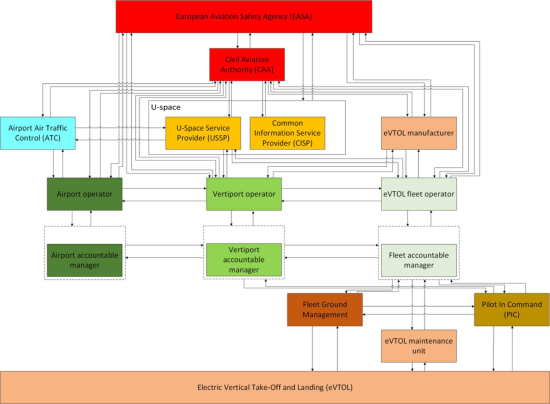
Modeling of the Control Structure The Safety Control Structure (SCS) of the system was considered necessary to analyse these hazards and sub-hazards. Figure 2 represents the SCS for the operations of eVTOL vehicles at a vertiport located inside an airport. In this figure, similar controllers are identified by boxes of the same colour. The interactions among them were phrased according to the taxonomy of explanatory factors proposed by EUROCONTROL (2015). An excerpt of these interactions referred to H-5 is reported in Table 3, with an indication of their types: Control Action (CA), Feedback (FB), Input (In), or Output (Out). They regard different HF aspects, spanning from personnel factors, interac- tions with the environment, and contextual elements. Personnel factors are mainly focused on physical actions and/or decision processes (e.g., conduc- tion of the mission and transmission of flight information performed by the Pilot In Command (PIC)), while interactions with the environment concern traffic management issues (e.g., traffic mix) involving operators and account- able managers. Most of the interactions related to H-5 deal with contextual factors and, specifically, documentation and procedures, organizational and team factors, training and experience.
Figure 2: SCS of the system (boxes of the same colour identify similar controllers).
Identification of Unsafe Control Actions The H-5 hazard could be caused by 39 UCAs for the controllers linked to airport and/or vertiport operations and management processes. These UCAs could occur because (i) the control action is not provided, (ii) the control action is provided, (iii) the control action is provided too late, or (iv) the control action is applied too long or is stopped too soon. For instance, the control action between the vertiport operator and accountable manager could become unsafe (UCA) in case:
the vertiport operator does not provide documentation, procedures, emer- gency services, capacity restrictions, and flight planning for eVTOL operations;
the vertiport operator provides documentation, procedures, emergency services, capacity restrictions, and flight planning that are not adequate for the eVTOL operations;
the vertiport operator provides documentation, procedures, emergency services, capacity restrictions, and flight planning too late;
the vertiport operator stops the communication about the flight planning and capacity restrictions too soon.
Table 3. Excerpt of the interactions related to H-5.
Table available in the original PDF paper.
Description Type
Controller Controlled process
CA
Airport operator
Airport accountable manager
Documentation; Procedures; Balance of safety and efficiency; Management decisions and support; Airport authority systems; Emergency services Convey/record information FB
(Continued)
Should I Board This Advanced Air Mobility Vehicle? A Systemic Risk Assessment 73
PIC Decide/plan; Entry into airspace (authorisation) CA Vertiport accountable manager
FB Convey/record information; Position or time report; Emergency handling CA PIC Decide/plan; Entry into airspace (authorisation); Operator flight planning; Position or time report; Training
Fleet accountable manager
FB Position or time report; Convey/record information; Expectation of skill level; Emergency handling
Identification of Loss Scenarios These UCAs can be caused by different loss scenarios, including (e.g.):
the vertiport operator does not provide documentation, procedures, emer- gency services, capacity restrictions, and flight planning for eVTOL oper- ations because they were informed that documentation is not required;
the vertiport operator provides documentation, procedures, emergency services, capacity restrictions, and flight planning that are not adequate for the eVTOL operations because they received incorrect information about the operations;
the vertiport operator provides documentation, procedures, emergency services, capacity restrictions, and flight planning too late because they received information that the operation has been delayed;
the vertiport operator does not indicate that new documentation is needed, and/or U-space and regulatory organs do not inform that the eVTOL operations require new procedures;
the vertiport operator provides documentation, procedures, emergency services, capacity restrictions, and flight planning for eVTOL opera- tions, but U-space and regulatory authorities did not inform the vertiport operator of new requirements;
the vertiport operator provides documentation, procedures, emergency services, capacity restrictions, and flight planning for eVTOL operations, but the vertiport accountable manager does not use them.
More than 150 loss scenarios are linked to H-5, which can be managed by means of more than 10 safety recommendations involving the various system controllers for an eVTOL operation. For example, the coordination among them needs to be guaranteed and to reflect the real operational situation:
organizational and team factors characterizing liveware-liveware interactions represent a necessary condition to ensure the safe use of infrastructure and conduction of operations. Furthermore, these stakeholders should:
be informed in a timely manner about the specific requirements established by regulatory authorities to maintain safe and compliant operations; such regulations, standards, and requirements need to clearly indicate precise roles and basis for operations certification;
be informed in advance and in a timely manner of changes in opera- tional procedures (e.g., Airport Air Traffic Control and flight procedures, airspace design, pre-flight checks);
be updated in time about the planning operation activities;
manage and control systems and services available in infrastructure to assure safe operations.
The eVTOL vehicle should be equipped with reliable surveillance capa- bilities transmitting flight data, including emergency status. The conveyed information must be truthful, updated, and airworthy.
STPA-Informed Risk Matrix The adoption of the set of recommendations permits assessing the risks by determining CMES and CPMS. CMES for H-5.1 has been determined as most effective thanks to the availability of proactive mitigations based on system design, whereas CMES for H-5.2 has been evaluated as moderately effective due to the presence of only reactive mitigation strategies. For both these sub-hazards, the CPMS values are equal to catastrophic due to impos- sibility of reducing the severity of losses related to the AAM operations in cities and regions. By employing SIRM and, in particular, a hazard-based approach, we obtained that H-5.1 could expose to a medium risk, while H- 5.2 to a high risk. The high-risk value cannot be fully mitigated due to the challenge of dealing with catastrophic severity in air traffic operations pro- cesses. To reduce severity, additional safety devices may be required (e.g.), a real ford to protect the airport field from unwanted eVTOL, which how- ever may not be integrated into air traffic processes. It is difficult to prevent uncontrolled movements of eVTOL across the airport field: there is still a risk of eVTOL collision with buildings or other aircraft. To improve the CMES scores, it is suggested eVTOLs to be equipped with surveillance equipment, such as Automatic Dependent Surveillance-Broadcast (ADS-B) systems and Secondary Surveillance Radar (SSR) transceivers, or other devices that meet the required integrity level. This will allow the eVTOL to be detected by Advanced Surface Movement Guidance and Control System (A-SMGCS), Multilateration (MLat), and other surveillance technologies, ensuring safe management of their operations on eVTOL routes, and on airport and ver- tiport fields. This equipment could potentially enable the transmission of accurate and current information among all system controllers, including airport and vertiport personnel. An integrated system-level capability could potentially improve situation awareness for all stakeholders and reduce the likelihood of collisions.
Should I Board This Advanced Air Mobility Vehicle? A Systemic Risk Assessment 75
CONCLUSION
The increasing interest towards the use of novel transportation and air solu- tions requires in-depth investigations of their safety risks in different use cases and environments. Systemic approaches could represent a valuable support to perform proactive hazard analyses and risk assessments of complex avia- tion socio-technical systems, where a wide range of interactions exist among various stakeholders and controllers. In such direction, this study adopts the STPA technique for assessing the risks associated with the operations of eVTOL vehicles at a vertiport located inside an airport. By embracing a neu- tralized and no-blame perspective, the study reveals various hazards and loss scenarios that should be controlled through the implementation of effective safety recommendations. These recommendations regard regulatory author- ities (e.g., definition of clear roles and responsibilities), humans involved in airports and vertiports (e.g., assurance and fostering of coordination), and eVTOL vehicles (e.g., availability and integrity of surveillance equipment). Our study could be further refined and enhanced when new regulations, stan- dards, and requirements (currently, under development or in consultation) will be established for vertiport infrastructure and eVTOL vehicles. The anal- ysis presented in this paper could also be extended to other VTOL-capable aircraft with different propulsion systems.
ACKNOWLEDGMENT
This work is part of the research activities developed by the authors within the framework of PNRR: CN4 “Sustainable Mobility Center” - SPOKE 1 “Air Mobility” (E.S., R.P.) and SPOKE 7 “CCAM (Cooperative, Connected Auto- mated Mobility), Connected Networks and Smart Infrastructure” (G.D.G.) - CN_00000023 - CUP B83C22002900007.
REFERENCES
Chen, J., Zhang, S., Lu, Y., & Tang, P. (2015). STPA-based hazard analysis of a complex UAV system in take-off. ICTIS 2015 - 3rd International Conference on Transportation Information and Safety, Proceedings, 774–779. Dakwat, A. L., & Villani, E. (2018). System safety assessment based on STPA and
model checking. Safety Science, 109(May), 130–143. EASA (2017). Acceptable Means of Compliance (AMC) and Guidance Material (GM) to Annex III Organisation requirements for air operations [Part-ORO] of Commission Regulation (EU) 965/2012 on air operations. EASA (2022a). Notice of Proposed Amendment 2022–06 in accordance with Article
6 of MB Decision No 1–2022. Introduction of a regulatory framework for the operation of drones. EASA (2022b). Vertiports. Prototype Technical Specifications for the Design of VFR Vertiports for Operation with Manned VTOL-Capable Aircraft Certified in the Enhanced Category (PTS-VPT-DSN). EASA (2023a). Easy Access Rules for Air Operations. EASA (2023b). Fourth Publication of Proposed Means of Compliance with the
Special Condition VTOL.
Elks, C., Martin, P., Klenke, R. H., Gautham, S., Simon, B., Will, A., Truslow, P., & Dill, E. T. (2022). Pervasive Runtime Monitoring for Detection and Assessment of Emerging Hazards for Advanced UAM Systems. AIAA Aviation Forum 2022. EU (2012). Commission Regulation (EU) No 965/2012 of 5 October 2012 laying
down technical requirements and administrative procedures related to air opera- tions pursuant to Regulation (EC) No 216/2008 of the European Parliament and of the Council. EU (2021). Commission Implementing Regulation (EU) 2021/664 of 22 April 2021 on a regulatory framework for the U-space. EUROCONTROL (2015). Explanatory Factors. Safety Learning Cards. European Parliament and Council (2008). Regulation (EC) No 1008/2008 of the
European Parliament and of the Council of 24 September 2008 on common rules for the operation of air services in the Community. FAA (2022). Engineering Brief No. 105 - Vertiport Design. Garrow, L. A., German, B., Schwab, N. T., Patterson, M. D., Mendonca, N., Gawdiak, Y. O., & Murphy, J. R. (2022). A Proposed Taxonomy for Advanced Air Mobility. AIAA AVIATION Forum and Exposition. Graydon, M. S., Neogi, N. A., & Wasson, K. S. (2020). Guidance for designing safety
into urban air mobility: Hazard analysis techniques. AIAA Scitech 2020 Forum, 1 PartF(January), 1–17. Gregorian, D. J., & Yoo, S. M. (2021). A System-Theoretic Approach to Risk Analysis. Guskova, N., Lališ, A., Vítovec, O., & Žd’Ánský, Z. (2023). A STAMP-based Risk
Register for Maintenance, Repair, and Overhaul Organisations. 2023 New Trends in Aviation Development (NTAD), 83–88. Kiesewetter, L., Shakib, K. H., Singh, P., Rahman, M., Khandelwal, B., Kumar, S., & Shah, K. (2023). A holistic review of the current state of research on aircraft design concepts and consideration for advanced air mobility applications. Progress in Aerospace Sciences, 142(August), 100949. Leveson, N. (2004). A new accident model for engineering safer systems. Safety
Science, 42(4), 237–270. Leveson, N. (2011). Engineering a safer world. Systems thinking applied to safety.
Massachusetts Institute of Technology Press. Leveson, N., & Thomas, J. (2018). STPA Handbook. Markov, A., Bendarkar, M., & Mavris, D. (2022). Improved hazard analysis for novel vehicle configurations using the systems-theoretic process analysis. AIAA Science and Technology Forum and Exposition, AIAA SciTech Forum 2022. Patriarca, R., Di Gravio, G., Cioponea, R., & Licu, A. (2019). Safety intelligence:
Incremental proactive risk management for holistic aviation safety performance. Safety Science, 118(May), 551–567. Plioutsias, A., Karanikas, N., & Chatzimihailidou, M. M. (2018). Hazard Analysis and Safety Requirements for Small Drone Operations: To What Extent Do Popular Drones Embed Safety? Risk Analysis, 38(3), 562–584. Shorrock, S. T., & Williams, C. A. (2016). Human factors and ergonomics methods in
practice: three fundamental constraints. Theoretical Issues in Ergonomics Science, 17(5–6), 468–482. Stanton, N. A., Li, W. C., & Harris, D. (2019). Editorial: Ergonomics and Human Factors in Aviation. Ergonomics, 62(2), 131–137.
LISTED IN THE AHFE DIGITAL BOOKSTORE CATALOGUE
Explore the complete digital volume
Advances in Human Factors of Transportation
Read this individual research paper free through the original publisher, or explore the full digital proceedings book.
ISBN 978-1-964867-24-3
Explore this ISBN in the AHFE Bookstore ↗Listed in the July 2026 bookstore catalogue; search by ISBN to confirm current availability · Digital book purchase optional