Saeedeh Mosaferchi, Alireza Mortezapour, Luca Orlando, Alessandro Naddeo (2024). Age limit for “driving” an autonomous vehicle: an open issue for future road transport system. In: Advances in Human Factors of Transportation. AHFE Open Access, vol. 148, pp. 191–201. https://doi.org/10.54941/ahfe1005209
Vehicles are an indisputable necessity for humans’ lives. Every day, people utilize both private and public transportation to fulfil their diverse demands. The advent of autonomous vehicles has presented novel opportunities as well as challenges for humanity, however when these cars become more commonplace, people will encounter a variety of new evolutions to manage. With a few exceptions represented by the cases in which their intervention is required, people will be free to manage their personal affairs and perform different activities during the trip with a self-driving car. Regarding this matter, it can be assumed that people will be able to utilize an autonomous vehicle even they are less than 18 years old (the minimum age for having a driving licence in most of the countries), although several questions will arise. A group of University students (whose have enough information about AVs) participated in a discussion panel and evaluated the arguments made for and against the topic to arrive at a logical conclusion. This work looks at and evaluates the panel's opinions, contrasting them with already published manuscripts and comparing the results with a wide surveys’ ones.
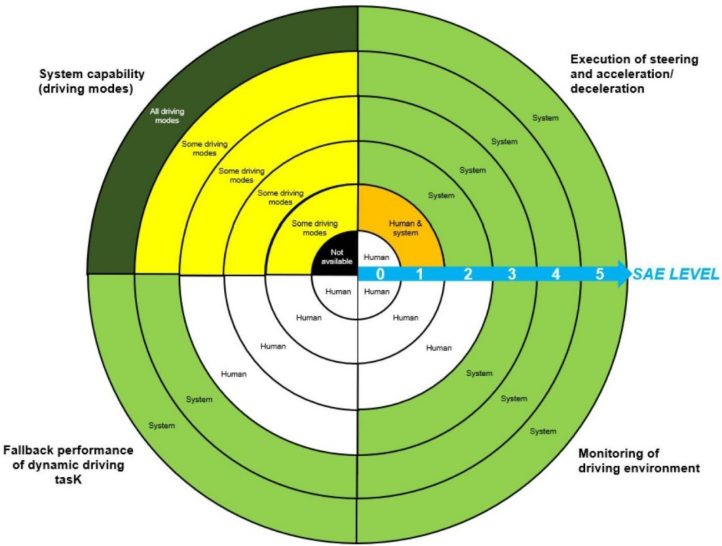
When driverless cars become more commonplace, the transportation sys- tem is predicted to undergo a dramatic transformation (Hakak et al., 2023). The Society of Automotive Engineers (SAE) has released SAE J3016, which defines six levels of automation for motor vehicles that are driven on public roads. From Level 0, which demands complete human attention and input, to Level 5, which is totally automated, are these six levels (Dirsehan and Can, 2020). Abu Bakar has defined the level of both human and system perfor- mance for different levels of an autonomous vehicle (Figure 1) (Abu Bakar et al., 2022).
Figure 1: Tasks allocation between human and AVs (with permission of Abu Bakar).
While traveling and running personal errands without having to drive may seem thrilling at first, there can be a lot of questions and obstacles involved which can even cause initial or prolonged reluctance (Gupta et al., 2021; Du et al., 2021). Even though eliminating human mistake from driving has been viewed as one of the most crucial potential benefits after the advent of self- driving cars, but trusting it in doing driving tasks instead of humans is pretty scary for people (Raue et al., 2019; Lee et al., 2020). In light of outsourcing of many driving tasks from humans to self-driving cars, a significant ques- tion is raised regarding whether the legal requirement of 18 years old for a driver’s license will remain in place in the future or if it can be lowered. In the meanwhile, a few studies have focused particularly on the shift in driv- ing duties from humans to self-driving vehicles in the previous several years (Bradley and Preston, 2020; Li et al., 2018; McLachlan, 2022). Considering this challenging question, a panel discussion was held to dive it deeply.
METHODOLOGY AND PROCEDURE The method used to develop the activities is a Panel Discussion based on two sessions of brainstorming. Brainstorming sessions have been performed within a week of each other in order to give time to panellists to go deeper in the matter and think about the topic of discussion.
A panel discussion containing 2 brainstorming sessions, focusing on the probable negative and positive opinions regarding lowering the legal age to get driving license for autonomous vehicles was held among 17 Mechanical engineering students in master’s degree at the University of Salerno in Italy.
Age Limit for “Driving” an Autonomous Vehicle 193
All students were Italian, but with enough ability to speak English, thus the sessions have been held in English. At the beginning of the panel discussion, some videos were shown to clarify what is an autonomous vehicle, however half of them had sufficient knowledge about it and a few mentioned that they have seen AVs on the street. Waymo was chosen to carry out the activ- ities. A few mishaps and mistakes that Telsa made on US roads and streets were captured on other videos. In the second step, 6 different levels of self- driving cars were described and discussed. Then, some useful information was provided to the participants, such as the average minimum legal age for a driver’s license in most countries (some US states have a minimum legal age of 16, Japan, Brazil, Singapore, and a total of 78% of countries at 18 y/o, Ethiopia at 14 y/o, Malaysia and Indonesia at 17 y/o, and Ghana at 21 y/o). Moreover, various limitations pertaining to the driver’s blood alcohol con- tent (BAC), the presence of specific illnesses, or specific surgical procedures were also listed in Norway, Germany, and Australia. Then the question was proposed in this way: “In autonomous vehicles which will be widespread in the near future, individuals will not do many driving activities, in particular in full autonomous vehicles (FAVs) people don’t need to intervene except in some emergency cases like an accident by pressing a key. Regarding this mat- ter, and according to the legal age to hold a driving license in 18 years old in most countries, will it be possible to lower the legal age?”
The first brainstorming conducted about the question raised and took around 3 hours. They declared distinct and scattered comments, afterwards they were left to put their comments on the whiteboard in one group among three clusters containing “positive”, “negative”, or “neutral”. Individuals who agreed lowering the basic legal age less than 18 years old to ride an autonomous vehicle, wrote their opinions in positive section. Otherwise, they had to compile in negative section since their disagreement. The third group were individuals who believed considering some issues or interven- tions it will be rational, if not it is better not to permit youngers less than 18 years old to receive the driving license. All students came to the stage to write and explain their opinions and for each one, others discussed and criticized one by one. After ending the first session, students were invited to read related manuscripts and discuss and conclude based on both papers and opinions. The second brainstorming session started by working on parame- ters which students assumed significant; they were mentioned, categorized as short phrases, and written on the whiteboard. Some other factors were added based on the literature and knowledge and experience of the panel organiz- ers, in total 18 items were voted. Then, they were asked to vote all phrases one by one. However, all phrases were discussed before their votes again. Although only 10 participants out of 18 were present at the second round which took 2 hours. Two experienced professors in Mechanical engineering, who had children and could look at this matter as both a technician and a parent participated as well.
RESULTS
To ascertain the participants’ ultimate opinion, eighteen phrases were provided with them during the second panel discussion session. These
phrases were chosen based on the participants’ opinions along with simi- lar approaches found in the articles. The discussed statements are displayed in the table below, along with the quantity of comments made in support, opposition, and abstention.
Table 1. All discussed phrases in panel discussion and participants’ votes.
Table available in the original PDF paper.
Neutral
Agreed
Disagreed
Num. Phrase
Considerations
1 Successful experience of Microcars in Italy (For 16 years old)
10 Based on an Italian driving rule, small scooters and small cars named minicars are allowed to be driven by people who are at least 16 years old. They are permitted driving only in cities. Participants didn’t confirm applying it for autonomous vehicles. 2 Automation level of Autonomous Vehicles (FAVs vs PAVs)
5 5 Five participants agreed only if people under the age of 18 are obliged to attend classes that teach the fundamentals of operating self-driving cars and the necessary steps in emergency scenarios.
10 (8+2) The level of automation in AVs can be a determinative to trust young people under 18 years old. 8 of ten agreed with decreasing legal age of driving licence for FAVs, while 2 of them claimed a PAVs are better to trust them. 3 Policymaking to increase youngers’ knowledge (Like establishing driving schools to teach them how and what they should perform in an AV) 1 9 In general, companies’ characteristics of most products can affect people’s intention to use and buy.
4 AVs’ manufacturers’ characteristics (such as the company size, fame, or brand) 5 Maturity level of passengers/drivers 10 (9+1) Mature individuals possess traits like autonomy, responsibility, and the capacity to discern personal qualities from actions, while social traits like sociability, harmony in the community, and the willingness to adjust to new circumstances are examples of social characteristics that characterize people’s maturity (Rashchupkina, 2020). Nine out of ten declared if this parameter can be measured by some valid psychological tests, they agree. Otherwise, they are against lowering the legal age of driver’s license for AVs. 6 Physical characteristics of drivers (such as height to push pedals, or enough strength to work with something like the gear)
1 9 It was the belief of disagreed people that the AVs’ companies would make the required adjustments to make up for drivers’ physical inadequacies, such as designing some adjustable pedals to facilitate accessibility, if the legal driving age was lowered. 7 Situation awareness/Decision making ability
10 (9+1) Similar number 4, they believed only it will be trustworthy if these traits can be measured by reliable people using valid methods/tools before getting a driver’s license.
(Continued)
Age Limit for “Driving” an Autonomous Vehicle 195
Table 1. Continued Agreed
Table available in the original PDF paper.
Disagreed
Neutral
Num. Phrase
Considerations
8 The blame is unknown in self-driving car accidents.
8 2 Technical aspects of AVs have an important role in experiencing a comfort ride, however they may need some human interventions
1 9 Who is to blame in the event of a collision between an autonomous vehicle with another car or a pedestrian? Self-driving car manufacturer? The pedestrian? Or the driver of the autonomous vehicle? It’s been quite the challenge ever then. 9 Quality of roads and streets 4 4 2 It can affect the driving quality. 10 Technical aspects of AVs (such as safety, sensors, data privacy regulation like showing violent or even sexual contents by displays during the trip) 1 8 1 Although, most driving tasks will be done by an AV, but passengers ‘health status can be significant to perform some probable interventions.
11 Health status: Physically and mentally/cognitive (For instance in Australia some rules are existed for people who have peace maker in their hearts to get their driving licence. Also, in Germany there are some limitations for individuals who have epilepsy)
3 7 People’ traits can impress their reactions in different situations
1 8 1 One agreed person was worried about some probable cyberattacks that can be happened since AVs are dependent to the Internet and are more vulnerable to these problems.
13 Countries differences, such as: social, technical, advancement level, climate condition like snowing more in northern European countries and higher probability of slippery roads, driving culture/pattern of other drivers.
14 Trip type (City or highway) 9 1 Based on the literature, people’s perception while using an AV is different in cities and highways. 15 Trip time (Day or night) 3 7 People have claimed different feelings during the night and day with AVs. 16 Driving pattern and/or accident history of parents
10 The first driving tutor of most people are their parents since they commute together at least at first years of their life. So, they can be impressed by their parents’ driving patterns. 17 Power and acceleration of AVs
10 In the same way that high-powered machines are stronger, their control is also more difficult and requires more experience. 18 Remote control/supervision (from out of the AV) for parents or customer service
9 1 It is about installing multiple cameras inside the AV and interacting online with the passenger’s family or support staff to address any potential issues or flaws. The only disagreed person believed that if parents want to trust their children under 18 y/o, remote control can be a stress source for them since they can’t help anyway.
DISCUSSION
These years, we are waiting for the stabilization of level 3 and the introduc- tion of higher-level self-driving cars to the market. In this time span, driving tasks which have been the responsibility of individuals are decreasing gradu- ally and transferring to AVs. On the other hand, the minimum age for driving is set at 18 years for the majority of countries, but there are higher and even lower legal ages in some countries. In the meantime, the question that has received attention in the last few years is about the age limit for driving autonomous vehicles, in which drivers have a few driving duties. By con- ducting a qualitative panel study, we have delved into 18 different concerns about lowering the minimum legal age from 18 years old to 16, 14, or even lower.
One issue that all participants were against is the extension of micro- cars’ permission in Italy (with a license age at least 16 years) to the issue of self-driving cars (Num. 1). Perhaps one of the reasons is that the power of micro-cars cannot be compared with AVs. Teenage accidents in Italy, even involving relatively tiny cars, are another factor contributing to this problem and have consistently generated significant coverage in the country’s media (Scquizzato et al., 2022). Those in attendance at the panel also expressed con- cern about the fact that the power, acceleration, and speed of self-driving cars are not equal to microcars (Num. 17). The impact of parents’ driving patterns on their children’s driving style was another important factor that was raised (Num. 16). To lower the legal age of driving license for AVs and teenagers’ usage, one must look at the driving patterns and accident rates of their par- ents. Their children will be more likely to get into accidents if they drive if they have a high accident rate. In a study published in 2020, authors claimed that parents driving style is a crucial parameter in young drivers’ compliance with driving Laws (Bates et al., 2020). Recent evidence from Australia is declared that, driving pattern of parents have not-negligible impact not also on young drivers’ intention to offend, but also on police perception of these young drivers (Bates et al., 2023; Rezaei et al., 2021). Despite the opposing opinion of the panel participants, according to the results of past studies, it seems that parents’ driving patterns can play a decisive role in giving or not giving licenses to teenagers at a younger age to drive an AV.
Situation awareness and decision-making capability of youth and teenagers are another important concern which are highlighted by the par- ticipants (Num. 7). They believed that if these parameters can be assessed in a scientific method by authorized persons, they can receive a driving license in a lower age. However, it has been claimed that they are measured directly or indirectly in driving licenses (Scott-Parker et al., 2020; Key et al., 2017). Undoubtedly, these cognitive parameters have been important in driving both conventional and self-driving cars, while they are affected by people’s age (Mutzenich et al., 2021). That is why they usually follow a bell-shaped graph in which these capabilities increase in people up to a certain age, then after reaching the peak, they decline after a specific age (Cole, 2020). It has a certain relationship with some aspects of maturity level of youth drivers as
Age Limit for “Driving” an Autonomous Vehicle 197
well (Num. 5). In some countries such as Australia and Serbia, a special pro- cess entitled “graduated driver licensing system” has been tested in recent years (Senserrick et al., 2021; Stanojević et al., 2022). This licensing sys- tem supports young drivers through supervised learner and independent but restricted license stages prior to an (unrestricted) license. In initial stage, mini- mum age of 16 is required for learner license stage. The success of this gradual system means that in the era of autonomous driving we can consider the decrement of the age limit in driving licenses.
Having a remote supervision of parents from outside the AV is another concern which was discussed (Num. 18). The panelists agreed about lower- ing the age of obtaining a driving license, likewise has been addressed in a qualitative study by Tremoulet et al. (2019). They conducted interviews with 19 parents after allowing them to ride an autonomous driving mode of a lab-based driving simulator. Some parents believed that having a monitoring mode inside the AV was necessary if they had to leave their children alone in the AV. It can be concluded that with designing some interfaces for allow- ing parents to monitor/support their youth, it can be possible to decrease the legal age in the era of autonomous driving.
The anonymity of the blame in an accident with AVs was another concern which was raised (Num. 8). Both the public and the scientific community are not unfamiliar with this problem (Zhang et al., 2024; Zhai et al., 2023). Contrary to the existence of this concern in the society, the panelists believed that it cannot be a significant matter in the decision to reduce the legal age. Thus, it can be concluded to do more studies to know the real impact of this factor on having a driving license at the lower age. Regarding to the panelists’ opinion, automation level of autonomous vehicle is an important parameter in decision making for lowering the age limit of driving license (Num. 2). They claimed (level 5) it is not rational to decrease the minimum age for a driver’s license while in lower automated levels it can be possible. In a study with aged drivers (≥65), the drivers contradictory believed that level 2 of autonomous vehicles is safer than higher levels and in fact, the lowest is level 5 (Lajunen and Sullman, 2021). According to another study, considering automation level of autonomous vehicles is essential when we think for required education and licensure for the drivers (Wanless et al., 2019). So, it is an open question to know what the role of automation level in decision is making about the license age limit. Undoubtedly, it is necessary to consider public concerns about the safety of higher levels of automation when making decisions.
Nine panelists believed that the characteristics related to the AVs’ manu- facturers is not an important consideration when deciding for decreasing the age limit of driving licenses (Num. 4). While the role and resistance of brands (manufacturers) in moderating users’ risk concern about autonomous driv- ing have been highlighted in Casidy’s study (Casidy et al., 2021). In another document, the reputation of brand of the autonomous vehicle’s producer had a relationship with consumers’ trust to technology (Leon and Mattsson, 2019). Not accordance with the opinion of the panelists, it seems that the manufacturers’ brand can be determinative in decision making for decreas- ing the age limit. However, it still needs more studies for supporting this
hypothesis. Quality of roads and streets individually or in connection with differences of countries is another concern that was mentioned in the panel. Despite the almost irreplaceable role of road quality in the safety of driv- ing with self-driving cars (Formosa et al., 2024; Tengilimoglu et al., 2023), half of the participants believed that it cannot be considered important in reducing the driver’s license age. The individuals who were opposed to the role of road safety, believed that when an autonomous car comes to the final market, it must tackle with some simple issues such as quality of roads or imperfection in marking lanes. So, it will be remained as an open question to explore in future studies. Some parameters related to drivers’ country were also discussed in the panel (Num. 13). For instance, social aspects and climate pattern were the most two important ones. Most of them voted that these parameters should not have a substantial role for lowering the minimum legal age. The effects of such parameters on perceived safety regards autonomous driving was the subject of a recent study which considered 41,932 individ- uals in 51 countries (Moody et al., 2020). Despite the role of psychosocial parameters (country location, income, etc.) on perception of AVs’ safety in mentioned study, designing more studies is suggested to answer this open concern. Some personal characteristics of prospective drivers as like risk- taking personality and openness to technology was also discussed (Num. 12). Despite the importance of these parameters on perceived safety in the litera- ture (Hamburger et al., 2022; Azuma et al., 2023), the attendees did not agree with considering for changing driving licensing policy making. Therefore, future research should take it into account.
The quantity and quality of sensors and other technical aspects of AVs were discussed in the panel as well (Num. 10). Despite the undeniable role of these parameters in safety and security of AVs (Hataba et al., 2022), they were not considered in relation to “driving license age policies” in the liter- ature. Some of the panelists agreed with the notion of their importance in decreasing the age limit of driving license in the era of autonomous driving. Increasing user knowledge—either directly or through the creation of regu- lations and policies—is a crucial aspect in the literature (Ebnali et al., 2019). In the current study, the panelists did not completely agree (5 vs. 5) regards the importance of some regulatory activities on increasing the youth users’ knowledge in the decrement of age limit of AVs’ driving license (Num. 3).
The majority of participants felt that factors such as users’ health (Num. 11), which includes physical or mental illnesses, and their physical attributes—such as height and weight (Num. 6)—were unimportant for deter- mining the legal age restriction for autonomous driving. Despite the ignorable role of these parameters in traditional licensing system, the panelists thought that autonomous vehicles could help customers who encountered similar issues. That being said, these are not as important as regular licenses. Lastly, as the importance of this subject is growing, it would be more advantageous to conduct large surveys through spreading in web-channels to gather diverse viewpoints and concerns. Nonetheless, national authorities and the automak- ers’ association will recognize the significance of this matter more and may create unique guidelines or requirements.
Age Limit for “Driving” an Autonomous Vehicle 199
CONCLUSION
Based on the results which are presented in the last section, the potential possibility of decreasing driving license age in the era of autonomous driving were discussed in two-session brainstorming. The panel members highlighted 18 concerns regarding this issue. Next step of research will be performed by spreading out a structured survey, based on the 18 phrases discussed by panelists, in order to check the validity of results and to achieve a more robust consensus about the open question in the title of this paper.
ACKNOWLEDGMENT
The authors express their special gratitude to Professor Nicola Cappetti and Dr. Francesco Villecco, as well as all students of MD in Mechanical Engineer- ing and Management Engineering of University of Salerno who participated in the study and gave us their brilliant and helpful ideas.
REFERENCES
Abu Bakar AI, Abas MA, Muhamad Said MF, Tengku Azhar TA. Synthesis of autonomous vehicle guideline for public road-testing sustainability. Sustainability. 2022;14(3):1456. Azuma MC, Giordano FB, Stoffregen SA, Klos LS, Lee J. It practically drives itself:
autonomous vehicle technology, psychological attitudes, and susceptibility to risky driving behaviors. Ergonomics. 2023;66(2): 246–60. Bates L, Seccombe J, Alexander M, McLean R. The impact of parenting style on perceptions of police and offending intentions of young drivers: evidence from Australia. Crime Prevention and Community Safety. 2023;25(1): 62–81. Bates L, Somoray K, Lennon A. Parenting style, young driver compliance and the
imposition of additional driving restrictions within graduated driver licensing systems. Accident Analysis & Prevention. 2020;144:105619. Bradley C, Preston V. A self driving license: Ensuring autonomous vehicles deliver on the promise of safer roads. MIT Science Policy Review; 2020. Casidy R, Claudy M, Heidenreich S, Camurdan E. The role of brand in over-
coming consumer resistance to autonomous vehicles. Psychology & Marketing. 2021;38(7): 1101–21. Cole JH. Multimodality neuroimaging brain-age in UK biobank: relationship to biomedical, lifestyle, and cognitive factors. Neurobiology of aging. 2020;92: 34–42. Dirsehan T, Can C. Examination of trust and sustainability concerns in autonomous
vehicle adoption. Technology in Society. 2020;63:101361. Du H, Zhu G, Zheng J. Why travelers trust and accept self-driving cars: An empirical study. Travel behaviour and society. 2021;22: 1–9. Ebnali M, Hulme K, Ebnali-Heidari A, Mazloumi A. How does training effect users’
attitudes and skills needed for highly automated driving? Transportation Research Part F: Traffic Psychology and Behaviour. 2019;66: 184–95. Formosa N, Quddus M, Man CK, Singh MK, Morton C, Masera CB. Evaluating the Impact of Lane Marking Quality on the Operation of Autonomous Vehicles. Journal of Transportation Engineering, Part A: Systems. 2024;150(1):04023126. Gupta A, Anpalagan A, Guan L, Khwaja AS. Deep learning for object detection and
scene perception in self-driving cars: Survey, challenges, and open issues. Array. 2021;10:100057.
Hakak S, Gadekallu TR, Maddikunta PKR, Ramu SP, Parimala M, De Alwis C, et al.
Autonomous Vehicles in 5G and beyond: A Survey. Vehicular Communications. 2023;39:100551. Hamburger YA, Sela Y, Kaufman S, Wellingstein T, Stein N, Sivan J. Personality and the autonomous vehicle: Overcoming psychological barriers to the driverless car. Technology in Society. 2022;69:101971. Hataba M, Sherif A, Mahmoud M, Abdallah M, Alasmary W. Security and Privacy
Issues in Autonomous Vehicles: A Layer-Based Survey. IEEE Open Journal of the Communications Society. 2022;3: 811–29. Key C, Morris A, Mansfield NJ. A study investigating the comparative situation awareness of older and younger drivers when driving a route with extended peri- ods of cognitive taxation. Transportation research part F: traffic psychology and behaviour. 2017;49: 145–58. Lajunen T, Sullman MJM. Attitudes Toward Four Levels of Self-Driving Technology
Among Elderly Drivers. Frontiers in Psychology. 2021;12. Lee JD, Kolodge K. Exploring trust in self-driving vehicles through text analysis.
Human factors. 2020;62(2): 260–77. Leon BR, Mattsson V. What Drives Trust?: A Study of the Effects of Brand Trust and Trust in Technology on Consumer Confidence in Autonomous Vehicle Development. 2019. Li J, Zhang J, Kaloudi N, editors. Could we issue driving licenses to autonomous vehi-
cles? Computer Safety, Reliability, and Security: SAFECOMP 2018 Workshops, ASSURE, DECSoS, SASSUR, STRIVE, and WAISE, Västerås, Sweden, September 18, 2018, Proceedings 37; 2018: Springer. McLachlan S. How might Driver Licensing and Vehicle Registration evolve if we adopt Autonomous Cars and Digital Identification? arXiv preprint arXiv:220209861. 2022. Moody J, Bailey N, Zhao J. Public perceptions of autonomous vehicle safety: An
international comparison. Safety Science. 2020;121: 634–50. Mutzenich C, Durant S, Helman S, Dalton P. Updating our understanding of situation awareness in relation to remote operators of autonomous vehicles. Cognitive research: principles and implications. 2021;6(1): 1–17. Rashchupkina Y, editor Features of career choices by young people depending on
their personality maturity. E3S Web of Conferences; 2020: EDP Sciences. Raue M, D’Ambrosio LA, Ward C, Lee C, Jacquillat C, Coughlin JF. The influence of feelings while driving regular cars on the perception and acceptance of self-driving cars. Risk analysis. 2019;39(2): 358–74. Rezaei P, Aghabayk K, Bates L. The Effect of Parenting Styles on Children’s Famil-
iarity with Traffic Signs. Journal of advanced transportation. 2021;2021: 1–16. Scott-Parker B, De Regt T, Jones C, Caldwell J. The situation awareness of young drivers, middle-aged drivers, and older drivers: Same but different? Case studies on transport policy. 2020;8(1): 206–14. Scquizzato T, Gamberini L, Stella F, Paoli A, Gazzato A, Forti A, et al. Analysis of
road traffic accidents involving standing electric scooters reported in newspapers in Italy. Clinical and experimental emergency medicine. 2022;9(1):36. Senserrick T, Boufous S, Olivier J, Hatfield J. At what stages of licensing do graduated driver licensing systems reduce crashes? Example from Queensland, Australia. Accident Analysis & Prevention. 2021;152:105989. Stanojevi´c P, Lajunen T, Jakši´c D, Jovanovi´c D, Matovi´c B. Effectiveness of imple-
menting a Graduated Driver Licensing (GDL) law among young Serbian drivers. Journal of safety research. 2022;83: 339–48.
Age Limit for “Driving” an Autonomous Vehicle 201
Tengilimoglu O, Carsten O, Wadud Z. Infrastructure requirements for the safe operation of automated vehicles: Opinions from experts and stakeholders. Transport policy. 2023;133: 209–22. Tremoulet PD, Seacrist T, Ward McIntosh C, Loeb H, DiPietro A, Tushak S. Trans-
porting Children in Autonomous Vehicles: An Exploratory Study. Human Factors. 2019;62(2): 278–87. Wanless OC, Gettel CD, Gates CW, Huggins JK, Peters DL, editors. Education and Licensure Requirements for Automated Motor Vehicles. 2019 IEEE International Symposium on Technology and Society (ISTAS); 2019 15–16 Nov. 2019. Zhai S, Gao S, Wang L, Liu P. When both human and machine drivers make mis-
takes: Whom to blame? Transportation research part A: policy and practice. 2023;170:103637. Zhang Q, Wallbridge CD, Jones DM, Morgan PL. Public perception of autonomous vehicle capability determines judgment of blame and trust in road traffic accidents. Transportation Research Part A: Policy and Practice. 2024;179:103887.
LISTED IN THE AHFE DIGITAL BOOKSTORE CATALOGUE
Explore the complete digital volume
Advances in Human Factors of Transportation
Read this individual research paper free through the original publisher, or explore the full digital proceedings book.
ISBN 978-1-964867-24-3
Explore this ISBN in the AHFE Bookstore ↗Listed in the July 2026 bookstore catalogue; search by ISBN to confirm current availability · Digital book purchase optional