Masayuki Yamada, Yuta Ogai, Sayaka Tohyama (2024). Analysis of the impact of playing area size on ball retention time and number of touches in soccer and ice hockey possessions: A case study. In: Affective and Pleasurable Design. AHFE Open Access, vol. 123, pp. 216–223. https://doi.org/10.54941/ahfe1004693
Does a change in training organization affect to play? In soccer, coaches often require players to pass a ball quickly. This speed includes the speed of the ball. In many cases, players must shorten their time on the ball and switch to the next play with as few touches as possible. How can such quick passing training be achieved? Coaches point to quick passage using language, but the critical factor in whether a player can execute it is considered to be the organization of the training: for example, the practice environment, such as the size of the playing area.The size is a factor in the organization of training to elicit appropriate play. For example, whether the playing area players want to familiarize is 5 or 10 meters is extremely different. Thus, providing the playing area which is different from the size of the entire soccer field may encourage players to a specific practice. One of the types of passing training described above involves players who do not have a ball and taking the ball away from the other players of the team who do. This training is called possession and considered to be widely used by modern soccer teams in various forms. How could the play be changed? Research areas, such as motor learning, have shown that humans and animals unconsciously shift their movement from a specific pattern to another by changing parameters. For example, a horse change the manner in which it moves its legs from walking to running. As the walking speed increased, the foot changed to running at a certain speed. Such changes in movement are not consciously caused by the humans or animals, but can be regarded as bodily knowledge. By this physical knowledge, coaches may induce the plays they want their players to execute by altering the practice environment.In this study, we examined how ball or puck in ice hockey retention time and the number of touches changes if the size of the playing area changes during 3-on-1 possession training in soccer and ice hockey.If the distance between each player is sufficient, it is expected that the possession players will have more time to hold and touch a ball because the defending players who do not control the ball will have time to apply pressure. However, as the distance shortened, the time it takes for the defending players to use pressure decreases; therefore, it is expected that possession players will have less time and fewer touches on the ball. This is a case study of gradual changes in training organizations. However, it is unclear that whether players can intentionally implement quick passing and adaptively play. We want to examine the training organization necessary to enable the metacognition of physical knowledge and adaptive changes in play.
Does a change in training organization affect players’ performance in soccer? Coaches often emphasize the need for players to make quick ball passes. This includes the speed of the ball. In many cases, players must shorten the time spent on the ball and switch to the next player with as few touches as possible.
Analysis of the Impact of Playing Area Size on Ball Retention Time 217
How can such quick-pass training be achieved? While coaches often stress the importance of communication for a quick passing using language, the critical determinant of a player’s ability to execute it is considered to be the organization of the training; for example, the practice environment, such as the size of the playing area (Fradua et al., 2013). Size is a factor in the organization of training that elicits appropriate play. There is a substantial difference in the skill required when players familiarize themselves with a playing area of 5 meters (m) compared to 10 m. Thus, providing a playing area that differs from the size of the entire soccer field may encourage players to engage in a specific practice. One of the types of passing training described above involves players who do not have a ball and who remove the ball from other players on the team. This training is commonly referred to as possession training and is widely used by modern soccer teams in various forms. How can play change?
It has been posited that individuals can modify their play through metacog- nition (Suwa, 2005), either consciously or unconsciously. Unconscious modi- fications are frequently observed in various situations. Extensive research has explored tacit knowledge (Polanyi, 1983), a type of knowledge that is often inexpressible. In sports contexts, this form of knowledge involving the use of the body has been referred to as ‘body knowledge.’ Research in areas such as motor learning has shown that humans and animals unconsciously shift their movements from one pattern to another by changing the parameters. For example, a horse can change the manner in which its legs move from walking to running. As the walking speed increases, the foot begins to run at a certain speed (Hoyt and Taylor, 1981). Similarly, it has been demonstrated that in the movement of the human thumb and little finger, an increase in the speed of finger movement leads to a change in the pattern of motion (Kelso, 1981). Such changes in movement are not consciously caused by humans or ani- mals but can be regarded as bodily knowledge. With this physical knowledge, coaches may induce the play they want their players to execute by altering the practice environment.
In studies on motor learning that focused on possession, interactions have been examined using various models (Yokoyama and Yamamoto, 2011). Fur- thermore, Ohya (2022) can be cited as an example of sports physiology research investigating the impact of various game areas on soccer. Both stud- ies compared novices with experts, emphasizing the need to examine how differences in distance between players affect variations in play.
In coaching scenarios, the key is to understand how setting the training organization at a certain distance can facilitate the desired play. While players are expected to implicitly switch their play as the distance decreases, knowing the exact distance can enable coaches to implement appropriate training. This study aims to examine how play changes during possession training when the length of the play area is altered. Specifically, the study focuses on ball retention time and the number of ball touches.
METHODS
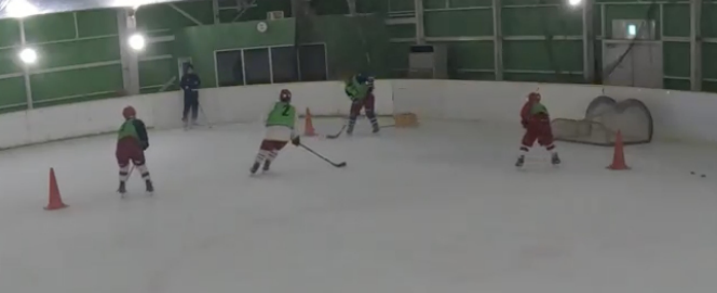
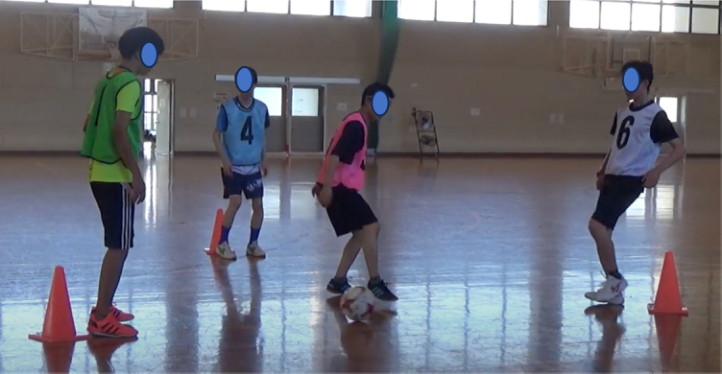
This study conducted experiments focusing on ball possession in soccer and ice hockey. These two sports were selected because they are goal-oriented. A key difference between them is the variation in the distance of pressure exerted by players, which is influenced by their speed and the presence or absence of a stick. The authors have previously conducted research related to ice hockey (Yamada et al., 2023; Ogai et al., 2021). Given the abundance of prior research on soccer, examining the insights from ice hockey, another goal-oriented sport, was considered to facilitate an exploration of charac- teristics common to goal-oriented games. The 3-on-1 possession scenarios considered in this study are shown in Figures 1 and 2.
Figure 1: The setup of the ice hockey experiment (distance between cones is 8 meters).Figure 2: The setup of the soccer experiment (distance is 4m).
In this study, possession drills were conducted by placing cones at the ver- tices of equilateral triangles. The size of the play area was varied by changing the distance of each side of the triangle. The players were required to play as
Analysis of the Impact of Playing Area Size on Ball Retention Time 219
much as possible within the confines of the cones and to maintain fixed posi- tions. As the distance in this study was measured from one cone to another, the actual distance between the players was shorter. If the ball exited the play area, a multi-ball system was used, with the balls placed around the perime- ter. The participating players were informed that the experiment aimed to examine how changes in distance affect play, specifically by observing how players possessing the ball circulated it.
Consequently, defensive players were instructed to apply pressure and limit passing routes without engaging in body checking, aiming to exert pres- sure without physical contact. The defenders understood that their objective was not to regain possession of the ball but to participate in the experiment with this specific role in mind. Each defender took turns participating in the various experiments.
The experiment was conducted with five soccer players (with the player acting as a defender, resting in the next turn) and four ice hockey players. The soccer experiment was conducted in a gymnasium using a size five ball, while the ice hockey experiment was performed using a skating rink.
The size of the play area gradually decreased, starting at a larger size. For soccer, the dimensions were set to 15, 12, 10, 8, 7, 6, 5, 4, and 3 m. Each participant took a turn acting as a defender once, and each dimension was tested five times. For ice hockey, the experiments were conducted at 15, 10, 8, and 5 m, and each dimension was tested four times. The duration of each trial was 30 s, for seconds. However, the trial at 15 m in ice hockey was conducted for 60 s. As the study focused on the number of touches by each player and ball retention time, as will be discussed later, the duration of a single experiment did not affect the analysis.
The soccer participants had an average age of 22.4 years, an average height of 170.8 cm, and an average experience of approximately 10 years. They practice soccer an average of 1.6 times per week. While there was some variation in years of experience among the five participants, there was no significant disparity in their level of proficiency. All participants possessed adequate fundamental skills for ball control.
The ice hockey participants had an average age and height of 20.75 years and 169 cm, respectively, and approximately 2.5 years of experience. They practiced ice hockey once a week. Among the four participants, there were no significant variations in age, height, years of experience, or frequency of practice. They acquired a basic level of proficiency in fundamental skills, such as passing and receiving.
Although none of the participants were beginners, they cannot be consid- ered experts. However, they had some consistent playing experience.
While the study did not examine the degree of expertise, the participants were chosen as described above. In sports coaching scenarios, it is essential to tailor coaching to the available players. Therefore, coaches need to recognize the appropriate size of the play area corresponding to the skill level of the players in actual coaching situations.
The experiment was video-recorded, and participants completed a brief online questionnaire survey immediately after the experiment.
DATA ANALYSIS In this study, recorded videos were manually annotated to determine ball retention time and the number of ball touches. The annotation process was conducted using the ELAN software. A research assistant performed the anal- ysis, and the first author verified the validity of the study. In this context, possession involves a player receiving the ball, controlling it, kicking it to pass, and then receiving it again after another player has passed it to per- form a similar action. This sequence of actions was considered a single play. Because the experiment involved passing among three players, there was a high likelihood of the ball being constantly in circulation.
The number of ball touches was calculated as the number of times a player touched the ball during a single-play session. For example, if a player passes the ball directly without controlling it, it is counted as a single touch. If the player touches the ball once to stop it and then kicks it, the number of touches is two. If the player touches the ball for an additional time between receiving and passing, the count is three. The minimum number of touches required is one.
The ball retention time was defined as the duration for which a player held the ball during a single play. This time was measured from the moment the player first touched the ball to the moment the pass was made. In the case of a single touch, the duration was expected to be extremely short.
After annotating each play, the data was processed by calculating the aver- age values, which were then used for further analysis. The average values refer to the number of ball touches and ball retention times per play, calculated after annotating all plays. Because each player takes a turn as a defender in each experiment of varying area sizes, in ice hockey, for example, a 30-second training session was conducted four times. The average values for the ball retention time and touch count were calculated from all annotated data for each distance. We examined how these two values change when the size of the play area is reduced. Specifically, the conditions under which a single-touch direct pass occurs naturally were explored.
To investigate participants’ awareness of their ball retention time and touch count, they were asked to respond to a questionnaire after the exper- iment. The questionnaire was administered online. It collected opinions on three aspects from players on the possession side while passing: ‘Did you think about the change in court size?’ ‘How do you think the play changed with the court size change?’ ‘Please describe any other observations you made during the experiment.’ This study examined whether the responses included any mention of touch count or ball retention time.
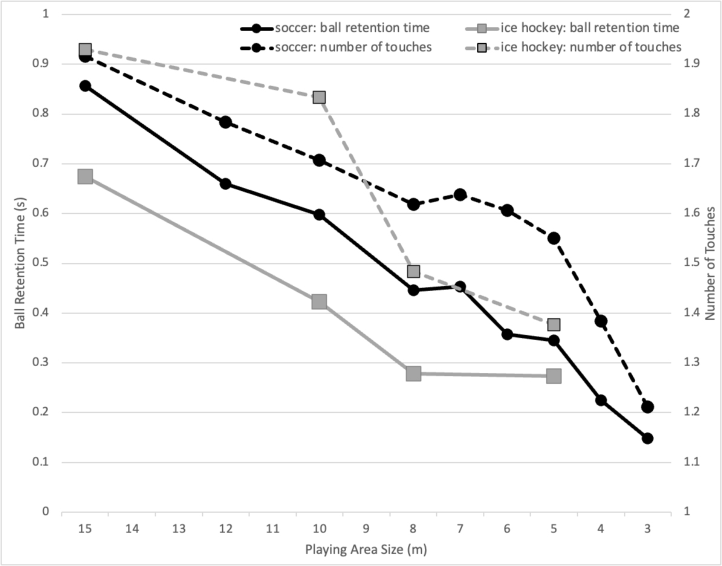
RESULTS AND INTERPRETATIONS The results for the number of touches and ball retention times are shown in Figure 3. In Figure 3, the two graphs with black circular markers represent the soccer data, whereas the two graphs with grey square markers represent the ice hockey data. The solid lines indicate ball retention times, which cor- respond to the values on the left vertical axis. The dashed lines represent the
Analysis of the Impact of Playing Area Size on Ball Retention Time 221
touch counts and correspond to the values on the right vertical axis. The hor- izontal axis represents the size (distance) of the possession areas used in the experiment.
In this study, we examine the size of the area conducive to increasing opportunities for direct passes and facilitating passing with as few touches as possible. As shown in Figure 3, the distance at which the average number of touches for both soccer and ice hockey falls below 1.5 is 4 m for soccer and 8 m for ice hockey. This suggests that the greater the speed of movement in ice hockey, the faster the speed of the puck. The fact that players hold sticks, resulting in a wider pressure area, may influence these findings. The results indicate that the appropriate size of the play area varies depending on the sport.
Figure 3: The results for the number of touches count and ball retention time.
The ball retention time in soccer at 4 m and ice hockey at 8 m was within 0.3 s. The results for ball retention time suggests that although the distances at which the number of ball touches approached one differed between the two sports, the ball retention time was ≤0.3 s for both. That is, setting up a play area that results in a ball retention time of ≤0.3 s, regardless of the sport, could potentially lead to training for plays with fewer touches.
The responses of the players to the questionnaire regarding touch count and ball retention time were examined. Initially, of the nine participants
from both sports, eight mentioned either element in their responses. Spe- cific mentions related to touch count included responses like ‘As the distance decreased, I used more one-touch passes’ and ‘As the court size reduced, the number of ball touches decreased (the proportion of direct passes increased).’ Regarding ball retention time, responses like ‘The speed increased, and the time from holding the puck to passing it decreased’ and ‘As the court got narrower, the time from receiving to passing the ball became quicker’ were observed.
These responses suggest that players become metacognitively aware of the reduction in touch count and ball retention time as the area decreases. How- ever, the specific distance at which play shifts to one-touch passes remains implicit, and a coach’s recognition of this could lead to an appropriate setting for play area size.
CONCLUSION
The insights obtained in this study are applicable to the players from whom data was collected, suggesting that in training scenarios, setting the area to 4 meters for soccer and 8 meters for ice hockey can result in ball retention times of less than 0.3 seconds, facilitating rapid passing drills. This study was limited to a specific number of participants and trials, so more reli- able results could be obtained by increasing both the number of participants and trials. The results may also vary depending on the players’ skill level. More skilled players than those in this study might require a shorter dis- tance, while beginners might need a longer one. Additionally, this study used the raw values of ball retention time and number of touches as results, with discussions based on touch count data, using 1.5 touches as a criterion. Focus- ing on the variation in these values and analysing them with a model could yield more detailed results. Further, analysing actual footage to measure the distance between the ball holder and the defenders could lead to a better understanding of the optimal play area.
In actual soccer and ice hockey games, players likely adjust touch count and ball retention time implicitly based on the distance to their oppo- nents. Examining how the 0.3-second retention time observed in this study translates to real game situations could increase its reliability and validity. Experienced experts might consciously implement touch passes even in wider areas. Investigating the effectiveness of training that allows for the demon- stration of such skills in wider areas is also necessary. As a progression of this study, examining whether the results are applicable to other sports could con- tribute to a deeper understanding of the tacit physical knowledge inherent in goal-oriented sports. Utilizing this implicit knowledge and enabling coaches to appropriately organize and set distances could lead to advancements in sports coaching methods.
ACKNOWLEDGMENT
This work was supported by JSPS KAKENHI Grant Number 22K12315.
Analysis of the Impact of Playing Area Size on Ball Retention Time 223
REFERENCES
Fradua, L. Zubillaga, A. Caro, O. Iván, Fernández-García, A. Ruiz-Ruiz, C. Tenga, A.
(2013). Designing small-sided games for training tactical aspects in soccer: extrap- olating pitch sizes from full-size professional matches, Journal of Sports Sciences. Volume 31, No. 6. Hoyt, D. F. Taylor, C. R. (1981). Gait and the energetics of locomotion in horses, Nature. Volume 292. Kelso, J. A. S. (1981). On the oscillatory basis of movement, Bulletin of the
Psychonomic Society. Volume 18. Ogai, Y. Rin, S. Tohyama, S. Yamada, M. (2021). Development of a Web Application for Sports Skill Acquisition Process Visualization System, 7th International Symposium on Educational Technology. Tokai, Japan. Ohya, T. (2022). Game activities of competitive and novice soccer players in small-
sided games: The effects of pitch dimensions, Research Journal of Health and Sport Sciences Chukyo University. Volume 62, No. 1 (in Japanese). Polanyi, M. (1983). The Tacit Dimension. Peter Smith, Gloucester: Mass. Suwa, M. (2005). Metacognitive verbalization as a tool for acquiring embodied expertise, Journal of the Japanese Society for Artificial Intelligence. Volume 20, No. 5 (in Japanese). Yamada, M. Ogai, Y. Tohyama, S. (2023). Distance Learning in Sports: Collaborative
Learning in Ice Hockey Acquisition, Towards a Collaborative Society Through Creative Learning, IFIP World Conference on Computers in Education, WCCE 2022, Hiroshima, Japan, August 20–24, 2022, Revised Selected Papers (IFIP AICT 685), Springer. Yokoyama, K. Yamamoto, Y. (2011). Three People Can Synchronize as Coupled Oscillators during Sports Activities, PLoS Computational Biology. Volume 7, No. 10.
LISTED IN THE AHFE DIGITAL BOOKSTORE CATALOGUE
Explore the complete digital volume
Affective and Pleasurable Design
Read this individual research paper free through the original publisher, or explore the full digital proceedings book.
ISBN 978-1-958651-99-5
Explore this ISBN in the AHFE Bookstore ↗Listed in the July 2026 bookstore catalogue; search by ISBN to confirm current availability · Digital book purchase optional