Noah Wickel, Okan Yilmaz, Klaus Radermacher, Armin Janß (2023). Dynamic control assignment and automated risk assessment for external control interfaces in the operating room based on ISO IEEE 11073 SDC. In: Health Informatics and Biomedical Engineering Applications. AHFE Open Access, vol. 78, pp. 142–152. https://doi.org/10.54941/ahfe1003943
Surgical procedures require a variety of medical devices, each bearing an ever-increasing number of settings and functions. Most devices are placed in the unsterile area of the operating room. Therefore, the surgeon and other sterile staff members are not able to interact with the device interfaces. Surgeons often rely on so-called ‘yell-and-click communication’ to have a setting changed, which is error-prone, slow and moreover leads to process interruptions for the involved OR personnel. Suitable control devices, like a foot switch or a sterile user interface, can allow sterile staff members direct access to certain device functions. In a networked operating room, such control devices could exist for any controllable value or operation. Due to spatial limitations in the OR, it is desired to use as few physical control devices as possible. To control a large variety of parameters, these control devices' associated functionality could be re-assigned during a surgical procedure. The manufacturer-independent communication standard ISO IEEE 11073 SDC is tailored for medical device control in the operating room and makes such a re-assignable control interface technically feasible.However, each control association must be assessed with regard to its usability and risk management. For example, a critical control target must never be controlled by an element which is too coarse for the intended task. Therefore, it is a key requirement to develop a software model for control devices and a mechanism to allow or deny a proposed mapping desired by the user based on safety and usability criteria.In the present work, we outline a system to describe and categorize input devices (control elements such as buttons, knobs and foot switches) and controllable counterparts (Targets) typically found in the surgical context. Great attention is given to the means necessary to safely control critical parameters. We assess the current descriptive capabilities of SDC and propose necessary additions to create more comprehensible software models of the control devices. Finally, we present a new convention for medical device modeling which could be used to propose or prohibit unsafe or unintended mappings in a user interface for configuring control devices in the operating room.
Dynamic Control Assignment and Automated Risk Assessment 143
INTRODUCTION
Modern surgical procedures lead to a large number of devices in the ope- rating room (OR). The necessary control devices are taking up space and burden the users with increasingly complex interfaces, which leads to errors (Weerakkody et al., 2013). A solution which has been proposed and is present in recent research is a multi-purpose, reconfigurable control device (univer- sal foot switch) shared for all control tasks of the surgeon (Dell’Anna et al., 2016). In the best case, such a device with a range of various controls would be sufficient to control every OR device in a specific workflow step as nee- ded. The association (control mapping) between a human-machine interface (HMI) such as a foot switch and a control target may be reconfigured during surgery.
However, pairing any two devices at will could create unfeasible, dange- rous or confusing mappings. The manufacturer of an HMI cannot possibly foresee the implications of a freely assignable control, which has major risk and usability implications. Manufacturers rely on a shared standard inter- face to make their devices compatible with one another, while also being able to prohibit inapt combinations. Control elements and requirements must be modeled in detail for accurate representation. Predictions about the quality of a control mapping must be possible purely based on these models and the rule set that the manufacturer has employed. If such a concept could be stan- dardized, it would pave the way for more user friendly integrated operating rooms.
STATE OF THE ART An interoperable OR based on ISO IEEE 11073 SDC is a decentralized arch- itecture of so-called Providers (offering functionality) and Consumers (using the functionality). Providers can offer Metrics (readable values) and Ope- rations (triggerable effects on the device). The descriptive possibilities for Providers are given by the Basic Integrated Clinical Environment Protocol Specification “BICEPS” (ISO/IEEE 11073-10207:2019, 2019). A network participant realizing a Consumer can utilize a Metric or Operation to inte- ract with the Provider (Kasparick et al., 2018). Controlling a Metric through an HMI input device via SDC has been discussed in-depth by (Kasparick, Schmitz, et al., 2016). They propose an architecture where both the Target device and the HMI device are Providers, and a Consumer between them car- ries out the necessary operations of a mapping. This Consumer is referred to as the Dynamic Orchestration Component (DOC), which is in charge of pre- senting possible mappings to the user, allow changes and fulfill the currently active associations. Every change in the HMI device metrics (called Indica- tors) is noticed by the DOC, which then requests an associated Operation on the Target. The authors mention the need for policing of the mappings created by the user, however they do not provide any implementation details.
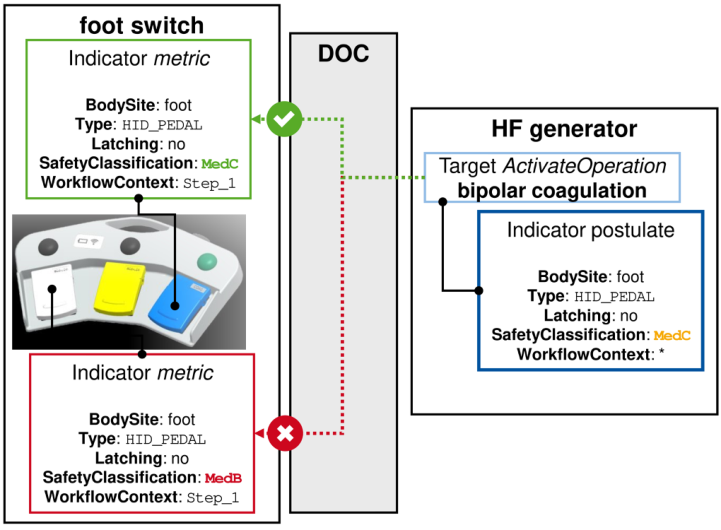
In order to decide about the validity of a desired mapping, the Indicator must supply relevant information about the design of the HMI input device and its capabilities to the DOC (see Figure 1). An in-depth analysis of human- machine interfaces for medical devices is provided by (Hölscher et al., 2008),
who list criteria and suitable parameters for a systematic description of such HMI elements (HMIEs). Classification parameters include the mode of ope- ration of an HMIE, grouping of elements, the body part which is used to operate the element, timing properties and possible measured values, ope- ration resolution and physical design of the HMIE. They also present three main requirements for usability. These are:
1) User feedback – the state of the HMIE must be perceptible by the user. 2) Reliability – the state of the HMIE after an interaction is as the user intended. 3) Intent – the user may reliably choose to operate the HMIE quickly, precisely or with transmission of force, and succeed in doing so.
With the exception of the “transmission of force” intent, these require- ments are applicable and provide additional guidance for the design of an HMIE description system. The findings in chapter 4.2 of (Hölscher et al., 2008) provide the foundational requirements for the model system developed in the present work.
A recent dissertation by (Dell’Anna-Pudlik, 2022) discusses the risk mana- gement of reconfigurable remote control devices in detail. The author has previously released a publication about the development of the reconfigu- rable foot switch unit (Dell’Anna et al., 2016). The analysis recognizes the challenges posed by existing standards (IEC 62366-1, 2015; ISO 14971, 2019) for conformity of medical devices. Using the modified HiFEM method (Janß et al., 2016), the work analyses interaction-related risks regarding the use of HF surgical equipment with a reconfigurable foot switch. In the end, a course of action for the certification of such systems in accordance with existing regulation is proposed. The approach is validated with clinical users, who predominantly approve of the results.
Other publications also propose to standardize the (graphical) user interfa- ces of medical devices (User-interface profiles, UIP). Both (Janß et al., 2021) and (Yilmaz et al., 2022) discuss the topic with regard for interfaces presented in a central status and control display (“workstation”) in the OR. Existing regulations are assessed and applied. In contrast to these publications, the present work focusses on physical user input devices and attempts to embed the necessary descriptive elements directly into an SDC-compatible model.
DESCRIPTION ATTRIBUTES FOR HMI ELEMENTS In order to develop a generic and useful representation of medical HMI input devices in ISO IEEE 11073, a systematic analysis of models and variants of such devices is required. The publication by (Hölscher et al., 2008) provides properties and interaction requirements (see Table 1 and Table 2), which will be used as a starting point for the description of HMIE in SDC.
The description attributes and decision criteria to realize these require- ments must be selected carefully. If they are not specific enough, they cannot describe the HMI device clearly, and the system may not be safe to use. If the criteria are too specific, interoperability between devices and manufacturers may be lost despite theoretical technical compatibility.
Dynamic Control Assignment and Automated Risk Assessment 145
Table 1. Design parameters and technical properties of human-machine interface elements and their generated control signals, adapted from (Hölscher et al., 2008; Rühmann, 1993).
Table available in the original PDF paper.
Property Description Supports requirement Intent Mode of operation The HMIE is operated by rotating, flipping, pushing, pulling, sliding or other means.
Intent
Has idle state The element either returns to an idle state (0, Off) or remains in the state the user left it in.
Finger, Hand, Foot, Mouth, … Reliability
Actuation body part Manual precision The smallest deviation from an intended setting which a user can reliably reproduce.
Reliability, Intent
Force threshold for actuation
A certain threshold must be overcome when operating the HMIE to produce an effect.
Reliability, Feedback Reliability
Actuation area ratio
The size of the element in relation to the actuating body part.
Feedback
Means of included user feedback
Tactile, visible state or associated optical or acoustic feedback elements.
Intent
Visual or geometric grouping
Some elements are in a specific orientation to each other (grouped visually by graphic design, arranged along a line or as a D-Pad).
Reliability
proximity to other HMIE
The HMIE has a specific amount of clearance around it to avoid erroneous activation of nearby elements.
Table 2. Technical parameters of an HMIE-derived digital date, adapted from (Hölscher et al., 2008; Rühmann, 1993).
Table available in the original PDF paper.
Property Description Supports requirement Timing-related behavior Information about the rate and delay with which the HMIE can generate data.
Intent, Reliability Intent Range of values The HMIE may generate a Boolean state or a digital number on a specified range.
Resolution Sensitivity of the sensor (e.g., 0.001). Reliability
Attributes in the SDC Information Model and Nomenclature
Table 1 and Table 2 define the key attributes which should be represented in the HMIE model. If they can be represented in BICEPS, the HMIE representa- tion can be created. This would be beneficial because the standard is already
being used in products and software entering the market (Drägerwerk AG & Co. KGaA; SurgiTAIX AG).
Tables 3 to 6 below present an excerpt of the attributes in BICEPS which SDC Providers must use for self-description. The attributes were grouped based on their descriptive content. Attributes present in the standard without any relevance for the description of HMIE were discarded. Attribute names in italics will always have only one possible state when describing an HMIE.
At the very least, an Indicator triggering a Target Operation must match or exceed the software safety classification of that Operation, as required by (IEC 62304, 2006). Furthermore, it must be ensured that the current user has sufficient permissions to execute an Operation. For instance, a computed- tomography (CT) scan may only be initiated by special personnel. Matching Patient, Location and EnsembleContext settings eliminate the possibility of erroneous activation.
Some surgical functions need to be executed with a certain degree of timing precision (e.g., fluoroscopic image when the patient has exhaled) or must be synchronized to other actions such as hand movements (e.g., activation of bipolar coagulation exactly when the forceps touches the tissue). BICEPS provides a range of parameters to describe the timing properties and capa- bilities of HMI elements. Some critical operations may require a repeated signal (retriggering) during their activation. Otherwise, they will return to a safe passive state after the InvocationEffectiveTimeout period (Kasparick, Rockstroh, et al., 2016). The HMIE must generate a signal at a sufficient rate to meet this timeout.
The attributes in Table 5 relate to the behavior of the operation and can be used to assess whether the data generated by an HMIE is compatible with the Target Operation. Some HMIEs return multiple discrete states or even (quasi-)continuous ranges of values while others can only have one of two possible states.
Semantic attributes describe Indicators on a higher level of abstraction. The MetricCategory and DerivationMethod attributes can be used to filter the metrics of an HMI Provider, since all HMIE Indicators are typically in
Table 3. Safety & permission related attributes (M = MetricDescriptor, S = SystemContext).
Table available in the original PDF paper.
Parent Attribute Use M SafetyClassification The information is either Informal or satisfies safety class A < B < C.
S PatientContext Reference to the patient the system operates on.
S LocationContext Specifies the location (room) in which the system operates.
S EnsembleContext The ensemble (group of devices) that the system operates in.
S OperatorContext Reference to the personnel currently operating the system.
Dynamic Control Assignment and Automated Risk Assessment 147
Table 4. Timing attributes for metrics relevant for HMIE modeling.
Table available in the original PDF paper.
Attribute Use MetricAvailability The information is either continuously available or only intermittent. Indicator metrics are always continuous.
MaxMeasurementTime The max. duration taken by the system to measure its sensors.
MaxDelayTime The max. duration taken by the system to process the measurement. MaxMeasurementTime + MaxDelayTime is the longest possible duration to gather a new date for this metric.
DeterminationPeriod The period (cycle time) with which this metric is updated.
LifeTimePeriod How long the information in this metric is deemed useful after measurement.
ActivationDuration How long an associated State will stay in “ON” state.
AveragingPeriod For measurements, how long the averaged data was collected.
Table 5. Attributes relating to the return value of an HMIE.
Table available in the original PDF paper.
Attribute Use Resolution NumericMetric only: smallest increment that can be detected within the TechnicalRange.
AveragingPeriod For HMI, indicates filtering (e.g., debouncing) and therefore the suitability for quick, repeated activation.
TechnicalRange Indicates (together with Resolution) the possible values generated by this metric.
AllowedValue Alternative for HMI which have discrete switch positions (use instead of returning a numeric value).
the Measurement category and are derived automatically. The Type and Unit attributes can clearly identify the behavior of the device if suitable coding systems have been defined. For instance, when a measurement metric has a Type attribute value of “MDC_HID_FOOT_PEDAL_DEPTH” and the Unit is “MDC_DIM_X_MM”, the other network participants can recognize that the numeric value will state the current impression on the pedal in millimeters.
Moreover, the manufacturer of the HMI device can specify multiple body parts as CodedValues (11073-10101 nomenclature) which are intended to operate the HMIE. The Relation attribute could potentially describe how two or more HMIE form a group or act as antagonists (e.g., for seesaw pedals or
Table 6. Semantic attributes in BICEPS for the description of HMIE.
Table available in the original PDF paper.
Attribute Meaning MetricCategory If the information is a measurement, a calculation, a setting, presetting, recommendation or other. Indicators are always a measurement.
DerivationMethod The information can be derived automatically or entered by hand. Indicators and control Targets are always Auto.
Type A semantic identifier according to a specified coding scheme, e.g., 11073-10101.
Unit A physical unit associated with the information, e.g., a button press depth in percent or mm. Coding defined e.g., in 11073-10101.
Relation Describes relation to other HMI elements, for instance proximity to each other, pairs, related axes (x/y) or a nearby optical display element.
BodySite The body part which the HMI is designed to be operated with.
WorkflowContext Reference to a step or state of the current surgical workflow.
grouped buttons). However, the available values in BICEPS currently do not support this application.
The WorkflowContext is set globally for the whole device and can be used to provide different control mappings depending on the current workflow step.
After selecting appropriate descriptive attributes from the BICEPS infor- mation model, it is attempted to use them to fulfill the requirements which were specified in Table 1 & Table 2. As the results in Table 7 indicate, several design properties of the HMIE cannot be represented in SDC as-is. BICEPS has been designed primarily to represent physiological medical device data such as patient vital signs. For human input devices, additional attributes and nomenclature definitions would be appropriate describing the most com- mon HMIE types (button, pedal, rotary, slider, joystick, etc.). Yet, the purely data-related properties of the HMIE classification (Timing information, value domain and resolution) can be described well by the current capabilities of BICEPS.
Proposed Additions to the Standards After comparing the desired possibilities and the current options of BICEPS, we propose the following additions to better describe HMI elements:
The representation of an idle state (off / safe / non-operated / initial) is currently not possible, but is essential for a machine-readable understan- ding of an HMIE. It must be known whether a control element will latch
Dynamic Control Assignment and Automated Risk Assessment 149
Table 7. HMIE parameters and BICEPS attributes which may represent them. Plus signs indicate that the attribute may be used for representation, but the nomenclature or allowed values would need to be extended in BICEPS.
Table available in the original PDF paper.
HMIE parameter BICEPS attribute candidate Mode of operation Type (+)
Has idle state - Actuation body part BodySite (+)
Manual precision - Force threshold for actuation -
Actuation area ratio - Means of included user feedback Relation
Visual or geometric grouping Relation (+) proximity to other HMIE Relation (+)
Timing-related behavior DeterminationPeriod, MaxMeasurementTime, MaxDelayTime Range of values TechnicalRange, AllowedValue
Resolution Resolution
(keep its position) after actuation or return to a known state after the user releases the element.
A manual precision attribute which indicates whether a user can reliably wield the provided technical precision of the element.
Special activation requirements (force threshold, safety lock) and the area ratio allows finding suitable HMIE for highly critical Operations.
The Relation attribute may currently describe how two metrics are influe- ncing each other (in order to motivate a Consumer to subscribe to both of them). However, the attribute is of a complex type and may be easily ada- pted to describe spatial grouping of elements, similar or opposed functions (e.g., “+” and “-” in seesaw pedals or scroll wheels) or axes (e.g., x- and y-axes of a haptic device).
The BodySite attribute already offers a descriptive collection of anatomi- cal positions well suited to describe the intended body part for actuation. Unfortunately, the attribute is designed to refer to the patient and the intended use in this work may be considered out of standard.
Some clinical functions may be typically associated with HMIE of speci- fic colors (blue pedal for bipolar coagulation). The appearance of HMIE currently cannot be communicated through BICEPS. Additional coding schemes (such as RAL or Pantone for colors) could be added.
AUTOMATED DECISION-MAKING When the user requests that a new control association shall be made, the DOC must be able to decide if this request can be allowed. The DOC itself
should not be required to judge the suitability of a mapping, as such a decision would put the burden of responsibility on the DOC manufacturer. Not only the intended use, but also the foreseeable misuse would need to be considered for every possible device combination (ISO 14971, 2019). Therefore, we pro- pose that the manufacturer of the Target device (e.g., HF generator) should add information about the HMIEs which were considered for control during risk and usability testing of their device. Only such HMIE devices which meet the Target device manufacturer’s requirements shall be allowed to send con- trol signals (see Figure 1). We call this list of HMIE attribute requirements “Indicator postulate”, because it postulates which properties an Indicator metric must exhibit to control the Target Operation.
The Indicator postulate supplies the DOC with a list of characteristics which must be checked during pairing. If all requirements are met by the HMIE, the mapping can be applied. The Indicator postulate may contain “don’t care” values for some attributes to increase the number of compati- ble devices. Future work could propose a second list of “soft” requirements. These can be overruled by an informed user, but may trigger a warning mes- sage. The Indicator postulate could be modeled on the Target device as a metric in a separate channel or VMD. The relationship between the Target metric and the Indicator postulate metric can be included via the Relation attribute of the Target metric.
Figure 1: The orchestrator (DOC) can allow or prohibit a control association based on the information it obtains from the Indicator postulate of the intended Activa- teOperation. Here, the attribute SafetyClassification is not sufficient on the grey pedal.
Dynamic Control Assignment and Automated Risk Assessment 151
CONCLUSION
The present work described an approach to embed design attributes and technical properties of Human-Machine Interface input devices into a device model based on the ISO IEEE 11073–10207 information model BICEPS. As- is, the model can provide a rudimentary framework for the representation of control elements. However, the standard currently lacks some expressiveness to satisfy all requirements from the literature. The proposed changes could be applied to the standards in the future after discussion with manufacturers and clinical users.
Despite the identified shortcomings of SDC, an approach was shown how manufacturers can use Indicator postulates to govern the allowable combination of their medical devices with HMI devices without sacrifi- cing interoperability. The approach can be realized with the current SDC standards without additions.
ACKNOWLEDGMENT
This research work has been funded within the project “5G FORUM” by the German Federal Ministry of Economy and Climate Protection, grant no. 01MJ22009C. The authors declare no conflict of interest.
REFERENCES
Andersen B, Baumhof S and Ingenerf J (2019) Service-Oriented Device Connectivity: Device Specialisations for Interoperability. Studies in Health Technology and Informatics 264: 509–511. DOI: 10.3233/SHTI190274. Dell’Anna J, Janß A, Clusmann H, et al. (2016) A Configurable Footswitch Unit for
the Open Networked Neurosurgical OR – Development, Evaluation and Future Perspectives. i-com 15(3): 227–247. DOI: 10.1515/icom-2016-0031. Dell’Anna-Pudlik J (2022) Modellbasiertes Risikomanagement offen vernetzter Chirurgie-Systeme für eine zentrale konfigurierbare Fußbedieneinheit. Drägerwerk AG & Co. KGaA (n.d.) IEEE 11073 SDC – Medizinische Gerätekon-
nektivität | Dräger. Available at: https://www.draeger.com/de_de/Hospital/Conne cted-Medical-Devices/IEEE11073-SDC (accessed 25 January 2023). Hölscher U, Laurig W and Müller-Arnecke HW (2008) Prinziplösungen zur ergonomischen Gestaltung von Medizingeräten: Erkenntnisse, Empfehlungen und Prinziplösungen zur ergonomischen Produktgestaltung am Beispiel der Gebrauch- stauglichkeit von Medizingeräten ; Forschung Projekt F 1902 ; [Abschlussbericht]. 2. Aufl. Dortmund: Bundesanst. für Arbeitsschutz und Arbeitsmedizin. IEC 62304 (2006) Medical device software — Software life cycle processes. Available
at: https://www.iso.org/standard/38421.html (accessed 27 January 2023). IEC 62366–1 (2015) Medical devices — Part 1: Application of usability engineering to medical devices. IEC. Available at: https://www.iso.org/standard/63179.html (accessed 27 January 2023). ISO 14971 (2019) ISO 14971:2019, Medical devices — Application of risk manage-
ment to medical devices. ISO. Available at: https://www.iso.org/standard/72704. html (accessed 27 January 2023). ISO/IEEE 11073-10207:2019(E) (2019) ISO/IEC/IEEE Health informatics–Pointof-care medical device communication Part 10207: Domain Information and
Service Model for Service-Oriented Point-of-Care Medical Device Communica- tion.: 1–24. DOI: 10.1109/IEEESTD.2019.8675788. Janß A, Plogmann S and Radermacher K (2016) Human-centered risk management for medical devices – new methods and tools. Biomedical Engineering / Biomedizinische Technik 61(2). DOI: 10.1515/bmt-2014-0124. Janß A, Thorn J, Schmitz M, et al. (2018) Extended device profiles and testing
procedures for the approval process of integrated medical devices using the IEEE 11073 communication standard. Biomedical Engineering / Biomedizinische Technik 63(1): 95–103. DOI: 10.1515/bmt-2017-0055. Janß A, Benzko J, Merz P, et al. (2021) Development of Medical Device UI-Profiles for Reliable and Safe Human-Machine-Interaction in the Integrated Operating Room of the Future. In: Advances in Human Aspects of Healthcare, 2021. AHFE Open Acces. DOI: 10.54941/ahfe100507. Kasparick M, Schmitz M, Golatowski F, et al. (2016) Dynamic remote con-
trol through service orchestration of point-of-care and surgical devices based on IEEE 11073 SDC. In: 2016 IEEE Healthcare Innovation Point-Of-Care Technologies Conference (HI-POCT), November 2016, pp. 121–125. DOI: 10.1109/HIC.2016.7797712. Kasparick M, Rockstroh M, Schlichting S, et al. (2016) Mechanism for safe remote activation of networked surgical and PoC devices using dynamic assignable con- trols. In: 2016 38th Annual International Conference of the IEEE Engineering in Medicine and Biology Society (EMBC), Orlando, FL, USA, August 2016, pp. 2390–2394. IEEE. DOI: 10.1109/EMBC.2016.7591211. Kasparick M, Schmitz M, Andersen B, et al. (2018) OR. NET: a service-oriented
architecture for safe and dynamic medical device interoperability. Biomedical Engineering / Biomedizinische Technik 63(1): 11–30. DOI: 10.1515/bmt-2017- 0020. Rühmann H (1993) Schnittstellen in Mensch-Maschine-Systemen. In: 1993. Carl Hanser Verlag. Available at: https://www.semanticscholar.org/paper/Schnittstell en-in-Mensch-Maschine-Systemen-R%C3%BChmann/17acfbd88d518cf0ce78c 53c84a0dbf9f94ea834 (accessed 25 January 2023). SurgiTAIX AG (2022) Release of the sdcX - SurgiTAIX AG. Available at: https://su
rgitaix.com/wp/2022/12/22/release-of-the-sdcx/ (accessed 25 January 2023). Weerakkody RA, Cheshire NJ, Riga C, et al. (2013) Surgical technology and operating-room safety failures: a systematic review of quantitative studies. BMJ Quality & Safety 22(9): 710–718. DOI: 10.1136/bmjqs-2012-001778. Yilmaz O, Janß A and Radermacher K (2022) Applying User Interface Profiles to
Ensure Safe Remote Control within the Open Networked Operating Room in accordance with ISO IEEE 11073 SDC. In: Healthcare and Medical Devices, 2022. AHFE Open Acces. DOI: 10.54941/ahfe1002094.
LISTED IN THE AHFE DIGITAL BOOKSTORE CATALOGUE
Explore the complete digital volume
Health Informatics and Biomedical Engineering Applications
Read this individual research paper free through the original publisher, or explore the full digital proceedings book.
ISBN 978-1-958651-54-4
Explore this ISBN in the AHFE Bookstore ↗Listed in the July 2026 bookstore catalogue; search by ISBN to confirm current availability · Digital book purchase optional