Yanfei Liu, Chao Shen, Junsong Liu, Feng Fu, Yuzhou Liu (2023). Situation Awareness Monitoring by Behaviour Detection and Model’s Processes Retroaction for Crew Member of Nuclear Power Plant. In: Cognitive Computing and Internet of Things. AHFE Open Access, vol. 73, pp. 162–168. https://doi.org/10.54941/ahfe1003293
Based on on-site operator’s control behavior and model’s consequential behavior & cognitive process’ retroaction (MBPR), a situation awareness detection method is proposed for crew members of nuclear power plant control room. Firstly, the cognitive models are built depending on of operator’s control knowledge, cognitive characteristic parameters and working environment’s. The cognitive model itself reflects the cognitive process and cognitive characteristics of the operator under that specific working conditions, and model’s consequential behavior embodies the operator’s cognitive characteristic and the selected procedural knowledge. From this point, the model’s consequential behavior is the representation of the operator’s procedural knowledge and operator’s certain cognitive characteristics. With this method, the on-site operator’s behavior can be captured and applied to compare model’s behaviour. Then by retroacting the model’s procedure, the operator’s cognitive characteristic and selected procedural knowledge at the moment can be obtained through tracing back the model’s behavior to its procedure. Finally, the operator’s cognitive characteristic and selected procedural knowledge are unearthed, and it can be as the representation of crew member’s cognitive status.
Effective operation for nuclear power plant (NPP) is a complex process that requires reactor operators to work together as a crew and follow prescri- bed procedures to ensure continuous, safe operations (Toquam et al., 1997). These operation crews undergo extensive training to ensure consistent peak performance. Unfortunately, even highly trained crews who perform, on ave- rage, very effectively, may vary. Although performance inconsistencies may be inconsequential for some work groups, inconsistency can produce serious consequences in NPP operations. With the rapid development of science & technology, the environment of main control rooms of large scale process
Situation Awareness Monitoring by Behaviour Detection and Model’s Processes Retroaction163
control systems has been changed from the conventional analog type to the digital type. In digitalized advanced main control rooms, human operators conduct highly cognitive work rather than physical work compared to the case of the originals. Various operating support systems and measures have been developed to reduce an operator’s workload, and the safety and relia- bility of the newly built NPP and have been improved significantly (Zhao and Smidts, 2018). However, the proportion of unplanned outage events caused by human error increased year by year. Most researches have been conducted in NPP so as to improve crew members’ performance and reduce operation errors. However, due to most of techniques applied to evaluate workload are based on subjective ratings, there are some limitations including the possibility of skewed results. As opposed to subjective ratings techniques, physiological measurement can be used for objective and continuous mea- surements of a human operator’s mental status by sensing the physiological changes of the autonomic or central nervous system (Choi et al., 2018), and therefore cognitive modeling methods and model-based applications such as workload evaluation, status monitoring and situation predication become prevail recently (Liu et al., 2020).
In the same time, maintenance of situation awareness (SA) in NPP process control has emerged as an important concept in defining effective relationsh- ips between humans and automation in this complex system (Ma et al., 2006). SA, a person’s understanding of what is happening in the current situation, is critical for performance in a wide variety of domains, including aviation, air traffic control, driving, military operations, emergency management, health care, and power grid operations. SA in teams, and the factors that underlie the development of team SA significantly affect performance in many settings. Developing and maintaining a high level of SA are the most difficult parts of many jobs and some of the most critical and challenging tasks in many domains today. Interactive SA trainer attempts to bootstrap the natural pro- cess by exposing the trainee to many, many situations in a very short period of time using computer-based training tools. Maintaining high levels of SA is essential for identifying and responding to potential hazards and unexpected events. Validated techniques for measuring SA in individuals and teams that can be used to evaluate new system designs and training programs, and to conduct further research on this important construct. Researchers have inve- stigated various methods for assessing or improving SA in industries, such as posture transition, workload model and subjective measures etc. Cognitive task analyses have been conducted to determine SA requirements in com- mercial aviation, fighter aircraft, bomber aircraft, infantry operations, and among others.
In this paper, we present a method for monitoring crew member behavior and retroactively analyzing processes as a means of detecting SA in NPPs. The method uses behavior detection techniques to identify deviations from expected patterns of behavior and provides real-time feedback to operators. It also allows for the retroactive analysis of processes to identify potential sources of errors and inefficiencies. The development and evaluation of this method is motivated by the need to enhance the effectiveness and reliability of SA monitoring in NPPs.
MBPR (MODEL’S BEHAVIOR & COGNITIVE PROCESS RETROACTION) METHOD A vast portion of the operator’s job is involved in developing SA and kee- ping it up to date in a rapidly changing environment. This is a task that is not simple in light of the complexity and sheer number of factors that must be taken into account to make effective decisions. The key to coping in the information age is developing systems that support this process, yet this is where current technologies have left human operators the most vulnerable to error. Problems with SA were found to be the leading causal factor in a review of military aviation mishaps and in a study of accidents among major air carriers; 88% of those involving human error could be attributed to pro- blems with SA (Endsley, 2021). A similar review of errors in other domains, such as air traffic control or nuclear power, showed that this is not a problem limited to aviation but one faced by many complex systems.
Successful system designs must deal with the challenge of combining and presenting vast amounts of data now available from many technological systems in order to provide true SA (whether it is to a pilot, a physician, a busi- ness manager, or an automobile driver). An important key to the development of complex technologies is understanding that true SA exists only in the mind of the human operator. Therefore, presenting a ton of data will do no good unless the data are transmitted, absorbed, and assimilated successfully and in a timely manner by the human in order to form SA. Unfortunately, most systems fail in this regard, leaving significant SA problems in their wake.
Cognitive models are script file that contains knowledge for task con- trol behavior under certain firing condition. The operation of the cognitive
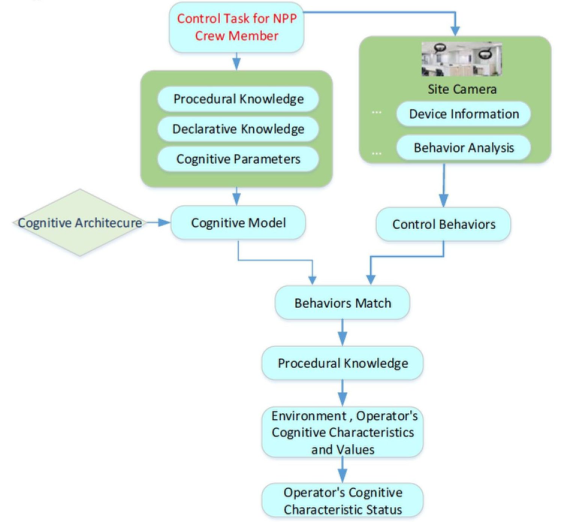
Figure 1: Main ideas for MBPR method.
Situation Awareness Monitoring by Behaviour Detection and Model’s Processes Retroaction165
model reflects the control behavior and cognitive process of the task, and the parameters in the cognitive model reflect the cognitive characteristics of the task operator. The cognitive characteristics of the operator can be refle- cted through the behavioral characteristics of the cognitive model during operation. The cognitive state of the operator can be perceived through the reflected cognitive characteristic parameters. Based on this relationship, the operator’s cognitive state is judged, which is used to evaluate the operator’s situational awareness level.
Figure 1 show the main ideas about MBPR method. The left side indicates the modelling process and the right shows the working process.
IMPLEMENTATION OF SA MONITORING IN NPP CONTROL ROOM One of the earliest and most widely applicable SA definitions describes it as “the perception of the elements in the environment within a volume of time and space, the comprehension of their meaning and the projection of their status in the near future” (Endsley, 1988). SA therefore involves perceiving critical factors in the environment (level 1 SA), understanding what those factors mean, particularly when integrated together in relation to the opera- tor’s goals (level 2), and at the highest level an understanding of what will happen with the system in the near future (level 3). These higher levels of SA allow people to function in a timely and effective manner, even with very complex and challenging tasks.
The “elements” of SA in the definition are very domain specific. Exam- ples for NPP control are dependency. These elements are clearly observable, meaningful pieces of information for a NPP control room. Things such as information on screen, different type of operations on dashboard, and action’s consequences, and restrictions in NPP control room or conformance to a clearance each comprise meaningful elements of the situation for NPP control room.
One of the common operations for operators in main control room of NPP is processing the warning information displayed on console screen. Different newly prompt information will be blink in the status bar on the bottom of console screen which it reminds the operator that there is new information to be processed with various color, and the yellow indicate warning mes- sage. It requests the operator to click the blink with the mouse to let the message display on screen with a pop up warning message dialog box. If the warning message does not need to be dealt with, the operator can directly click the ‘OK’ button. If the operator thinks that the warning information needs a further process, he will click the ‘MARK’ button to mark the war- ning information as a task that needs to be processed. The cognitive behavior for processing the warning message can be illustrated as follows:
1) The operator finds (vision) yellow blink in the status area of the dashboard; 2) The operator makes decision to click (manual behavior) mouse to let the warning message display;
3) The operator reads (vision) the warning massage and searches knowledge and matches knowledge in mind; 4) The operator uses declarative knowledge to choose the operation; 5) The operator executes the chosen operation OK or MARK (manual behavior).
To verify the proposed method, two sample cases are applied to detect the operator’s on-site SA for processing of warning information for NPP control dashboard. The one is the operator deals with multitask (here read articles) and the another one is the operator falls in a drowsy situation at work.
To implement the method for accessing operator’s behavior and analy- zing retroactively cognitive model’s processes, we first identified the key behaviors and processes that are critical for ensuring the safe and efficient operation, and developed cognitive model for normal situation operations. We then collected real-time data from system obtaining operator’s behaviors and response time, using machine learning models to detect deviations from normal patterns.
The method works by continuously collecting data from a variety of sou- rces, including system feeds, operator inputs, and sensor data. This data is then processed by the algorithms, which use pattern recognition techniques to identify behaviors and processes that may be indicative of a decrease in SA or an increased risk of error or accidents.
When the method detects a deviation from normal patterns, an alert is generated and sent to the appropriate personnel for further investigation. This allows for timely and proactive intervention to address any potential issues before they can escalate into more serious problems.
RESULTS
To test the method, we conducted simulations for the two selected sample cases in a controlled environment that replicated the conditions and tasks typically encountered in NPP. We collected a large dataset of behaviors and processes from these simulations, which was used to train and validate the method.
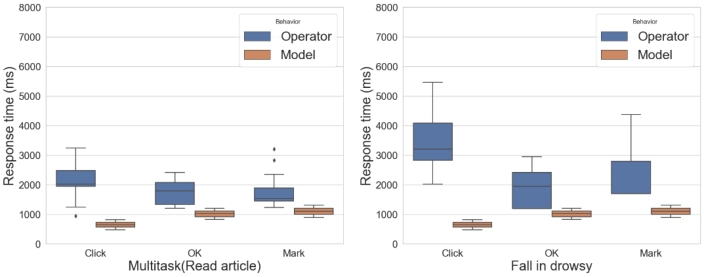
Figure 2 shows the statistical results of collected behaviors. The left side figure shows the deviation of the multitask and the right side ones shows the deviation of the drowsy situation. In the statistical results of multitask, it is found that operator behaviors are affected by multitask. The deviation betw- een model and operator behavior are relatively stable. However, in a drowsy situation, mostly the first deviation between model and operator behavior become larger while the others varied little. By analyse of the behavioral devi- ation between on-site operator and normal cognitive model and use of pattern recognition algorithms and machine learning models, the operator’s situation awareness status can be achieved. The results of simulation show that the method was able to accurately detect deviations from normal patterns and generate appropriate alerts in a timely manner.
MBPR method achieved high accuracy in detecting and classifying the SA for selected cases in our study. Moreover, the method was able to accurately
Situation Awareness Monitoring by Behaviour Detection and Model’s Processes Retroaction167
Figure 2: Behavioral features for SA detection of sample cases.
identify instances of crew members sabotage, novice, and interacting with equipment, as well as more subtle behaviors such as moments of distraction or frustration. Overall, the results indicate the method is an available tool for detecting crew member SA.
DISCUSSION
There are several limitations to the current method that should be addressed in future work. First, the method is applied to detecting SA for only two selected sample cases the sample size is only for method interpretation. As we know there are lots of behaviors and information in NPP control room for maintaining the crew member’s effective operation, and it exists that several SA cases may be with the same behavioral characteristics. There needs more other information or evidences to join in for discriminating which types of the SA case it is for this case.
Despite these limitations, the results of this study suggest that the system has great potential for improving understanding of human behavior in work- place. By accurately detecting and analyzing various behaviors, the system can provide valuable insights into the social dynamics of a crew, as well as identify potential issues that may affect mission performance.
In terms of future directions for research, there are several areas where the method could be improved. One possibility is to incorporate additio- nal data sources, such as video or physiological measurements, and improve pattern recognition algorithm, to enhance the method’s ability to detect beh- aviors that are not directly available from system and practicality for on-site application.
CONCLUSION
In summary, the main findings of our study demonstrate the effectiveness of using machine learning to detect and analyze crew member behavior in NPP workplace. The method achieved high accuracy in detecting and classif- ying selected SA cases, outperforming existing some other subjective methods. One potential application of this method is in the use of behavior detection to
understanding and managing human behavior in high-stakes environments, specifically most critical scenario with complex control task.
Overall, this study contributes a way to the field of SA analysis While there are still several challenges to be addressed, it has significant benefits to human behaviour study with a non-invasive way.
ACKNOWLEDGMENT
The authors would like to acknowledge CGN Research Institute Co., Ltd. for the technical and financial support for this study.
REFERENCES
Choi, M. K., Lee, S. M., Ha, J. S., & Seong, P. H. (2018). Development of an EEGbased workload measurement method in nuclear power plants. Annals of Nuclear Energy, 111, 595–607. Endsley, M. R. (2021). Situation awareness. Handbook of human factors and
ergonomics, 434–455. Liu, Y., Tian, Z., Liu, Y., Li, J., & Fu, F. (2020). Cognitive architecture based mental workload evaluation for spatial fine manual control task. In Advances in Human Factors of Transportation: Proceedings of the AHFE 2019 International Confe- rence on Human Factors in Transportation, July 24-28, 2019, Washington DC, USA 10 (pp. 819-829). Springer International Publishing. Ma, R., Kaber, D. B., Jones, J. M., & Starkey, R. L. (2006). Team situation awareness
in nuclear power plant process control: a literature review, task analysis and future research. Toquam, J. L., Macaulay, J. L., Westra, C. D., Fujita, Y., & Murphy, S. E.
(1997). Assessment of nuclear power plant crew performance variability. In Team performance assessment and measurement (pp. 265-300). Psychology Press. Zhao, Y., & Smidts, C. (2018). A computational cognitive modeling approach to human performance assessment in nuclear power plants. In Safety and Reliability– Safe Societies in a Changing World (pp. 441-448). CRC Press.
LISTED IN THE AHFE DIGITAL BOOKSTORE CATALOGUE
Explore the complete digital volume
Cognitive Computing and Internet of Things
Read this individual research paper free through the original publisher, or explore the full digital proceedings book.
ISBN 978-1-958651-49-0
Explore this ISBN in the AHFE Bookstore ↗Listed in the July 2026 bookstore catalogue; search by ISBN to confirm current availability · Digital book purchase optional