Sami Berghälaa, Osmo Mattilaa, Jari Kuusistob, Liina Häyrinena, Anne Toppinena (2019). Are the Social Layers of Ecosystem Services Understandable Through Service Dominant Logic: The Business Potential of Forest as an Experience. In: Advances in The Human Side of Service Engineering. AHFE Open Access, vol. 8. https://doi.org/10.54941/ahfe100302
In the state-of-the-art Service Dominant Logic debate (e.g. Vargo & Lusch 2004, 2008, 2011), the user, customer or utilizer defines the value of an offering. This paper reports the preliminary results of an inquiry into the ecosystem services and the value they deliver for forest owners (e.g. Millenium ecosystem assessment. 2005). We used Finnish non-industrial forest owners as a proxy for a high-involvement group of ecosystem service utilizers. Within this group we tried to identify new spearhead groups in order to try to understand the future of forest resource utilization. This paper reports survey findings of 302 personal (phone) interviews with Finnish forest owners. An 18-point scale was adopted in measuring respondents’ personal views on forests they own, in particular, seeking to find out what forests mean for them. These questions were contrasted with questions measuring forest owners’ multi-use views of our natural surroundings. We found a clear five dimensional valuation structure in a principal axis factoring analysis and we were able to identify a group of highly multi-use orientated forest owners from the sample. The factor structure explained almost 60% of the variance existing. The multi-use owners had differed views in all five dimensions of forest meaning (economic income from the forest, hedonistic value of forest, self-efficacy related to forests, perceived health effects of natural forests and nature protection locally & globally. Thus, the results portray new types of nature based and nature originating value creation, and thus, highlight the business potential of new types of services catering this group.
It seems our economic form of organization is changing. The previous industrial form of production is giving way to post-industrial economic systems. While the concept of post-industrial production is often associated with high-tech, knowledge-intensive forms of renewal the content of this renewal seems to point to truly new forms of economic exchanges. This happens even to the degree that our economic statistics are un-able to reflect the servitization (Toivonen & Tuominen, 2009) and intangible exchanges going on in our societies. Only the huge GDP share of the services seems to reflect the change. Of course, one can argue, that services as such are nothing new, and service exchanges existed long before any form industrial production. However, the present challenge seem to be our lack of knowledge on: a) how to provide services on an industrial scale and b) how to renew the present industrial organizations to meet the challenges of the future. Our aim in this paper is to dive into the latter challenge on a very preliminary level. Our task is to search for the intangible, experiential, or emotional dimensions of our relationship to our surrounding nature. We use the axiomatic framework of Service Dominant Logic (Vargo & Lusch, 2004) to search for multi-use values and new forms of relating oneself to the surrounding forests. We make a survey into the values and thoughts of Finnish forest owners and try to identify groups of people with non-traditional views on forest usage. In searching for these “needles in the haystack”, we hope to provide light into potential new customer needings and thus possible new value basis of new businesses.
This paper is a part of a research program aimed at understanding forest sector renewal in Finland and elsewhere. We begin by first presenting the theoretical ideas that for the logic behind the work. After this we describe the data collection and the measurement development associated with the survey. After this we present the result of the survey with a sequence of multivariate analysis that start from profiling respondents based on multi-use values. Of the last we used a tentative term of LOHAS-consumer (life of health and sustainability) earlier but have given up this term as our aim is not to describe new consumer life-styles but to search for some type of multi-use, front- runner, opinion-leader type of a “black-box” of a consumer. After profiling we compare the respondent profiles with their forest use aims. Via this we produce three characterizations of possible new consumers.
THEORETICAL BACKGROUND Research interest in services, service innovations and value creation has evolved from various disciplinary backgrounds. A distinct area of service research has stemmed from business-oriented research into knowledge intensive services (Gallouj 2002, Miles 2005, Kuusisto 2005, Toivonen et al. 2007). In marketing theory, Vargo and Lusch (2004, 2006, 2008) and Grönroos (2008) have been vocal on the need for propagating a new service marketing discipline.1 These issues have been discussed in studies on services under the topic of ‘company driven inside-out view of the approach to one’s markets’ vs. ‘outside-in view of a customer driven service-company’. If the organisations in the markets truly have a customer-driven approach as a basic premise, there actually should not be a wide gap between the service supply and demand for these services. Instead, the forestry service offerings should already have been adjusted to the on-going structural changes among the customers.
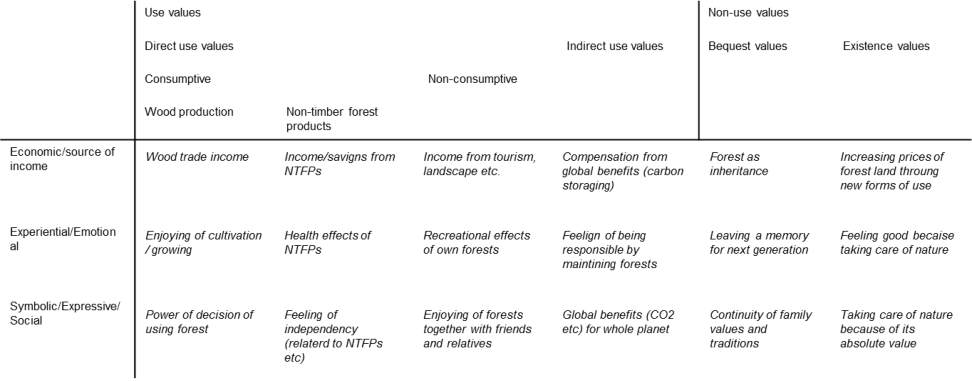
As nature, as such, might not be depictable in strictly interpersonal terms we used the four layer structure of Customer value creation by Smith & Colgate (2007) to supplement our theoretical basis with the concepts of functional, experiential, symbolic and cost/sacrifice value. This supplements the cultural, provisioning, regulating 1 From the strategic perspective of the firm, Kim and Mauborgne’s (1999) value creation concept would be, for example, another view to emphasize the key importance of information on customer needs in the process of firm value creation.
and supporting services perceived by the forest owner. We combined the layer of ecosystem services with the four layers of customer value creation and earlier forest owner objectives with the schemata below.
Figure 1: The value map behind forest owner profiling and value measures Source: Mattila et al. 2013: Based on Rchnau et al. 2013, combining the Millennium Ecosystem Assessment (2005) and Smith and Colgate 2007 While the forests can bring all the layers of ecosystem services into view (i.e. the cultural, provisioning, regulating and supporting), the value is created by the perceptions of the forest owner. A rough division would thus be to divide the values into use and non-use (or existence) values (Krutilla 1967, Jacobsson and Dragun 1996) including the direct aspects of the ecosystem services (Millenium… 2005): provisioning, regulating and cultural services. We excluded supporting services (that enable the previously mentioned services) because they were expected to be too far away from the everyday life of the interviewees. At the same time the three layers of consumer value types divide the previous two into sequentially deepening level of intangibility (or experience). Based on this classification, we grouped the scales and measures under the above titles. The following describes the process more deeply.
MEASURES The first phase of measurement development consisted of two strategies. First, the Forestry literature scales under the above mentioned topics (Fig.1) were screened and collected into a data base. The scales included at this phase were Horne et. al. 2004, Häyrinen 2012, Taari 2013, Hänninen et. al. 2000 & 2010, and Karppinen 2010. Second the measures from a general handbook (American Marketing Association Handbook of Marketing Scales, 2000) of related scales were screened. The topics under scrutiny here were scales related to involvement, innovativeness/conservatism, attitude towards consumption/products, measures of affect, and concepts that describe the respondent angst or feelings towards ones surroundings. These scales included: Hawes and Lumpkin 1984, Saegert et. al. 1985, Moschis 1981, Lumpkin and Darden 1982, Gaski and Etgar 1986, Shimp and Sharma 1987, Lambert 1980, Holbrook and Crofman 1984, Slama and Taschian 1987, Rahtz el. al. 1989, O’Quin and Faber 1989, Lumpkin and Hunt 1989, Goodwin and Etgar 1980, Dillon et. al. 1984, Joseph and Vyas 1984 and Raju 1980. The scales were combined and grouped under the Fig. 1 themes. After this overlapping items were identified and removed. This procedure resulted in over 100 questions that were screened in two phases. The first consisted of few personal interviews done both by the researchers themselves and the research company. The feedback from these two spheres was combined in preparing separate versions of the questionnaire. As we strived for personal interviews (done by phone) the length of the questionnaire was a serious issue. Further, as we searched for new views and insights, the aim was not to build representative measurement scale. Thus, we balanced the length with the depth. Therefore, the first interview phase built a shortlist of 100 questions. These questions were then put through the first pilot. This resulted in 18 items measuring forest owner perceptions of their forest supplemented with 9 items measuring forest owner multi-use values (profiling tool). The following describes the analysis process.
DATA & ANALYSIS The data was collected based on a nation-wide registry of Finnish Forest Owners. The registry is held by the state agency of Finnish Forest Centre. The registry has the addresses of over 300.000 forest owners. From this registry a random sample was picked. The sample consisted of 100 + 300 addresses were the first 100 addresses were used for pilot-testing purposes after which the remaining 300 were used for the main interview phase. All interviews were done as telephone interviews by a Finnish survey research company. Extra effort was put to train and inform the interviewers on the challenges associated in interviewing forest owners about future and possible new uses of Forests (and nature in general). This was done to secure that the responses would reflect new ideas more than conventional forest management thinking.
As the interviews were telephone interviews this paper represents the results of the complete data. Thus 400 interview results are reported. In case the surveying company was unable to reach a pre-selected respondent they supplemented this lack with another randomly picked respondent.
After receiving the data it was checked for basic distributional properties and possible problems related to missing values or outliers. As the observations were relatively complete and no other problems were found the data was entered into a sequence of multivariate analysis. Two separate multivariate analyses were done. One for the multi- use measures and one for the meaning of ones forest. After this we checked whether the respondent profiling might have any predictive power on the respondent evaluation of ones forest and their usage. The following reports the results of these computations.
RESULTS
Respondent Background By age, 24% of the owners are 40-49 years of age. Likewise 24% consist of 50-59 year old forest owners. 26% are over 60 years of age while 26% are 39 years or younger. This somewhat biased distribution is due to the natural fact that most of the forests are inherited. Most of the forest owners are male (72%) by gender leaving the female as a growing minority (Karppinen et. al, 2010) of 24%. Due to their age the level of education is relatively low with 69% having upper secondary school or lower education. Only 12% hold an academic degree. By profession, two biggest groups are pensioner (21%) and people employed by agriculture or forestry (24%). The forest hectare varies from almost nil to estates over 100ha. However, 77% are less than 50ha in size. For a big majority (40% of the owners) the forest income is 0% of their total income. While for 20% the income is over 30% of their total income. 55% of the forest owners live in rural are while others live in bigger or smaller towns. Thus, our sample is slightly biased towards rural dweller in that in the general population 48% live in rural areas while the rest live elsewhere (Karppinen et. al. 2010).
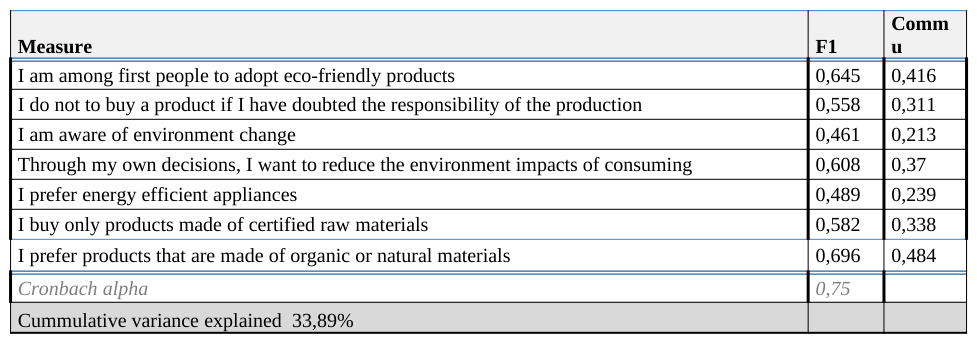
Respondent profiling tool As mentioned earlier the profiling tool consisted of 9 questions. The basic properties were first screened on the level of basic distributions. After this the questions were fed into a Principal axis factoring analysis in SPSS182. The aim was to check for the dimensionality of the measures and, as the measure was used the first time, to screen out possible errors caused by questions definition, scale misspecification etc. Via this procedure three questions were left out of the original nine. One was a reverse coded question that seemed to be miss-understood as it distorted the whole factor solution via clear heywood case3. Second the items measuring furniture buying and an individual possibility to affect global environmental problems were left out due to low factor loadings. After this we got the following uni-dimensional solution.
2 Statistical package for social scientist - SPSS 3 division by zero, resulting on 0,999 factor loading in one of the questions.
Table 1: Factor solution of the profiling measures
While the level of common variance explained is low it seem the reliability point towards some level of uni- dimensional consistency in the measures. The solution was checked for sensitivity by computing alternate versions of the solution both with the low-loading questions included and also by computing two dimensional solutions. The most logical and interpretable outcome was the above mentioned factor solution. A two dimensional solution resulted in one or two factor loading on the second factor but having a very artificial interpretation. Thus, we concluded that the above six-question solution reflected what we sought for. Next the solution was saved as factor score variables. Thus, we got a new uni-dimensional solution measuring (in theory) forest owner multi-value orientation towards the sustainable use of natural resources – i.e. a proxy for the social dimensions of the ecosystem services.
Meaning of forests The relationship, to ones forests, was measured with an 18 item scale. The table also shows the factor solution acquired.
Table 2: Meaning of ones forests
The above table displays a five factor solution. The cut-off point for displaying the loading was 0,4. The factor analysis was computed by principal axis factoring utilizing the Varimax rotation. Thus, it is a classic exploratory analysis (Hair. et. al, 2000) with its benefits and handicaps. However, as can be seen the explanatory power of the solution is relatively high 62% of explained variance. Also, the Cronbach alphas display a good level of factor consistency. As exploratory solutions exist in the number of hundreds or more, the critical thing is to check for the stability of the solution. We did this by both varying the number of factors and the scales entered into the analysis. Our core conclusion was the above solution as alterations would only combine the loadings in an un-intelligible way while the level of explained variance would vary only slightly.
Based on the above, our key result is, that forest owner perceptions of ones forest can be described by a five dimensional space. The five dimensions seem to center around the concepts of economic income from the forest, inheritance value of forest, self-efficacy/sufficiency related to forests, perceived health effects of natural forests and nature protection locally & globally.
Next we delved into inquiring could these conceptual spheres of forest meaning and multi-use profile be contrasted to each other in order to gauge the social and psychological meaning of the different layers of forest provided experience or service as such (Vargo & Lusch, 2004).
Forest owner profile as a predictor of multi-use value We picked two different approaches to describing the relationship between forest owner multi-use profiles and perceptions of forest meaning. At first we divided the forest owners into three groups according to their factor score coefficients of the first factor analysis (multiuse value). The factor score means were then plotted on the radar-type figure below.
Nature protection
.5
.0
Inheritance & tradition
Health
-.5
low medium high
Selfsufficiency Income
Figure 2: The high, medium and low multi-use groups of forest owners depicted against the meaning of the forest factors.
Figure available in the original PDF paper.
As can be seen the differences are dramatic between the groups. All differences are significant (p<0,00) in the areas were the points do not exist close to each other. What the figure seems to suggest is that there could be a group of forest owners to whom the meaning of the forest is much higher that to the two other groups of low and medium, but further, that to this group the picture of forests as such is more complicated than purely as income, health (recreation) and inheritance.
Next we made another attempt to understand the relationship of the profiles with the perceptions of ones forests. Thus, to find out if the respondent valuation would have an effect on the valuations of the different “produce” (or services) of the forests, we computed a few simple path analyses where the multi-use values were the predictor of each of the five factor acquired in the previous section. As the level explained variance in the profiling measures (the first factor analysis) was only slightly above 30%, we felt, that one could not search for high level of predictive power in the path models but only gauge whether the relationship between the predictor and the predicted might be significant. The following table displays the results.
As can be seen all but one of the dimensions is predicted to a significant degree. Also, for the remaining inheritance, the significance figure has an accentuated level. The relationships seem to be that strong that the sample size effect is not able to counter these last results. Thus, we feel, that the tentative outcome of this exercise is that there seems to be a group(s) of forest owners to whom the provisional and social layers (at least) of ecosystem services have a positive value as such. Turned around, the service perceptions of the five factors seem to reflect new potential in building services based on the sustainable use of natural resources. The following ties the findings together and reflects on the results via the proposition presented earlier.
CONCLUSIONS
The core of this exercise was to explore opportunities for value creation in the group of people with non-traditional views on forest usage. The aim was to build a preliminary understanding on if forest owner perceptions of their forest use could contain material that could be tied to or organized under the banner of ecosystem services. Further, we wanted to find out, if such layers of perceptions could have enough potency to act as a proxy to understand future service value of the forest or nature in general. We advanced from profiling forest owners based on their valuations and their views on sustainability. Via developing measurement scales for both the two conceptual spheres we were able to describe and predict the forest owner views on their forest usage. While the results are still on a tentative level they see to provide some assurance to new forms of needing as existing, at least in this group of people. While our measures, originally designed for gauging LOHAS-lifestyle was latter seen to be a narrower measurement by nature, the results still seem to have some level of predictive power. Further, the five dimensional factor solution was clearly valuable in depicting the vast differences of attitude towards forest utilization. We will continue to search for the logic explaining the perceptions of the high multi-users but believe that in their value structure lie a good description of the future ecosystem-based service businesses.
REFERENCES
Berghäll, S. (2004): Two-dimensional Concept of Commitment, Marketing Theory, Vol. 3, pp. xx-xx. Boon T. E., Meilby H. and Thorsen B. J. 2004. An empirically based typology of private forest owners in Denmark: improving communication between authorities and owners. Scand. J. For. Res. 19(S4): 45–55. Butler, B. J., Tyrrell, M., Feinberg, G., VanManen, S., Wiseman, L. and Wallinger, S. 2007. Understanding and
reaching family forest owners: lessons from social marketing research. J. For. 105(7): 348–357. Chesborough, H. (2007); Business model innovation: it’s not just about technology anymore, STRATEGY & LEADERSHIP , VOL. 35 NO. 6 2007, pp. 12-17. Conway, M.C., Amacher, G.S., Sullivan, J., 2003. Decisions nonindustrial forest landowners make: an empirical
examination. J. Forest Econ. 9(3): 181–203. Favada, I.M., Kuuluvainen, J. and Uusivuori J. 2007. Consistent estimation of long-run non-industrial private forest owner timber supply using micro data. Can. J. For. Res. 37(8): 1485–1494. Favada, I.M., Karppinen, H., Kuuluvainen, J., Mikkola, J. and Stavness, C. 2009. Effects of timber prices,
ownership objectives, and owner characteristics on timber supply. For. Sci. 55(6): 512–523. Gallouj, F. (2002). Innovation in the service economy: the new wealth of nations, Edward Elgar, Cheltenham. Gronroos, C. (2008); Service logic revisited: who creates value? And who co-creates?, European Business Review, Vol. 20 No. 4, 2008, pp. 298-314. Hair, J. F., Anderson, R. E., Tatham, R. L., and Black, W. C. 1998. Multivariate data analysis. Prentice-Hall
International, Upper Saddle River, New Jersey. Hogl, K., Pregernig M. and Weiss, G. 2005. What is new about new forest owners? A typology of private forest ownership in Austria. Small-scale Forest Economics, Management and Policy. 4(3):325–342. Hujala, T., Karppinen, H. & Kurttila, M. 2013. Customer segments among family forest owners: combining
ownership objectives and decision-making styles. Small-scale Forestry. doi:10.1007/s11842-012-9215 Hänninen, H., Karppinen, H. and Leppänen, J. 2011. Suomalainen metsänomistaja 2010. Working Papers of the Finnish Forest Research Institute 208. Ingemarson, F., Lindhagen, A. and Eriksson, L. 2006. A typology of small-scale private forest owners in Sweden.
Scand. J. Forest Res. 21(3):249–259. Jacobsson, K.M., and A. Dragun. 1996. Contingent valuation and endangered species. Methodological and applications. Cheltenham: Edward Elgar. Karppinen, H. 1998. Values and objectives of non-industrial private forest owners in Finland. Silva Fennica. 32(1):
43-59.
Kline, J.D., Alig, R.J., and Johnson R.L. 2000. Fostering the production of nontimber services amongst forest owners with heterogeneous objectives. For. Sci. 46(2):302–311. Kurtz, W.B. and Lewis, B.J. 1981. Decision-making framework for non-industrial private forest owners: an
application in the Missouri Ozarks. J. For. 79(5):285–288. Kuuluvainen, J., Karppinen, H. and Ovaskainen, V. 1996. Landowner objectives and nonindustrial private timber supply. For. Sci. 42(3): 300-309. Krutilla, J.V. 1967. Conservation reconsidered. American Economic Review 57: 777–786. Lehtonen, E., Kuuluvainen, J., Pouta, E., Rekola, M. and Li, C-Z. 2003. Non-market benefits of forest conservation
in southern Finland. Environ. Sci. Pol. 6(3): 195-204. Leskinen, P., Pykäläinen, J. and Haara, A. 2009. Incorporation of preferential uncertainty into interval-scale priority functions - a case of multicriteria forestry decision making. Can. J. For. Res. 39(8): 1498-1506. Lönnstedt, L. 2012. Small-scale forest owners responsibilities: Results from a Swedish case study.
Small-scale Forestry. 11(3): 407-416. Majumdar, I., Teeter, L. and Butler, B. 2008. Characterizing family forest owners: a cluster analysis approach. For.
Sci. 54(2): 176–184. Mattila, O., Häyrinen, L., Berghäll, S. and Toppinen, A. 2013. Widening the scope of the forestry services towards other ecosystem services. Presentation in IUFRO Conference on Forests for People Conference, Traverse City Michigan, USA, May 23rd. Millenium ecosystem assessment. 2005. Ecosystems and human well-being: synthesis. Island Press, Wash Nı´ Dhubha´in, A., Cobanova, R., Karppinen, H., Mizaraite, D., Ritter, E., Slee, B. and Wall, S. 2007. The values
and objectives of private forest owners and their influence on forestry behaviour: the implications for entrepreneurship. Small-scale Forestry 6(4): 347–357. Pouta, E., Rekola, M., Kuuluvainen, J., Li, C-Z. and Tahvonen, O. I. 2002. Willingness to pay in different policyplanning methods: insights into respondents' decision-making processes. Ecol. Econ. 40(2): 295-311. Richnau, G., Angelstam, P., Valasiuk, S., Zahvoyska, L., Axelsson, R., Elbakidze, M., Farley, J., Jönsson, I. &
Soloviy, I. 2013. Multifaceted Value Profiles of Forest Owner Categories in South Sweden: The River Helge å Catchment as a Case Study. AMBIO 2013, 42:188–200. Smith, J.B, & Colgate, M. (2007). Customer value creation: a practical framework. Journal of Marketing Theory and Practice, 15, 7–23. Størdal, S., Lien, G. and S. Baardsen. 2008. Analyzing determinants of forest owners' decision-making using a
sample selection framework. J. Forest Econ. 14(3): 159-176. Toivonen, R., Järvinen, E., Lindroos, K. and Rämö, A. 2005. The challenge of information service development for private forest owners: the Estonia and Finland cases. Small-scale forest economics, management and policy. 4(4): 451-470.
Toivonen, R., Toppinen, A., Valkeapää, A. and Rämö, A. 2012. Consumer perceptions on environmental and social responsibility of wood products suppliers in the Finnish markets. In Proceedings of Biennial Meeting of the Scandinavian Society of Forest Economics, Hyytiälä, Finland, May 23-26, 2012. Edited by Toppinen, A., Karppinen, H. and Kleemola, K. Scand. For. Econ. 44: 159-167. Urquhart, J. and Courtney, P. 2011. Seeing the owner behind the trees: a typology of small-scale private woodland
owners in England. Forest Policy and Economics. 13(7):535–544. Valkeapää, A. and Karppinen, H. 2013. Citizens' view of legitimacy in the context of Finnish forest policy. Forest Policy and Economics 28 (2013) 52–59. Vargo, S.; Lusch, R. (2004). Evolving to a New Dominant Logic for Marketing. Journal of marketing 68, pp. 1-17. Vargo, S.; Lusch, R.; (2006). Service dominant logic—what it is, what it is not, what it might be. In: Lusch, R.;
Vargo, S. (ed.) The service-dominant logic of marketing: dialog, debate. Vargo, S.; Lusch, R. (2008). Service-dominant logic: continuing the evolution. Journal of the Academy of Marketing Science 36, pp. 1–10. Voima, P.; Heinonen, K.; Strandvik, T. (2010): Exploring customer value formation – a customer dominant logic
perspective, COMBI 2010 conference, 7-10 October, 2010, Vantaa, Helsinki, paper published in Conference proceedings.
LISTED IN THE AHFE DIGITAL BOOKSTORE CATALOGUE
Explore the complete digital volume
Advances in The Human Side of Service Engineering
Read this individual research paper free through the original publisher, or explore the full digital proceedings book.
ISBN 978-1-4951-2091-6
Explore this ISBN in the AHFE Bookstore ↗Listed in the July 2026 bookstore catalogue; search by ISBN to confirm current availability · Digital book purchase optional