Raymund J. Lina, Tai-Lin Chinb, Houn-Gee Chenc, Seng-cho Choud (2019). UX as a Service. In: Advances in The Human Side of Service Engineering. AHFE Open Access, vol. 8. https://doi.org/10.54941/ahfe100246
User experience design (UXD) has become an important discipline for improving the usability of service innovations. However, user interface (UI) and user experience (UX) alone normally do not define a service, nor do they become services. Recently, we have observed the rise of “Gamification as a Service”, which introduce game-based mechanics to non-game services. The “fun” experiences created by gamification is therefore added onto the original experiences offered by the non-game services, and it creates extra values to the services such as customer participation and customer loyalty. Moreover, "socialization of brands" demonstrated the possibility of offering social networking experiences as a value-adding service to another service that is not related to social networking at all. A lot of business websites now include social filters, social tagging, or social feeds, so as to improve the overall service experiences. In this position paper, we discuss this emerging trend of User Experience as a Service (UXaaS), in which user experiences are offered as value-adding software services to other online services.
With increased use of information and communication technologies (ICT) in service delivery, human-computer interaction (HCI) has become an important research topic for improving the usability of service innovations. User experience design (UXD) further extends HCI to include all aspects of a service or product perceived by users, including interfaces, graphics (UI), physical and informational interactions (Hartson and Pyla, 2012). However, user interface (UI) and user experience (UX) alone normally do not define a service, nor do they become services. The popularity of Software as a Service (Fox and Patterson, 2013) has made “Social Networking as a Service” and “Gamification as a Service” becoming a reality, where user experiences like belongings and fun are offered as value-adding services to non-social and non-game services, such as retailing, e-learning, banking and even heathcare services. In other words, user experiences as a service (UXaaS) could become valid in both service design and service business, where service companies earn their profits through creating online user experiences.
Are there other user experiences that can be packaged and offered as a software service? If we define good user experiences from an online service as satisfactions of specific user needs from the use or anticipated use of the service, then besides the direct needs to be satisfied by the functional software service itself, there are psychological needs to be satisfied by the UX services. It seems that gamification services offered satisfactions of esteem needs, while social networking services offered satisfaction of belonging needs. These UX services can be dropped from the original functional services without disabling them, meaning the UX services are pure add-ons with extra value that can be priced. The challenge is that how can we leverage ICT to create sophisticated user experiences by satisfying safety needs, understanding needs, aesthetics needs, and/or even self-actualization needs defined by physiological studies (Maslow 1993), and make money, or at least create concrete value from them? Several cases are discussed in the following.
CASE STUDIES OF UXAAS The following cases are finished or on-going studies matching our definition of UXaaS. More studies are expected to be discussed in the UXaaS conference session. The cases are analyzed with a structure of: project background, service design, impacts and implications.
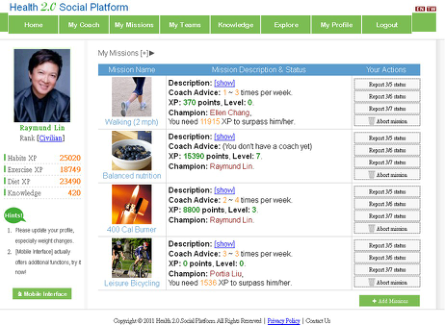
Gamification as a Service for Healthcare This is a completed study of applying Gamification as a Service to healthcare (Lin et al. 2012a, 2012b). The background of this project was an attempt to solve behavior motivation issues in healthcare. There is a unresolved issue in treating chronic diseases that medications may cure up to a limit and behavior change is expected to fully overcome the diseases. A social website was established to track participants’ behavior change, and social interactions are encouraged as suggested by studies of peer-supporting groups. However, mere peer-supporting is considered not enough in resolving the issue, and some sort of goal-setting and fun experiences are devised to improve participants’ motivation.
The service to bring in goal-setting and fun experiences, known as Mission-Oriented Social Learning & Gaming (MOSGAL) service, is built as an independent software service, shown in the following Figure 1(b). The social gaming control layer in Figure 1(b) offers application programming interfaces (APIs) such that the website in Figure 1(a) could retrieve goals (shown as missions) and games (shown as challenges) for participants of healthcare portal. Records of completions of missions and challenges are submitted back to the MOSGAL service for calculations of leader boards. MOSGAL also offer advanced coaching service to urge the participation of games, known as smart coaching. The only down-side of this service is that it does not offer reusable visual widgets, and therefore the original website must find its own ways of displaying the leader boards. In other words, the MOSGAL service only provides APIs to manipulate data related to the satisfaction of esteem needs, mainly leader-boards.
Views Views … Social Gaming Control Layer Modules SC Modules
Figure 1. The group purchasing interface
The impact of applying such UX service to an existing healthcare service can be measured by comparing the service with UX and the service without UX. In this case, the original online service only provides health-related information and excel documents for participants to download for the purpose of book-keeping their exercise and diet records. After the service is gamified by MOSGAL, participants can then submit the same records online while competing with others (i.e. participate the challenges offered by MOSGAL service). The two-month experiment shows that the UX add-on service does improve the participation of the healthcare service (Lin et al. 2012b), meaning that people submit exercise/diet records more often then they used to be. However we failed to justify the business value of such an UX service because the original website is non-profit.
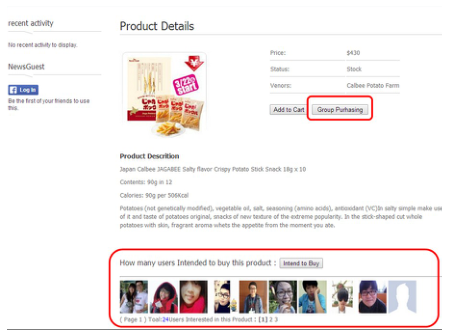
Shopping Experience as a Service for On-line Group Purchasing The second case study (Chin, Tsai, & Lin, 2014) is about offering group shopping experiences to online stores that do not have group purchasing capability. This is a pilot project done in universities to test how people are affected by group shopping experiences. Shopping in groups have a lot of benefits, such as bargaining power by quantify, and acknowledgement of need through peer supporting. Moreover, it brings in the joy of knowing friends are browsing the same online store as I am. This project is unique because it starts from thinking how a software service can bring in new experiences to an existing online service, instead of brining in new functionality. However, it could be difficult to separate user experiences from functions sometimes, as discussed in the following.
By focusing on UX and UX only, the service designer leveraged existing software services to provide functions of group purchasing, including an existing social networking service and a payment service. As shown in Figure 2, the UX service wants to provide group shopping experiences to a seller’s website, with “shopping friends” coming from an existing social networking service, and “payment facility” coming from an online payment service. The seller’s website only needs to incorporate a small piece of codes from the UX service, then visitors to the website can leave a social “tag” on the “intend-to-buy” products that their friends can see. A visitor can even start gathering a group to buy a product if he/she saw enough friends intend to buy the same product. The UX service creates an group shopping experiences to any online store such that people no longer feel that they are shopping alone.
An experiment is conducted and showed that people enjoy the new experiences brought by the UX service. In the experiment, people are given an ordinary online store for shopping in the beginning, and later an UX enhanced version of the online store is presented to them. Some shopping goals are given to the participants of the experiment, such that they could leverage group purchasing to buy more stuff if they wish to achieve the goals. The participants quickly learned the tricks of getting discounted prices from the online store by gathering a group of people with similar interests, and the group shopping experiences from real life shortens their learning curves.
Group Shopping Experience
Group Purchasi ng Provider Server Social Networks
Online Payment
Sel l er
Buyer
Seller`s Website
(a) Design an UX Service (b) Online Store Integrating the UX Service
Figure 2. Designing an UX of Group Shopping as a Service
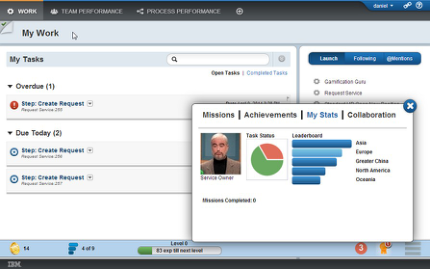
User Experiences of a Socially Engaged Business Process Management Environment This is a pioneering project inside IBM corporation. Since Business Process Management (BPM) is a 10-year-old discipline (Chang 2005) that drives process efficiency by automating process modeling, bottle-neck analysis, and flow control of a business process. Participants of a BPM system usually concentrate on competing the tasks assigned to them without much social collaborations. However the situation is changed since more and more process tasks require peer supporting and even peer pressure to further improve the efficiency and effectiveness of completing them. The idea of a socially engaged BPM system becomes obvious. How to design a UX service that can enhance an already deployed BPM system environment is the main challenge.
The new user experiences to be added on current BPM experiences include: easy of use for first-time users, peer supporting, and peer pressures. To provide such user experiences, some functions like process guidance, process helpers, and leader-boards are expected to be implemented by the new UX service, however highly decoupled from the BPM service. In other words, the BPM service is not fully aware of the data manipulated and stored by the UX service, and the experiences created by the UX service is purely an add-on that can be dropped at any time without affecting the functions of BPM. This design allows a BPM development team to delegate almost all UX issues of BPM usage to another service team that knows human factors more than the development team.
The resulted service design, as shown in Figure 3(b), leverages event listening to decouple a BPM service and the UX service. This design requires that a BPM service makes its event queue visible to the UX service, and fortunately most BPM environments support this functionality. Therefore, whenever a UX service team wants to introduce a new user experience, they provide UX scripts triggered by specific BPM events, to facilitate a user journey. Taking Figure 3(a) as example, whenever a task is completed by a process participant, the UX service knows it from the event queue, and add a point to a regional score representing the region’s participation in the process. The UX display integrated by the BPM portal will show a region leader-board to create the peer pressure experiences. The BPM service only needs to incorporate a piece of code for display, and opens their event queue to the UX service, then UX aspects of the process is delegated to the service team.
Since this is an ongoing project, no experiments are conducted yet to justify the value of a separated UX service. However, the proposed service design already created a management value that the UX design team can work independently and work in parallel with the process improvement team.
BPM Display
UX Display BPM UX
BPM Event Queue Service Service
BPM Execution History BPM Definition
User Interaction History UX Script (a) Peer Supporting/Pressure as s Service (b) Highly Decoupled Service Design
Figure 3. A Socially Engaged BPM Experience
GENERAL GUIDANCE TO UXAAS Targeting Psychological Needs
Good user experiences are defined as satisfactions of certain psychological needs in this paper. This is true for pure online/digital services since satisfaction of physiological needs such as food, water, breathing and homeostasis is not an option. The key challenge is to offer these “satisfactions” via an independent online/digital service with proven business value. Facebook.com did it by offering the satisfactions of belonging needs, and they prove its value by making money from advertisements. The successful stories of online social games make the concept of Gamification as a Service a new research topic to be pursued, which offers the satisfactions of esteem needs. However, in this paper, a more generic concept UXaaS is proposed to guide the design of an independent service that help other online services improve user experiences by satisfying any possible combination of psychological needs, including safety, social, esteem, growth needs and more. In the future, website owners will be asking which online services can provide peer supporting experiences to my service without knowing exactly what functions need to be implemented by them. The website incorporates a small piece of codes and turn on the service, and visitors to the site now feel “peer supported”.
Capturing User Events A UX service provider could not know whether an user satisfaction occurred without capturing corresponding user events. Events precede these satisfaction events or events causing the satisfaction will need to be carefully “listened”. Therefore a piece of codes or an interact-able component must be provided to capture the events. In the group shopping case, the “Intend-to-Buy” button captures the preceding event, while the “Intend-to-Buy” friend list and “Group Buy” button fire the satisfaction event. Pushing the “Group Buy” button is never the same feeling as pushing the “Buy” button, given the satisfactions of belonging needs and safety needs. The UX service in BPM case, on the other hand, captures all user related events perfectly leveraging BPM built-in event queue service. The UX service could also be completely hidden from users of the targeted website, and offers only data APIs as in the healthcare case.
Scripting User Experiences Once the UX services capture user events, UX scripts can be applied to lead the user journeys. In the BPM case, users are guided by a series of rewarding actions to found his/her position in the regional leader-board, and the position of his/her region in the global leader-board, satisfying esteem needs. Some educational scripts can easily help BPM users to become “masters” of their jobs, satisfying both growth needs and esteem needs. These experiences are absent in traditional BPM environments, making them less engaging. The UX script in group shopping help users of the online store website to engage in a “friendly” shopping where they see friends’ intentions to buy, and they can buy goods “together”, satisfying belonging and safety needs. The healthcare case has an even higher goal than previous ones to help participants achieve self-actualization through healthy life.
Presenting It as a Software Service Since guiding users through a series of online experiences could be highly automated, the UX scripts can be presented as a software service to be customized and integrated by other online services. The immediate examples are social networking APIs and gamification APIs. More advanced UX APIs, such as the group shopping APIs and the BPM experiences APIs should be discovered and researched. Technically speaking, UX service innovators can leverage popular service technologies, such as REST, OAuth, and Cloud (Fox and Patterson, 2013), to easily devise public available independent software services. This paper also suggests a possibility of making a generic experience script engine that speeds up all UXaaS developments.
CONCLUSIONS
This position paper discusses cases of UXaaS, and presents general guidance to the design of UXaaS. The idea of a generic experience script engine is proposed but not yet realized. However, as human factors of service engineering are becoming more and more important in “experience economy”. It is expected that the UXaaS phenomenon will be thoroughly studied with automation tools sophisticatedly crafted in the near future.
REFERENCES
Chang, J. F. (2005), Business Process Management Systems: Strategy and Implementation, ISBN-10: 084932310X, ISBN-13: 978-0849323102. Chin, T.-L., Tsai, Y.-S. and Lin, R. (2014), “Shopping Experience as a Service for On-line Group Purchasing,” in proceedings
of 5th AHFE 2014. Fox, A. and Patterson, D. (2013), Engineering Software as a Service: An Agile Approach Using Cloud Computing, ISBN-10: 0984881247, ISBN-13: 978-0984881246. Hartson, R. and Pyla, P. (2012), The UX Book: Process and Guidelines for Ensuring a Quality User Experience, ISBN-10:
0123852412, ISBN-13: 978-0123852410. Lin, R., Ramakrishnan, S., Chang, H., Spraragen, S. and Zhu, X. (2012a), “Desiging a Web-based Behavior Motivation Tool for Healthcare Compliance,” in Journal of Human Factors and Ergonomics in Manufacturing and Service Industries. Lin, R., Zheng, K.-Q., Yang, Q. Zhu, X. and Chou, S. C. (2012b), “Acceptance Study of Gamification of Health Promotion
Program for University Students,” in proceedings of ICIS 2012. Maslow, A. H. (1993), The Farther Reaches of Human Nature, ISBN-10: 0140194703, ISBN-13: 978-0140194708. Pine, J. and Gilmore, J. (1999), The Experience Economy, Harvard Business School Press, Boston, 1999.
LISTED IN THE AHFE DIGITAL BOOKSTORE CATALOGUE
Explore the complete digital volume
Advances in The Human Side of Service Engineering
Read this individual research paper free through the original publisher, or explore the full digital proceedings book.
ISBN 978-1-4951-2091-6
Explore this ISBN in the AHFE Bookstore ↗Listed in the July 2026 bookstore catalogue; search by ISBN to confirm current availability · Digital book purchase optional